Showing posts with label New Hampshire. Show all posts

January 30, 2023

Haunted Houses and Terrifying Specters: Ghost (?) Stories from Weare, New Hampshire

There are a lot of ghost stories from New England, and one of my favorite types is what I call the "Scooby-Doo" ghost story. In these stories, the ghost is rationally explained away at the end. There is nothing supernatural in these stories, although people in them initially think there is. I call them Scooby-Doo stories because each episode of the Scooby-Doo ended with the ghostly terror being revealed as someone impersonating a ghost, not something supernatural. These stories are similar, but without all the greedy real estate developers and smugglers.

You can find these Scooby-Doo ghost stories in a lot of the local town history books which were written in the 19th century. I found a bunch of them recently in William Little's The History of Weare, New Hampshire, 1735 - 1888 (1888). In one story, an early settler named John Hodgdon was riding home to Weare on horseback one night when he saw something creepy in his cornfield. As the hair on his neck stood up, he saw a large white object appear on a small knoll in the field. It disappeared with an uncanny sound, only to reappear again. Hodgdon dismounted and walked through the dark field to the knoll, determined to discover what this ghostly object (or entity) was. He learned it was not a ghost, but was instead a large basket some of his workers had left in the cornfield. When the wind blew it rolled up the hill, and when the wind subsided it rolled back down. Mystery solved!

William Little, author of The History of Weare, New Hampshire

In another tale, David and Betsy Purington lived in an old shanty, and "one winter were terribly troubled with ghosts." David Purington thought it was the spirit of his deceased father-in-law. One night, a neighbor came to visit the Puringtons. As they sat talking a strange rapping sound was heard from the attic loft above them. It grew louder and louder and louder. David screamed out for the ghost to desist, but the infernal rapping grew louder! Their neighbor was the only one brave enough to climb into the attic to confront the ghost. After climbing the rickety ladder, she saw a chicken whose legs and been frozen by the cold. It was unable to walk, and made a rapping sound as it tried to stand. "The hen was carried to the room below, and the ghost was laid." Mystery solved! Hopefully the hen recovered from being frozen. 

In East Weare, there was another house that was supposedly haunted. A minister had once lived there, but after he moved away the house stood abandoned. People reported hearing strange noises and even seeing strange lights at night. Some brave schoolboys once approached the house during the day, but fled when they heard an eerie noise and heard the doorknob rattle. Eventually the apparitions stopped. When someone finally went into the haunted house, they saw a dead cat lying on the middle of the floor. Apparently the minister had left it behind when he moved and it had caused all the noise. Mystery solved! 

Or is it? A cat doesn't create ghostly lights. And clearly people didn't take very good care of their animals then...

William Little does include at least one ghost story in The History of Weare that's slightly ambiguous. A man name Mr. Eaton was out hunting raccoons one misty autumn night with some friends. Mr. Eaton paused to rest, when out of the mists emerged a terrifying ghost. "He could see the sunken eye-balls, the worm-eaten face, the shriveled hands, and he shook with terror." One of his friend arrived and Mr. Eaton explained what he had seen. The ghost was not visible to the friend. Many people in Weare believed Mr. Eaton had truly seen a ghost, but others suspected that he had just been drunk. So that mystery was perhaps not completely solved. 

There are a lot of books like The History of Weare out there, histories of New England towns written in the mid-to-late 19th century by people who lived in these places. New England had become a modern industrial area by this time, and you can sense the pride the authors feel in the progress their towns had made. At the same time, they're fascinated by the earlier, pre-industrialized way of life that is vanishing and the supernatural worldview that went with it. Maybe these rationalized ghost stories are the authors' way of straddling both worlds, of indulging the wonders and terrors of the past but also explaining them away with the light of reason. 

December 05, 2022

Bewitched in the Woods: Old Rif and the Rabbit

A few weeks ago I went to the Boston Athenaeum and found lots of old witch stories in various in old New Hampshire history books. A few weeks ago I wrote about Mother Carr from Weare, New Hampshire. Here's another witch story I found, this time from the town of Windham. As the days grow shorter I find myself drawn more and more to these stories!

Many years ago, an enslaved Black man named Old Rif and a man named George Simpson were out hunting in the woods near Windham. After hunting for a while they became lost.

The sun was sinking behind the western hills, and they came to a halt. At that moment they saw a rabbit standing upon its hind legs, looking at them; they tried to frighten it away, but it would not away at their bidding. Old Rif knew that the rabbit was bewitched, and he had heard that to shoot silver sleeve-buttons at a rabbit would destroy the witch. So he loaded his gun, putting in his silver sleeve-buttons, and shot the rabbit. The witch was instantly killed, their minds immediately became clear, the ground at once became familiar, the pathway was plain before them, and they readily and quickly found their way home. He (Old Rif) was said to be the last slave in New Hampshire, and died not far from 1842 (L.A. Morrison, History of Windham in New Hampshire, 1719 - 1883 (1883))

There are lots of interesting things about this story. First of all, there's Old Rif. He's a reminder that there was slavery in New England. I am not an expert on the history of New England slavery, but it seems that although the New Hampshire legislature banned slavery in 1789, it was not completely abolished until the 1850s. Was Old Rif really the last slave in New Hampshire? I will leave that to a better historian than me to determine. Regardless, Old Rif is clearly the hero of this story. He knows that he and George Simpson are bewitched, and he knows how to end it.

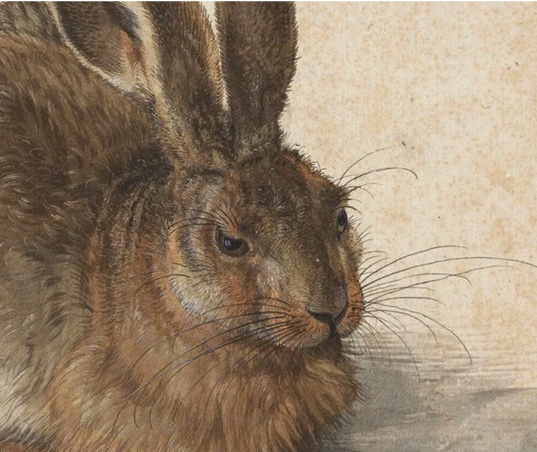
Young Hare, by Albrecht Durer

He ends the witch's spell in a traditional way - by shooting a silver button at an animal that is actually a witch in bestial form. Silver bullets are familiar to modern readers from Hollywood werewolf movies, but any silver object would do the trick. If you don't have a bullet, use a button. 

Maybe the most famous story of a witch being shot with a silver button is the one about Peg Wesson from Gloucester, Massachusetts, who had taken the form of a crow to harass a group of soldiers. It's unclear in either story if the witch is possessing an actual animal, or if the witch has merely sent out their soul in the shape of an animal. Either way, the result of the silver button/bullet is the same - the animal is injured or killed, as is the witch. 

In the Peg Wesson story, Peg is only injured after a soldier shoots the crow with a silver button. But in this story about Old Rif, the witch dies as soon as the rabbit is shot. I wish there was more information about the witch in this story. Who were they? Did they just keel right over in their house? Did anyone find a silver button embedded in their corpse? I suppose we'll never know.

It's a little strange that the witch is never identified in Old Rif's story, but the witch is almost never the main character in these stories. These stories are instructional tales, intended to tell the listener or reader how to fight witchcraft. The witch's identity didn't really matter to the person in Windham who first told this story. What did matter was instructing people how to stop a witch.

I will end with a couple disclaimers. One, your neighbors are not evil witches hexing you. Two, please don't go around shooting random animals if you get lost in the woods. That little bunny just wants to eat some grass in peace. 

November 12, 2022

Mother Carr, the Witch of Weare: Turn Your Clothes Inside Out

A few weekends ago I went to the library and randomly looked through the histories of some New Hampshire towns, hoping to find interesting stories about witchcraft and ghosts. Many 19th century town histories include those local legends, and I was happy to find several stories I had not read before. 

Some of those stories were about Mother Carr. She lived in Weare, New Hampshire in the early 1800s, and many people suspected her of being a witch. There are several accounts of her allegedly bewitching her neighbors, including this one.

Antique postcard of Weare, NH from Wikipedia

One summer day some of Mother Carr's neighbors went berry-picking in the woods. It was a very successful trip. They returned carrying buckets that overflowed with ripe juicy berries. When Mother Carr saw all the delicious berries she asked if she could have some, but her neighbors refused. She stomped off angrily, telling them they would regret their stinginess. (Cue the ominous music...)

A few weeks later, the same group of neighbors went into the woods to pick berries again. And once again, they filled their buckets with plump, juicy berries. But as they began to make their way back to Weare they became lost. They wandered around for hours, unable to find the path that led home. No matter how hard they tried they couldn't find their way out of the woods, even though they had been there many times before. 

Suddenly, one of the berry-pickers remembered Mother Carr's angry words, and realized she had cursed them. They would never find their way home as long as they were under her spell! Someone suggested that if they turned their clothes inside out the spell would be broken. It sounded foolish, but everyone was afraid of being stuck in the woods overnight, so they turned their coats, shirts, pants and skirts inside out. To their amazement, it worked. Although they were tired and bedraggled, they were able to find their way out of the woods.

Antique postcard of Weare, NH from Wikipedia

That is the end of the story. It might sound alien to a modern reader, but turning your clothes inside out is a very old form of folk magic. However, it was most often used to prevent fairies from leading you astray, not witches. As the 17th century English poet Richard Corbet wrote in his poem "Iter Boreale":

As in a conjurers circle, William found

A menes for our deliverance: Turne your cloakes,

Quoth hee, for Puck is busy in these oakes:

If ever yee at Bosworth will be found,

Then turne your cloakes, for this is Fayry-ground.

Special thanks to Beachcombing's Bizarre History Blog for posting this piece of poetry! I am not 100% sure of the metaphysics behind this folklore, but I think turning your clothes inside out is supposed to confuse the fairies, which makes them stop hexing you. 

But why would people in New Hampshire do this when they were lost in the woods? When the English Puritans came to New England they didn't bring much fairy folklore with them, but they did bring a lot of witch lore. Instead of blaming misfortunes on fairies they blamed them on unpopular neighbors (like Mother Carr) they thought were witches. Practices that were once used to protect against fairies were used to protect against witchcraft. 

I found this story in William Little's 1888 book The History of Weare, New Hampshire, 1735 - 1888. These old history books are amazing. You never know what you'll find!

October 23, 2022

The Spookiest States: Vermont and Maine Lead the Pack

People often ask me if New England is weirder or scarier than other parts of the country. I’ve been asked this by podcasters, other writers, and even personal friends. It would be easy for me to respond with a joke about scary Massachusetts drivers, our weird infatuation with Dunkin Donuts, or the frightening price of housing. But I generally avoid going for the easy laugh and try to answer the question sincerely.

Certainly, it seems that New England has a reputation in popular culture as a strange place. I usually mention that the world’s three most famous horror writers all came from New England. Edgar Allen Poe (1809 – 1849) was born in Boston, and although he left as a child he returned when he was 16 to work and enlisted in the army. He didn’t remain in Boston long, and although he thought the Bostonian literary establishment was uptight he still published his first book with the byline “a Bostonian.” 

The second writer is H.P. Lovecraft (1890 – 1937), who was born in Providence and spent most of his life there. Lovecraft incorporated lots of New England history and legends into his fiction. He definitely understood the weird appeal of the region’s moldering Puritan cemeteries, old coastal towns, and dark woods. Lastly, there is the legendary Stephen King (b. 1947), who was born in Maine and still lives there. Many of his novels, including classics like Salem’s Lot and Pet Sematary, are set in Maine.

I like to think there's something unique about New England which inspired these three influential writers. Certainly, New England has some strange history due to the Puritan colonists who came in the 1600s. They brought over their beliefs in witches, ghosts and the Devil, but not the more charming folklore like fairies. That definitely shaped our region's culture. And like most of the United States, our region has its history of violence, racism and genocide. Perhaps all these things, combined with a sometimes strange and dramatic landscape and our long dark winters, helped inspire Poe, Lovecraft, and King. (The author Faye Ringel explores these themes in her book 1995 book New England’s Gothic Literature.)

But does this really mean New England is weirder or scarier than other parts of the country? And how would you even go about measuring these things regionally? I wouldn't know how to even start, but someone has tried. Cycling Frog, a THC and CBD company in Seattle, compiled a ranked list of the scariest states in the country. Vermont ranked number one, Maine came in second, and Connecticut placed fifth. Not too bad for such a small part of the United States!

The other New England states are apparently not as spooky. New Hampshire was 14, Rhode Island 19, and Massachusetts was way down the list at 35. I feel ashamed as a Massachusetts native that we ranked so low. Massholes, we need to try harder to be spooky.

Upon reading this list two questions came to my mind. How did they rank the states, and why did a CBD/THC company do this? Sadly, I can only answer the first one. Cycling Frog looked at how many of the following each state had:

1. Serial killers (from murderpedia.org)

2. Haunted locations (from frightfind.com)

3. UFO sightings (from National UFO Reporting Center)

4. Ghosts (from ghostsofamerica.com)

5. Top 100 horror films set there (from IMDb.com)

To measure equitably across states, they wanted to show how many of each phenomena the states have per 100,000 people. For example, Texas had the most number of serial killers with 890 (!), but it has a very large population. This means that Delaware, which has a much smaller population, actually has the highest number of serial killers per person, with 41 serial killers per 100,000 inhabitants. According to Cycling Frog, this makes Delaware the most murderous state. (Note: Massholes, we do NOT need to try harder at being serial killers.)

Vermont was ranked the scariest because it had the highest number of UFO sightings and haunted places per person, and also had a high number of ghost sightings as well. That's pretty impressive, which is why they think Vermont is the scariest state. But is it? When I think of Vermont, I tend to think of Ben and Jerry's Ice Cream, rolling green hills, and peaceful hippies. Maybe all that peace and love is just a cover for the true horrors of Vermont. 

Let's face it, I don't think this survey is statistically valid, but it is fun to think about as we approach Halloween. Apparently if you live in Vermont, Maine or Connecticut you're ensured a spooky Halloween. The rest of us may just have to console ourselves by eating extra candy corn and Twix. 

May 15, 2022

Finding Bigfoot in The Old Farmer's Almanac (and the Flea Market)

Do you read The Old Farmer's Almanac? I do, even though I'm not a farmer (but I am getting old). It's sold at supermarkets and CVS stores here in Boston, so clearly it's not just intended for farmers. It's for anyone who likes weird and possibly useful information

I like it for the astronomical information (full moons, sunrise and sunset times, etc.), and also the weird little facts the editors list for each month. For instance, the 2022 edition of the Almanac notes that J. Edgar Hoover, the FBI's notorious first director, died on May 2,  and that stage and TV magician Doug Henning was born on May 3. Fun facts about the cycle of life and death. 

The Almanac also notes that Bigfoot was seen in Hollis, New Hampshire on May 7, 1977. Another fun fact, this time about the weird things that happen in this part of the world. 

I was excited to see this mentioned in The Old Farmer's Almanac, since it's a famous New England Bigfoot sighting. In fact, I wrote about it way back in 2015. I was planning to rewrite that post, but I like the original so much I'm posting it again. I found Bigfoot in the Almanac, but in 1977 some folks found him at the flea market...


Finding Bigfoot At the Flea Market: An Encounter from 1977

When I was a kid my parents often took my brother and me to flea markets and yard sales. It was the 1970s and I guess this was the thing to do. Quite often we didn't find anything good, but every now and then we'd get some great stuff. I still have a large teak Buddha I found, and we definitely found plenty of old paperbacks about weird occult and paranormal topics.

I never had an actual paranormal experience at a flea market, but apparently they do happen. Or at least they did, back in the 1970s.

On the evening of May 7, 1977 a Lowell, Massachusetts man named Gerald St. Louis arrived at a flea market site in Hollis, New Hampshire. St. Louis had brought his wife and two sons with him. The flea market began the next day, and the St. Louises wanted to get a good spot to set up their table early in the morning. After sunset they went to sleep in their pickup truck. Attached to the truck was a small trailer. 

They were awakened that night when their truck began shaking. Standing next to their vehicle was a large humanoid. Mr. St. Louis later described the creature as being 8 or 9 feet high, brown-colored, and covered in long hair. When he turned on the headlights it became startled and ran across the parking lot, jumping easily over a four-foot high fence. Once over the fence it stood and stared at the truck. 

Needless to say the St. Louis family got out of there fast. They drove to the Hollis police station and reported their sighting to Chief Paul Bosquet. The police inspected the area, but found no sign of the creature. The ground was covered in pine needles and not even any footprints could be seen. Well, at least according to the press at the time. I've seen at least one article online that says 16-inch footprints were found in the soil.

Chief Bosquet said he thought the family had seen a bear. Whatever it was, it seriously spooked them. They left Hollis quickly and didn't even take their trailer with them. I guess they got more than they bargained for at that flea market. (Get it? Bad pun.)

Was it just a bear? I have no idea, but someone else had a similar experience a few days earlier. A woman named Regina Evans was camping in Hollis on May 5, 1977 when she was awakened in the middle of the night by someone shaking her trailer. She did not see the culprit, but large footprints were found nearby.

Andre the Giant and Lee Majors in The Six Million Dollar Man.

The 1970s was a heady time for paranormal phenomena. The occult and metaphysical movements of the late 1960s had paved the way for Bigfoot, UFOs and the Bermuda Triangle to conquer America. Bigfoot was featured in movies like The Legend of Boggy Creek (1972),  In Search of Bigfoot (1976), and just plain Bigfoot (1970), where a biker gang tries to save women captured by the cryptid. Bigfoot also showed up on TV. He was actually a bionic robot created by aliens on an episode of The Six Million Dollar Man, while on the kids' show Bigfoot and Wildboy he fought crime.

As a result of all this, most Americans knew what Bigfoot looked like and what he did - jump out of the woods, scare people, and then disappear. Were the experiences of the St. Louis family and Regina Evans colored by the media? It's very possible, but something really did shake their vehicles in the middle of the night, and the St. Louises seemed legitimately scared.

Perhaps it was pranksters enacting the role of Bigfoot. It's a time-honored tradition. In ancient Greece people dressed like satyrs and in the Middle Ages they dressed like leafy, hairy wildmen. Dressing in an ape costume and running through the woods might just be part of our cultural heritage. We all think there are monsters in the woods, so someone needs to play the part. 

Or who knows? Maybe there really are creatures lurking in the woods, and they are the ones who change costumes over time, appearing as whatever we expect, a goat-footed daemon to the ancient Greeks and a huge hairy monster to someone who just wanted to go to a flea market.

Bigfoot was not seen again in Hollis, but happily he's still out there somewhere, lurking behind the trees and evading easy categorization.

August 03, 2021

Bottomless Ponds of New England: Monsters, Witches, and Dead Horses

I read a lot of books about local legends and folklore, and have discovered some weird things. I recently learned there are several bottomless lakes and ponds here in New England. Yes, you read that correctly. There are several bodies of water here that are immeasurably deep. And some have monsters in them...

One of these bottomless bodies of water is Hall's Pond in Brookline. Hall's Pond is located just off Beacon Street, one of the Boston area's busiest thoroughfares, and you can even take the Green Line trolley to it. Very convenient!

The pond is now part of Amory Park, and there is a nice boardwalk that leads you around it. The last time I visited it was teeming with fish, turtles, and birds. Hall's Pond used to be much larger and swampier, and is actually the remains of an ancient cedar swamp. The soil is quite peaty, and creates an oily sheen on the water. 

Hall's Pond in Brookline

The January 28, 1902 proceedings of the Brookline Historical Society, include the following information about the development of Amory Park:

The town's purchase was about eight acres, which includes a part of Hall's Pond, the dreaded hole and terror of youngsters, which was believed to be bottomless.

The 1954 - 1955 proceedings of the Society include the following reminiscence from one Mrs. Luquer:

The story goes that, in my childhood, one dark night, a man with his horse and buggy went down what he thought was Essex Street straight down to Beacon Street right down into Hall's Pond where there was quicksand and he was never seen again. I remember I often skated on the Pond and always wondered whether I was over the horse and buggy.

It's a grim story, but not as terrifying as the stories told about Dublin Lake in Dublin, New Hampshire. According to a July 26, 2017 issue of the Monadnock Ledger-Transcript, in the early 20th century people thought the lake was bottomless. More contemporary legends say it is the home of hideous monsters who live in underwater caves:

Lore surrounding the lake monster dates back to the 1980s, when a free-diver allegedly went missing after a routine dive. The diver was found a number of days later, naked and incoherently babbling about monsters. 

Another version of the story states a diver was using a diving bell when exploring the lake’s bottom, but the tether was not long enough as he descended. 

After heading down deeper to find the caverns, the diver disappeared. A group of hikers found the diver in the woods naked days later, with the diver once again was babbling about monsters. ("The search for the Dublin Lake Monster," Monadnock Ledger-Transcript, July 26, 2017)

I think the whole "naked diver babbling insanely about monsters" is pretty creepy. Perhaps those monsters are from another planet, because another legend claims there is a spaceship or UFO at the bottom of the lake. 

Dinglehole, a small pond in Millis, Massachusetts, is also believed to be bottomless. Much like Hall's Pond, Dinglehole was once larger and swampier. In the 18th and 19th century, legends said it was haunted by a headless ghost who misled travelers. People also heard the ringing of a mysterious bell near the pond, giving it the name Dinglehole. (The bell went "dingle dingle dingle.")

Hall's Pond in Brookline

A headless ghost and mysterious bell are bad enough, but the the Devil and his witches would gather near Dinglehole to celebrate the Witches Sabbath. The witches arrived in the shape of weasels, raccoons, and other small woodland animals. 

One evening, a local hunter was walking home when he noticed a large raccoon watching him from a tree. Unable to resist such an easy target, the hunter shot the raccoon and hit it squarely in the chest. Nothing happened to the raccoon. It sat there unharmed. Did the hunter notice a slight smirk on its face? He fired several more shots, each time hitting the raccoon, which continued to ignore the bullets.

Finally, it dawned on the hunter that this was no ordinary animal. He plucked a branch from a nearby witch hazel shrub, a plant known for its magical powers, and fired it from his rifle like a small harpoon. It hit the raccoon in the face. The animal then vanished. Several days later, the hunter learned that Murky Mullen, a local woman suspected of witchcraft, had an unexplained injury on her face. Clearly, she (or her spirit) had been wandering the woods in the shape of a raccoon. (That story appears in Ephraim Orcutt Jameson and George James La Croix's 1886 book The History of Medway, Mass. 1713-1885.)

Hall's Pond, Dublin Lake and Dinglehole are just three bottomless bodies of water I learned about while researching other things. I assume there are probably others out there in New England. Of course, modern science says a bottomless pond or lake is an impossibility. After all, the center of our planet is hot and molten. If a lake reached all the way down to Earth's molten core it would probably be some kind of volcano, not a nice body of water you can swim in or skate on. 

I suspect the idea of a bottomless lake reflects an older view of the world, one in which the universe was filled with water. We now know that our planet is a sphere floating in the void of outer space. Many earlier civilizations believed the world was a flat disc that floated in an infinite abyss of water. For example, in the Babylonian creation myth, the only two beings that exist at the beginning of time are Apsu, the primal god of fresh water, and Tiamat, the dragon goddess of the sea. There is no land. It only appears after Apsu and Tiamat are slain and the god Marduk divides the waters using Tiamat's corpse. 

A similar situation is seen in the Biblical Book of Genesis, where God separates the waters from the waters during the creation of the world. There is water above the world, and water below the world.

And God said, Let there be a firmament in the midst of the waters, and let it divide the waters from the waters.

And God made the firmament, and divided the waters which were under the firmament from the waters which were above the firmament: and it was so.

So in a traditional Biblical view, the world looks something like this:

The Earth is surrounded by water, both above and below. This is alluded to in the Flood story, where not only are the "windows of heaven" opened to make it rain, but "all the fountains of the great deep broken up" as well. God is letting all the primal waters back in, returning the world to its primal state of chaos. 

I think local legends about bottomless bodies of water might reflect this older cosmology, even if accidentally. The ponds and lakes in these stories are not only immeasurably deep, but they are also associated with terrifying things. Dead men and dead horses, lost in the middle of the night. Monsters so hideous they cause insanity. Witches, ghosts, and even the Devil himself. The forces of chaos are lurking just below the surface, ready to drag the unwary down into the fathomless waters. These things are probably just lurking in our subconscious, not in the water, but I'd still be careful. You don't want to wander too far from shore and get in over your head. Who knows what you might find there?

*****

I wanted to give you an update on my new book, Witches and Warlocks of Massachusetts. I got my author's copies the other day, and they look great. I'm really excited for people to read this one. 


It's currently available for pre-order on Bookshop.org, Barnes and Noble, Books-A-Million, Amazon, and most other places you buy books. It will be available on September 1, just in time for the fall and spooky season. 

April 09, 2020

Molly Bridget and the Bewitched Pigs: A New Hampshire Witchcraft Story


Molly Bridget lived in Portsmouth, New Hampshire during the 1700s. Molly made her living telling fortunes for sailors and young lovers (as fortune tellers do) but over time she developed a reputation for being a witch. People in Portsmouth grew to fear and hate her.

Molly was never wealthy to begin with, and as she grew older she slipped into poverty. Sometime around the Revolutionary War she wound up living in Portsmouth's almshouse (or poorhouse). This was not to her liking so she decided to move south to Boston for a fresh start.

Unfortunately her reputation preceded her and when she arrived in Boston the following occurred:

Finding her way to Boston, the police gave her warning to leave the city forthwith.
"Why?" she asked.
"Is not your name Molly Bridget?"
"No, sir," she replied. "Do you think I am such a despicable creature as Molly?"
(Charles W. Brewster, Rambles About Portsmouth. Second Series. 1869)

The police weren't fooled. Molly realized that she wouldn't be able to leave her old identity behind so with a heavy heart she returned to Portsmouth and the almshouse.

An English woodcut of a witch from 1643
The almshouse was managed by a man named Clement March. One day in 1782 Mr. March noticed that the almshouse's pigs were acting strangely. His thoughts immediately turned to his resident witch, Molly Bridget. Had she bewitched the pigs?

There was only one way to find out. Like many people at that time, Mr. March believed that when a witch cursed something (or someone) they created a magical connection with the object of their curse. If Molly had cursed the pigs there was a connection between her and the animals. Molly's evil magic flowed from her into the pigs through this connection, but Mr. March thought he could use the connection to his advantage. He could make pain flow from the pigs back into Molly. If Molly felt enough pain she would stop cursing the animals.

Putting his plan into action, Mr. March took a knife out to the stye and cut off the pigs' ears and tails. He thought that this would be enough pain to cure the pigs of their strange behavior, but that was not the case.* He then decided to up the ante and burn their severed ears and tails, but when he went to gather them up the ears and tails were missing. Clearly this was more witchcraft! He surmised that Molly had made them disappear somehow.

Not willing to give up, Mr. March gathered the dead leaves and wood chips that were in the pig stye. These were soaked in the pigs' urine, feces, and blood, and therefore still had a connection to the animals and to the witch who had theoretically cursed them. He then burned the chips and leaves in the almshouse's various fireplaces.

The fires had a sudden and violent effect on Molly Bridget:

After the fires were kindled, Molly hastened from room to room in a frenzied manner. She soon went to her own room, and as the flames began to subside her sands of life began to run out, and before the ashes were cold, she was actually a corpse. (Brewster, Rambles About Portsmouth, 1869)

Mr. March and the residents of the Portsmouth almshouse took this as proof that Molly had indeed cursed the pigs. On the day of her funeral a violent storm struck Portsmouth, which was taken as further evidence that she was a witch.

*****

Like last week's post about the witch of Pepperell, this story shows how the belief in witchcraft lingered in New England well past the witch trials of the 1600s. Also like last week's legend, there's no official documentation about Molly Bridget and her witchcraft. The only account I've found is in Charles W. Brewster's Rambles About Portsmouth (1869). 

So is this story true or just a legend? Brewster has the following to say on the matter:

These are facts - how far the results were induced by the superstitious feelings of that day, the reader is left to judge. The poor creature might have believed herself a witch, and the expectation expressed that the burning of the pigs' tails would kill the witch, might have so wrought upon her mind as to produce the result.

I might also suggest that stories like these tend to become more legend-like over time. Perhaps Molly Bridget just died from natural causes and people in Portsmouth created the legend about her death over the years. By the time Brewster wrote down the story 80 years later it had become the traditional witch legend it is now. 

* I don't think cutting off an animal's ears and tail will ever improve its behavior. Be kind to animals!

March 22, 2020

Daisy Wheels and Witch Marks in New England

People in pre-modern New England used a variety of magical techniques to protect their homes from witches. Some of these are attested to in witch trial documents, where we read about people hanging horseshoes over doorways or lining their windows with bay leaves. The Puritans thought the world was full of sinister magical forces and they tried to ward them off with these protective spells. 

Historians and archaeologists believe other techniques were used as well. For example, a cat skeleton and a pot were found buried under the entrance of a historic tavern in Charlestown, Massachusetts. The cat was killed with a single blow to the skull. Animal burials inside walls or under foundations are also commonly found in England, and it's believed the animals were buried to somehow deter witches from entering the buildings. Pots (and shoes) are also commonly found buried under or hidden inside walls, and researchers believe they were intended to trap witches. 

Unfortunately, no one has found a historic document that explicitly spells this out so it's not clear if that's really the case. Researchers assume these odd burials had a magical purpose but the people who performed them didn't leave any written explanations. Because witches were perceived to be a common threat it seems likely these burials were protective magic. It's likely - but not proven. 

The Fall 2019 issue of Historic New England magazine had an interesting article about daisy wheels, another likely form of defensive magic. "Magic Markings" by Michael J. Emmons, Jr. examines a type of distinctive circular marking that is found many older New England buildings. They look like this:

From Spade and the Grave
You can see why they're called daisy wheels. Emmons notes that one of these markings is found in a Portsmouth, New Hampshire house built in 1664, and that they are found in many other old buildings in New England and along the East Coast:
I have encountered dozens of sites featuring these symbols. They are found on walls, doors, fireplace lintels, stairs, attic beams, and even floorboards, and they probably exist in hundreds of early American houses. Apparently created (most of the time) with compasses or carpenters' dividers, the symbols typically consist of an inscribed outer circle enclosing six pointed "petals" that stretch from the circle's center to its perimeter, thus resembling a flower. ("Magic Markings," Michael J. Emmons, Jr., Historic New England, Fall 2019, pp. 4 - 8.)
Emmons goes on to write that they are thought to be "..'witch marks' or 'hex signs,' protective inscriptions to guard one's house, and family, against misfortune (and perhaps actual witches)." He also lays out some other theories: that they were used by carpenters when designing buildings, or were simply doodles carved into the walls by children. There's no strong proof for those theories either, and currently we just don't know the purpose of the daisy wheels. 

From Country Living
Personally, I think they probably did have a magical purpose, at least at some point in history. As this site points out, daisy wheels are not limited to North America. The ancient Romans seem to have been the first to carve daisy wheels into buildings, and after they conquered Britain the symbol began to appear there as well. It can be found in many Medieval English churches, often carved near baptismal fonts, and carved into furniture as well. The Puritans brought the practice with them when they colonized New England, and in addition to houses the symbol also appears on some 17th century grave stones. I think there must be a purpose to something that was done for nearly 2,000 years. 


But perhaps over time the exact purpose was slowly forgotten until finally the practice finally died out. Americans stopped carving daisy wheels into houses by the middle of the 19th century. Significantly, that's also when most Americans had stopped believing seriously in witches. Witchcraft changed from something to be feared to something quaint and folkloric. Witches became the subject of stories told to scare children, not entities to protect your house from. 

December 30, 2019

Ghosts, Treasure and A Scam in Exeter, New Hampshire

Rainsford Rogers arrived in Exeter, New Hampshire in 1798. Exeter was a sleepy rural town back then and Rogers made a big impression when he arrived. Not only was he an outsider, which was exciting in itself, but he also claimed he could command spirits and ghosts. 

This was a big deal in Exeter. According to Charles Henry Bell's History of the Town of Exeter, New Hampshire (1888), Exeter's citizens hadn't had many encounters with the supernatural. There weren't any witchcraft accusations in the town's past, and there weren't even any haunted houses. Well, Bell notes that one house did for a time experience some poltergeist activity ("strange and inexplicable freaks of self-propelling furniture and the like") but "it never received a bad name on that account." Exeter was just a practical-minded place full of hard-working people. So it was quite exciting to hear Rainsford Rogers say he could invoke spirits.

Rogers became an Exeter celebrity and was soon befriended by twelve of the town's wealthiest citizens. Rogers confided to these men a great secret: there was buried treasure hidden somewhere nearby. The spirits would guide Rogers to it but he needed men he could trust to help dig it up. Anyone who helped him would get a share of the treasure. He asked the twelve if they were trustworthy. With visions of treasure in their eyes they said yes.

A woodcut of a ghost from this blog!
Rogers and his followers fell into a pattern. Rogers would consult with the spirits to determine where the treasure was, and then the twelve men would try to unearth it. The digging always took place late at night, usually in desolate locations like swamps or in the woods. Rogers also told the men they needed to wear white caps while digging, and the people in Exeter named the group the White Caps. 

They made frequent night-time trips in search of treasure. One night while they were out digging a ghost appeared to the White Caps. 
On one of the nocturnal excursions there appeared before the eyes of the awe-stricken diggers a figure all in white, representing a spirit, which uttered some words which were not well understood. One of the "white caps" anxious to lose nothing of the weighty communication, responded - "a little louder, Mr. Ghost; I'm rather hard of hearing." (Bell, History of the Town of Exeter, New Hampshire, 1888, p. 413).
But despite many nights spent excavating the White Caps never found any treasure. The spirits finally told Rainsford Rogers why. He needed a special divining rod (or dowsing rod) made from expensive materials. Such an artifact could only be produced in Philadelphia. Rogers asked the White Caps if they could contribute money towards the cost of the divining rod. They agreed, giving him several hundred dollars and a new saddle for his horse. 


A diving rod or dowsing rod.
Rogers rode out of Exeter with the money. The White Caps waited eagerly for his return. And waited. And waited. After several weeks they finally realized they had been duped, something their neighbors had suspected all along. Rogers was in fact a serial con-man, and had tricked people in many states out of their money. Born in Connecticut and originally employed as a schoolteacher there, Rogers changed careers when he learned that fooling gullible people with spiritual hocus-pocus was more profitable than educating children. (Sadly I think that may still be the case.)

He pulled his most notorious scam in Morristown, New Jersey, where he fooled 50 wealthy men into believing ghostly entities would reveal buried gold left behind by the British troops in the Revolutionary War. His antics in Morristown were far more elaborate than those in Exeter. He made his followers stand in magic circles inscribed on the ground in the woods, exploded pyrotechnics hidden under the soil, told people to carry bags containing bone dust for protection, and dressed up like a ghost to lurk outside houses. He also told his wealthy followers to give him large amounts of money. He was eventually arrested, but when a still-faithful follower paid his bail he fled town. 

A book detailing Rogers's criminal exploits (called The Morristown Ghost) was published in 1792.  Some historians speculate that Rogers wrote the book himself, both as a money-making venture and to vengefully humiliate the people in Morristown by revealing their gullibility. Unfortunately no one in Exeter ever read The Morristown Ghost so they were vulnerable to Rogers's scheme.

It's easy for a 21st century person to look back and laugh at how foolish people were, but at the time it was widely believed that America was littered with buried treasure. Legends like this were found across the country, and the treasures were usually thought to be guarded by fearsome spirits that could only be tricked through magical means. Here in Massachusetts several examples immediately come to mind: the alleged pirate treasure at Dungeon Rock in Lynn, the terrifying treasure cats of Ipswich, and the legend of Hannah Screecham of Cape Cod. There are dozens of other examples from across New England alone. Washington Irving wrote several stories on this theme, and some historians even say that treasure hunting (or money-digging as it was known) might have influenced Joseph Smith, the founder of the Mormon religion. 

Although we don't believe in buried treasure these days, sadly there are still unscrupulous people out there who will take advantage of vulnerable people. Our beliefs have changed but human nature hasn't.

November 03, 2019

Encountering A Ghost at New Hampshire's Haunted Resort

Well, another Halloween has come and gone. I'm a little sad because it's one of my favorite holidays but I console myself at its passing by knowing that the truly spooky season has just begun. Halloween kicks off the darkest time of the year. The days are rapidly getting shorter, the trees are growing bare, and we set the clocks back tonight. Boston may even see some snow flurries on Friday.

In other words, we're entering the bleak, barren time of the year.  It's the perfect time for weird tales and ghost stories - particularly if they might be true. Someone emailed me a story (which might be true) just last week and gave me permission to share it. Here it is for your November pleasure.

*****

In October of this year a Canadian woman (I'll call her Shawna), her daughter, and a cousin decided to visit New Hampshire during foliage season. Their trip included staying at the Bretton Woods Resort. Bretton Woods is one of the great New England resorts, with a fabulous old grand hotel (the Mount Washington) and the smaller Bretton Arms Inn on the grounds. Bretton Woods has everything you could want in a mountain resort: good food, fireplaces, hiking and horseback trails that wind through the woods and along rivers, and skiing in the winter.

Lobby of the Mount Washington Hotel.

Bretton Woods also has a ghost. Shawna discovered this first hand during her visit while staying at the Bretton Arms Inn.
On our first night my teenaged daughter woke up screaming that she saw an apparition beside her bed (we were in a bedroom with two twin beds adjacent to the main room). As a result we had to sleep with the lights on for the second night. For the record, my daughter does not believe in ghosts (at all) and does not suffer from nightmares
I put it from my mind until a week after we returned to Toronto and Googled Mt Washington Resort when I discovered the resort has a history of this (we had no idea before).
Like most paranormal accounts the story is quite short. I think it's interesting that Shawna didn't know about the resort's haunted history. It makes her story more credible.

*****

The ghost that haunts Bretton Woods is said to be the spirit of Caroline Stickney, the wife of Joseph Stickney, a wealthy industrialist who built the Mount Washington Hotel in 1902. Mr. Stickney died one year after the hotel was completed, but Caroline remarried a wealthy European prince and continued to spend her summers at the hotel. She had a private suite she stayed in, and even had a special balcony built above the main dining room so she could survey what the other guests were wearing. She wanted to be sure that she was the best dressed person in the room! 

A portrait of Caroline Stickney at the Mount Washington Hotel.

Caroline Stickney died in 1936. The winter after she died a hotel caretaker reported seeing strange things. He said he saw a well-dressed woman walking into the dining room at night - and there were no guests staying in the hotel at the time. That winter other staff reported that lights would turn themselves off and on when no one was in the room.

Caroline's ghost has haunted the resort ever since. She is a benevolent ghost but can be frightening to those who aren't prepared for the encounter. Her spirit is the most active in Room 314 of the Mount Washington Hotel, which was her private suite while alive. Guests who stay in this room often report a wide range of strange phenomena including flickering lights, faucets and fireplaces that turn themselves on and off, and objects disappearing. 

Tony and I stayed at Bretton Woods way back in November 2013. There weren't a lot of guests at the time since foliage season had ended and ski season hadn't begun. Our room was in the Mount Washington and the hotel, with its long empty corridors and formal public spaces, reminded me of the one in The Shining. We didn't encounter anything ghostly but we did have dinner with a family member who lived in the area. She had once worked at a conference there and had seen strange things happen. Office supplies vanished only to reappear someplace else, and files had moved around on their own. 

As a hotelier who loved the Bretton Woods I don't think Caroline Stickney means any harm to the guests. But still it must be quite a shock to wake up in the middle of the night and see her standing above your bed.

September 15, 2019

Goody Cole: Old Tales of New Hampshire Witchcraft

As the days grow shorter my thoughts turn once again to old stories about witchcraft! Those of us in New England are lucky to live someplace blessed with an abundance of strange and spooky witch tales.

I am particularly fond of witchcraft accounts from the 17th century, back when the Puritans were establishing their settlements in a land much different from the one they left behind. Demons and monsters were thought to lurk in the woods, but even scarier things could be hidden inside the walls of a neighbor's home. The Puritan witchcraft stories read like horror films or dark fairy tales.


For example, here is some testimony from Abraham Perkins of Hampton, New Hampshire. One evening in November 1662 while he was walking by the home of Goodwife Eunice Cole he heard two voices in conversation. Goody Cole had been widowed earlier that year, so he was curious who was talking with her at night. He paused near her house and listened:
I heard a discoursing . . . and, harkening, I heard the voice of Eunice Cole and a great hollow voice answer her, and the said Eunice seemed to be discontented with something, finding fault, and the said hollow voice spake to her again in a strange and unworldly manner . . . as if one had spoken out of the earth or in some hollow vessel...
Perkins was disturbed by this, so he ran and brought two friends back to her house with him. The three men stood outside and heard more strange things:
We three went to her house and harkened, and heard the said Eunice Cole speak and the said strange voice answer her diverse times, and the said Eunice Cole went up and down in the house and clattered the door to and again, and spake as she went, and the said voice made her answer in a strange manner . . . and there was a shimmering of a red color in the chimney corner (quoted in John Demos, Entertaining Satan, 1982)
That testimony sounds like something from a horror novel or a very dark fairy tale. The great hollow voice is creepy enough, but the shimmering red  color is the perfect ending to Perkins's account. 

In addition to dealing with infernal forces, Goody Cole also supposedly had a penchant for stealing children. Well, at least she tried to steal children, but they always got away. Here is testimony from Sarah Clifford of Hampton, who claimed in 1673 that Goody Cole tried to steal away nine-year old Ann Smith:
... and then the child told her that there came an old woman into the garden with a blue coat and a blue cap and a blue apron and a white neck cloth and took this girl as she told us by the hand and carried her into the orchard and threw her under a pearmain tree, and she was asked to live with this old woman and she said if she would live with her she would give her a baby and some plums... (quoted in David Hall, Witch-Hunting in Seventeenth Century New England, 1991)
Young Ann Smith refused Goody Cole's offer. In response, Goody Cole threatened to kill her and then allegedly struck her on the head with a rock. The girl said that Goody Cole then turned into a dog, climbed a tree and flew off. 


Goody Cole was a childless elderly widow. Maybe she really did want the little girl to come live with her. Maybe the encounter did turn violent. But did she really turn into a dog and fly away? The testimony is a mix of the realistic and the fantastical, like "Hansel and Gretel" set in coastal New England. 

Cole was arrested and tried for witchcraft three times. She spent several years in jail but always avoided the gallows. Despite being whipped and serving time Goody Cole still filled the people of Hampton with fear.  Everything from minor household mishaps to major accidents were blamed on her. In 1657 eight people drowned when a small ship sank in the Hampton River. According to tradition Goody was to blame (although she was jailed at the time), and the incident was popularized in a poem by 19th century poet John Greenleaf Whittier:
"Fie on the witch!" cried a merry girl,
As they rounded the point where Goody Cole
Sat by her door with her wheel atwirl,
A bent and blear-eyed poor old soul.
"Oho!" she muttered, "ye're brave to-day!
But I hear the little waves laugh and say,
'The broth will be cold that waits at home;
For it's one to go, but another to come!" (John Greenleaf Whittier, "The Wreck of Rivermouth", 1864) 
Even after she died in 1680 the strange stories about Goody Cole continued. Legends say her body was buried at a crossroads. To keep her from causing mischief after death the citizens of Hampton drove an iron stake through her heart. Just to make sure the magic worked they also placed a horseshoe on top of her as well. But it's hard to kill a legend or a fairytale. In 1938, as Hampton celebrated its tricentennial, several people claimed to see Goody Cole's ghost walking through the oldest parts of town. The town posthumously pardoned her for being a witch that same year.


I know that fairy tales aren't true, and neither are these scary stories about Goodwife Eunice Cole. If anything, the real scary story is how an elderly woman was harassed and accused of demonic crimes by her neighbors for decades, simply because she was a curmudgeonly widow. But even if the stories aren't true I still get a thrill reading about hollow voices speaking from the earth and strange red lights shimmering by the chimney. 

July 24, 2019

Bigfoot, Poltergeists, and Witches: 300 Years of Weird Phenomena

A few weeks ago I posted about the states where you are most likely to see a UFO.  Maine, Vermont and New Hampshire were in the top ten, which makes sense because they are all rural states where you can get a good look at the night sky. After I posted that I wondered to myself, "I wonder if there are any statistics about Bigfoot sightings?"

Well, the Internet has answered my question. A recent article on Ok Whatever examines statistics from the Bigfoot Field Researchers Organization to determine what states have the highest (and lowest) cumulative number of hairy humanoid sightings.

A Bigfoot carving in Mocksville, North Carolina
Washington leads the way with a whopping 666 sightings. And yes, that is the Biblical number of the Beast so apparently the beast in question is Sasquatch. Washington is large and very woodsy which is supposedly the terrain that Bigfoot really likes. California, another large state which also has huge forests, comes in second with 441 reports. 

New England doesn't fare well in this list with Rhode Island and Vermont in the bottom five. Rhode Island is small and densely populated which might explain why there have only been five reported Bigfoot sightings. Vermont, however, is heavily forested and parts of it are quite rural so I would expect more than nine sightings.

The remaining New England states don't have high numbers of sightings either:

Connecticut: 17
Maine: 17
Massachusetts: 35
New Hampshire: 16

Despite low numbers some of the New England sightings are still pretty creepy. And quite familiar to anyone who's read a lot of paranormal accounts or folklore. Take this reported encounter, for example. On May 27, 2016 a married couple in Hancock, New Hampshire was awakened at 3:00 am by strange screaming sounds in the woods near their house. The screaming was followed by a knocking on the outside of their house and the sound of multiple things rustling through the trees and undergrowth. The husband went out on the back deck:
I felt like there were multiple sets of eyes on me. As I stood there I could hear breaking limbs, tree shaking and what sounded like a creature with serious power. My 12 gauge felt like nothing and I knew I better get back in the house. The noises carried on for a half hour.
After hearing something rush right up to him and grunt in the darkness he retreated inside. The noises eventually stopped. In the morning the couple saw broken tree branches and trampled plants near their home.

A camper in Western Massachusetts reported something similar: rocks were thrown at him one night in the fall of 2016.
I was camping in Massachusetts on top of October Mountain by a pond through the evening something was throwing small rocks at my tent I smelled it foul smell like dead fish. Rocks coming on the opposite side about 50 yards away I heard wood knocking I had no idea what it was until I heard some noises a growling sound and some yells this was going on for about 25 minutes then I shined a flashlight Into the Woods, I do not see anything but after that the noises went away the next morning. I woke up I found some broken limbs near where the sounds were coming from.
Although some people actually do report seeing large hairy humanoids many others just report these strange phenomena: knocking sounds, shrieks, rocks thrown by unseen hands, and damaged trees. Is all this really being caused by Bigfoot, who some people claim is just a large undiscovered apelike animal? It sounds like poltergeist phenomena to me. And it would have been familiar to the earliest English settlers of this region.


This type of weird phenomena has been reported in New England for hundreds of years. Here is testimony from John Russell in 1683 about the experiences of one Nicholas Disborough of Hartford, Connecticut:
This providence becomes amazing things: things being thrown at him and his boy, night and day in house and field: sometimes in open places where one might see a quarter of a mile about and no appearance of hand or person to throw them. The things were stones, dirt brickbats, cobs of Indian corn. 
People in New Hampshire and Massachusetts also reported similar occurrences during the 17th century as well. Here is William Morse's description of a strange assault on his house in Newbury, Massachusetts in 1679:
On last Thursday night my wife and I being in bed we heard a great noise about the house of knocking against the roof with sticks and stones throwing against the house with great violence; whereupon I arose myself and my wife and saw not anybody but was forced to return into the house again the stones being thrown so violently against us...
The Puritans interpreted these phenomena as witchcraft and trials often ensued. In fact, William Morses' own wife was eventually convicted of witchcraft. I think in most cases the phenomena can be explained away as pranks played by angry neighbors or relatives, but it's interesting that the same weird things are supposedly happening to people in the 21st century. The only thing that changes is the explanation.

The Puritan settlers understood these phenomena through their religious worldview. Weird sounds and rocks thrown by invisible assailants were caused by witches in league with the Devil. The witches needed to be arrested and punished to stop the phenomena. Three centuries later modern New Englanders understand them through a scientific worldview. Those weird knocking noises and thrown rocks are interpreted as the work of a large as-of-yet undiscovered hominid creature that lives in the woods. We just need to capture a Sasquatch and then we'll understand why they behave the way they do. The Sasquatch explanation is an improvement over the witchcraft one because at least no one is being arrested and executed. 

So which is it, witches or Sasquatch? I suspect it's actually neither. I don't have a good explanation myself, but I suspect in 300 years people will have a totally different interpretation for the same old tricks.

June 26, 2019

Maine, Vermont and New Hampshire Among the Top States for UFO Sightings

I feel like UFOs are having a resurgence these days. They've been showing up in all kinds of media, most recently in The New York Times in late May, which reported that U.S. Navy pilots witnessed strange flying objects over the East Coast from the summer of 2014 until March 2015.

You know something is serious when it is in The New York Times, and it's really serious when they include video footage. If you haven't seen the video (which was taken by the pilots) I suggest taking a peek. It's pretty impressive and maybe a little spooky.

In addition to those two objects (one that spins like a top and one that seems to be smaller and speeding above the ocean) The Times earlier published a video in 2017 of a 40 foot long oval object that hovered above the ocean. Again, it was seen by Navy airmen, and the video was released by the Defense Department's Advanced Aerospace Threat Identification Program. That sounds pretty serious, but everyone involved from the military to the media has been careful to note that there is probably a terrestrial explanation for these sightings. The pilots who saw the objects expressed amazement about their experience, not fear, which is reassuring. It doesn't sound like we're going to be invaded by extraterrestrials anytime soon.


I suppose there could be some natural explanation for these UFOs, or they might be secret experimental aircraft from the United States or another country. However, as I've pointed out before, people have seen weird things in the sky for hundreds of years. It's unlikely any country was developing advanced flying craft in the 17th century. For now I think these Unidentified Flying Objects will continue to remain unidentified.

If you want to see one head north. The best places to see UFOs in New England are Vermont, Maine and New Hampshire. In fact, according to USA Today, those are some of the best places to see UFOs in the entire country. Of the fifty states, Vermont is ranked first in UFO sightings, with 80.8 sightings per 100,000 people between 2001 and 2015. Maine came in third nationally, and New Hampshire fifth. The other New England states did not crack the top ten. Step it up, Rhode Island, Connecticut and Massachusetts!

It's important to note that other states had more overall sightings. California had the most overall sightings with 15,836 followed by Florida with 7,787. Those are both very populous states, though, so the three northern New England states still each had a higher ranking per person. USA Today does note that sightings wane during the winter in the north (because people stay inside during the cold nights) but for some reason Vermont, Maine and New Hampshire still are all in the top ten.


One possible factor the article mentions: those states all have reasonably good internet service. Most UFO sightings are reported online these days, and if you're not online you can't tell people about the weird thing you saw hovering above the woods. That's a possibility. Maybe, though, the answer is just this: New England has always been a weird place and it continues to be one. A high likelihood of seeing a UFO is just one of the nice things about living here.

April 24, 2019

Ghosts, Strange Graves and General Weirdness at Gilson Road Cemetery

I always like to read about a haunted location before we visit it. It helps me know what I should look for when I get there.

One of the first things I read about Gilson Road Cemetery really intrigued me. According to an urban legend, a ghost will appear if you leave the cemetery and shout "Betty Gilson, I have your baby!" The ghost appears as a woman in Colonial-era clothing, and is sometimes seen in the middle of Gilson Road. At other other times she hides behind the trees that line the road.


Who is Betty Gilson? Why is she so concerned about her baby? Unfortunately I didn't learn the answers to these questions when we visited Gilson Road Cemetery recently. Actually, I came away with even more questions.

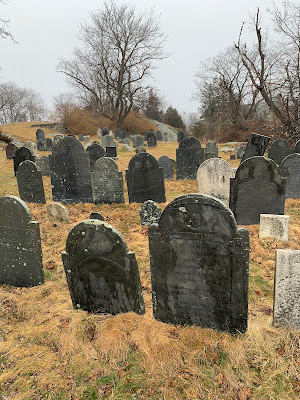
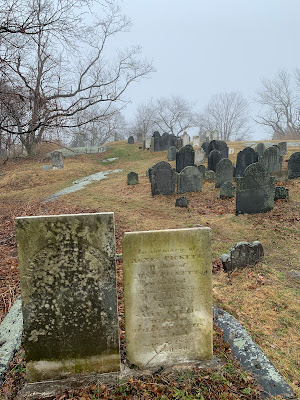
Gilson Road Cemetery is located on a quiet rural street in Nashua, New Hampshire. The cemetery itself is quite small and doesn't have a lot of gravestones standing, but it's pretty obvious there used to be more than there are today. For example, a quick scan showed that there were several stone bases that used to support gravestones that are no longer there. I'm sure there are many more graves that are completely unmarked.


I couldn't find any historical records of this cemetery online. The oldest grave, that of Hannah Robbins, seems to date from the 1790s. Most of the graves are from the 1800s. Many of them are for members of the Gilson family, although the Fiskes, Searles and other families are buried here as well.

Lisa Rogak's 2004 edition of Stones and Bones of New England claims it had a reputation as New Hampshire's most haunted cemetery, and ghost hunter Fiona Broome has been investigating since 2008. Many, many people have seen ghosts there. Orbs, strange lights, apparitions and small ghostly children have all been sighted by visitors to Gilson Road. My Facebook friend Sandra has gone to many haunted locations and said that she saw strange faces in photos she took at Gilson Road Cemetery.

Did we see ghosts? No. Was Gilson Road Cemetery weird? Yes. Unlike Vale End, which I blogged about last week, Gilson Road does not feel well-maintained. It feels vaguely neglected. Neglect doesn't necessarily equal weird in my book, but Gilson Road Cemetery is also the site of a lot of human activity. That's what made it seem so strange.


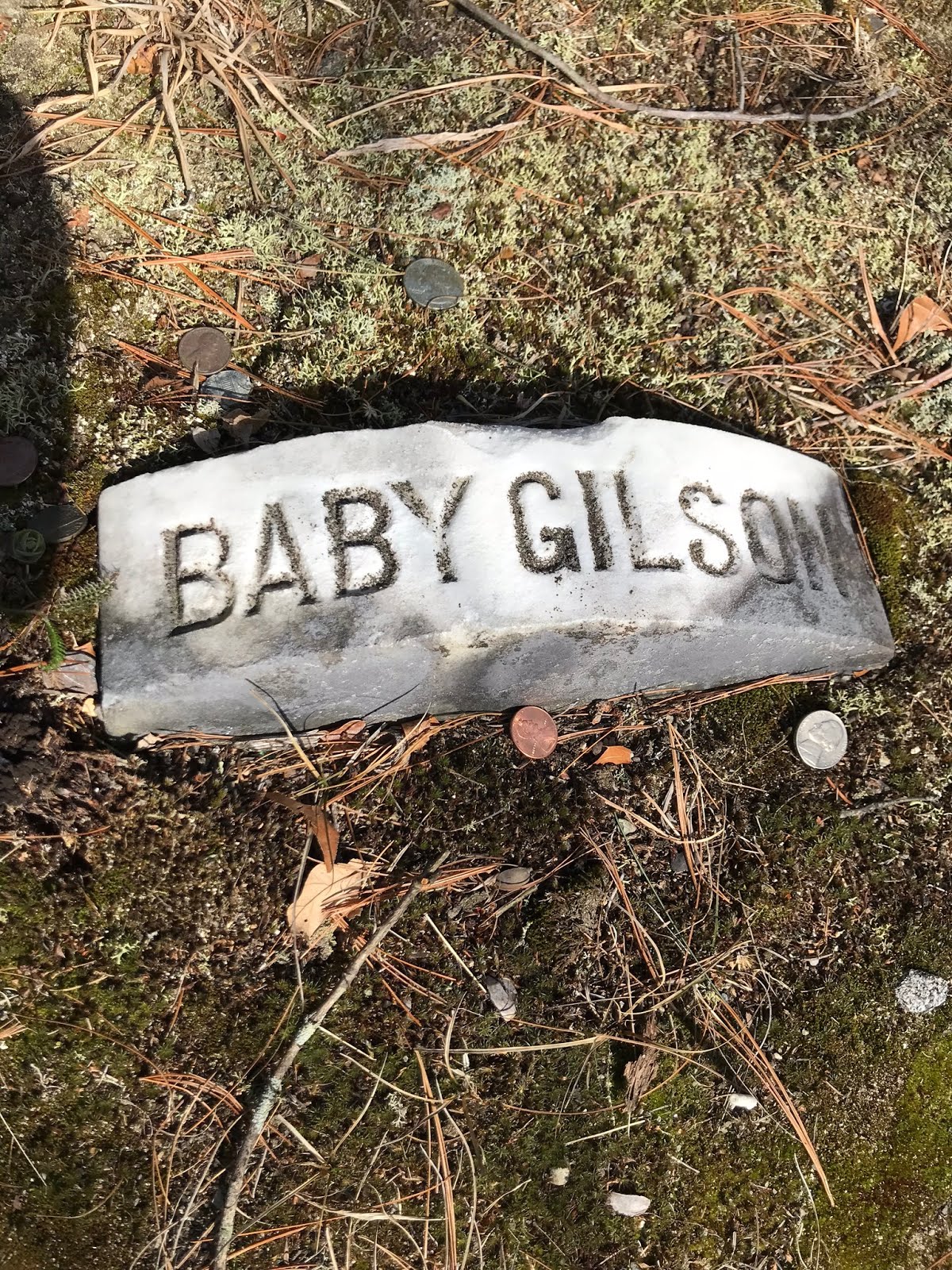
Visitors to cemeteries will sometimes leave coins on the graves of famous or important people. I think that's common. But visitors to Gilson Road have left coins on many, many graves and no one famous is buried there. I think people are leaving coins to honor (or perhaps propitiate?) the restless spirits that are said to reside there.

The neglect and the coins make Gilson Road Cemetery feel weird, and so do all the child graves. And there are a lot of them. For example, there are three identical tiny gravestones for unnamed babies from the Gilson family. Coins have been left on all of them. Perhaps these graves marked "Baby Gilson" have given rise to the legend about Betty Gilson and her baby?


Here is another child's grave, this time with a stuffed Big Bird left at it. All the graves are all quite old, so it's very, very unlikely Big Bird was left by someone who knew the child while he was alive.


The most memorable grave is probably that of little Walter Gilson, who died in 1811 when he was just over three years old. Walter's gravestone has a round hole drilled all the way through it. I haven't found a definitive explanation for this and have never seen another grave like it anywhere else.


People have left a lot of items at Walter's grave, including Barbie dolls, a solar powered crucifix, toy cars, and a rubber space alien. I think the stuffed Scooby Doo is particularly appropriate. A ghost-hunting dog is probably the best toy for a haunted cemetery.


Finally, adding to the weirdness, we saw this object on the ground. Was it a charm of some kind? It definitely had a Blair Witch vibe to it, but I suppose it could just have been a broken dreamcatcher. Or maybe not. We just left it right where it was. I'm not messing around with somebody else's graveyard magic, thank you very much.


There are a few theories about why the cemetery is supposed to be so haunted. According to one it was the site of a bloody battle between two local Native American tribes. Another claims the cemetery was the site of not one, but two deadly house fires. I don't think there's any evidence to back up either theory so they may just be legends. Still, true or not, they reflect the eerie atmosphere of the cemetery.

I guess you can see why I came away from Gilson Road Cemetery with a lot of questions. It's one of the more interesting graveyards I've been to recently and I recommend visiting if you get the chance. Maybe you'll find more answers than I did! My usual caveats apply: don't go at night and don't damage anything. This is someone's final resting place so be respectful.