Showing posts with label Weare. Show all posts

January 30, 2023

Haunted Houses and Terrifying Specters: Ghost (?) Stories from Weare, New Hampshire

There are a lot of ghost stories from New England, and one of my favorite types is what I call the "Scooby-Doo" ghost story. In these stories, the ghost is rationally explained away at the end. There is nothing supernatural in these stories, although people in them initially think there is. I call them Scooby-Doo stories because each episode of the Scooby-Doo ended with the ghostly terror being revealed as someone impersonating a ghost, not something supernatural. These stories are similar, but without all the greedy real estate developers and smugglers.

You can find these Scooby-Doo ghost stories in a lot of the local town history books which were written in the 19th century. I found a bunch of them recently in William Little's The History of Weare, New Hampshire, 1735 - 1888 (1888). In one story, an early settler named John Hodgdon was riding home to Weare on horseback one night when he saw something creepy in his cornfield. As the hair on his neck stood up, he saw a large white object appear on a small knoll in the field. It disappeared with an uncanny sound, only to reappear again. Hodgdon dismounted and walked through the dark field to the knoll, determined to discover what this ghostly object (or entity) was. He learned it was not a ghost, but was instead a large basket some of his workers had left in the cornfield. When the wind blew it rolled up the hill, and when the wind subsided it rolled back down. Mystery solved!

William Little, author of The History of Weare, New Hampshire

In another tale, David and Betsy Purington lived in an old shanty, and "one winter were terribly troubled with ghosts." David Purington thought it was the spirit of his deceased father-in-law. One night, a neighbor came to visit the Puringtons. As they sat talking a strange rapping sound was heard from the attic loft above them. It grew louder and louder and louder. David screamed out for the ghost to desist, but the infernal rapping grew louder! Their neighbor was the only one brave enough to climb into the attic to confront the ghost. After climbing the rickety ladder, she saw a chicken whose legs and been frozen by the cold. It was unable to walk, and made a rapping sound as it tried to stand. "The hen was carried to the room below, and the ghost was laid." Mystery solved! Hopefully the hen recovered from being frozen. 

In East Weare, there was another house that was supposedly haunted. A minister had once lived there, but after he moved away the house stood abandoned. People reported hearing strange noises and even seeing strange lights at night. Some brave schoolboys once approached the house during the day, but fled when they heard an eerie noise and heard the doorknob rattle. Eventually the apparitions stopped. When someone finally went into the haunted house, they saw a dead cat lying on the middle of the floor. Apparently the minister had left it behind when he moved and it had caused all the noise. Mystery solved! 

Or is it? A cat doesn't create ghostly lights. And clearly people didn't take very good care of their animals then...

William Little does include at least one ghost story in The History of Weare that's slightly ambiguous. A man name Mr. Eaton was out hunting raccoons one misty autumn night with some friends. Mr. Eaton paused to rest, when out of the mists emerged a terrifying ghost. "He could see the sunken eye-balls, the worm-eaten face, the shriveled hands, and he shook with terror." One of his friend arrived and Mr. Eaton explained what he had seen. The ghost was not visible to the friend. Many people in Weare believed Mr. Eaton had truly seen a ghost, but others suspected that he had just been drunk. So that mystery was perhaps not completely solved. 

There are a lot of books like The History of Weare out there, histories of New England towns written in the mid-to-late 19th century by people who lived in these places. New England had become a modern industrial area by this time, and you can sense the pride the authors feel in the progress their towns had made. At the same time, they're fascinated by the earlier, pre-industrialized way of life that is vanishing and the supernatural worldview that went with it. Maybe these rationalized ghost stories are the authors' way of straddling both worlds, of indulging the wonders and terrors of the past but also explaining them away with the light of reason. 

December 05, 2022

Bewitched in the Woods: Old Rif and the Rabbit

A few weeks ago I went to the Boston Athenaeum and found lots of old witch stories in various in old New Hampshire history books. A few weeks ago I wrote about Mother Carr from Weare, New Hampshire. Here's another witch story I found, this time from the town of Windham. As the days grow shorter I find myself drawn more and more to these stories!

Many years ago, an enslaved Black man named Old Rif and a man named George Simpson were out hunting in the woods near Windham. After hunting for a while they became lost.

The sun was sinking behind the western hills, and they came to a halt. At that moment they saw a rabbit standing upon its hind legs, looking at them; they tried to frighten it away, but it would not away at their bidding. Old Rif knew that the rabbit was bewitched, and he had heard that to shoot silver sleeve-buttons at a rabbit would destroy the witch. So he loaded his gun, putting in his silver sleeve-buttons, and shot the rabbit. The witch was instantly killed, their minds immediately became clear, the ground at once became familiar, the pathway was plain before them, and they readily and quickly found their way home. He (Old Rif) was said to be the last slave in New Hampshire, and died not far from 1842 (L.A. Morrison, History of Windham in New Hampshire, 1719 - 1883 (1883))

There are lots of interesting things about this story. First of all, there's Old Rif. He's a reminder that there was slavery in New England. I am not an expert on the history of New England slavery, but it seems that although the New Hampshire legislature banned slavery in 1789, it was not completely abolished until the 1850s. Was Old Rif really the last slave in New Hampshire? I will leave that to a better historian than me to determine. Regardless, Old Rif is clearly the hero of this story. He knows that he and George Simpson are bewitched, and he knows how to end it.

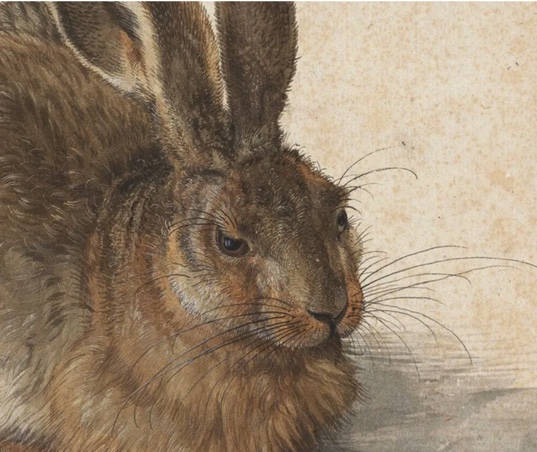
Young Hare, by Albrecht Durer

He ends the witch's spell in a traditional way - by shooting a silver button at an animal that is actually a witch in bestial form. Silver bullets are familiar to modern readers from Hollywood werewolf movies, but any silver object would do the trick. If you don't have a bullet, use a button. 

Maybe the most famous story of a witch being shot with a silver button is the one about Peg Wesson from Gloucester, Massachusetts, who had taken the form of a crow to harass a group of soldiers. It's unclear in either story if the witch is possessing an actual animal, or if the witch has merely sent out their soul in the shape of an animal. Either way, the result of the silver button/bullet is the same - the animal is injured or killed, as is the witch. 

In the Peg Wesson story, Peg is only injured after a soldier shoots the crow with a silver button. But in this story about Old Rif, the witch dies as soon as the rabbit is shot. I wish there was more information about the witch in this story. Who were they? Did they just keel right over in their house? Did anyone find a silver button embedded in their corpse? I suppose we'll never know.

It's a little strange that the witch is never identified in Old Rif's story, but the witch is almost never the main character in these stories. These stories are instructional tales, intended to tell the listener or reader how to fight witchcraft. The witch's identity didn't really matter to the person in Windham who first told this story. What did matter was instructing people how to stop a witch.

I will end with a couple disclaimers. One, your neighbors are not evil witches hexing you. Two, please don't go around shooting random animals if you get lost in the woods. That little bunny just wants to eat some grass in peace. 

November 12, 2022

Mother Carr, the Witch of Weare: Turn Your Clothes Inside Out

A few weekends ago I went to the library and randomly looked through the histories of some New Hampshire towns, hoping to find interesting stories about witchcraft and ghosts. Many 19th century town histories include those local legends, and I was happy to find several stories I had not read before. 

Some of those stories were about Mother Carr. She lived in Weare, New Hampshire in the early 1800s, and many people suspected her of being a witch. There are several accounts of her allegedly bewitching her neighbors, including this one.

Antique postcard of Weare, NH from Wikipedia

One summer day some of Mother Carr's neighbors went berry-picking in the woods. It was a very successful trip. They returned carrying buckets that overflowed with ripe juicy berries. When Mother Carr saw all the delicious berries she asked if she could have some, but her neighbors refused. She stomped off angrily, telling them they would regret their stinginess. (Cue the ominous music...)

A few weeks later, the same group of neighbors went into the woods to pick berries again. And once again, they filled their buckets with plump, juicy berries. But as they began to make their way back to Weare they became lost. They wandered around for hours, unable to find the path that led home. No matter how hard they tried they couldn't find their way out of the woods, even though they had been there many times before. 

Suddenly, one of the berry-pickers remembered Mother Carr's angry words, and realized she had cursed them. They would never find their way home as long as they were under her spell! Someone suggested that if they turned their clothes inside out the spell would be broken. It sounded foolish, but everyone was afraid of being stuck in the woods overnight, so they turned their coats, shirts, pants and skirts inside out. To their amazement, it worked. Although they were tired and bedraggled, they were able to find their way out of the woods.

Antique postcard of Weare, NH from Wikipedia

That is the end of the story. It might sound alien to a modern reader, but turning your clothes inside out is a very old form of folk magic. However, it was most often used to prevent fairies from leading you astray, not witches. As the 17th century English poet Richard Corbet wrote in his poem "Iter Boreale":

As in a conjurers circle, William found

A menes for our deliverance: Turne your cloakes,

Quoth hee, for Puck is busy in these oakes:

If ever yee at Bosworth will be found,

Then turne your cloakes, for this is Fayry-ground.

Special thanks to Beachcombing's Bizarre History Blog for posting this piece of poetry! I am not 100% sure of the metaphysics behind this folklore, but I think turning your clothes inside out is supposed to confuse the fairies, which makes them stop hexing you. 

But why would people in New Hampshire do this when they were lost in the woods? When the English Puritans came to New England they didn't bring much fairy folklore with them, but they did bring a lot of witch lore. Instead of blaming misfortunes on fairies they blamed them on unpopular neighbors (like Mother Carr) they thought were witches. Practices that were once used to protect against fairies were used to protect against witchcraft. 

I found this story in William Little's 1888 book The History of Weare, New Hampshire, 1735 - 1888. These old history books are amazing. You never know what you'll find!