February 26, 2023

Visiting the Gates of Hell in Newburyport

A couple weeks ago Tony and I drove up to Newburyport. It's always a pleasure to visit Newburyport - so charming! so historic! - but we weren't looking for charm or history. We were looking for the GATES OF HELL. Cue the ominous music...

The gateway to Hell?

The gates of Hell are supposedly located in Maudslay State Park, 450 acres of woods, meadows and gardens situated on the banks of the winding Merrimack River. The park used to be the private estate of the Moseley family, and takes its name from the family's ancestral home in England. The grounds once included two mansions, a castle, greenhouses, stables, and other buildings. Most of these structures are now long gone. 

The Moselelys sold their estate for $5 million dollars in 1985 to the state of Massachusetts, and the state turned it into a park. I've wandered through a lot of parks in eastern Massachusetts, and Maudslay is quite different than most. Most parks around here are woodsy and often quite rocky. That's not the case with Maudslay. Although parts of it are heavily wooded, the landscape is more manicured, with open fields and some ornamental gardens that are still maintained. We could definitely tell it used to be an estate. There are also some ruins scattered around as well. 

It was a very pleasant park, even on a cold windy day. But according to local legends the gateway to Hell is said to be located there. I'm not sure why this is. There aren't any shocking scandals surrounding the Moseley family - no murders, no rumors of witchcraft, nothing. Nothing really creepy seems to have happened in the park either to caused these legends.  

Two structures in Maudslay State Park are alleged to be the gate into Hell. The first is the formal gate that once led into the estate. This is located right on Curzon Mill Road, just past the parking area if you drive towards the river. People who pass by this gate at night report seeing severed heads stuck on the spikes. Yikes. I've heard that adventurous young folks will park by the gate late at night, hoping (dreading?) to see the apparitions. Not being young or adventurous, we went there during the daytime. Happily we did not see any ghostly heads. Some people also report seeing the ghosts of small children playing in the park. 

Or is this the gateway to Hell?
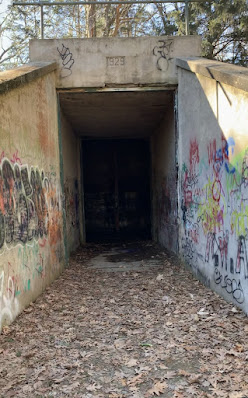

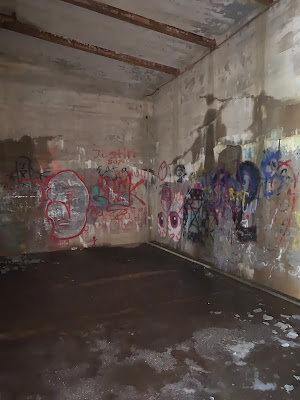
The second structure that may be the gates of hell is a little spookier. Buried in the side of a small hillside is some kind of large underground room that was built in 1929. Was it a garage, perhaps? A large storage bunker? I don't know, but it's big, dark, and filled with graffiti. A large doorway, perhaps 15 - 20' high, leads into the underground room from the outside. It's definitely impressive, and maybe a little creepy. It was really dark inside, and very slippery since the floor was covered in ice. Again, happily we did not see any ghosts. 

I'm not sure why either of these gates are the gates of Hell, instead of just being haunted gates. Do they lead to the underworld? Do demons come out at night? Or maybe the ghosts hang around before heading through the gates to the underworld? I just don't know. The legend is a little vague.

The legend about the gates of Hell seems to be pretty recent. The estate only became a park in 1985, so I'm guessing it only appeared since then. That's just speculation on my part. If you have any information about the history of this legend please share it. 

I have noticed that anomalous or weird structures often attract equally strange legends. A house that looks like its sinking into the earth? Maybe it's because of Satanic rituals. A large iron cage around a grave? It must be intended to imprison a restless ghost. A cemetery gate that looks like spiders? Surely the cemetery must be haunted. I'll note that the Spider Gates cemetery may also contain a gateway to hell, so there are several convenient paths to Hell if you live in Massachusetts.

You get the idea. There are rational explanations for all these things, just as there are rational explanations for the two gates in Maudslay. With the estate long gone, the formal gates and the giant underground chamber now seem a little weird, though. Their original purpose has been forgotten, so people make up new legends to explain why they're there. At least I hope that's what's happening. Otherwise, we've got two gates to Hell in one small park, and that's not good. 

January 30, 2023

Haunted Houses and Terrifying Specters: Ghost (?) Stories from Weare, New Hampshire

There are a lot of ghost stories from New England, and one of my favorite types is what I call the "Scooby-Doo" ghost story. In these stories, the ghost is rationally explained away at the end. There is nothing supernatural in these stories, although people in them initially think there is. I call them Scooby-Doo stories because each episode of the Scooby-Doo ended with the ghostly terror being revealed as someone impersonating a ghost, not something supernatural. These stories are similar, but without all the greedy real estate developers and smugglers.

You can find these Scooby-Doo ghost stories in a lot of the local town history books which were written in the 19th century. I found a bunch of them recently in William Little's The History of Weare, New Hampshire, 1735 - 1888 (1888). In one story, an early settler named John Hodgdon was riding home to Weare on horseback one night when he saw something creepy in his cornfield. As the hair on his neck stood up, he saw a large white object appear on a small knoll in the field. It disappeared with an uncanny sound, only to reappear again. Hodgdon dismounted and walked through the dark field to the knoll, determined to discover what this ghostly object (or entity) was. He learned it was not a ghost, but was instead a large basket some of his workers had left in the cornfield. When the wind blew it rolled up the hill, and when the wind subsided it rolled back down. Mystery solved!

William Little, author of The History of Weare, New Hampshire

In another tale, David and Betsy Purington lived in an old shanty, and "one winter were terribly troubled with ghosts." David Purington thought it was the spirit of his deceased father-in-law. One night, a neighbor came to visit the Puringtons. As they sat talking a strange rapping sound was heard from the attic loft above them. It grew louder and louder and louder. David screamed out for the ghost to desist, but the infernal rapping grew louder! Their neighbor was the only one brave enough to climb into the attic to confront the ghost. After climbing the rickety ladder, she saw a chicken whose legs and been frozen by the cold. It was unable to walk, and made a rapping sound as it tried to stand. "The hen was carried to the room below, and the ghost was laid." Mystery solved! Hopefully the hen recovered from being frozen. 

In East Weare, there was another house that was supposedly haunted. A minister had once lived there, but after he moved away the house stood abandoned. People reported hearing strange noises and even seeing strange lights at night. Some brave schoolboys once approached the house during the day, but fled when they heard an eerie noise and heard the doorknob rattle. Eventually the apparitions stopped. When someone finally went into the haunted house, they saw a dead cat lying on the middle of the floor. Apparently the minister had left it behind when he moved and it had caused all the noise. Mystery solved! 

Or is it? A cat doesn't create ghostly lights. And clearly people didn't take very good care of their animals then...

William Little does include at least one ghost story in The History of Weare that's slightly ambiguous. A man name Mr. Eaton was out hunting raccoons one misty autumn night with some friends. Mr. Eaton paused to rest, when out of the mists emerged a terrifying ghost. "He could see the sunken eye-balls, the worm-eaten face, the shriveled hands, and he shook with terror." One of his friend arrived and Mr. Eaton explained what he had seen. The ghost was not visible to the friend. Many people in Weare believed Mr. Eaton had truly seen a ghost, but others suspected that he had just been drunk. So that mystery was perhaps not completely solved. 

There are a lot of books like The History of Weare out there, histories of New England towns written in the mid-to-late 19th century by people who lived in these places. New England had become a modern industrial area by this time, and you can sense the pride the authors feel in the progress their towns had made. At the same time, they're fascinated by the earlier, pre-industrialized way of life that is vanishing and the supernatural worldview that went with it. Maybe these rationalized ghost stories are the authors' way of straddling both worlds, of indulging the wonders and terrors of the past but also explaining them away with the light of reason. 

January 02, 2023

Eli Wing's Ghostly Arm

 Eli Wing was born in Wayne, Maine sometime in the early 19th century. In the fall of 1837, Eli took a job at a sawmill in Chesterville. He had recently graduated from a nearby Methodist seminary and wanted to earn some money to attend law school. Unfortunately, fate had other plans for Eli.

One day the owner of the mill, Captain Bachelder, asked Eli to go down and clean the water wheel that powered the sawmill. It had been clogged by weeds and was slowing down the mill's work. Always eager to please, Eli did as he was asked. Since he was new at the job, Eli tried to clean the wheel as it was turning, which was a big mistake. His hand got caught in the turning wheel, and the powerful motion of the wheel tore his arm completely off.

Bachelder and the others rushed to the trap door in the floor. Below them they saw Eli lying face down in a pool of bloody water; his arm was going around and around the wheel, spattering the mill with blood. (Helen Caldwell Cushman, Along Thirty Mile River, 2016)

For a while it seemed like Eli would die, but he was taken to a physician and survived. He worked briefly as a portrait painter, and eventually did attend law school and become a lawyer. Despite only having one arm, he lived to the ripe old age of ninety and is buried in the Wing Family Cemetery in Wayne. 

Eli's severed arm was not taken to the physician on that gruesome fall day. Instead, Captain Bachelder buried it by the river bank that after Eli had been carried off. While Eli went on to become a reputable member of the community, his arm did not. Instead, it became a disruptive spectral force. 

A few days after Eli's accident, two of the Bachelder children went to the river to fetch water. They came back in tears, telling their parents that long white arm had emerged from the river and tried to pull them in. Captain Bachelder was skeptical.

But soon other people saw the arm near the river, including a man who said it poured cold water on him as he was trying to drink from the river. Business began to drop off at the sawmill because people were afraid of the ghostly arm, so Captain Bachelder dug it up and buried it in a stone wall, hoping to lay the arm to rest. 

It didn't work. People across the area began to see the ghostly arm. It knocked on windows in the middle of the night, locked people in outhouses (and occasionally tipped them over), rang church bells, and knocked people's hats off their heads. Although some people even believe the arm had strangled a local woman, many others doubted this, and said the Eli's ghostly arm sometimes did good deeds, like punishing a farmer who stole gravestones or helping people who were outcasts. 

Although the arm was allegedly taken from the wall and buried with Eli Wing after he died, there are some people who say it still haunts the woods and backroads. 

*****

I found this story in Helen Caldwell Cushman's book Along Thirty Mile River: Maine Campfire Tales of the Strange and Supernatural (2016). Caldwell Cushman lived most of her life in Maine, and collected local legends for newspaper articles and radio shows. She passed away in 1986. I first learned about her from Chris Packard, author of Mythical Creatures of Maine (2021).

I really like the idea of someone's ghostly arm flying around causing trouble (and possibly doing some good deeds). It's just such a weird and compelling image! I tried to find more information about Eli Wing, but couldn't find any. Caldwell Cushman claims he was buried in the Wing Family Cemetery, but Find-A-Grave does not list an Eli Wing being buried there. Of course, their listing may not be complete, or perhaps Eli was just a nickname and he's buried under a different name. 

In some ways this reads just like a ghost story, but I also wonder if there was a local tradition of blaming pranks on the arm. If some teenagers tipped over an outhouse, did they deflect blame onto the arm? If someone knocked off someone's hat, did they claim the arm did it? It may have been a joke that local people understood, even if they didn't like it. 

December 17, 2022

Christmas Chaos: Puritans, Saturnalia, and Lords of Misrule

On December 25, 1621, some young men in Plymouth, Massachusetts wanted to celebrate Christmas. Their celebration sounds pretty meager by modern standards – just playing a few ball games in the street. However, when William Bradford, Plymouth’s governor, saw what was happening he shut their little party down. He told them they shouldn't be celebrating Christmas, but he was willing to let them observe the day by praying piously indoors. They could not have any fun, however, particularly not in public.

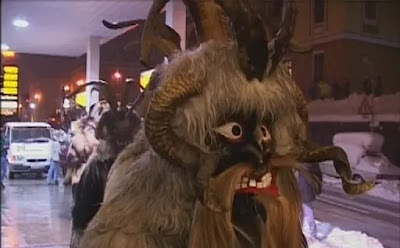
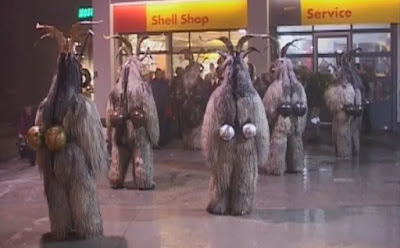
A still from Kranky Klaus (2003), a film by Cameron Jamie.

This sounds like a Grinchy move, and it was. Unlike Governor Bradford and many other Plymouth colonists, the game-players weren’t Puritans. They hadn’t realized how strongly the Puritans hated and feared Christmas. In 1659, the Massachusetts legislature even passed a bill banning Christmas - that's how much they hated the holiday. The bill was repealed in 1681 by Sir Edmund Andros, a much-despised governor appointed by the English king, but Christmas was still not widely celebrated in Massachusetts, or New England in general, until the mid-19th century. Schools and business remained open, and churches did not hold religious services on Christmas. A few  people on the margins of New England society celebrated Christmas, but most didn't.

Puritans hated Christmas for two reasons. First, they thought it was just a pagan holiday that had become thinly Christianized. There’s probably some truth in that. The Bible does not indicate the date of Christ’s birth, so the early Church fathers decided it should be celebrated on December 25, a time when people across the Roman Empire were already celebrating various winter holidays like the Saturnalia and the birthday of Sol Invictus, the sun god. It made good political sense for the new religion to piggyback on already popular holidays.

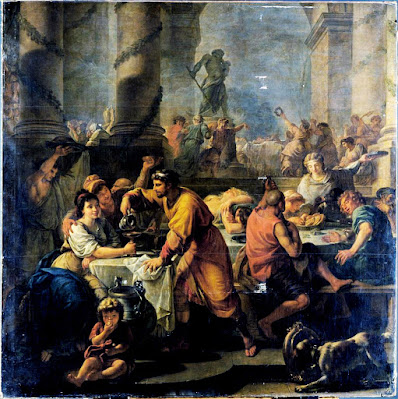
Saturnalia by Antoine Callet

Puritans also hated Christmas because it was celebrated very differently in the 17th century than it is now. Christmas was a raucous and chaotic holiday that featured lots of drunken public revelry and social disorder. There is still some heavy drinking at Christmas these days, but in the 17th century Christmas was associated with large, drunken, disorderly mobs roaming through the streets and countryside. This can be traced back to the Roman Saturnalia, which celebrated the god Saturn, who had supposedly ruled over Earth’s Golden Age. During Saturn’s reign, everyone had been equal. There were no slaves and no masters, no kings and no subjects, no bosses and no employees. It was blissful and idyllic anarchy, with the Earth providing bountiful food so no one needed to work. These beliefs about the Golden Age were reflected in the Saturnalian celebrations holiday, with masters waiting on their slaves, men dressing as women, and much public drinking and ribaldry. All boundaries were dissolved. 

Saturnalia was a season of misrule, a time when society’s rules were temporarily inverted or suspended. It was a release valve, a way for the lower classes to temporarily let off some steam and a way for the upper classes to buy some good will. After the Roman Empire collapsed, this pattern continued in Europe through the Middle Ages and into the Renaissance, but Christmas became the holiday of misrule, not Saturnalia. In many European towns and cities, prominent lower class men were appointed the Lord of Misrule by their fellows to preside over the holiday debauchery, leading crowds that mocked priests, noblemen, and the wealthy with impudence. Carolers, often drunk and in costume, demanded food and drink at wealthy homes. Once the celebrations ended, the Lord of Misrule stepped down and the old hierarchical relationships reasserted themselves until Christmas came around again. 

Illustration from Masks of Misrule (1996) by Nigel Aldcroft Jackson

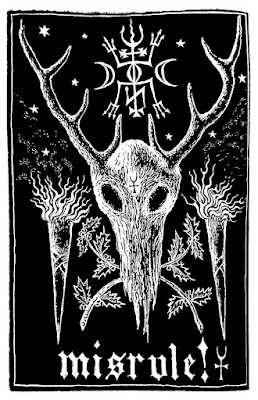
The misrule of Christmas was antithetical to the Puritan values of hard-work, moderation, and self-control, but some modern Americans have recently have shown interest in bringing back a little of the old Christmas chaos. Some contemporary witches and occultists acknowledge a Lord of Misrule in their winter solstice rituals, and the Krampus, a monstrous Yule creature associated with misrule from northern Europe, has become increasingly popular, appearing on t-shirts, tree ornaments, and in movies. Krampus celebrations are a long-standing tradition in Germany and Austria, and some Americans are trying to bring it here.

Idyllic holiday anarchy sounds like fun, but there was definitely a dark side to Christmas misrule. The threat of violence lurked beneath the surface, and vandalism sometimes occurred, even in Puritan New England. For example, a group of young men in Salem, Massachusetts harassed 72-year-old John Rowden on Christmas night in 1679. The men forcibly entered Rowden's home, caroled, and then demanded wine as payment for their performance. Rowden refused, and in retaliation the young men pelted his house with stones and branches for 90 minutes, knocked down a stone wall, and stole six pecks of apple from his cellar. Something similar happened in Deerfield, Massachusetts in 1794, when shopkeeper John Birge was awoken at 2:00 am on December 22 by a group of drunken men demanding entrance to his home. He refused, and the men broke his windows.

Perhaps if Rowden and Birge had played along, their property wouldn't have been damaged. Much like Halloween's trick-or-treat, if you gave out food, liquor or money at Christmas you and your home would escape unharmed. The threat of violent retaliation was an integral part of the holiday.

A still from Kranky Klaus (2003), a film by Cameron Jamie.

Back in 2007, I saw a short documentary by Cameron Jamie called Kranky Klaus, which follows a group of Krampuses as they roam around an Austrian town in a pre-Christmas celebration. The movie is unsettling. The Krampuses are aggressive and violent. They try to break into a pizza shop, and when a female employee stops them they push her into a snow bank. They enter a nightclub, where they knock over tables, wrestle patrons to the floor, and whip people. The Krampuses terrify a group of children, and then shove snow into pedestrians' faces in the street. No one stops them because it's a holiday tradition, but a lot of folks seem unhappy and terrified. You can watch Kranky Klaus on YouTube for yourself. What are your thoughts? Misrule and Christmas chaos sound like fun on paper, but the reality looks pretty scary.

I love weird old traditions, but I'm happy with the tamer, milder Christmas we now celebrate. The Puritan's anti-Christmas attitude wasn't defeated by misrule, but by 19th-century capitalism and a kinder, gentle approach to raising children. The prospect of happy children opening presents under a tree won out over the Puritan's "bah humbug" attitude, and over Christmas misrule as well. Feel free to celebrate Christmas (or not) as you see fit, but I'll be sitting by the tree, drinking eggnog, and listening to Mariah Carey, trying to find that happy medium between grumpy Puritan and kranky Krampus. 

*****

My favorite book about the history of Christmas is Stephen Nissenbaum's The Battle for Christmas: A Cultural History of America's Most Cherished Holiday. I got much of this post's information from it. 

December 05, 2022

Bewitched in the Woods: Old Rif and the Rabbit

A few weeks ago I went to the Boston Athenaeum and found lots of old witch stories in various in old New Hampshire history books. A few weeks ago I wrote about Mother Carr from Weare, New Hampshire. Here's another witch story I found, this time from the town of Windham. As the days grow shorter I find myself drawn more and more to these stories!

Many years ago, an enslaved Black man named Old Rif and a man named George Simpson were out hunting in the woods near Windham. After hunting for a while they became lost.

The sun was sinking behind the western hills, and they came to a halt. At that moment they saw a rabbit standing upon its hind legs, looking at them; they tried to frighten it away, but it would not away at their bidding. Old Rif knew that the rabbit was bewitched, and he had heard that to shoot silver sleeve-buttons at a rabbit would destroy the witch. So he loaded his gun, putting in his silver sleeve-buttons, and shot the rabbit. The witch was instantly killed, their minds immediately became clear, the ground at once became familiar, the pathway was plain before them, and they readily and quickly found their way home. He (Old Rif) was said to be the last slave in New Hampshire, and died not far from 1842 (L.A. Morrison, History of Windham in New Hampshire, 1719 - 1883 (1883))

There are lots of interesting things about this story. First of all, there's Old Rif. He's a reminder that there was slavery in New England. I am not an expert on the history of New England slavery, but it seems that although the New Hampshire legislature banned slavery in 1789, it was not completely abolished until the 1850s. Was Old Rif really the last slave in New Hampshire? I will leave that to a better historian than me to determine. Regardless, Old Rif is clearly the hero of this story. He knows that he and George Simpson are bewitched, and he knows how to end it.

Young Hare, by Albrecht Durer

He ends the witch's spell in a traditional way - by shooting a silver button at an animal that is actually a witch in bestial form. Silver bullets are familiar to modern readers from Hollywood werewolf movies, but any silver object would do the trick. If you don't have a bullet, use a button. 

Maybe the most famous story of a witch being shot with a silver button is the one about Peg Wesson from Gloucester, Massachusetts, who had taken the form of a crow to harass a group of soldiers. It's unclear in either story if the witch is possessing an actual animal, or if the witch has merely sent out their soul in the shape of an animal. Either way, the result of the silver button/bullet is the same - the animal is injured or killed, as is the witch. 

In the Peg Wesson story, Peg is only injured after a soldier shoots the crow with a silver button. But in this story about Old Rif, the witch dies as soon as the rabbit is shot. I wish there was more information about the witch in this story. Who were they? Did they just keel right over in their house? Did anyone find a silver button embedded in their corpse? I suppose we'll never know.

It's a little strange that the witch is never identified in Old Rif's story, but the witch is almost never the main character in these stories. These stories are instructional tales, intended to tell the listener or reader how to fight witchcraft. The witch's identity didn't really matter to the person in Windham who first told this story. What did matter was instructing people how to stop a witch.

I will end with a couple disclaimers. One, your neighbors are not evil witches hexing you. Two, please don't go around shooting random animals if you get lost in the woods. That little bunny just wants to eat some grass in peace.