Showing posts with label haunted. Show all posts

December 14, 2025

The Spirit of Paw Wah Pond

Paw Wah Pond is an eight-acre saltwater pond located in Orleans on Cape Cod. It’s not an ordinary pond – a local legend says it is watched over by a spirit that lives in its depths. 

Even the town historical society used to acknowledge this legend. Near the pond once stood a historical marker upon which was written: “Pau Wah Pond, named for Pau Wah, Chief of the Potonamequoits who drowned herein after Chief Quanset refused marriage to his daughter Wild Dove. Fable says - Cast a pinch of tobacco in the pond and Pau Wah gives you good fishing.” Unfortunately, the marker was destroyed in a storm and was never replaced. 

Photo by Richard Burlton, courtesy of Unsplash.

The name "Paw Wah" can be spelled several different ways, and there are a couple variations of the legend as well. The writer Elizabeth Reynard included one in her book The Narrow Land: Folk Chronicles of Old Cape Cod (1934). According to Reynard, many centuries ago a local Indian chieftain named Pau Wah fell in love with Wild Dove, the daughter of Quansett, who was chief of another local tribe. One cold winter day Pau Wah went to Quansett with offerings of furs, wampum shells, and other valuables and asked to marry Wild Dove. 

Quansett looked at the offerings. He looked at Pau Wah. Then he refused the offer, saying his daughter was worth more than anything Pau Wah could ever give him. Pau Wah stormed off, angry and humiliated. 

Days later he returned to Quansett’s village, this time with a band of warriors, intent on stealing Wild Dove by force. Pau Wah and his warriors fought fiercely, but they were defeated by Quansett and the men in his tribe. 

Pau Wah fled alone into the snowy woods, accompanied only by his faithful dog. He had been humiliated in battle and knew that he was now a pariah. No one would come to help him. He ran for hours, until he came at last to an isolated frozen pond. Here, he thought, he would be safe from his enemies.

Pau Wah built a wigwam on the frozen pond, and then cut a hole in the ice to fish. Unfortunately, in his duress he forgot one crucial thing. He neglected to give an offering to Niba-nahbeezik, the spirit who controls lakes, rivers, and ponds, as one should always do. Niba-nahbeezik was offended by Pau Wah’s oversight, and vengefully made the ice under his wigwam collapse. Pau Wah, his wigwam, and his dog all sank instantly to the bottom of the cold, icy pond. 

Pau Wah sank too quickly to realize what happened – and apparently too quickly to die. He and his dog are supposedly still alive, and they live in their wigwam at the bottom of the pond. Pau Wah spends his days controlling the pond’s fish, and wishing he had some tobacco to smoke. Therefore, if anyone goes fishing at Paw Wah pond, they should throw some tobacco into it as a gift and say “Pau Wah, Pau Wah, Pau Wah, give me fish and I give you tobacco.”

The name Pau Wah (or Paw Wah) is probably a variant of the Algonquian word powwow, which means shaman or sorcerer. (Powwow is also used these days to refer to a Native American gathering with ceremonial dances.) If Pau Wah was actually a powwow, his magical prowess might explain why he is still alive under the pond. It might also explain why Niba-nahbeezik was so offended. As a shaman, Pau Wah should have known not to forget an offering. It might have seemed like a deliberate snub to the spirit. 

A local historian named W. Sears Nickerson offered up a slightly different version of the legend. According to Nickerson, Pau Wah was actually a powwow named Pompmo, who was the son of Pekswat, a well-known chieftain. Pompmo never tried to abduct Wild Dove and did not flee into the woods. Instead, he successfully wooed and married an unnamed woman, had children, and lived to an old age. 

Pompmo met his death the same way, though. He and wife lived on the shores of a saltwater pond. One cold winter, Pompmo and his wife moved their wigwam onto its frozen surface so they could fish through the ice. According to Nickerson: 

“…Cape Cod salt water ice has a reputation for being treacherous, and one stormy night with a sweeping, high tide accompanied by a warm rain, a regular January thaw set in and caught him napping. When morning broke, every vestige of ice was gone from the pond, and old Pompmo, his wigwam, and his wife were nevermore to be seen in this life” (Delores Bird Carpenter, Early Encounters: Native Americans and Europeans in New England. From the Papers of W. Sears Nickerson, 1994).

Pompmo’s spirit became restless and bored in the afterlife, so he came back to the pond where he lived so much of his life. If you want to catch any fish in his pond, you should toss some tobacco into the water and say, “Paw Waw, Paw Waw, I give you tobacco. You give me some fish?”

Are either of these stories true? Is it even an authentic Native American legend, or was it made up by white folks? There are a lot of fake Native American legends out there, unfortunately, and this could be one of them. Still, I do like the story, particularly as we've had a lot of cold weather recently. 

I’m not sure if the legend is true, but if you go fishing at Paw Wah pond you may want to bring some tobacco, just in case. Don’t throw in a cigarette or cigar, which might kill the fish. Just a tiny pinch of plain, organic, untreated tobacco will do. Maybe Pau Wah, or Pompmo, or even Niba-nahbeezik himself will accept your offering and send you some fish.

*********

A special thank-you for my friend David Goudsward for sharing the Nickerson information with me!


March 28, 2024

Walnut Cemetery: A Ghost, A Crossroads, and A Poetic Tragedy

I was chatting with someone a while ago, and they asked if I had ever visited Walnut Cemetery in Haverhill, Massachusetts. I was born and raised in Haverhill, but had surprisingly never been to this particular cemetery. After they told me it was haunted, I decided it was finally time to pay a visit. It's an interesting place, and I have lots of thoughts. 


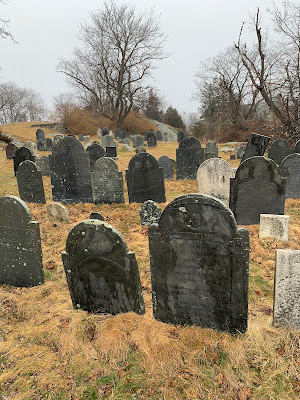
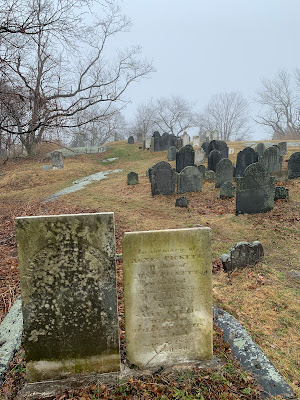
Walnut Cemetery is located in one of the more rural areas of Haverhill. I couldn't find what year the cemetery was started, but it's quite old, with a few gravestones dating back to the 1700s. It's still active today, with newer burials and monuments being added. The newer section is well-maintained, but the older section is a little rough looking. It looks, in fact, like a haunted cemetery. There are a lot of tall weeds. Tree branches have fallen on the graves. Some of the oldest monuments are covered in lichen. We went in the winter, so it may just have been between scheduled maintenance. The older section of the cemetery is also on a rocky hill, so perhaps it is harder to cut the grass there. But whatever the reason, the old part of Walnut Cemetery looks a little spooky. I can understand why someone might think it's haunted. 


The cemetery is said to be haunted by a ghost known as the Woman in White, who roams through it at night. You don't even need to go inside the cemetery to see her - the Woman in White has also been seen by motorists just driving by. Some people say she's terrifying, but others say she is simply eerie and mysterious. As with so many things, I think your mindset might influence what you see. If you go expecting something scary, that's what you'll probably encounter. 

When we visited, I noticed that Walnut Cemetery is located within a triangular crossroads. There's a lot of interesting folklore associated with crossroads, so perhaps it's not surprising there are legends associated with this particular cemetery. The ancient Greeks and Romans believed that crossroads were sacred to Hecate, the goddess of witches, and to Hermes, the divine messenger who guided the dead to the underworld. In England, Scotland and Ireland, people who died by suicide were buried at crossroads, often with stake in their heart. Something similar happened more locally in 1680 in Hampton, New Hampshire, when the citizens of that town buried accused witch Eunice Cole at a crossroads with a stake in her heart. For good measure, they placed a horseshoe on her chest to keep her in her unhallowed grave. And in the American south, legends say that if you want to sell your soul to the Devil, you can find him at a crossroads at midnight. 


Speaking of triangular shapes, paranormal investigator Fiona Broome thinks Walnut Cemetery could be linked to a ley line triangle connecting several weird, legendary places in New England. Ley lines are straight lines that connect important locations on a map, and some people believe these lines conduct mystical energy across the landscape. I can't say if that's true or not, but it's another interesting idea to consider when thinking about Walnut Cemetery. Ghosts plus a  crossroads plus ley lines must all add up to something, right? Well, it may not, but it's still fun to think about. 

Broome and several other ghost hunters investigated Walnut Cemetery back in 2009. They perceived several spirits, including a woman in black, an undefined male spirit, and possibly the restless spirit of a small child. They did not encounter the Woman in White, however. 


Who exactly is the Woman in White? Some people think she is the ghost of Lydia Ayer, the most famous person buried in the cemetery. Ayer was immortalized by the Haverhill poet John Greenleaf Whittier in his 1868 poem "In School-days." In this autobiographical poem, Whittier recalls an incident from his childhood, when he lost a spelling bee to a girl in his class. The girl was Lydia Ayer. Rather than revel in her victory, Ayer instead felt sorry for Whittier.

'I'm sorry that I spelt the word: 

I hate to go above you, 

Because,’ - the brown eyes lower fell, - 

'Because, you see, I love you! ' 


Still memory to a gray-haired man 

That sweet child-face is showing. 

Dear girl! the grasses on her grave 

Have forty years been growing!

He lives to learn, in life's hard school,
How few who pass above him
Lament their triumph and his loss,
Like her, - because they love him.

It's a melancholy poem, and justifiably so, because Ayer died in 1827 when she was just fourteen years old. It's clear that her death made a big impact on Whittier. The poem itself also made a big impact. "In School-days" was one of Whittier's most popular poems, and is often still taught to students today. 

Death is the great equalizer, but Lydia Ayer is the star attraction for living visitors to Walnut Cemetery. A wooden sign points towards her grave, which is marked with a large, handsome memorial that was put up in 1937 by a local civic organization. But is her spirit the Woman in White? 


I'm not sure. Ayer died when she was just a young teenager, and the Woman in White is usually described as a woman, not a young girl. Maybe people only see that the ghost is female, and can't really discern her age, and think she is a full-grown woman. Or maybe Ayer's ghost actually looks older than fourteen. After all, she's over two-hundred years old. Or maybe it's not her ghost at all. And of course, this could all just be a legend. There may not be a ghost at all. 

Women in white are a classic form that ghosts appear in, and stories about them can be found all over the world. In a sense, a Woman in White transcends the story of an individual and partakes in a greater, archetypal identity. In his book Daimonic Reality (2003), Patrick Harpur says the following about "white ladies":

"A ghost? Possibly. But it is a distinguishing characteristic of white lady apparitions they are not individually identifiable. They have deeper resonances than the shade of a historical personage. The time and location are suggestive... an hour and place of transition, of in-between. "

He goes on to say: 
"... white ladies do not speak. But their silence is eloquent. Their appearance itself is the message: enigmatic, often sinister, pointing towards the unknown."


December 03, 2023

Haunted by the Nantucket Mermaid

This post is about a mermaid who has fascinated, and possibly haunted, people for centuries. But I want to start by talking about a human man: Ichabod Paddock. 

Ichabod Paddock was born around 1661 in Yarmouth, Massachusetts, and died around 1750. He's buried in Middleborough, Massachusetts. Paddock is remembered today for two things: his pioneering role in the Nantucket whaling industry, and his alleged extramarital affair with a mermaid. As a whaling pioneer, Ichabod came with his two brothers to Nantucket in 1690 and taught the islanders how to hunt whales. Their actions were instrumental in making Nantucket into the whaling capital of the world. 

Oddly, we have more details about his alleged (and probably legendary) affair with the mermaid than we do about his actual life as a whaler. The legend goes something like this. Once while on a whaling voyage, Ichabod was swallowed alive by a large, seemingly invulnerable whale nicknamed Crookjaw. The local whalers thought Crookjaw was somehow magical, and this was confirmed by what Ichabod found inside the creature's stomach. Rather than digestive fluids and half-eaten fish, Paddock found a cozy ship's cabin with lit lanterns, a luxurious featherbed, and a table. Two people - a beautiful, golden-haired mermaid and the Devil himself - were playing cards at the table when Ichabod arrived. 

Engraving from 1817 by John Paas

The mermaid won the game, and the Devil angrily disappeared in a flash of sulfurous smoke. "What were you playing for?" Ichabod asked. "We were playing for you," the mermaid said, "and I'm glad I won." She took Ichabod by the hand and led him to the bed, where they made passionate love for hours. 

Ichabod eventually emerged from Crookjaw's mouth and swam back to his ship, but the next day he again commanded the crew to sail to the magical whale so he could enjoy more of the mermaid's loving embraces. After several hours he emerged from the whale and returned to his ship, only to sail back to Crookjaw and the mermaid the next day, and the next after that. Ichabod's passion for the beautiful mermaid was insatiable. 

Eventually, news of Ichabod's strange extramarital affair reached his wife, Joanna. Ichabod was a formidable whaler, but Joanna was equally formidable in her own way. Since both Crookjaw and the mermaid were magical creatures, Joanna asked a local silversmith to craft a silver-tipped harpoon. At the time, silver was believed to have the power to harm magical creatures like witches, mermaids, and even invulnerable whales like Crookjaw. Vestiges of this belief still remain today, with the idea that werewolves and vampires can be killed with silver bullets. 

Joanna presented the silver-tipped harpoon to Ichabod as a gift. He accepted it, and although he was a formidable whale-killer and mermaid-lover, he apparently wasn't bright enough to realize that silver  could kill enchanted whales and the lustful mermaids who live in them. At the urging of his crew, Ichabod hurled the silver-tipped harpoon at Crookjaw, expecting it to bounce off the whale's impenetrable hide. Instead, it sunk deep into the body of Crookjaw, who died with a groan and a geyser of blood. 

Ichabod screamed in horror, incredulous at what he had done. What had happened to his beloved mermaid? When the crew butchered the whale's body, nothing was found inside its stomach except some long yellow seaweed that reminded them of a woman's hair. The beautiful mermaid was gone. 

In 1710 Ichabod and his wife left Nantucket and returned to mainland Massachusetts, eventually having nine children. According to author Nathaniel Philbrick, little else is really known about the life of Ichabod Paddock. His legendary encounter with the mermaid has lived on, though, and is still surprisingly resonant with some people today. 

For example, the book The Ghosts of Nantucket: 23 True Accounts (1984) contains the following story which a Nantucket woman told author Blue Balliett. The woman came from an old Nantucket family, and went to visit the Nantucket Whaling Museum with her sister who was visiting the island. While touring the museum, the woman became entranced by a painting of a young man. She had the strange feeling that she somehow knew him, and had been in an intimate relationship with him, similar to a marriage. She said:

"I was held by a magnetism of some kind that was so strong I couldn't move. It wasn't that I was objectively interested in him, or thought I saw a family resemblance of some kind. It was rather that he had an iron grip on me." (Blue Balliett, The Ghosts of Nantucket: 23 True Accounts, (1984), p.62)

The woman remained staring at the painting, immobilized, until her sister came and shook her arm, asking if something was wrong. This ended the trance.

 A mermaid illustration from 1687

The woman later went to visit her minister, and told him about her strange encounter with the painting. The minister explained that it was a portrait of Ichabod Paddock, who had fallen in love with a mermaid who was killed by a silver harpoon. The woman felt dizzy as she heard the story, because ever since she was a young child she'd had a weird "recurrent memory" that popped into her head like a daydream:

"It goes like this: I remember being in pitch darkness and having an excruciating pain in my side as I swim back and forth, back and forth, in black water. I also remember phosphorescence around me, the kind you see in the ocean on a dark night. I always thought it was peculiar, and I used to tell myself that maybe it was a memory of being inside the womb or something." (Blue Balliett, The Ghosts of Nantucket: 23 True Accounts, (1984), p.62)

Her encounter with Ichabod's portrait seemed eerily meaningful to her as she listened to the minister talk. Were these daydreams memories of a past life? Was she somehow the mermaid, reincarnated in 20th century Nantucket? She wasn't sure, but for months afterward she had a craving (which she resisted) to revisit the museum to see the portrait, and would wake up in the middle of the night seeing Ichabod Paddock's face floating above her bed. 

Perhaps it was just coincidence that this woman's unusual, recurring dream fit so well with the mermaid legend. That's what I thought, until I received an email from a young woman who is a member of the Paddock family, which still exists today. Like the woman in The Ghosts of Nantucket, she also feels a strange connection to the legendary mermaid, writing that "In my mythos, I am the mermaid who was given the opportunity to reincarnate because of winning half of Ichabod's soul." 

About two years later, I received an email from a man who was also a Paddock, telling me that his daughter felt a powerful connection to the mermaid legend, that she had a large mermaid tattoo on her back, and that she often dreamt of being a mermaid. I arranged to talk with him and his daughter, who it turned out was the young woman who had already emailed me. We had a nice conversation over Zoom, and I learned a lot about their family history and connection to the mermaid story. I didn't get the impression that either the young woman or her father literally believed she was the reincarnated mermaid, but rather that the mermaid was a source of family pride and artistic inspiration. 

Unlike the woman quoted in Ghosts of Nantucket, this young woman didn't feel upset or scared by the legend. Neither did her father. They thought the the legend was an interesting part of their family's genealogy. I don't blame them. Many people descended from old New England families have witches in their family tree, but only a few have a mermaid.

Mermaids aren't just cute cartoons, like Ariel in The Little Mermaid, or sexy fantasy figures, like you might see online. Mermaids are the modern iteration of ancient ocean spirits. They are elemental beings personifying the vast and unknowable waters that cover most of our planet. The ancient Greeks knew them as nereids and oceanids, the nymphs who lived in the seas and ocean. Nymphs were powerful godlike beings who were feared and petitioned for their blessings. Mermaids may also partly have their origin in stories about the Sirens, seductive female monsters that lured sailors to their doom. The seductive and possible devilish Nantucket mermaid certainly seems to share some traits with the Sirens. 

You may not believe in mermaids, just like you may not believe in invulnerable magic whales like Crookjaw. But you can't deny the hold mermaids still have on our imagination. They may not be seen in the ocean as often as they once were, but they still haunt our dreams and subconscious. 

October 25, 2023

Black Agnes: Montpelier's Death-Cursed Statue

As I mentioned before, Tony and I recently traveled up to Montpelier, Vermont to see our old friend Brian. He showed us around Vermont's charming capital, and also showed us some of its spooky sights, including the infamous Black Agnes statue. 

When we reached Montpelier, Brian immediately took us on a tour of Green Mount Cemetery. He is a Montpelier native, and had a lot of gossip and stories about the different folks buried in Green Mount. For example, he showed us a funerary statue of a young girl called "Little Margaret." Little Margaret's family commissioned a local sculptor to carve the statue after she died (apparently of spinal meningitis), but refused to pay because one of the statue's shoes only had five buttons instead of six. The sculptor was about to apologize when he looked again at the photo of Little Margaret the family had given him to work from. One of her shoes was missing a button in the photo. The sculptor stormed back to Little Margaret's family, showed them the photo, and angrily collected his payment.  

Brian also told us that the road leading to Green Mount Cemetery has been the site of many deadly auto accidents. "When I was young, this road was routinely covered in human viscera," he said, morbidly joking. At least I hope he was joking. 

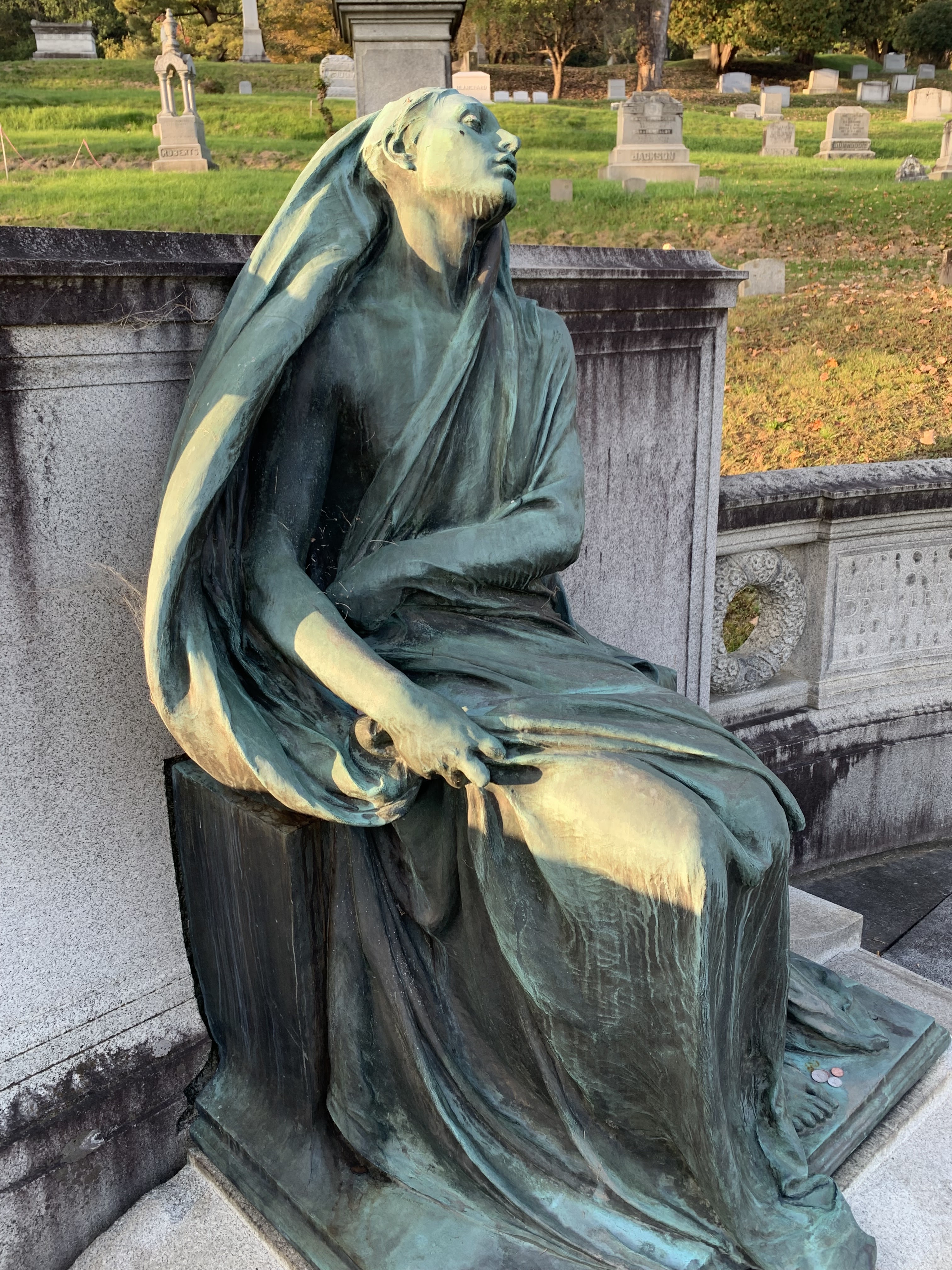
The Black Agnes statue

Towards the end of the tour, we reached the grave of John Erastus Hubbard (1847 - 1899), a wealthy Vermont businessman. Hubbard's grave features a spectacular bronze sculpture of a robed figure titled Thanatos. This statue is more popularly known as Black Agnes. 

According to legend, terrible luck comes to anyone who sits on Black Agnes's lap. Accounts differ as to what form the bad luck will take. Some say three unlucky things will occur to the person who sits on her lap, others say it will be an uncountable amount of bad luck. That doesn't sound good. Still another legend claims that anyone who sits on Black Agnes's lap will die within seven days, which is perhaps the worst luck of all. 

Many years ago, three teenage boys went to Green Mount Cemetery during a full moon. They dared each other to sit on the statue's lap. Not wanting to look cowardly, each boy took a turn sitting on Black Agnes. They all laughed. It was just a dumb statue, after all. Nothing to be afraid of. But within a week, one fell and broke his arm, one was in a serious car accident, and the third boy drowned while canoeing on the Winooski River. Some people said these misfortunes were just coincidences, but others said it was the curse of Black Agnes. 

Well, at least that's one legend. All the legends vary slightly, with some saying, for example, that you only suffer Black Agnes's wrath if you sit on her when the moon is full. Personally, I say why take the risk? Just don't sit on the statue, regardless of the moon phase. I don't recommend sitting or climbing on any cemetery statue. It is disrespectful to the dead, even if there isn't a death curse. 

Brian told us that the Black Agnes legend didn't exist when he was a kid, and that it must be relatively recent. That could very well be the case - new legends arise and old ones disappear all the time. There are in fact other allegedly cursed statues named Black Agnes around the United States. There is one in Washington, DC, which was originally a grave marker in Baltimore for a dead Civil War general in the Union Army named Felix Angus. It was apparently moved from Baltimore because too many fraternity and sorority pledges kept sitting on it as part of their rush process, daring each other to risk the death curse. It seems likely the Black Agnes legend traveled from the DC area to Montpelier, but I'm not sure how. 

Some folks, apparently in an attempt to debunk the Montpelier version of the legend, have pointed out that the statue is clearly of a male, so therefore the legend cannot be true. This argument doesn't hold up for me. It's 2023, and we all know that gender is a social construct. A statue of a male can easily be named Black Agnes. 

John Erastus Hubbard (1847 - 1899)

John Erastus Hubbard, upon whose grave Black Agnes sits, generated some controversy while he was alive. Hubbard came from a prominent Vermont family, and his wealthy aunt left a significant amount of money in her will to the city of Montpelier to build a library. Hubbard was unhappy about this, and managed to get his aunt's will overturned and inherit the money himself. Montpelier officials took him to court, and he eventually agreed to pay for the library. Upon his death, he left the majority of his fortune to Montpelier as well. However, this late generosity did not necessarily win him many fans among the city's citizens, some of whom noted that a terrible thunderstorm raged through Montpelier the night Hubbard died, which they took as an omen indicating the state of his soul. 

September 21, 2023

The Haunted Charlesgate: Ghosts, College Students, and Weird Engimas

Living someplace old and historic, like the Boston area, brings both perils and joys. Among its current perils is the decaying subway system, which has been well-documented elsewhere. To avoid the most hellish parts of the MBTA, lately my commute home from work has involved more walking. Which brings me to one of the joys of living in the Boston area: beautiful old architecture. 

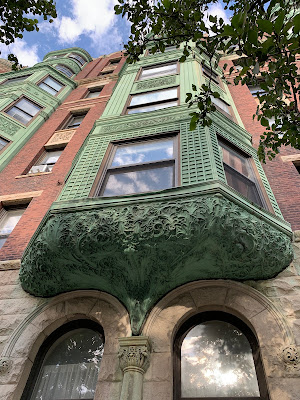
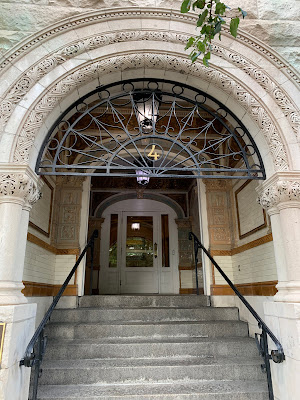
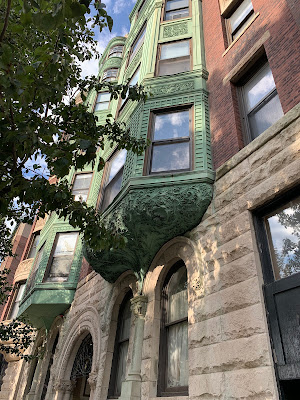
Most nights, I walk through parts of Back Bay on my way home. Among all the beautiful old brownstones and apartment buildings, one in particular stands out: the former Charlesgate Hotel, located at the corner of Beacon Street and Charlesgate East. The hotel was designed by John Pickering Putnam, a prominent local architect, and completed in the 1890s. Putnam apparently loved the building he created, and took up residence there with his own family. 

He died there on February 23, 1917 at the age of sixty. A legend claims it was suicide, but he really died of natural causes. Still, esotericists of a certain bent will notice he died on the 23rd, making his death an example of the 23 enigma, the idea that the number 23 is considered strange, somewhat sinister, and connected to unusual phenomena. So maybe Putnam's death date was a precursor of the weirdness that was to come...

The Charlesgate operated as a hotel until 1947, when it was sold to Boston University as a dorm. In 1981, it was sold to Emerson College, which also used it as a dorm until 1995. It was during those 14 years that the Charlesgate acquired its reputation as one of the most haunted buildings in Boston. Here are a few of the ghostly legends from that time..

The building was said to be haunted by the ghost of Elsa Putnam, John Pickering Putnam's daughter, who died as a little girl when she was playing with a ball on an upper floor. The ball rolled into an open elevator shaft, and Elsa ran after it and fell to her doom. This story is not true - Elsa Putnam lived until the 1970s and had several children of her own - but many Emerson students still reported seeing her ghost. 

Another legend claims that mobsters owned the building in the 1930s and murdered three people in the elevator. The ghosts of these gangland slaying victims were often seen wandering in the dormitory. Emerson students also claimed they saw the restless spirits of young women who had committed suicide in the building back when it housed female Boston University students. 

A phantom "Man in Black" was also seen lurking around the elevator. No one was quite sure who he was, but students were afraid to encounter this black-clad ghost, particularly late at night. 

Even when ghosts were not seen, Emerson students living in the Charlesgate experienced a variety of strange phenomena including unexplained cold spots, toilets flushing by themselves, and doors slamming shut. Some students also claimed the hotel had once been the headquarters for a demonic cult. According to an article in a 1990 issue of Fate magazine:

"Also at one point, a good part of Charlesgate Hall's residents allegedly belonged to a demonic cult. 

When Emerson College bought Charlesgate Hall as a dormitory in 1980, it was not completely filled by students. It was claimed that some members of the cult still lived there, and it was not unusual for students to walk by the open door of a room belonging to a cult member and find a group of them chanting."

Well, college is supposed to expose you to new experiences, isn't it? The same Fate article also claims that Emerson forbid students from using Ouija boards in the Charlesgate - and then goes on to describe a group of them using one to contact spirits in the dorm. I guess college is also about defying authority.

The Charlesgate's ghosts have been written about in many places: The Berkeley Beacon (Emerson's student paper), The Boston Phoenix, Emerson's official newsite, and various books about haunted locations in Boston. The building also appears in Scott Von Doviak's 2018 novel, Charlesgate Confidential, as do some of the ghost stories. The combination of a creepy old hotel, ghosts, and college students makes the Charlesgate an appealing subject for writers.

The Charlesgate is no longer a dormitory, but instead is filled with condos and apartments. I haven't heard of any ghosts appearing in the building since it became condos. Are any ghosts even there now? Maybe the ghosts were chased away during the renovations, or maybe they were conjured up by the Emerson students who lived there. College students tend to like ghost stories, and many local New England colleges are said to have haunted dormitories. 

I mentioned the 23 enigma at the start of this post. Although the concept first appeared in works by William S. Burroughs, it was popularized by the author Robert Anton Wilson. Wilson didn't necessarily believe the 23 enigma was real, but rather that it showed how people have the ability to find patterns in random occurrences. Some people starting seeing the number 23 in all kinds of unexpected places once they learn about the enigma. The number is only meaningful, though, because they think it is significant. They are creating a pattern out of random data.

Perhaps the ghost stories at the Charlesgate are something similar. Students heard rumors the dorm is haunted, and then noticed lights flickering, strange cold spots, and weird noises at night. These all could have perfectly rational explanations - old buildings often have bad fuses, drafty windows, and frisky rodents - but students interpreted them as ghostly phenomena because they had heard the rumors. 

This is, of course, all speculation on my part. The only way for me to know for certain would be to rent an apartment at the Charlesgate and see what happens. A one bedroom starts at $2,400/month, which is more than I have budgeted for ghost-hunting. Or then again, maybe I'm just scared that the legends are true? I don't want to encounter the Man in Black late at night, no matter what he is. 


April 22, 2023

A Pukwudgie Sighting in Massachusetts

Sometimes people write to me about strange experiences they've had. Just a few weeks ago, a woman I'll call Mary sent me an email about a weird encounter she had while walking a dog. 

Mary lives in Norwell, and was taking care of a friend's large Labrador retriever while the friend was traveling. The dog would wake Mary up every morning between 4 and 5 am to take it for a walk. Mary would usually bring the dog to a small nearby watershed - a patch of woods and swamp - for its morning perambulation. 

Mary and the dog went on these early morning walks for a few weeks without anything strange happening, but that changed on March 1. It was pitch black, and as they walked on a road near the watershed the dog stopped in its tracks and let out a low growl. Had it seen a raccoon, or maybe a coyote? Feeling nervous about being alone in the dark with a wild animal nearby, Mary looked around to see what startled the dog. It was not a raccoon, or a coyote. It was something much stranger. 


Crouched near the woods was a small humanoid creature. It was covered in what looked like matted, black fur. Mary thought the creature stared at her with glowing green eyes, but isn't sure if she just imagined this detail. Whatever the creature was, it was something she had never seen before. She and the dog ran home. 

A few days later the dog went home to its owner, and Mary thought that was the end of her strange experience. But on the night of March 13, Mary heard some unusual sounds coming from outside her house. It sounded as though something were quietly but insistently tapping on the side of her house, or possibly on the window. At first Mary thought maybe her daughter had locked herself out of the house, but that was not the case - she was safely inside. Nervously, Mary's thoughts then turned to the small humanoid she had seen near the woods. Was it outside her house, tapping on the walls and windows?

The next day she talked with some people at work about what had been happening, and one of them suggested she had encountered a pukwudgie. Pukwudgie is a one name for the small, hairy, magical humanoids that are said to live in the woods in New England. Basically, they are a type of fairy. Not a pretty, tutu-wearing fairy like Tinkerbell, but a scragglier, rough-around-the-edges fairy. They're the type of fairy you'd expect to see in the woods around here, which are rough, rocky, and filled with poison ivy. 

Pukwudgie is something of a modern term, at least in New England. The Native Americans in New England had other names for these beings, like makiawisug, mekumwasuck, or mikumweswack. Pukwudgie was originally a word used by the Ojibwa Indians of the Midwest to describe the small magical beings they encountered, but it has since became a popular word in New England, and particularly in Massachusetts. (You can read more about the history of the term pukwudgie here.)


Pukwudgies are believed to be mischievous at best, and malevolent at worst. Traditionally, the local Native Americans believed that the little people would help humans if treated with respect. That is not the case with pukwudgies, who supposedly like to shoot people with darts, lure them off cliffs, and in general lurk around and frighten anyone who encounters them. If I can speculate, perhaps this change in behavior is because most New Englanders don't know how to treat them with the respect they deserve? 

Mary's encounter is similar to several other well-known pukwudgie encounters. For example, in 1990 a Raynham, Massachusetts man named Bill Russo was walking his dog late at night near some woods when he saw a small hairy humanoid creature, which tried to lure him into the woods. He declined the offer. And Christopher Balzano describes a very similar situation in his 2007 book Dark Woods: Cults, Crime and the Paranormal in the Freetown State Forest. A woman named Joan was walking her dog in the Freetown State Forest when she noticed someone watching her. It was a small, grey-skinned humanoid with hairy arms and a hairy head, and it stared at her with deep green eyes. After encountering the pukwudgie in the woods, Joan noticed the pukwudgie lurking around her house several times. Apparently it had followed her home. Creepy!

After I got the email from Mary, I asked Balzano if he had any advice for people who encounter pukwudgies, particularly if the pukwudgie seems to be lurking around their house. He said the best thing to do is just ignore them. Eventually, they'll go away and the strange phenomena will stop. That sounds like good advice to me. I think that the more attention you give to weird phenomena, the more of it you'll notice. You can just get sucked down the rabbit hole!

In a subsequent email, Mary told he that she had some lucky things happen to her on the day she encountered the creature in the woods. So maybe seeing it had been a fortuitous event, even if it was spooky? In the end, the situation was oddly ambiguous, much like the pukwudgies themselves. 

March 29, 2023

A Visit to Medfield State Hospital: Charming and a Little Spooky

A few weeks ago Tony and I visited Medfield State Hospital, in charming Medfield, Massachusetts. Originally known as the Medfield Insane Asylum, the hospital is now a park open to the public. Intrigued? Read on. 

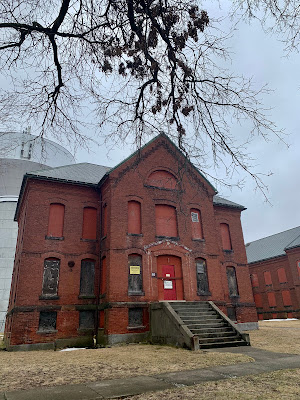
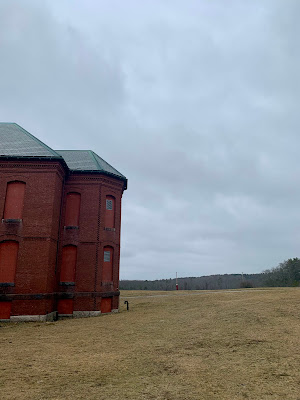
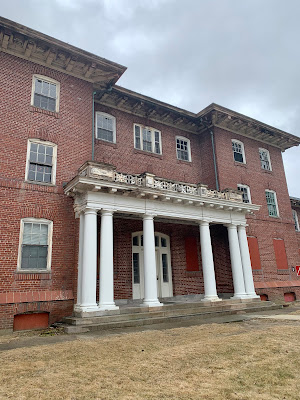
Medfield State Hospital opened in 1896, and was one of the state's first hospitals to deal with long-term patients with mental disorders. It was designed in the "cottage style," according to an informational sign erected at the hospital, with more than 50 buildings spread across 1.4 square miles. Many of the buildings are still standing, although they are now boarded up and public cannot access them. Medfield State today looks a lot like a small, traditional New England liberal arts college - but with absolutely no people. It's both charming and maybe a little spooky. 

Tony and I visited on a cold, snowy day, and there weren't many other visitors. A few people were walking their dogs, but that was about it. The hospital was quite bustling in the past, however. During World War II, almost 2,300 people lived at Medfield State. The hospital finally closed in 1993. 

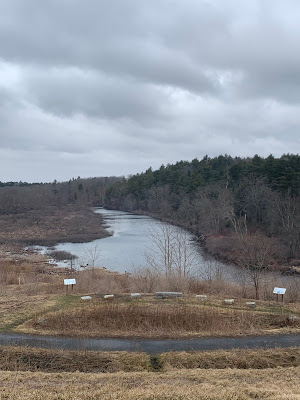
In the early part of the 20th century, the hospital was self-sufficient. Patients grew crops on hundreds of acres of farmland, and tended more than 1,000 cattle and 3,000 chickens. That's quite an operation! Medfield State Hospital even was able to supply food to the other state hospitals in eastern Massachusetts. Even today there is still quite a bit of open land at Medfield State, including a bluff overlooking the Charles River. It has a great view!


You'd think there would be some weird legends associated with an abandoned insane asylum, but that's not really the case here. The only possible ghost story is quite recent. In 2017, the movie The New Mutants was filmed at Medfield State. Part of the X-Men series, The New Mutants tells the tale of five young mutants imprisoned in a spooky hospital. The movie wasn't released until 2020, and the director suggested The New Mutants might have been cursed by being filmed at the abandoned insane asylum. 

The director, Richard Boone, told The Boston Globe the following on August 20, 2020:

It was during the press push for the first trailer that Boone first spoke of “weird” things happening to crew members at Medfield State Hospital during filming. 

“Literally every single person on my crew — all my grips — all those people had weird things happen to them while they were there,” Boone told IGN of the abandoned state hospital, which also served as a filming location for “Shutter Island” in 2009. “I even told the behind-the-scenes crew to go interview everyone who had weird stuff happen to them for an extra on the Blu-ray.”

I would like a little more detail, but I don't want to buy the Blu-Ray. Not everyone was freaked out, though. Actor Anya Taylor-Joy said the following:

"I've shot in four abandoned mental institutions, so it's kind of a second home for me," Taylor-Joy said (ABC Seven.com)

That's a good attitude to have! Soon the hospital will be home to hundreds of people again. The town of Medfield will be developing Medfield State into apartments and an arts center, which is probably a good use of the property. Maybe some more ghost stories will emerge once people start living there full time again?


February 26, 2023

Visiting the Gates of Hell in Newburyport

A couple weeks ago Tony and I drove up to Newburyport. It's always a pleasure to visit Newburyport - so charming! so historic! - but we weren't looking for charm or history. We were looking for the GATES OF HELL. Cue the ominous music...

The gateway to Hell?

The gates of Hell are supposedly located in Maudslay State Park, 450 acres of woods, meadows and gardens situated on the banks of the winding Merrimack River. The park used to be the private estate of the Moseley family, and takes its name from the family's ancestral home in England. The grounds once included two mansions, a castle, greenhouses, stables, and other buildings. Most of these structures are now long gone. 

The Moselelys sold their estate for $5 million dollars in 1985 to the state of Massachusetts, and the state turned it into a park. I've wandered through a lot of parks in eastern Massachusetts, and Maudslay is quite different than most. Most parks around here are woodsy and often quite rocky. That's not the case with Maudslay. Although parts of it are heavily wooded, the landscape is more manicured, with open fields and some ornamental gardens that are still maintained. We could definitely tell it used to be an estate. There are also some ruins scattered around as well. 

It was a very pleasant park, even on a cold windy day. But according to local legends the gateway to Hell is said to be located there. I'm not sure why this is. There aren't any shocking scandals surrounding the Moseley family - no murders, no rumors of witchcraft, nothing. Nothing really creepy seems to have happened in the park either to caused these legends.  

Two structures in Maudslay State Park are alleged to be the gate into Hell. The first is the formal gate that once led into the estate. This is located right on Curzon Mill Road, just past the parking area if you drive towards the river. People who pass by this gate at night report seeing severed heads stuck on the spikes. Yikes. I've heard that adventurous young folks will park by the gate late at night, hoping (dreading?) to see the apparitions. Not being young or adventurous, we went there during the daytime. Happily we did not see any ghostly heads. Some people also report seeing the ghosts of small children playing in the park. 

Or is this the gateway to Hell?


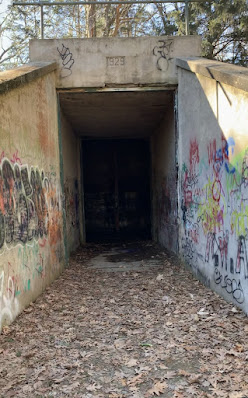
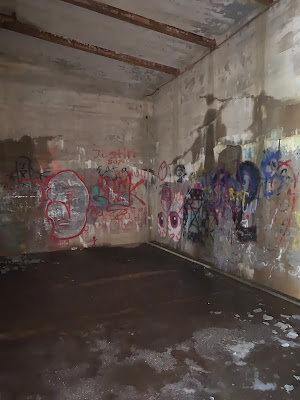
The second structure that may be the gates of hell is a little spookier. Buried in the side of a small hillside is some kind of large underground room that was built in 1929. Was it a garage, perhaps? A large storage bunker? I don't know, but it's big, dark, and filled with graffiti. A large doorway, perhaps 15 - 20' high, leads into the underground room from the outside. It's definitely impressive, and maybe a little creepy. It was really dark inside, and very slippery since the floor was covered in ice. Again, happily we did not see any ghosts. 

I'm not sure why either of these gates are the gates of Hell, instead of just being haunted gates. Do they lead to the underworld? Do demons come out at night? Or maybe the ghosts hang around before heading through the gates to the underworld? I just don't know. The legend is a little vague.

The legend about the gates of Hell seems to be pretty recent. The estate only became a park in 1985, so I'm guessing it only appeared since then. That's just speculation on my part. If you have any information about the history of this legend please share it. 

I have noticed that anomalous or weird structures often attract equally strange legends. A house that looks like its sinking into the earth? Maybe it's because of Satanic rituals. A large iron cage around a grave? It must be intended to imprison a restless ghost. A cemetery gate that looks like spiders? Surely the cemetery must be haunted. I'll note that the Spider Gates cemetery may also contain a gateway to hell, so there are several convenient paths to Hell if you live in Massachusetts.

You get the idea. There are rational explanations for all these things, just as there are rational explanations for the two gates in Maudslay. With the estate long gone, the formal gates and the giant underground chamber now seem a little weird, though. Their original purpose has been forgotten, so people make up new legends to explain why they're there. At least I hope that's what's happening. Otherwise, we've got two gates to Hell in one small park, and that's not good. 

October 23, 2022

The Spookiest States: Vermont and Maine Lead the Pack

People often ask me if New England is weirder or scarier than other parts of the country. I’ve been asked this by podcasters, other writers, and even personal friends. It would be easy for me to respond with a joke about scary Massachusetts drivers, our weird infatuation with Dunkin Donuts, or the frightening price of housing. But I generally avoid going for the easy laugh and try to answer the question sincerely.

Certainly, it seems that New England has a reputation in popular culture as a strange place. I usually mention that the world’s three most famous horror writers all came from New England. Edgar Allen Poe (1809 – 1849) was born in Boston, and although he left as a child he returned when he was 16 to work and enlisted in the army. He didn’t remain in Boston long, and although he thought the Bostonian literary establishment was uptight he still published his first book with the byline “a Bostonian.” 

The second writer is H.P. Lovecraft (1890 – 1937), who was born in Providence and spent most of his life there. Lovecraft incorporated lots of New England history and legends into his fiction. He definitely understood the weird appeal of the region’s moldering Puritan cemeteries, old coastal towns, and dark woods. Lastly, there is the legendary Stephen King (b. 1947), who was born in Maine and still lives there. Many of his novels, including classics like Salem’s Lot and Pet Sematary, are set in Maine.

I like to think there's something unique about New England which inspired these three influential writers. Certainly, New England has some strange history due to the Puritan colonists who came in the 1600s. They brought over their beliefs in witches, ghosts and the Devil, but not the more charming folklore like fairies. That definitely shaped our region's culture. And like most of the United States, our region has its history of violence, racism and genocide. Perhaps all these things, combined with a sometimes strange and dramatic landscape and our long dark winters, helped inspire Poe, Lovecraft, and King. (The author Faye Ringel explores these themes in her book 1995 book New England’s Gothic Literature.)

But does this really mean New England is weirder or scarier than other parts of the country? And how would you even go about measuring these things regionally? I wouldn't know how to even start, but someone has tried. Cycling Frog, a THC and CBD company in Seattle, compiled a ranked list of the scariest states in the country. Vermont ranked number one, Maine came in second, and Connecticut placed fifth. Not too bad for such a small part of the United States!

The other New England states are apparently not as spooky. New Hampshire was 14, Rhode Island 19, and Massachusetts was way down the list at 35. I feel ashamed as a Massachusetts native that we ranked so low. Massholes, we need to try harder to be spooky.

Upon reading this list two questions came to my mind. How did they rank the states, and why did a CBD/THC company do this? Sadly, I can only answer the first one. Cycling Frog looked at how many of the following each state had:

1. Serial killers (from murderpedia.org)

2. Haunted locations (from frightfind.com)

3. UFO sightings (from National UFO Reporting Center)

4. Ghosts (from ghostsofamerica.com)

5. Top 100 horror films set there (from IMDb.com)

To measure equitably across states, they wanted to show how many of each phenomena the states have per 100,000 people. For example, Texas had the most number of serial killers with 890 (!), but it has a very large population. This means that Delaware, which has a much smaller population, actually has the highest number of serial killers per person, with 41 serial killers per 100,000 inhabitants. According to Cycling Frog, this makes Delaware the most murderous state. (Note: Massholes, we do NOT need to try harder at being serial killers.)

Vermont was ranked the scariest because it had the highest number of UFO sightings and haunted places per person, and also had a high number of ghost sightings as well. That's pretty impressive, which is why they think Vermont is the scariest state. But is it? When I think of Vermont, I tend to think of Ben and Jerry's Ice Cream, rolling green hills, and peaceful hippies. Maybe all that peace and love is just a cover for the true horrors of Vermont. 

Let's face it, I don't think this survey is statistically valid, but it is fun to think about as we approach Halloween. Apparently if you live in Vermont, Maine or Connecticut you're ensured a spooky Halloween. The rest of us may just have to console ourselves by eating extra candy corn and Twix. 

September 11, 2022

Ghosts and Graffiti at Fort Revere

Over Labor Day weekend Tony and I drove down to Hull, Massachusetts. Hull is of course a popular destination in the summer because of Nantasket Beach, but we had a different destination in mind. We wanted to visit a haunted fort. 

Fort Revere sits on top of Telegraph Hill, a promontory that looks out over the town and Boston Harbor. The views are amazing, and I can understand why someone would build a fort there. You definitely would be able to see any ships approaching Hull, as well as a view of the one road leading into town.

Hull was first colonized by the English in 1622, and they considered fortifying the hill as early as 1633. It wasn't until the American Revolution, though, that anyone actually built anything there. In 1775, General Joseph Palmer constructed the first fort and named it Fort Independence. After the war that name was given to the fort on Castle Island in Boston, and the Hull fort was demolished and buried. 


The current fort on Telegraph Hill was constructed from 1898 - 1906. Named Fort Revere, it housed troops during the Spanish-American war and was armed with multiple cannons. In 1948 the US Government finally decommissioned the fort and gave it to the Commonwealth of Massachusetts. It is now a public park. 

Where are the ghosts in all this history? Well, according to local legends, the fort is haunted by the spirits of 200 French soldiers who died of smallpox in 1778. The soldiers had been captured by the British while fighting in Nova Scotia, but had been freed in a prisoner exchange. They were sent to the fort in Hull, where French marines were garrisoned. Unfortunately, most of the freed prisoners died from smallpox. Their countrymen buried them somewhere on the hill's slopes. Local archaeologists tried to find their grave in 1976 but were unable to locate it. 


The smallpox victims were real, but are the ghosts? Tony and I didn't encounter anything odd, but we went during the daytime and didn't try to engage with any restless spirits. I'm not that brave! Maybe if we had we would have experienced some of the strange phenomena said to occur. People say unseen entities will throw a rock back to you if you throw it down one of Fort Revere's many dark tunnels. They also say shadowy shapes can be seen flitting by doorways and whispers are heard in empty rooms.

As my friend Sam Baltrusis notes in his book Haunted Boston Harbor, paranormal investigators have recorded strange EVPs (electronic voice phenomena) in the fort. Anne Kerrigan and Michael Markowicz, of the group East Bridgewater's Most Haunted, investigated the site in 2007. Markowicz recored an EVP that sounded like a choir singing, which is pretty freaky. They also captured voices saying, "What do you want with us, Michael?" and "Watch us, watch you." That's even freakier.


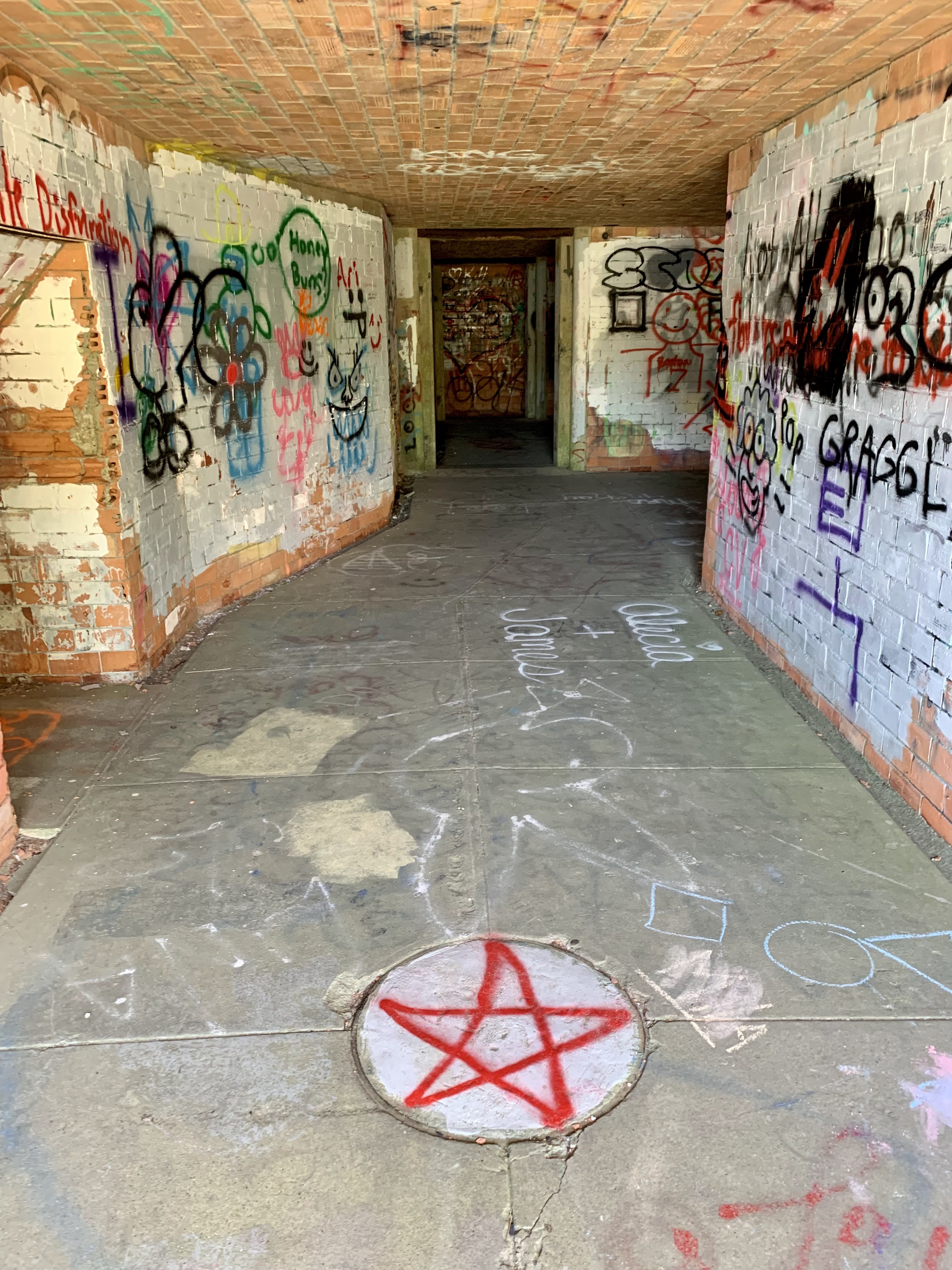
Happily, they didn't encounter any malevolent energy at the fort. Tony and I didn't either, although we did encounter a lot of graffiti. A lot!  Some of it is over 20 years old, so I don't think anyone has been cleaning the inside of the fort. The outside is almost spotless though (and has amazing views).

We had a good time exploring the fort. If you want to visit someplace historic, scenic, and possibly haunted, I'd recommend Fort Revere.