Showing posts with label Connecticut. Show all posts

July 26, 2026

Celebrating America's Birthday with a Sasquatch Sighting

It was America's 250th birthday this past July 4th - how did you celebrate? I visited friends and ate pizza they made in their outdoor pizza oven. So delicious! I know lots of people who went to barbecues, to the beach, and, of course, to watch fireworks. 

There are many fun ways to celebrate Independence Day, but no matter how you hard you celebrated, I think a Rhode Island man has us all beat: he saw Bigfoot on the Fourth of July.  

An exhibit at the International Cryptozoology Museum 

Okay, technically it was 1:44 am on July 5th, but I think that still counts as Independence Day. Kevin Klimas was driving home after visiting a friend at Beach Pond in Voluntown, Connecticut. It was late at night and the road was illuminated only by his car's headlights. As he approached an intersection, he saw something emerge from the woods:

"I had to hit my brakes to avoid a collision with this thing. Upon doing so I witnessed a bipedal,8-8½ foot tall creature swiftly crossing the road. It had coarse, matted, and greasy looking long brown hair covering every part of its body I could see. Its legs were shorter than its torso and its arms literally hung down to right around knee height. Must have had an 8 - 9ft "wing span" if it fully outstretched its arms. Extremely broad in the shoulders (4+feet easy) Thick with what I can only assume is muscle, and moving like on a mission. It never stopped nor did it turn to look at me. I was only able to see a side profile of its head and face. 


The top of its head seemed to cone up slightly and it had a jawline any pugilist would kill for. Minimal hair on its face. It stepped onto the road, took another step, then a third step which put it back into the woods on the opposite side of the road. Walked more like a human than any other animal. I was (and remain) dumbstruck. Took me a minimum of 60-90 seconds to regain control of my faculties and get my car moving again"(from the Bigfoot Field Researchers Organization (BFRO) website).

You can also see Kevin Klimas talk about the sighting in this YouTube video. You may be skeptical about Bigfoot, but Klimas certainly seems sincere about whatever he saw on that Connecticut road. 

The BFRO investigators assigned to this case commented that the area has a history of Bigfoot sightings. Like much of New England, it's very woodsy, providing lots of cover where something large and hairy could lurk. The organization even hosted an expedition in the area a few years ago, but sadly didn't find anything.

An exhibit at the International Cryptozoology Museum

One of the investigators also hypothesized that the Bigfoot seen by Klimas may have been attracted by the sound of fireworks. He notes that there have been a few cases from other parts of the country where people shooting off fireworks in the woods have wound up attracting a Bigfoot. 

Why would this be? The investigator thinks Bigoot may misidentify the sound of fireworks as gun shots: 

"It may sound like hunters shooting. During deer season the sound of gunfire will sometimes indicate where a deer has been shot and eventually gutted. It is the gut piles (and particularly the liver) that a sasquatch want from a killed deer" (from the Bigfoot Field Researchers Organization (BFRO) website). 

I hadn't heard that Bigfoot likes liver to eat before, but apparently that's one theory drifting around the internet. Since no one has ever captured a Bigfoot, I'm not going to speculate about what they may or may not eat. Instead, I'll suggest that maybe Bigfoot was attracted to the fireworks because he wanted to celebrate the Fourth of July? He is, after all, the quintessentially American. Nothing says "U!S!A!" more than a giant, hairy hominid. 

Sadly, I didn't get to see any Bigfoots during the holiday, but we did see lots of Bigfoot memorabilia the following weekend at the International Cryptozoology Museum. The museum has relocated from its old home in Portland to a new, much larger building at 490 Broadway in Bangor, Maine. 


Exhibits at the International Cryptozoology Museum

I was excited to participate in the grand opening celebration, and was even more excited to look at all the exhibits. Plaster casts of footprints, creepy mermaids, and a replica of Mothman were just a few of the weird and wonderful things at the museum. There was even a taxidermied coyote with three heads, which reminded me of Cerberus, the dog who guards the underworld, but New England-style. I highly recommend visiting if you like cryptids or just want to spend some time at a really unique museum.

I hope you enjoy these last few weeks of summer!

February 29, 2024

Cotton Mather and the Connecticut Triton

Many of you are probably familiar with Cotton Mather, the 17th century Puritan minister. Mather was born in Boston in 1663, and was the son of Increase Mather, the city’s leading minister. Cotton attended Harvard, entering at age eleven and a half, making him the youngest person to attend the university. (Thanks for that tidbit, Wikipedia!) Clearly, he was a smart person. After graduating, he followed in his father’s footsteps and became a minister, serving with him as co-pastor of Boston’s most prominent church. 

During the 1692 Salem witch trials, the colony’s political leaders asked Cotton Mather for his opinion on witchcraft. They wanted some guidance on what types of evidence were acceptable, and to know if witchcraft was even real. Mather replied that witchcraft was indeed real, and that execution was an appropriate punishment for the most dangerous witches. He did tell the judges to proceed with caution and be careful with the types of evidence they accepted, but he otherwise said the Salem trials were valid. He maintained this position even after most other people in Massachusetts realized no witches were being executed, just innocent people. 

Ultimately, nineteen people were executed during the Salem trials, one man was crushed to death during questioning, and several people died in jail. Some, or maybe many, of those deaths might have been avoided if Cotton Mather had given the magistrates a different opinion.

Cotton Mather was twenty-nine in 1692. I had a lot to learn about life when I was twenty-nine, and it's pretty obvious that Cotton Mather did too. Luckily, no one was asking me to make life-or-death decisions, or maybe I would have screwed up like he did. Mather's misjudgment about the Salem trials tainted his reputation for the rest of his life. He expected to become president of Harvard, like his father was, but that didn't happen. A shadow hung over him until he died, and still hangs over our memory of him today. 

Despite Mather’s superstitious and ignorant beliefs about witches, he was also one of the best-educated people in Massachusetts and was very interested in science. In 1721, he even helped to start an inoculation campaign in Boston against smallpox, one of the first in the Western world. Most of Boston's physicians violently opposed the campaign, but it turned out to be a resounding success. It's odd to think of Mather as the voice of scientific reason, but in that situation he was.

Mather also wrote dozens of letters to the Royal Society, England’s national academy of sciences, describing interesting phenomena in New England. Some of his letters discussed topics that today we might think of as appropriately scientific, like local New England wildlife (snakes, muskrats, moose), people suffering from unusual medical conditions, and earthquakes. Other letters covered somewhat stranger topics, such as prophetic dreams, ghosts, and a calf born with a human face. The boundaries between science, religion, and magic were poorly delineated at the time, and Cotton Mather was not alone in mixing these topics together. 


One letter, which he wrote in July of 1716, describes a triton, or what we might call a merman. In the letter, Mather writes that he doubted the existence of merfolks until learning about three men who had seen a triton off the coast of Connecticut. On February 22, 1716, the men had been sailing from Milford to Branford when they saw a “creature that seemed a man, lying on the top of a rock” close to the Branford shore. 

“… his head, and face, and neck, and shoulders, and arms, and elbows, and breast and back, all of a human shape, only his arms were little more than half the length of a man’s. He wanted not for hair, which was of a grayish color. However – desinit in piscem (Latin – “it ends in a fish”); his lower parts were those of a fish, and colored like a mackerel. His tail was forked, and he had two fins about a half foot above the tail. The whole animal was about five or six feet in length.” 

That's a very vivid and specific description. Was this a hoax played on Cotton Mather, or did the men actually see something strange on that rock? Or maybe they misidentified a large seal or some other creature? My mind tries to find a rational explanation, but here in the 21st century we're more skeptical about the existence of mermen and mermaids. People were still learning how the physical world worked back in the 17th century and were more willing to believe strange, half-human creatures lurked in the ocean.

It’s interesting that Cotton Mather considered the triton an animal, rather than a mythical being, a monster, or some kind of sea-demon. I suppose he was trying to be scientific, and not superstitious. I’m sure he would have liked to study the triton, but he did not get the opportunity. The men who saw the triton attempted to capture it, but it jumped off the rock and quickly swam away. 

The truth about the Connecticut triton will never be known. Was there a scientific explanation, or a supernatural one? It's fun to speculate there might supernatural creatures like tritons. That type of speculation is less fun when those "supernatural" creatures are innocent people being accused of witchcraft. 

October 23, 2022

The Spookiest States: Vermont and Maine Lead the Pack

People often ask me if New England is weirder or scarier than other parts of the country. I’ve been asked this by podcasters, other writers, and even personal friends. It would be easy for me to respond with a joke about scary Massachusetts drivers, our weird infatuation with Dunkin Donuts, or the frightening price of housing. But I generally avoid going for the easy laugh and try to answer the question sincerely.

Certainly, it seems that New England has a reputation in popular culture as a strange place. I usually mention that the world’s three most famous horror writers all came from New England. Edgar Allen Poe (1809 – 1849) was born in Boston, and although he left as a child he returned when he was 16 to work and enlisted in the army. He didn’t remain in Boston long, and although he thought the Bostonian literary establishment was uptight he still published his first book with the byline “a Bostonian.” 

The second writer is H.P. Lovecraft (1890 – 1937), who was born in Providence and spent most of his life there. Lovecraft incorporated lots of New England history and legends into his fiction. He definitely understood the weird appeal of the region’s moldering Puritan cemeteries, old coastal towns, and dark woods. Lastly, there is the legendary Stephen King (b. 1947), who was born in Maine and still lives there. Many of his novels, including classics like Salem’s Lot and Pet Sematary, are set in Maine.

I like to think there's something unique about New England which inspired these three influential writers. Certainly, New England has some strange history due to the Puritan colonists who came in the 1600s. They brought over their beliefs in witches, ghosts and the Devil, but not the more charming folklore like fairies. That definitely shaped our region's culture. And like most of the United States, our region has its history of violence, racism and genocide. Perhaps all these things, combined with a sometimes strange and dramatic landscape and our long dark winters, helped inspire Poe, Lovecraft, and King. (The author Faye Ringel explores these themes in her book 1995 book New England’s Gothic Literature.)

But does this really mean New England is weirder or scarier than other parts of the country? And how would you even go about measuring these things regionally? I wouldn't know how to even start, but someone has tried. Cycling Frog, a THC and CBD company in Seattle, compiled a ranked list of the scariest states in the country. Vermont ranked number one, Maine came in second, and Connecticut placed fifth. Not too bad for such a small part of the United States!

The other New England states are apparently not as spooky. New Hampshire was 14, Rhode Island 19, and Massachusetts was way down the list at 35. I feel ashamed as a Massachusetts native that we ranked so low. Massholes, we need to try harder to be spooky.

Upon reading this list two questions came to my mind. How did they rank the states, and why did a CBD/THC company do this? Sadly, I can only answer the first one. Cycling Frog looked at how many of the following each state had:

1. Serial killers (from murderpedia.org)

2. Haunted locations (from frightfind.com)

3. UFO sightings (from National UFO Reporting Center)

4. Ghosts (from ghostsofamerica.com)

5. Top 100 horror films set there (from IMDb.com)

To measure equitably across states, they wanted to show how many of each phenomena the states have per 100,000 people. For example, Texas had the most number of serial killers with 890 (!), but it has a very large population. This means that Delaware, which has a much smaller population, actually has the highest number of serial killers per person, with 41 serial killers per 100,000 inhabitants. According to Cycling Frog, this makes Delaware the most murderous state. (Note: Massholes, we do NOT need to try harder at being serial killers.)

Vermont was ranked the scariest because it had the highest number of UFO sightings and haunted places per person, and also had a high number of ghost sightings as well. That's pretty impressive, which is why they think Vermont is the scariest state. But is it? When I think of Vermont, I tend to think of Ben and Jerry's Ice Cream, rolling green hills, and peaceful hippies. Maybe all that peace and love is just a cover for the true horrors of Vermont. 

Let's face it, I don't think this survey is statistically valid, but it is fun to think about as we approach Halloween. Apparently if you live in Vermont, Maine or Connecticut you're ensured a spooky Halloween. The rest of us may just have to console ourselves by eating extra candy corn and Twix. 

September 21, 2022

Rufus Goodrich's Funeral: A Devilish Deal Gone Bad

As I watched the enormous number of mourners at Queen Elizabeth's recent funeral, I found myself wondering how many people will attend mine. I hoped that I would get a big turnout. 

It's kind of a morbid thought but I think it's a common one. And as I had this thought, I was reminded of a weird and grim little tale about a man named Rufus Goodrich. It appears in Catharine Melinda North's 1916 book History of Berlin Connecticut and it will make you think twice about wishing for a big funeral. 

*****

Many years ago, people used to gather at the cider mill in Berlin, Connecticut to enjoy hard cider and good gossip. One day a man named Rufus Goodrich, who lived in nearby Rocky Hill, came into the mill and ordered some cider. He had a big smile on his face and seemed almost giddy with excitement. 

Someone said, "Why so happy Rufus?"

Rufus took a sip from his cider and explained he had just sold his soul to the Devil. Everyone in the cider mill fell silent. 

Rufus went on to say that the Devil promised him he would be famous if he just signed away his soul. Rufus had asked the Devil exactly how famous he would be. 

The Devil replied, "Well, let's just say there will be thousands at your funeral. Thousands." This sounded pretty good to Rufus, so he sold his soul to the Devil. 

Once he finished telling his story, Rufus slammed down his now-empty cider mug and stood up. "See you folks later. I'm off to become famous," he said and strutted out the door. 

No one saw Rufus around Berlin or Rocky Hill for a few days after that. People thought maybe he had gone to Boston or New York to become famous. But they soon learned the terrible truth when a local farmer complained that huge swarms of flies kept buzzing in and out of his barn. And a horrible smell was coming from the back of the barn too...
A group of local men gathered their courage and made their way to the back of the barn. They had to cover their noses and mouths to keep out the flies and the stench. When they reached the back of the barn they found the body of Rufus Goodrich. It was covered with flies. 

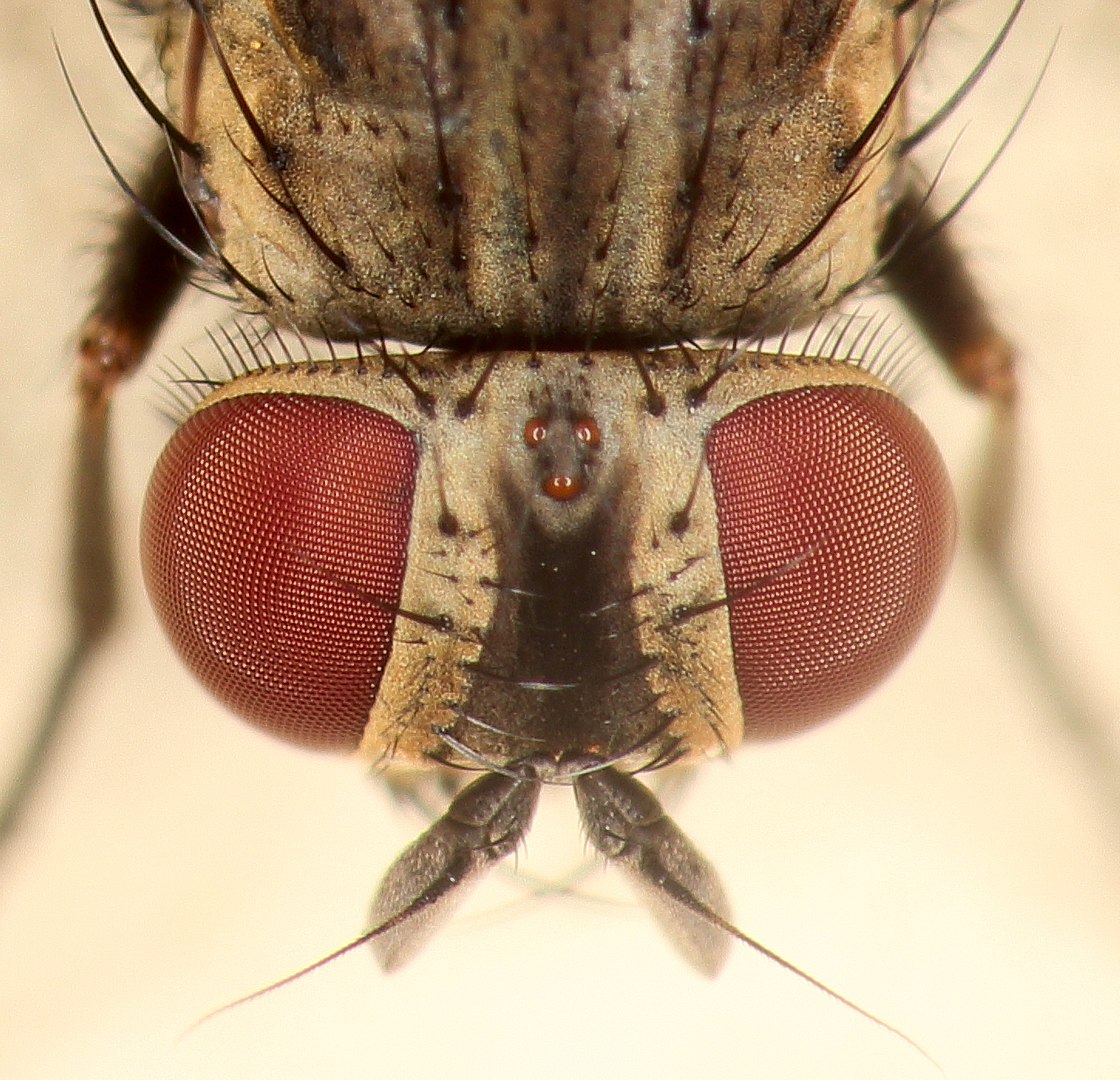
The men thought of the Devil's promise when they saw Rufus's corpse. There were thousands of flies crawling on him. Thousands. 

*****

I love these gruesome little New England folk stories. A lot of them are quite grim, but this is one of the grimmest. I haven't seen it anywhere except in North's book, and I wonder where she heard the story. I haven't been able to locate any records of a "Rufus Goodrich" but the Goodriches were a well-known Rocky Hill family, so perhaps it is based on an actual person. It might be quite old too. Earl Chapin May, in his book Century of Silver, 1847 - 1947, claims the story dates back to the 18th century.

To sum up: be careful what you wish for. 

December 05, 2021

Meeting the Devil on Christmas Day

Ho ho ho! It's December, and Christmas madness is once again upon us. We just decorated our tree, I've had my first glass of eggnog, and I made fruitcake yesterday. Bring on the holidays. 

Christmas is so widely celebrated in modern New England that you might not believe it was once viewed as a dangerous and possibly even Satanic holiday. But it's true! The following post (which I first published in 2017) explains more...

*****

In 1662, Rebecca Greensmith of Hartford, Connecticut was arrested and charged with witchcraft. She confessed to meeting the Devil, but she denied having signed a contract with him. Well, at least she hadn't signed one at the time of her arrest. Rebecca and the Devil were waiting for a special day to sign it: Christmas.

The Reverend John Whiting of Hartford wrote the following in a letter:
But that the devil told her, that at Christmas they would have a merry meeting, and then the covenant should be drawn and subscribed. ... Mr. Stone (being then in court) with much weight and earnestness laid forth the exceeding heinousness and hazard of that dreadful sin, and therewith solemnly took notice (upon the occasion given) of the devil's loving Christmas. (quoted in David Hall's Witch-Hunting in Seventeenth-Century New England.)
That sounds a little strange to modern readers. Why would the Devil love Christmas? Isn't it a holiday about hope, love and charity?

Merry Christmas?

Four-hundred years ago, Christmas was a very different holiday than it is today. It wasn't focused on family, gift-giving, and children. Instead, it was characterized by heavy drinking and public rituals that inverted the social order. Europe and its colonies were agricultural societies then, and food and alcohol were most plentiful during the late autumn and early winter. Crops had been harvested, herd animals slaughtered, and beer brewed. There was no more farm-work to be done.

In short, it was a great time to have a huge party. Wealthy people would feast themselves and their friends at home. People from the lower social classes, usually groups of young men, roamed around at night in disguise. The young men (called mummers) would usually target the homes of the wealthy, where they would perform a skit or song in return for food or beer. This is the origin of the wandering Christmas carolers so often portrayed in Christmas stories or movies. If they were denied entry or not given gifts for their performance, the mummers would retaliate with violence or by vandalizing property.


Some hints of this older-style Christmas can still be heard in the lyrics of Christmas carols. For example, "The  Gloucestershire Wassail" describes men threatening a butler to give them good strong beer and demanding entry to a wealthy person's home:
Come butler, come fill us a bowl of the best
Then we hope that your soul in heaven may rest
But if you do draw us a bowl of the small
Then down shall go butler, bowl and all. 
Be here any maids? I suppose here be some;
Sure they will not let young men stand on the cold stone!
Sing hey O, maids! come trole back the pin,
And the fairest maid in the house let us all in.
The lyrics of "We Wish You A Merry Christmas" describe something similar:
Oh, bring us a figgy pudding;
Oh, bring us a figgy pudding and a cup of good cheer
We won't go until we get some;
We won't go until we get some, so bring some out here
Christmas was raucous, drunken, socially disruptive, and occasionally violent. The Puritans valued order, sobriety, and hard work. They didn't want anything to do with Christmas.

During their brief tenure ruling old England the Puritans tried to suppress Christmas celebrations. The Puritans who colonized New England did the same. It was even illegal to celebrate Christmas in Massachusetts between 1659 and 1681. Anyone found doing so could be fined five shillings.

Puritan ministers in New England wrote sermons against Christmas. The Reverend Increase Mather wrote the following, equating Christmas with pagan deities and Satan:
The Feast of Christ's nativity is attended with such profaneness, as that it deserve the name of Saturn's Mass, or of Bacchus his Mass, or if you will, the Devil's Mass, rather than have the holy name of Christ put upon it. (A Testimony Against Several Prophane and Superstitious Customs, Now Practiced by Some in New-England, 1687).
Mather mentions Saturn for a very specific reason. The Bible doesn't provide a date for Christ's birth, and the early Christian church fathers decided to place it on December 25 to coincide with pagan Roman winter holidays like Saturnalia, which venerated the harvest god Saturn. This compromise between Christianity and paganism was another argument the Puritans used for hating Christmas. 

So there you have it. That's why the Puritans thought the Devil loved Christmas. Their efforts to suppress Christmas were modestly successful. Christmas wasn't widely celebrated in New England until the mid-nineteenth century. Christmas is now the biggest holiday in the United States. The Puritans would have blamed Satan, but I think it's just because people like to have fun.

*****

My favorite source for information about Puritans and Christmas is Stephen Nissenbaums's fantastic book The Battle for Christmas. It's great for anyone who wants to really understand the weird history of Christmas in America.

If you want to read more about witches, check out my new book Witches and Warlocks of Massachusetts, which is available wherever you buy books online.


June 06, 2021

The Devil Made Me Do It: Is The New Conjuring Film True?

I'm a big horror movie fan, and enjoyed the first two Conjuring films, The Conjuring (2103) and The Conjuring 2 (2016). Both films are based on supposedly true cases examined by Ed and Lorraine Warren, Connecticut paranormal investigators. Played by Patrick Wilson and Vera Farmiga, in these films the Warrens are portrayed as clean-cut, devout Catholics who are deeply in love with each other. I think their relationship is one of the reasons the Conjuring movies stand out in the crowded horror field. Ed and Lorraine are so wholesome it's almost comical at times. 

The real-life Warrens are now deceased, and a 2017 article in The Hollywood Reporter suggests they may not have been as wholesome as their film counterparts. According to the Reporter, Ed Warren initiated a relationship with a 15-year old girl when he was in his 30s and married to Lorraine. The girl eventually moved in with the Warrens and lived with them for forty years. At one point, the girl became pregnant with Ed's child and Lorraine arranged for her to have an abortion, something clearly at odds with the Warrens' public image as strict Catholics. 

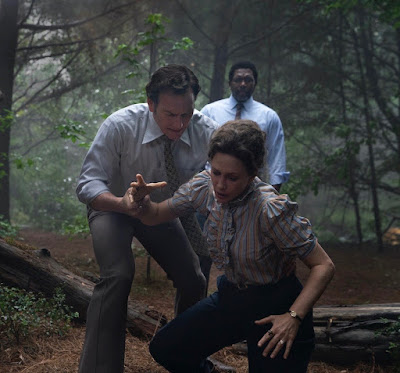
A scene from The Conjuring: The Devil Made Me Do It.

So what does it mean when a movie like The Conjuring says it's "Based on a true story?" Very little, I think. It's marketing, and not a legally defensible claim. Take it with a big grain of salt. You certainly won't see Ed Warren having sex with teenage girls in the Conjuring movies, or his wife arranging for an abortion. And I think that's OK, as long as you realize the movies are basically fiction.

The newest Conjuring movie has just been released: The Conjuring: The Devil Made Me Do It. It's a great title, and once again it's supposedly based on a true case investigated by the Warrens. 

Here are the facts of the case. On February 16, 1981, nineteen-year old Arne Cheyenne Johnson of Brookfield, Connecticut, stabbed his landlord, Alan Bono, several times in the chest with a knife. Johnson's fiancee, Debbie Glatzel, watched as it happened and later testified that Johnson growled like an animal as he did it. 

Johnson was arrested and charged with murder. When asked why he killed Bono, Johnson said, "The Devil made me do it." He claimed he was possessed by a demon. 

The Conjuring: The Devil Made Me Do It

It had started the previous summer. On July 3, 1980, Debbie Glatzel's brother, 11-year old David, woke up in a panic. He said he had seen a demon in his sleep, "a man with big black eyes, a thin face with animal features and jagged teeth, pointed ears, horns and hoofs." David continued to see the demon throughout the summer, and a house-blessing by the a local priest did nothing to stop his visions. David sometimes even saw the demon in the daytime, when it appeared as an old man wearing a flannel shirt and jeans. According to People magazine:

In desperation, the Glatzels called on a couple from nearby Monroe, Conn. who are self-styled “demonologists.” Ed and Lorraine Warren, both 54, were professional artists until 1968, when they decided to pursue what was until then an avocation, the occult. Though they accept no fees for conducting demonic investigations, they lecture indefatigably (at up to $1,000 per), and once hosted a weekly local TV show, Ghost Hunting With Ed and Lorraine Warren.

Lorraine, who also claims the gift of clairvoyancy, describes her first encounter with David Glatzel: “While Ed interviewed the boy, I saw a black, misty form next to him, which told me we were dealing with something of a negative nature. Soon the child was complaining that invisible hands were choking him—and there were red marks on him. He said that he had the feeling of being hit.” ("In a Connecticut Murder Trial, Will (Demonic) Possession Prove Nine-Tenths of the Law?", People, October 26, 1981)

The Warrens believed there were 43 demons inside David, and coordinated several exorcisms. They had little effect. At one point, in desperation, Arne Cheyenne Johnson taunted the demons to enter his body instead. Again, it had little effect. David was eventually sent to a private school for "disturbed children."

Johnson seemed changed, though. After his taunt during the exorcism, he too claimed to see the demon that David had seen, and Debbie later testified he fell into trances in the months leading up to Bono's murder. 

On February 16, Johnson and Debbie Glatzel were taken to lunch by Alan Bono, who was Debbie's boss at a kennel and was also their landlord. Johnson's sister Wanda and Glatzel's nine-year old cousin Mary joined them. Bono supposedly drank heavily during lunch, and later that day became agitated and grabbed Mary. Johnson argued with Bono, and stabbed him several times in the chest and stomach. Johnson then walked into the woods, where he was found by the police. It was the first murder in Brookfield's 193-year history. Johnson was convicted of first-degree manslaughter and served five years of a 10 - 20 year prison sentence. 

After the trial ended, an author named Gerald Brittle published a book about the case, The Devil in Connecticut, which was written with help from Lorraine Warren. When the book was republished in 2006, Brittle was sued by David Glatzel and his brother Carl for misrepresenting them in the book. Carl also claimed his brother's possession had been a hoax created by the Warrens to take advantage of David's mental illness. Arne Cheyenne Johnson and Debbie Glatzel, who were by this point married, stood by the Warrens and author Brittle, claiming they accurately presented the situation. 

The Conjuring: The Devil Made Me Do It

So there you go. Were David Glatzel and Arne Cheyenne Johnson really possessed by demons, or were the Warrens taking advantage of a mentally ill boy? I can't say, but it's interesting that David, the subject of the Warrens' exorcisms, now claims he was not possessed. 

The judge in Johnson's trial didn't accept his claim of demonic possession. As we all learned from the 1692 Salem witch trials, it's impossible to prove the Devil's existence in court.

'Demon' defense rejected in Conn. murder trial.

Danbury, Conn. - A Superior Court judge yesterday refused to allow a much-publicized "demon defense" to be used in the murder trial of a Connecticut man. 

The defense strategy was to try to prove that Arne Cheyenne Johnson was possessed by demons when he allegedly stabbed a neighbor to death eight months ago. 

The jury process had just begun when Judge Robert Callahan said the defense that attorney Martin Minnella planned was "irrelevant and I am not going allow it, period." (Boston Globe, October 29, 1981)

I haven't seen The Conjuring: The Devil Made Me Do It yet, but have seen the trailer. It shows Arne Cheyenne Johnson walking down the road covered in blood, Lorraine Warren being dragged off a cliff by a monstrous arm, a little boy getting pulled into a waterbed, and Lorraine Warren saying, "It's a witch's totem. We think your family was cursed, and that connection is still open." 

It looks like a great horror movie, but is it a true story? Probably not. Horror movies require literal monsters, but the real situation in Brookfield seems complicated and nuanced. 

February 21, 2021

Bigfoot Stole My Laundry: High Strangeness in Connecticut

Here's an interesting and very brief story that appears in Phillip Imbrogno's 2010 book Files from the Edge: A Paranormal Investigator's Explorations into High Strangeness. Imbrogno writes:

Although most Bigfoot sightings come from credible sources, some seem really questionable. For example, in 1992 I received a call from a Connecticut woman who said that a black helicopter landed in her yard and a Bigfoot jumped out, messed up the yard, and stole her clothes hanging on the line too dry. The creature then quickly climbed back into the helicopter and took off. As strange as it sounds, I've heard even weirder reports. Such tales are not this book's focus, but they do exist!

First of all, I have to say this story is amazing. I love the idea of Bigfoot jumping out of a mysterious black helicopter just to act like a bad teenager, messing up someone's yard and stealing their laundry. Amazing! Was Bigfoot piloting the helicopter, or was someone else? Maybe there were two Bigfoots on board, one acting as pilot and one as laundry thief. I want more details.

Getty Images.


I'm not really familiar with Phillip Imbrogno, but some people in the paranormal community claim he has faked his academic credentials. You can look up the details online if you're curious. You may want to take his writings with a grain of salt, and even he says the story about Bigfoot and the helicopter is pretty questionable. 

There is a certain "mix and match" aspect to some contemporary paranormal stories that make them seem even stranger than they normally would. A Bigfoot or UFO story is anomalous by its very nature, but some of these stories are strange hybrids of multiple paranormal ideas. For example, last week's story about ZoZo was "reptoid entity + Ouija board = demon," or possibly "reptoid entity + Ouija board = alien being," depending on when it was told. 

This week's story is the same. Black helicopters have been a feature of UFO and paranormal accounts for decades, and they are often implied to be part of some unnamed government conspiracy. And of course, Bigfoot has been a staple of paranormal stories for decades. When they're mashed together they provide surprisingly entertaining results: "Bigfoot + black helicopter = missing laundry." 

I like old folklore as well as new paranormal stories, but the older folklore was much more standardized. For example, classic witch tales from across New England were all pretty similar, reflecting the shared belief system of our cultural ancestors. Ghost stories were pretty much the same as well. People are much more creative now with their stories of strange encounters. I think there's just a wider range of beliefs these days. Some people think Bigfoot is a reclusive animal, some think he's an alien, others that he's from another dimension. Apparently someone thinks he flies around in a black helicopter pulling pranks. There's a lot of variety. 

A cynic might say this is all caused by capitalism and our ever-expanding range of media outlets. Readers and viewers crave novelty, so authors and TV producers always need to find new stories to tell (and sell). People online need to post weirder and wilder stories in order to get views and likes. You saw a UFO last night or a mysterious large footprint in the snow? Old news! Tell me about black-eyed children who came out of a UFO after you bought a haunted house. Then maybe I'll read your post. Maybe. 

That's the skeptical perspective. On the other hand, humans have been experiencing strange phenomena for thousands of years, and probably will for thousands more. These experiences have always been filtered through our cultural perspectives. The ancient Greeks saw nymphs and satyrs, the Puritans saw witches and ghosts, people in the late 20th century saw UFOs and Bigfoot. As we move into the 21st century American culture is comprised of more viewpoints, and more diverse viewpoints, than ever before. We just have a larger set of cultural filters than people had in the past, so let's enjoy the weirdness that results. And of course, keep an eye on your laundry.

January 13, 2021

Let's Scare Jessica to Death: Folk Horror in 1970s Connecticut

It's a classic urbanite fantasy. You'll escape all the stresses of big city life by moving to the country, where you'll live in a big farmhouse, grow crops, and make your own strawberry preserves. Maybe you'll raise some goats and sell artisanal cheese. Your life will be like a never-ending Martha Stewart photo shoot.

It's definitely something I've fantasized about, but I realize I'm probably not suited for country life. I haven't lived less than a ten-minute walk from a subway stop in the last thirty years - how am I going to shear sheep? And who knows what lurks out there in the countryside? After all, that same escapist fantasy is also the premise of many horror films. 

Last night we watched one of those films. Let's Scare Jessica to Death (1971) tells the story of Jessica (Zohra Lampert) and Duncan (Barton Heyman), a married couple who move from New York City to rural Connecticut. Jessica is recovering from some type of nervous breakdown, and Duncan thinks quiet country living will help the recovery process. Their friend Woody (Kevin O'Connor) comes with them to help manage the apple orchard at the old farm they've bought. 


Their move to Connecticut isn't quite the idyll they hoped for. On their way to the farm the trio stops at a historic cemetery for some sightseeing and Jessica sees a feral-looking woman in a white gown. In their new hometown they encounter a group of surly and disapproving old men, all strangely bandaged and wounded, at the general store. And at their farmhouse they discover an attractive bohemian young squatter named Emily (Mariclare Costello) who disrupts the group's equilibrium.

I first saw Let's Scare Jessica to Death on TV when I was a kid, and rewatched because I'm in the mood for some New England atmosphere. The movie was actually filmed on location in Connecticut in the autumn of 1970 and it makes the most of the setting. There are shots of an old 19th century farmhouse shrouded in fog - real fog, not smoke machine fog. Jessica traipses through a field of blooming goldenrod and an orchard whose trees are covered in red apples. When someone drives down the road I saw a maple tree that had just lost all its leaves in the background. The characters visit an antique store in a barn, a common sight across the area.

Seeing these scenes is like comfort food for me, particularly now, but it's a horror movie, not a video promoting tourism. The antiques dealer tells them the house they bought might be haunted. A young woman named Abigail Bishop drowned on the property, he says, but her body was never found. Local folks say she now roams the countryside as a vampire, eternally frustrated because she never got to marry and wear her wedding gown. Needless to say, the legend of Abigail Bishop doesn't sit too well with the still fragile Jessica.

Image from this excellent review. 

Abigail Bishop's vampiric ghost is at the heart of Let's Scare Jessica to Death and is open to many interpretations. Maybe she's just a figment of Jessica's imagination, something the movie hints at repeatedly. Abigail might also be symbolic of the characters' unspoken sexual needs and fears, particularly as they explore the new social norms of the late 1960s.

The movie was made when America's hippie counterculture was still strong, and although the main characters are too old to be true hippies they are clearly toying with the hippie lifestyle. Instead of a traditional car they drive an old hearse with a peace sign painted on the door, and their move "back-to-nature" is straight from the 1960s counterculture playbook. Abigail's ghost is the dark side of that counterculture, the footloose Manson girl who'll party with you and then quite literally drink your blood. 

Image from this great review.

She might also represent the spirit of the land itself, a grim genius loci who doesn't really approve of outsiders. Abigail Bishop is rooted in the town's history, in its lakes and coves, its orchards and old cemeteries. Her ghost is often shown in beautiful natural settings. The local old-timers have learned to live in harmony with their town's rapacious spirit, but the newcomers find out there's more to country life than sing-a-longs and antiquing. 

There really were cases of alleged vampirism in Connecticut. Folklorist Michael Bell discusses three of them in his excellent book Food for the Dead: On the Trail of New England's Vampires (2001). They weren't the seductive sexual predators we see in movies, but rather were victims of tuberculosis who died. When their relatives also became sick they thought the recently deceased person was feeding on them after death. The only way to stop the "vampire" from feeding was to unearth the corpse and burn its heart. It sounds unbelievable, but Bell has evidence that the practice continued up until the 1890s. This type of vampirism is very different from what's portrayed in Let's Scare Jessica to Death but it serves as a reminder that beautiful rural landscapes often have unpleasant histories. 

Venture Smith's gravestone rubbing. Screen cap from here. 

The movie alludes directly to one of those histories early on, when Jessica visits a cemetery to make some gravestone rubbings. The scene was filmed in East Haddam's First Church Cemetery, and Jessica makes a rubbing from a real gravestone, that of Venture Smith, a former slave who died in 1805. In 1798, Smith wrote a narrative of his life and as you might imagine it is full of violence and abuse. In the movie, Jessica decorates the bedroom of their new home with graverubbings, and Venture Smith's is taped right above the bed she shares with her husband. To her Smith's life is a charming relic, an attitude showing she and her friends are unfortunately clueless about the real history of their new home. 

Let's Scare Jessica to Death has a minor cult following, and several people have tracked down the various locations where it was filmed. The farmhouse in Old Saybrook where many of the exterior scenes were shot is now a decaying ruin. The house was surrounded by wide open fields when the movie was made in 1970. Now, fifty years later, the woods have reclaimed the land and will probably reclaim the house soon too. 

The house today. From DreadCentral. 

Let's Scare Jessica to Death isn't a perfect movie, but it's an interesting one, and definitely worth watching if you want to experience some unsettling New England folk horror vibes.

August 18, 2020

Demonic Doll Escapes from Museum?


Everyone knows 2020 has been a bad year. 

First there was the COVID-19 pandemic, followed by the huge recession and staggering unemployment. There were ongoing murders of unarmed Black people by police. This July was the hottest July on record in Boston. It looks like the president is trying to cripple the Postal Service to impede voting. Eastern equine encephalitis is back again in Massachusetts. 

You get the picture. But to make things even worse, Annabelle the evil doll escaped from a museum and is running amok. 

Well, at least that was the rumor spreading on social media. First, for those who don't know, Annabelle is an allegedly possessed doll who first came to fame in The Conjuring (2013). That movie is partly based on a true story involving Ed and Lorraine Warren, two paranormal investigators from Connecticut. The Warrens, who are now both deceased, claim that in 1970 a nursing student in Hartford received a Raggedy Ann doll named Annabelle as a gift. 

The student and her roommate, also a nursing student, noticed lots of strange things happening in their apartment after Annabelle arrived. They became concerned when Annabelle began to move around on her own and consulted a psychic, who told them the doll was possessed by the spirit of a child who had died in their apartment. The dead child felt comfortable around the two young women, which was why it had inhabited the doll. 


The two women were compassionate and decided to keep Annabelle. Who can resist a lost child? They changed their minds, though, when Annabelle tried to choke one of their friends. Suspecting this was no ordinary ghost child, the women brought in the Warrens, who confirmed their suspicions. The doll was actually possessed by a demon masquerading as a dead child. Yikes.

The Warrens took Annabelle and placed her in a glass case in their occult museum in Monroe, Connecticut, where she has been confined ever since. Interest in Annabelle increased after The Conjuring, and a fictionalized version of the doll starred in three movies: Annabelle (2014), Annabelle: Creation (2017), and Annabelle Comes Home (2019). 

Movie Annabelle on left, real Annabelle on right.

On August 14, 2020, rumors started to spread on social media that Annabelle had escaped from her case in Monroe and was going to spread evil. This would be a serious matter if it were true, but it's not. According to Snopes.com, the rumor all began with an interview given by actress Annabelle Wallis, who appeared in two of the Annabelle movies. In that interview, Wallis talked about running and escaping from danger in 2017's The Mummy. International social media sites picked up the story, and through a series of misunderstandings "Annabelle Wallis, actress, discussed escaping in a movie" changed into "Annabelle, evil doll, has escaped." It makes perfect sense to me, and I can understand why the rumor spread. 2020 already seemed like the year that anything could happen.    

Happily, Tony Spera, the Warren's son-in-law, confirmed that Annabelle is still safely in her case. The Warren's Occult Museum was closed down several years ago by the town of Monroe due to zoning violations so sadly no one can see her. Like many of us, Annabelle is stuck in quarantine. 

This story appeared in many places: New York Magazine, Newsweek, People, etc. I'm a little surprised, but I guess a demonic doll makes for a nice change from all the other bad news we're dealing with right now. Let's hope the rest of the year just brings more bizarre paranormal rumors, or maybe even good news for a change.

July 24, 2019

Bigfoot, Poltergeists, and Witches: 300 Years of Weird Phenomena

A few weeks ago I posted about the states where you are most likely to see a UFO.  Maine, Vermont and New Hampshire were in the top ten, which makes sense because they are all rural states where you can get a good look at the night sky. After I posted that I wondered to myself, "I wonder if there are any statistics about Bigfoot sightings?"

Well, the Internet has answered my question. A recent article on Ok Whatever examines statistics from the Bigfoot Field Researchers Organization to determine what states have the highest (and lowest) cumulative number of hairy humanoid sightings.

A Bigfoot carving in Mocksville, North Carolina. 
Washington leads the way with a whopping 666 sightings. And yes, that is the Biblical number of the Beast so apparently the beast in question is Sasquatch. Washington is large and very woodsy which is supposedly the terrain that Bigfoot really likes. California, another large state which also has huge forests, comes in second with 441 reports. 

New England doesn't fare well in this list with Rhode Island and Vermont in the bottom five. Rhode Island is small and densely populated which might explain why there have only been five reported Bigfoot sightings. Vermont, however, is heavily forested and parts of it are quite rural so I would expect more than nine sightings.

The remaining New England states don't have high numbers of sightings either:

Connecticut: 17
Maine: 17
Massachusetts: 35
New Hampshire: 16

Despite low numbers some of the New England sightings are still pretty creepy. And quite familiar to anyone who's read a lot of paranormal accounts or folklore. Take this reported encounter, for example. On May 27, 2016 a married couple in Hancock, New Hampshire was awakened at 3:00 am by strange screaming sounds in the woods near their house. The screaming was followed by a knocking on the outside of their house and the sound of multiple things rustling through the trees and undergrowth. The husband went out on the back deck:
I felt like there were multiple sets of eyes on me. As I stood there I could hear breaking limbs, tree shaking and what sounded like a creature with serious power. My 12 gauge felt like nothing and I knew I better get back in the house. The noises carried on for a half hour.
After hearing something rush right up to him and grunt in the darkness he retreated inside. The noises eventually stopped. In the morning the couple saw broken tree branches and trampled plants near their home.

A camper in Western Massachusetts reported something similar: rocks were thrown at him one night in the fall of 2016.
I was camping in Massachusetts on top of October Mountain by a pond through the evening something was throwing small rocks at my tent I smelled it foul smell like dead fish. Rocks coming on the opposite side about 50 yards away I heard wood knocking I had no idea what it was until I heard some noises a growling sound and some yells this was going on for about 25 minutes then I shined a flashlight Into the Woods, I do not see anything but after that the noises went away the next morning. I woke up I found some broken limbs near where the sounds were coming from.
Although some people actually do report seeing large hairy humanoids many others just report these strange phenomena: knocking sounds, shrieks, rocks thrown by unseen hands, and damaged trees. Is all this really being caused by Bigfoot, who some people claim is just a large undiscovered apelike animal? It sounds like poltergeist phenomena to me. And it would have been familiar to the earliest English settlers of this region.


This type of weird phenomena has been reported in New England for hundreds of years. Here is testimony from John Russell in 1683 about the experiences of one Nicholas Disborough of Hartford, Connecticut:
This providence becomes amazing things: things being thrown at him and his boy, night and day in house and field: sometimes in open places where one might see a quarter of a mile about and no appearance of hand or person to throw them. The things were stones, dirt brickbats, cobs of Indian corn. 
People in New Hampshire and Massachusetts also reported similar occurrences during the 17th century as well. Here is William Morse's description of a strange assault on his house in Newbury, Massachusetts in 1679:
On last Thursday night my wife and I being in bed we heard a great noise about the house of knocking against the roof with sticks and stones throwing against the house with great violence; whereupon I arose myself and my wife and saw not anybody but was forced to return into the house again the stones being thrown so violently against us...
The Puritans interpreted these phenomena as witchcraft and trials often ensued. In fact, William Morses' own wife was eventually convicted of witchcraft. I think in most cases the phenomena can be explained away as pranks played by angry neighbors or relatives, but it's interesting that the same weird things are supposedly happening to people in the 21st century. The only thing that changes is the explanation.

The Puritan settlers understood these phenomena through their religious worldview. Weird sounds and rocks thrown by invisible assailants were caused by witches in league with the Devil. The witches needed to be arrested and punished to stop the phenomena. Three centuries later modern New Englanders understand them through a scientific worldview. Those weird knocking noises and thrown rocks are interpreted as the work of a large as-of-yet undiscovered hominid creature that lives in the woods. We just need to capture a Sasquatch and then we'll understand why they behave the way they do. The Sasquatch explanation is an improvement over the witchcraft one because at least no one is being arrested and executed. 

So which is it, witches or Sasquatch? I suspect it's actually neither. I don't have a good explanation myself, but I suspect in 300 years people will have a totally different interpretation for the same old tricks.

March 26, 2019

Weird New England News: Goat Elected Mayor, Haunted Supermarket, Vermont Pigman and UFOs.

There are lots of strange things happening around New England lately. To begin with, a town in Vermont recently elected a goat as mayor. The good citizens of Fair Haven (population 2,500) have chosen Lincoln, a three-year old female Nubian goat, as their new leader. I suppose there's some joke in there about politics going to the dogs (or the goats) but I'm unable to find it right now.

Her honor the mayor. Photo: Boston Globe.

Happily, Lincoln is only the honorary mayor and will not be making any major civic decisions. That's probably a good idea, since during her first day of office she defecated on the floor of Town Hall. Fair Haven is actually run by a board of selectman and a town manager, and it was the town manager's idea to elect an honorary mayor as a way to raise money for a new playground. Lincoln beat out several other candidates, including a hamster named Crystal, to win the job.

It all seems like good-natured fun, but The Boston Globe points out that sometimes these things can take a dark turn. For example, in the 1980s a goat named Clay Henry was elected mayor of Lajitas, Texas. Clay Henry became a tourist attraction for his ability to guzzle beer but was violently killed by his own son, Clay Henry Jr., during a fight over a female goat. Clay Henry Jr. took over as mayor and local beer-drinking beast. His son, Clay Henry III in turn became the town's third goat mayor but was castrated by a neighbor who became furious when he saw the goat drinking beer on Sunday, a day when liquor sales were illegal. The mayor survived the attack. Hopefully things stay more peaceful up in Fair Haven.

Meanwhile, shoppers have reported a ghost at a Market Basket in Wilmington, Massachusetts. Market Basket, a locally-owned supermarket chain beloved for its fresh produce and low prices, was founded by Greek immigrants Athanasios and Efrosini Demoulas in 1917. In recent years the chain has been at the center of multiple lawsuits by members of the Demoulas family fighting for ownership, and in 2014 thousands of employees protested to support the rights of Arthur T. Demoulas, who is now the current owner. The ghost is perhaps just the latest chapter in the ongoing saga.

Photo: CBS Boston.

People who have seen the ghost report that she appears as a young woman in Victorian garb.Why is a modern supermarket being haunted by a Victorian ghost? No one seems to know but at least one person said she had earlier seen the ghost in her home, which is located nearby. Perhaps the ghost just wants to see what's on sale? A spokesperson for Market Basket made the following comment:
“As far as we know all of our stores are ghost-free,” Justine Griffin said in a statement to the Globe. “But if there’s anything to it, she’s probably attracted to our Victorian-era prices.”
Apparitions may be haunting Market Basket, but UFOs are haunting the skies of Connecticut. The Connecticut Post notes that eleven UFOs have been reported in the state so far this year. A wide variety of phenomena were seen, ranging from classic saucer-shaped objects to those that were large and triangular. Several witnesses in different towns reported seeing strange green flashes in the sky on different days. Last year 100 UFOs were reported in Connecticut so perhaps sightings are slightly down this year? 

Image: Connecticut Post.

No one in Connecticut has reported any strange extraterrestrial humanoids yet. Perhaps this is a blessing, since personally I find ET sightings to be kind of spooky. If you do want to learn about a spooky humanoid, I can direct you to the New England Legends podcast. This week they are talking about the Pigman of Northfield, Vermont. They also give a shout out to this blog!

Image: YouTube.

The Pigman is one of my favorite New England cryptids. This swine-headed monster was first seen lurking outside a high school dance in the 1970s and gained notoriety in the 1990s through the books of Vermont writer Joseph Citro. Is he a missing teenager who went feral? The unholy offspring of a lonely farmer and a farm animal? A high school trickster who sold his soul to Satan on Halloween? Accounts of his origin vary, but people in Northfield agree that he still lurks in the woods outside of town. One of these days I hope to visit Northfield and visit the Pigman's stomping grounds. Here's hoping I don't find him. 

Special bonus: here's an image of the Pigman looking buff that I found on Pinterest. I guess the feral life is good for your physique? The covered bridge in the background adds the right New England touch. 
Image: Pinterest.
 

November 29, 2018

Wild Men Invaded Connecticut in 1888

Things always feel a little weird when the days grow short. The circle of civilization contracts and the wilderness encroaches with the growing darkness. Who knows what might be lurking out there in the gloom? Wild animals, criminals, ghosts... or maybe even wild men. We don't hear too much about wild men these days, but they were a popular topic in the 19th century press.

For example, the January 4, 1888 issue of The Boston Daily Globe, ran this shocking headline:

Lonely Regions Infested by Wild Men Who Terrorize All.

Connecticut Now Overrun with These Weird Creatures, Who Scare Children, Fight Men and Scream All Night. 

Cow Hill Forests and the Man with the Bearskin

Mr. Dunham's Midnight Fight by the Light of A Lantern

That's a really long headline, but I would say an effective one, since it certainly drew me in. Tell me more, Boston Daily Globe!

The article describes a variety of "wild men" who were causing trouble in Connecticut. For example, in Willimantic, a "well-dressed, wild-man who was about 40 years old" ran down the street screaming "Chloroform!" After several citizens tackled him he said his name was John Mullin, that he had deserted from the Italian Navy, and that government officials were pursuing him with the intent of chloroforming him. He ultimately escaped his captors, screaming "Chloroform!" as he ran off.

Someone dressed as Bigfoot during a 2015 snowstorm in Boston. Photo from the New York Times. 
Much creepier was the wild man who terrorized women in Spofford, Connecticut. This particular wild man, who was was "very tall, garbed in funereal black," would silently sneak up on women, grope them, and then disappear into the darkness. This wild man stopped his molestations after one of his victims, a Mrs. William Brown, emitted an ear-piercing shriek and collapsed onto the ground in terror.

One of the wild men was not a man at all, but was actually a young girl who leapt out of the bushes at some hunters in a swamp near Madison. She laughed hysterically at them and the hunters fled in fear.

The fourth wild man the Globe mentions seems like the wildest, and by wildest I mean least connected to civilization.
At Cow hill, near Mystic, there is a wild man of the woods. He wears a big black bearskin, and he looks hideous. His other clothes are not worth much. He says not a word, but he glares with a wild, determined stare. He advances on a man who approaches his lair in the forest of Cow hill, glares straight in the man's eyes once and then runs...
A man named George Dunham encountered this wild man while chopping wood and struck him on the head three times with his axe handle. The wild man ran off into the woods.

Meanwhile, outside of Norwich, a brawny man with a red face would appear in the woods at night. Carrying a lantern, he would shout "Murder!" and then dig a hole in the ground with a shovel. When confronted by a group of locals he disappeared into the dark forest.

A similar wild man haunted Monet's Valley on Rhode Island's Block Island that winter. He too would dig a hole late at night accompanied by a lantern, and when people went to investigate he would vanish with his light, leaving only a hole behind. Block Islanders were of mixed opinion about their wild man, with some thinking he was just a treasure hunter and others that he was a ghost from either the shipwrecked Palatine or Captain Kidd's pirate crew.

Wow! There's a lot to digest in that article, starting with the concept of the wild man. Although wild men appear frequently in 19th century American newspapers, the wild man is a cultural archetype who has been with us since the beginning of Western civilization. In the Sumerian Gilgamesh epic a hairy wild man named Enkidu dwells outside the city walls and frees prey from hunters' traps. Ancient Greeks and Romans thought the woods were filled with half-human satyrs and fauns, while art from Medieval Europe depicts hairy, club-carrying men lurking in the forests. When you leave the boundaries of civilization you enter the wild man's domain.

It's interesting to see how broadly this Globe article applies the term wild man. The bearskin clad man and the young girl seem the most archetypal, the first wearing an animal skin and the second scaring hunters from their prey. They also both seem to live outside of any town in the woods and swamps. But some of the wild men discussed just behave outside cultural norms and don't actually live in the wilderness. The "chloroform!" man (who sounds mentally ill) and the sexual predator who wore black fit in that category. We would use other terms to describe them today, but in 1888 they fit in the catch-all category of wild man. 

I'm not sure what to make of the two nocturnal hole-diggers, and it sounds like people in 1888 weren't either. Heck, one of them might have been a pirate's ghost, but I suppose they were also living outside cultural norms. The Norwich digger was described as "brawny," and this is a description often applied to other wild men of the time. An 1879 wild man spotted in Truro, Massachusetts was powerfully built and shirtless, while Connecticut's Winsted wild man was large, muscular and capable of breaking iron chains. I guess all the fresh air is good for your health.

An image from the 1974 TV show Korg: 70,000 BC.
Our own modern version of the wild man is Bigfoot. He's large, he's hairy, he lives in the woods, and like the 1888 Connecticut wild men is very elusive. Some wild men described in 19th century newspapers are described as ape-like and actually sound similar to Bigfoot. For example, the Winsted wild man was described by some witnesses as looking like a gorilla, and many cryptozoologists consider this an early Bigfoot sighting.

Is the wild man human, or is he a monster? Were early reports really Bigfoot sightings, or were they some kind of hoax? It's hard to say, and personally I don't think the wild man can be pinned down so easily. It just goes against his wild nature. He'll continue to elude capture and haunt the spaces outside the boundaries of civilization. Just be careful when you go out walking in the woods at night!