Showing posts with label Sam Baltrusis. Show all posts

September 11, 2022

Ghosts and Graffiti at Fort Revere

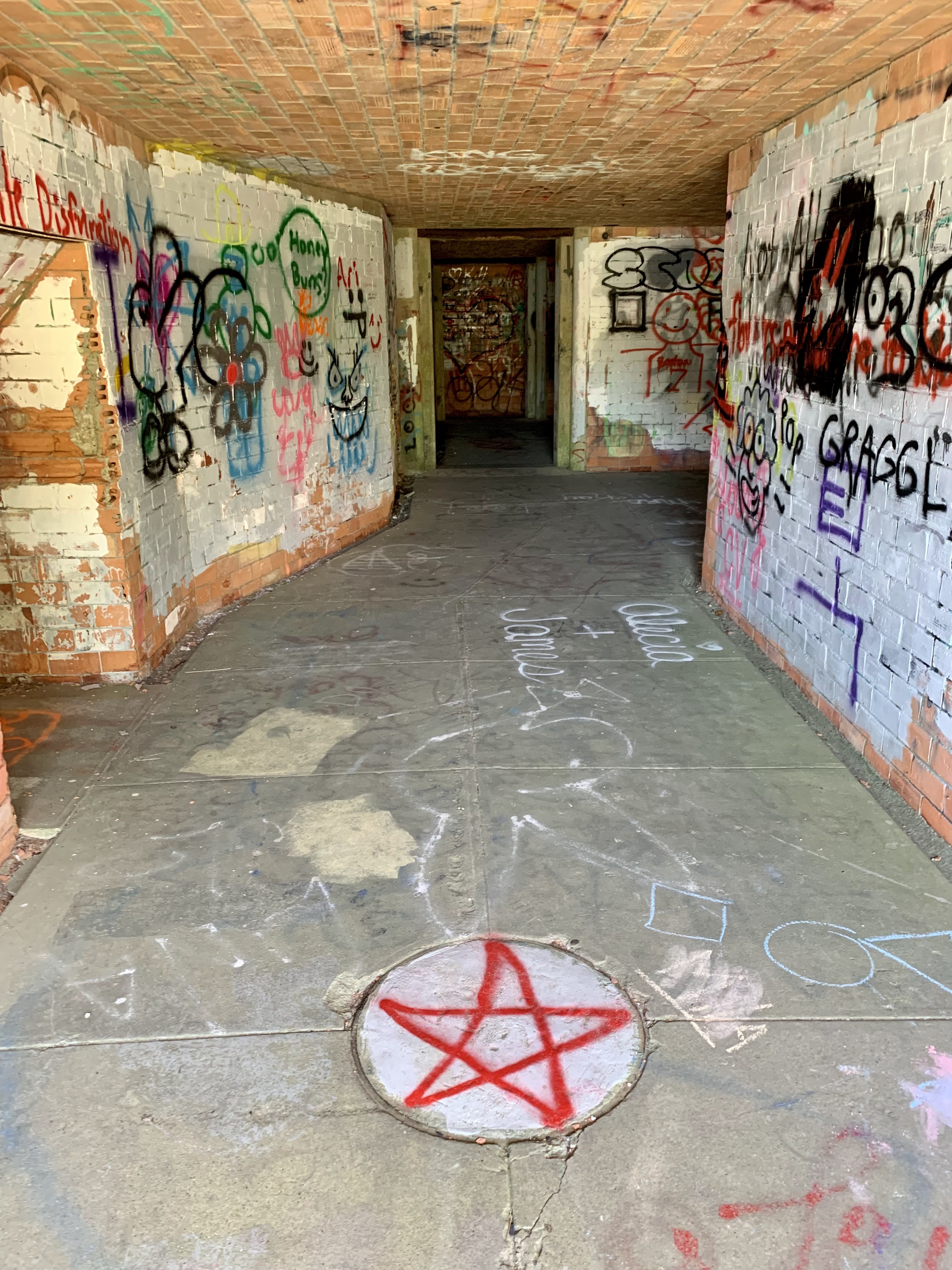
Over Labor Day weekend Tony and I drove down to Hull, Massachusetts. Hull is of course a popular destination in the summer because of Nantasket Beach, but we had a different destination in mind. We wanted to visit a haunted fort. 

Fort Revere sits on top of Telegraph Hill, a promontory that looks out over the town and Boston Harbor. The views are amazing, and I can understand why someone would build a fort there. You definitely would be able to see any ships approaching Hull, as well as a view of the one road leading into town.

Hull was first colonized by the English in 1622, and they considered fortifying the hill as early as 1633. It wasn't until the American Revolution, though, that anyone actually built anything there. In 1775, General Joseph Palmer constructed the first fort and named it Fort Independence. After the war that name was given to the fort on Castle Island in Boston, and the Hull fort was demolished and buried. 


The current fort on Telegraph Hill was constructed from 1898 - 1906. Named Fort Revere, it housed troops during the Spanish-American war and was armed with multiple cannons. In 1948 the US Government finally decommissioned the fort and gave it to the Commonwealth of Massachusetts. It is now a public park. 

Where are the ghosts in all this history? Well, according to local legends, the fort is haunted by the spirits of 200 French soldiers who died of smallpox in 1778. The soldiers had been captured by the British while fighting in Nova Scotia, but had been freed in a prisoner exchange. They were sent to the fort in Hull, where French marines were garrisoned. Unfortunately, most of the freed prisoners died from smallpox. Their countrymen buried them somewhere on the hill's slopes. Local archaeologists tried to find their grave in 1976 but were unable to locate it. 


The smallpox victims were real, but are the ghosts? Tony and I didn't encounter anything odd, but we went during the daytime and didn't try to engage with any restless spirits. I'm not that brave! Maybe if we had we would have experienced some of the strange phenomena said to occur. People say unseen entities will throw a rock back to you if you throw it down one of Fort Revere's many dark tunnels. They also say shadowy shapes can be seen flitting by doorways and whispers are heard in empty rooms.

As my friend Sam Baltrusis notes in his book Haunted Boston Harbor, paranormal investigators have recorded strange EVPs (electronic voice phenomena) in the fort. Anne Kerrigan and Michael Markowicz, of the group East Bridgewater's Most Haunted, investigated the site in 2007. Markowicz recored an EVP that sounded like a choir singing, which is pretty freaky. They also captured voices saying, "What do you want with us, Michael?" and "Watch us, watch you." That's even freakier.


Happily, they didn't encounter any malevolent energy at the fort. Tony and I didn't either, although we did encounter a lot of graffiti. A lot!  Some of it is over 20 years old, so I don't think anyone has been cleaning the inside of the fort. The outside is almost spotless though (and has amazing views).

We had a good time exploring the fort. If you want to visit someplace historic, scenic, and possibly haunted, I'd recommend Fort Revere. 

April 27, 2020

Bathsheba Sherman: Evil Witch or Innocent Victim? The Story Behind The Conjuring's Villain

This probably won't be a surprise to hear, but I'm a big horror movie fan. Zombies, summer camp killers, carnivorous alien monsters - yes please! I like arthouse movies like The Lighthouse, schlock like Friday the 13th, and the mainstream horror films that have been popular the last few years. 

One of the decade's most popular horror films was The Conjuring (2013), which tells the story of the Perron family and their encounter with the malevolent spirits haunting their old Rhode Island farm house. The film is based on true events - the producers based the script on the real-life paranormal investigation carried out by ghost-hunters Ed and Lorraine Warren. 

Bathsheba Sherman from The Conjuring (2013)
The Warrens believed that the main spirit haunting the Perron's house was the ghost of Bathsheba Sherman. According to local legends, Bathsheba was a devil-worshipping witch who murdered at least one child in the 1800s. The film claims Bathsheba committed suicide by hanging herself her from a tree and that her spirit lingered at the farm to torment any future owners. 

Obviously I like weird legends, but I also like to know the truth behind them. Did Bathsheba Sherman really commit the crimes The Conjuring attributes to her? Suicide. Devil-worship. Infanticide. Those are some serious charges to level against a 19th-century farm woman.

My friend Sam Baltrusis discusses the hauntings at the Perron house (and many others) in his new book Mass Murders: Bloodstained Crime Scenes Haunting The Bay State. The book is about haunted sites in Massachusetts, and the Perron's property in Burrillville straddled the Massachusetts/Rhode Island border. Baltrusis interviewed Andrea Perron, who lived in the house when she was a child, about Bathsheba Sherman and the stories surrounding her:

According to Perron, the alleged murderess was a far cry from the blood-spewing villain that was portrayed on the silver screen. In fact, Perron believes that Sherman was targeted by her nineteenth-century community and the witch hunt continues in the afterlife... 
“There’s nothing recorded that substantiates the idea that she practiced witchcraft,” Perron said. “If she did, it would have been a Salem-style death. As we saw with the innocent people who were hanged in 1692, witch was a dangerous word to say..."

There’s no way that she secretly practiced witchcraft, especially since Sherman was given a proper Christian burial next to her family. “She was buried in hallowed ground and that wouldn’t have been the case if she had been found guilty of witchcraft,” Perron confirmed (Sam Baltrusis, Mass Murders (2020).

Well, if she wasn't a Devil-worshipping witch, maybe she was still a baby murderer who killed herself? Not true, says Perron. There's no evidence that she killed anyone, and she didn't die by suicide either. Bathsheba Sherman died in 1885 from natural causes at the age of 73.
Photo of the Perron's house by Frank Grace, Trig Photography.
Perron says the Warrens were the first people to suggest that Bathsheba's ghost was the malevolent force haunting their house. It sounds like the Warrens made this decision after they researched the town's folklore. 

So does this mean the house isn't haunted? Not quite. Perron claims that the old farm house is indeed haunted but by a variety of ghosts, including seven soldiers, a young girl murdered in 1849, and others. Perron said she has also contacted Bathsheba's spirit but that she is not malevolent. 

The Burrillville house was recently purchased by a couple who intend to open it up for paranormal tours. I suppose if I took the tour I'd find out the truth about the ghosts, but I think I'll pass. I've seen one too many horror films to feel safe in a haunted house.

October 15, 2019

Bunhgole Liquors: Salem's Haunted Liquor Store

A few weeks ago we went up to Salem on a pre-Halloween excursion. We did a lot of our usual things. We drank cocktails made with pumpkin vodka. We visited witchcraft stores. We bought candy at Ye Olde Pepper Company. We visited a cheesy haunted house where we had to wear 3-D glasses.

You get the idea. We also took photos of Bunghole Liquors on Derby Street. It's a popular photo stop because it has a cool retro sign and "bunghole" sounds like a dirty word. Of course a bunhgole is actually the hole cut into a wooden cask so liquor can flow out, but the owners of Bunhole Liquors still play up the raunchy innuendo of the name. Their website has the motto "We're not #1 butt we're right up there," and you can buy t-shirts with slogans like "I Got It In the Bunghole."


Like many places in Salem, Bunghole Liquors is surrounded by some strange legends and weird history. According to their website the building on Derby Street was originally a funeral home where embalming was performed in the basement. During Prohibition the funeral home operated as a speakeasy. Guests would drink contraband alcohol in the basement surrounded by corpses and embalming equipment. It sounds creepy to me but I guess some people will do anything for a drink! The secret password to get in was "See you in the bunghole."

There are persistent rumors that a network of tunnels once ran between various buildings in Salem, and according to Sam Baltrusis's book Wicked Salem the bootlegging morticians smuggled in their illicit booze using a tunnel that ran from the basement of the funeral home down to the harbor. Is that true or just a rumor? I don't know but you can read more about Salem's tunnels in Christopher Jon Luke Dowgin's 2012 book Salem Secret Underground: The History of the Tunnels in the City.


After Prohibition the owner of funeral home gave up on embalming and went into the liquor business legally. In 1933 Bunghole Liquors became the second liquor store to open in Salem after Prohibition.  The tunnel (if it existed) was sealed up and the embalming equipment was sealed in the walls behind plaster. So let that sink in for a minute. Bunghole Liquors used to be a funeral home. Corpses were embalmed in the basement. The equipment was just shoved into the walls and hidden away. And there may have been a secret tunnel.

That sounds like the setup for a horror film to me, and unsurprisingly some staff at Bunghole Liquors have reported some strange things when working late. According to Baltrusis's Wicked Salem workers at the Bunghole tend to avoid the basement, a location where security cameras have recorded unexplained lights. Several have reported seeing a woman disappear after walking into the store. Perhaps strangest of all are the accounts of an unseen phantom cat that rubs against the legs of people working there. 

It's all kind of spooky, but what do you expect from a store that sells wine, beer and spirits? Get it? Spirits? I know, a bad pun. 

August 21, 2019

Dining at A Haunted Restaurant

A few years ago we were in Provincetown for the annual Tennessee Williams Festival. We met a group of friends for brunch at Local 186 and, since it was a sunny September day, decided to eat outside. Little did we know what that brunch would bring...

One of my friends ordered a Belgian waffle, and when it arrived it came topped with a mountain of whipped cream and an enormous dusting of powdered sugar. It looked very tasty, but just as we were about to eat a gusty breeze blew in from the harbor. The powdered sugar blew off the waffle and all over the person who ordered it. To make matters worse he was wearing a black shirt.

He wiped off the sugar, ordered another Bloody Mary, and moved on. We all assumed the mishap was just caused by a random seaside breeze - but we may have been wrong. Local 186 is supposed to be haunted. Perhaps a ghost had caused the sugar incident?


Many restaurants, hotels and guest houses are allegedly haunted these days. I think in the more superstitious past people would be afraid to patronize a haunted establishment but now having a resident ghost is considered an extra attraction for a business. An establishment needs good food, attentive service, and preferably an undead entity. Owners publicize their ghosts in an attempt to entice customers. Modern capitalism can absorb everything, even the restless dead.

The ghost who supposedly haunts Local 186 was a businesswoman herself so she may not mind. Her name is Esther Chamberlain, and for many years she ran the restaurant and the guest house above it when it was called Esther's Inn. She was a formidable and driven entrepreneur, and even after death she is said to be interested in how the business is run. 


For example, several staff have said the ghost has rearranged silverware when they weren't looking. Here's a quote about Esther's ghost from Sam Baltrusis's book Paranormal Provincetown:
Jeffrey Doucette, a veteran ghost tour guide, said he's heard stories of table settings being rearranged and objects moving at Local 186 if guests or employees don't adhere to basic rules of etiquette. "I ran into one woman while I was giving the tour and she confirmed that the restaurant and inn's namesake was a bit of a stickler... The spirit seems to be interested in table manners..."
Esther's ghost is apparently polite and there aren't any particularly horrific stories about her. She doesn't sound sinister, just stern. 

We had dinner at Local 186 just a couple weeks ago. Our meal passed without incident (and was quite tasty) but I noticed the Ouija board that had been in the bar on past visits was gone. Paranormal investigator Joni Mayhan told Baltrusis that sometimes people playing with Ouija boards can accidentally summon sinister entities. I think that would be doubly the case for drunk folks at a bar. Maybe the ghost haunting Local 186 isn't really Esther at all? 


Perhaps the owner removed the Ouija board for psychic safety but there may be another reason. Baltrusis notes in Paranormal Provincetown that the website Building Provincetown claimed Local 186 was reputedly haunted. That has been taken down since Baltrusis's book was published in 2016 and there's no mention of it. I wonder if the new owner is downplaying the ghost angle? If so maybe that's why they removed the Ouija board as well. 

It's their business and they can market it however they please. But if Esther's ghost really does haunt Local 186 I am sure she will stick around to make sure patrons use the right fork and place their napkins in their laps. 

May 03, 2015

Ghosts of the Great Elm and The Witching Elm

Many years ago, a great elm tree used to dominate the landscape of Boston Common. It was so large is was just referred to as the Great Elm.

According to Wikipedia, at its height the tree was nearly sixty-five feet high and the canopy of its branches spread out over eighty feet. It was so big that it had a hollow a child could climb into. That's a really big tree!

The tree eventually fell in a winter storm in 1876, but it was estimated to be over 250 years old at its demise. Even in the 1830s the tree was surrounded by a fence to protect it, and a plaque nearby proclaimed that the tree had been in existence since before the English settlers arrived. I don't know if that can be proven, but I like the idea of one last piece of the older, wilder world surviving into the Industrial era.

A 19th century photo of the Great Elm (from Wikipedia)

A lot of stories and legends gathered around this "vegetable patriarch," as it is called it the 1838 book The Boston Common, or Rural Walks in Cities. For example, Samuel Barber claims that Benjamin Franklin used to play under the tree while tending his family's cattle on the Common. Quaint and patriotic!

Not all the legends are quite so charming. The Common wasn't just used for cattle-grazing; it was also used for executions. Executions were a public affair in the Colonial era, and large crowds would turn out to watch. This was the era before television, and executions were often festive (if gruesome) sources of entertainment. For the common people they were a chance to take a break from work, while the government regarded public executions as a good deterrent to future law-breakers.

Murderers and other criminals were executed on the Common, but the definition of "criminal" three hundred years ago was much broader than it is today. Dozens of rebellious Indians were publicly executed, as were four witches and several religious dissenters like Quakers. On some occasions gallows were constructed to do the dirty deed, but in other cases large sturdy trees were used. We do know that Mary Dyer, the famous religious dissident, was hanged from a tree on the Common in 1660 after her final return to Boston from exile.

We don't know exactly which of the many trees on the Common were used for hangings, but tradition assigns the grim role to the Great Elm. It certainly was big enough.

A plaque on Boston Common commemorates the spot where the Great Elm once stood, but ghosts of those unlucky people hanged on its branches may still linger. According to my friend Sam Baltrusis's book Ghosts of Boston: Haunts of the Hub (2012), tenants in a nearby commercial building reported hearing clanking chains in their empty basement. Perhaps they were psychic echoes of the shackles used to restrain doomed criminals as they were led to their deaths? More significantly, the ghost of a woman in Puritan attire has been sighted near the Great Elm site. The ghost weeps and wails before disappearing. Baltrusis speculates that it might be the ghost of the Irish witch Goody Glover, who was hanged on the Common, but there unfortunately are many other possible candidates.


Now to shift gears, from ghost stories to young adult fiction. The Great Elm, or something very much like it, reappears in C.N. Crawford's new young adult novel The Witching Elm. The book's young hero, Tobias Corvin, lives in an alternate universe's version of Boston. The city is called Maremount, and it was founded by Algonquian and English magicians.

In our world's history Maremount, or Merrymount, was a free-loving, multicultural settlement destroyed by the Pilgrims in the early 1600s. In The Witching Elm Maremount is a place where magic is real, but that doesn't mean it doesn't have its problems. Only the upper classes are allowed to practice magic, and as the novel begins Maremount's forces of oppression, led by the mysterious Rawhead, are cleansing the city of illegal magicians and witches. Tobias's family is under suspicion, and for safety Tobias is transformed into a raven and sent to an even stranger city in another dimension: modern-day Boston, Massachusetts.

After regaining his human form Tobias takes shelter at Mather Academy, a prestigious old boarding school located near Boston Common. But things at the school are not quite what they seem. Why are students turning into withered corpses? What's the connection between the Academy, the Salem witches, and Nathaniel Hawthorne? What's up with the weird jewelry some students wear?

After Rawhead's minions appear in Boston to find Tobias, a new tree mysteriously grows at the site of the Great Elm. And then the executions begin...

I really enjoyed reading The Witching Elm, which was sent to me by the authors. (C.N. Crawford is really two people, Christine and Nick Crawford.)  I appreciated the way elements of New England folklore were woven into the book to make a compelling mystery. It's sort of like Harry Potter meets The House of Seven Gables meets this blog. If you like any of those things, or are just a fan of well-written YA fantasy, I'd recommend you purchase a copy. Don't read it too late at night, though, because things do get a little gruesome for the students and faculty at Mather Academy...

October 26, 2014

The Pigman: Fact, Fiction, Freakishness

It was great to see people at the Tewksbury Library this past week and at the Boston Book Fair, where I was promoting my book Legends and Lore of the North Shore. At the book fair I also met Sam Baltrusis, author of Ghosts of Salem and Ghosts of Boston, and Dee Martin, author of Boston in the Golden Age of Spiritualism. If you get a chance please check out their books! They're full of the weird stories and interesting legends that I really love.

Speaking of weird legends, Halloween is this Friday, and when Halloween rolls around I think of my favorite New England monster, the Pigman. An overall creepy fellow, the Pigman haunts a woodsy area outside Northfield, Vermont called the Devil's Washbowl. Just who is the Pigman? Some stories say he's the half-human offspring of a local farmer and a friendly pig. Others say he's a local teenager who ran into the woods and became feral.

The most detailed story claims he's Sam Harris, a teenager who set out to cause some mischief on October 30, 1951. October 30 is called Picket Night up in Northfield, and it's the designated night for teenagers to make pre-Halloween trouble by throwing eggs, toilet papering houses, and probably at one time stealing pickets from fences. Sam set out on that chilly October night many years ago an innocent teen, but went missing. Three years later he briefly returned home for just one night. Now a squealing madman, he strewed pig innards on his parents' porch, only to disappear again. His mother was driven mad by even this brief glimpse of her now monstrous son, and committed suicide by throwing herself into a pen of hungry hogs. Locals whispered that Sam had sold his soul to Satan, and that he now lurks in the woods wearing the head of a pig to cover his own deranged visage.

I first read about the Pigman in Joseph Citro's Weird New England, but I've found other legends and rumors floating around on the web. Here's one that appeared last year. Dim the lights for maximum creepy effect. 


 Back in the 1980s a group of high school seniors decided to go camping overnight in the Devil's Washbowl. There were some caves in the area, and recently hunters had found pig bones (freshly gnawed) in some of them. Were they the remains of the Pigman's dinner? The seniors thought they were and hoped to get a glimpse of the town's resident monster. 

I think they were also hoping for some romantic action, since as the sun set they split up into couples, each taking a sleeping bag and flashlight and each settling into a different cave for the night...

I'll just interject here and say that anyone who has ever seen a horror movie knows this was a bad decision. Frisky teenagers. Dark woods. Separating the group. A hideous monster. I guess these were the rare teenagers who had never seen a scary movie. 

Back to the story. The teens were settling in for a night of snuggling when they heard screams coming from one cave. Grabbing their flashlights they all ran to see what had happened. Inside the cave they found one of the girls, screaming hysterically. Her boyfriend was nowhere to be seen.

When she calmed down enough to speak, the girl said that as soon as she and her boyfriend had settled down to sleep a large man wearing a pig's head came into their cave. They shouted at him to leave, but without even hesitating he grabbed a rock and clubbed the boyfriend on the head. The Pigman threw the unconscious boy over his shoulder and stalked off into the night.

The teens frantically drove back to town and told the police what happened. Search parties looked through the woods for days, and although heavy footprints were found leading away from the Devil's Washbowl the searchers lost the trail in the leaf-strewn forest. No sign could be found of the boy or his abductor.

Desperate for leads, the police put up posters with the boy's photo around around Northfield. Only one person came forward. A man said a few nights ago he had been in his kitchen when he heard something rummaging around outside in the trash. Thinking it was a racoon, he turned on the porch light and went to chase the animal away. But it wasn't a racoon digging through his trash, it was the missing boy. The man recognized him from the poster.

But the poster wasn't quite accurate, the man said. He had definitely seen the same boy, but his eyes were strangely hollow looking, and his body was covered in long white hair. 

Is this story true? It appears on a sight called Phantoms and Monsters, which is focused on UFOs, the paranormal, etc. It's written anonymously as a first-person account ("My sister and a couple of her friends went out to the Devil's Washbowl...") which would lead one to believe someone, somewhere said this all really happened.

However, a little poking around on the web showed that this version of the Pigman story was first posted on Reddit last year by  a user named William Dalphin. Dalphin writes horror fiction, so maybe this story isn't true. Or at least not entirely. It's in a section of Reddit for both true and fictional scary stories, so there's a little confusion. And the other Pigman stories are supposedly true, so I can understand why people think this one is.

The Pigman legend is relatively new, apparently first appearing in the 1970s. It's changing and growing over time, incorporating tropes and themes from popular horror movies and fiction. Will this story be passed on as true? For me, the Pigman stories are like good campfire tales told by someone who's seen a lot of horror movies. I'll be interested to see what new ones appear over time.

And the Pigman could be real, even if the stories about him change. Perhaps there really is some anomalous monster lurking around Northfield and people are just trying to describe him using the stories and themes that are familiar to them. Perhaps it's the only way the locals can wrap their heads around the hideous, porcine enigma. He's a monstrous blank slate for them to write their fears on.

I suppose the only way to settle the question of the Pigman's existence is for someone to spend the night in the Devil's Washbowl. I'll leave that to someone braver than myself.

My other Pigman posts are here and here, if you really want to stay awake all night.