Showing posts with label ghost story. Show all posts

April 01, 2025

Brookline's Haunted Schoolhouse: Stalked by an Angry Ghost

A few weeks ago, Tony and I paid a visit to Larz Anderson Park in Brookline, Massachusetts. Although it's a popular place for dog walkers, and well-known for its Auto Museum, we went there for a different reason. We wanted to see a schoolhouse that was once haunted by a vengeful ghost.

Built in 1768, the schoolhouse in question is a charming, one-room building known as the Putterham School, and originally stood at the intersection of Grove Street and Newton Street. In addition to being a school, the building may also have served as a synagogue and a Catholic church after World War II. It was moved to Larz Anderson Park in 1966, where it now serves as a museum. 

I love a historic building, but I love a historic building with a ghost story even more. According to Ken Liss, president of the Brookline Historical Society, the Putterham School was allegedly haunted for seven years by an angry ghost. Well, at least according to a local legend, that is.  

Here's how the school supposedly became haunted. Sometime after the Revolutionary War, a young man named Samuel Frothingham fell in love with the Putterham School's teacher. Unfortunately for him, she loved another man, and rejected Samuel's advances. 

Samuel did not accept rejection lightly. He became so distraught that he stopped eating, growing ever more emaciated. He eventually starved to death, but not before he wrote a message on the chalkboard, "berating the teacher for her betrayal and saying the note would appear every year until she died"(Brookline Tab, October 25, 2018, "Spooky Brookline: ghost stories").

True to his word, the angry message appeared on the blackboard every year for seven years, until the teacher eventually died. I don't think her death was connected to being haunted, but I'm sure the ghostly messages didn't help her mental health. As far as I know, Samuel Frothingham's ghost never haunted the schoolhouse after her death. 

To use a modern term, Samuel Frothingham seems a little bit like a stalker, doesn't he? The schoolteacher wanted another man, but rather than move on, Samuel starved himself to death and then sent her nasty messages from beyond the grave. This doesn't seem like a very mature reaction. Even though she was haunted for seven years, I think the teacher made the right choice. If Samuel was that creepy while dead, think how bad he would have been while alive?

February 21, 2025

The Deadly Ghost of Harvard College: Killed by a Prank

I'm giving a tour of Harvard Square for a group of friends this weekend, and have been trying to find good ghost stories I can tell. Cambridge is an old city and Harvard is America's oldest college, so there must be ghost stories, right? 

No surprise, there are a lot of ghost stories about Harvard Square, including this one from a 2012 Boston.com article titled "Nine ghost stories in haunted Cambridge." The author of the article heard it on a Harvard Square ghost tour:

... an incident that happened at the Porcellian Club, one of the oldest, secretive final clubs at the school. A group of men wanted to trick a skeptical man into believing ghosts were real. 

A man dressed as a ghost and woke the other man up, who then swallowed his tongue and died. The man now allegedly haunts the hall as a warning. 

I like a good Scooby Doo story (you know, one where the ghost is fake at the end), but in this one, the fake ghost results in a real ghost. It's an added twist. If it's true I feel bad for the poor skeptic, forced to spend eternity as the very thing he didn't believe in! 

I was curious about where this story came from, since it's so good. When did it happen, and to whom? I did a little browsing in my library and found some clues. My friend Sam Baltrusis had written about it in his 2013 book Ghosts of Cambridge, and happily Sam cites the source, an 1846 book by Felix Octavius Carr Darley. 

But Sam doesn't say the dead skeptic haunts the Porcellian Club, and neither does Darley. In fact, the title of Darley's book is Ghost Stories; Collected with a Particular View to Counteract the Vulgar Belief in Ghosts and Apparitions. Yes, you read that title right. Darley's book is a collection of ghosts stories aimed at counteracting the belief in ghosts. Darley doesn't believe in ghosts, and doesn't want you to either. It's an entire book of Scooby Doo stories.

"It's not your undead mother, it's just a dog."

Every ghost Darley writes about is revealed to have a logical, non-supernatural explanation. That undead noblewoman haunting a French chateau? It's really just a dog that sneaks into the bedroom at night. That demonic figure seen in an old German town? Just a local priest in disguise scaring people away so he can have some peace and quiet. That pale wet hand a sleeper on his face feels at midnight? Just someone trying to see if his sister has rented out his bed to a lodger. 

The Harvard ghost story was told to Darley by Washington Allston, a prominent 19th century painter. He's not particularly well-known today, but he was very popular in his time. He was so popular, in fact, Boston named one of its neighborhoods after him. Allston graduated from Harvard in 1800, and claims the ghost story happened while he was a student there. It goes something like this...

Washington Allston, Self-Portrait, 1805. He's projecting "Timothee Chalamet
chaotic twink" energy. 

One night a group of Harvard students were telling each other ghost stories, but one student was skeptical ghosts existed:

The thing was too absurd in itself to gain his belief. He would never believe in ghosts till he should see one with his own eyes. As for fearing them, "he would like to see the ghost that could frighten him"(Darley, Ghost Stories, p. 13).

Upon hearing this, one of the other students decided to test the skeptic's bravery and disbelief. He didn't necessarily believe in ghosts either, but he didn't like the skeptic's attitude and wanted to play a trick on him. 

The next night, he dressed up in a white sheet and snuck into the skeptical student's bedroom. The skeptical student reached under his bed, pulled out a pistol, and fired at the 'ghost.'

Happily, the trickster knew the skeptic kept a loaded gun under his bed, and had secretly removed the bullets earlier (but not the gunpowder). The skeptic didn't know this and thought the gun had fired after the gunpowder went off. Upon seeing the ghost was unharmed after being shot, the skeptic panicked. 

Instantaneously the appalling belief came over the mind of the unhappy beholder that he was actually in the presence of a spirit from the other world. All his preconceived opinions - all his habits of thought, all his vaunted courage vanished at once. His whole being was changed; and he instantly fell into the most frightful convulsions (Darley, Ghost Stories, p. 14).

Uh-oh. The prank had gone too far. The student continued to convulse. The fake ghost and some other students tried to help him, but were unable to revive him.

Convulsion succeeded convulsion; and the unfortunate youth never recovered sufficient consciousness to be made aware of the trick that had been played upon him, until the melancholy scene was closed by his untimely death (Darley, Ghost Stories, p. 14).

The moral of this story is, obviously, don't pretend to be a ghost. Reading it reminded me of something that happened when I was a freshman in college. A friend and I were jogging around the track one night when another friend of ours, a notorious prankster, jumped out from under the bleachers wearing a hockey mask and waving some kind of weapon. My friend and I briefly panicked, thinking we were about to be attacked by a homicidal killer, but we soon realized it was just our friend and the weapon was just a hockey stick. Lucky for him we didn't go into deadly convulsions! Still, it's interesting that college student behavior hadn't changed much over 200 years.

It's also interesting to see how different the story in Boston.com is from the original version. For one thing, the Boston.com story is more specific than the original. Washington Allston doesn't say it happened at the Porcellian Club, but I suppose it could have, since he was a member. He also doesn't say the student choked on his own tongue, just that he died of convulsions. But most importantly, he doesn't say the student came back as a ghost. 

The whole point of Darley's book, including Allston's story, is that ghosts aren't real. Darley wants to convince people ghosts don't exist. If the student came back as a ghost, it would defeat the whole purpose of the book. But I suppose that wouldn't make it a good story for a ghost tour. Someone obviously read Allston's story and decided to embellish it for the tour. 

Personally, I'm a little skeptical that even Washington Allston's original story is true. Wouldn't it be better known that some Harvard students scared another student to death? Wouldn't they have been arrested? Or was there some conspiracy of silence? It sounds like the premise for a good horror movie, particularly if the dead student's brother started murdering the other students while disguised as a ghost. I Know What You Did Last Summer of 1799! And of course it would have a sequel, I Still Know What You Did Last Summer of 1799. 


December 17, 2023

Spooky Holiday Reading: Merry Christmas, or Scary Christmas?

I'm sure you've heard the 1963 song, "It's the Most Wonderful Time of the Year." Andy Williams croons in his soothing voice,"...there'll be scary ghost stories, and tales of the glory of Christmases long, long ago." Although modern Americans tend to associate ghosts with Halloween, in Victorian England ghosts were associated with Christmas. I suppose this makes sense in some ways. After all, Christmas occurs at the darkest point of the year, which seems like a good time for ghosts to be out haunting. 

In the spirit of a spooky Christmas, here are four things you can read to get you in the holiday spirit. Two of them are even available free online, if you're feeling cash-strapped after holiday shopping. 

1. The Fright Before Christmas: Surviving Krampus and Other Yuletide Monsters by Jeff Belanger

This is the latest book by Jeff Belanger, a local author, paranormal investigator, and host of the New England Legends podcast and TV show on PBS and Amazon Prime. Full confession: the publisher sent me a copy of this book to review, and I've appeared on Jeff's podcast in the past. This is a great book for anyone interested in learning about the spooky folklore of Christmas. 

Me holding my copy of Fright Before Christmas!

I think by now most people are familiar with Krampus, the horned Austrian monster who terrorizes folks at this time of year, but Jeff also writes about many other strange Christmas creatures that are less well-known. For example, have you heard of Hans Von Trapp, the Cannibal Christmas Scarecrow of Alsace, France? Merry Christmas - but sleep with the lights on.

2. NOS4A2 by Joe Hill

The protagonist of this novel by Joe Hill (Stephen King's son) is Vic McQueen, a psychic, ass-kicking, biker mama who grows up in Haverhill, Massachusetts (my hometown). The villain is a creepy vampire named Charles Talent Manx III. Imbecilic yet cunning, child-like yet predatory, Manx travels around the country in an old Rolls Royce. 

Armed with gingerbread-scented laughing gas, Manx abducts small children and brings them to Christmasland, a creepy holiday-themed amusement park that exists just beyond the border of our reality. He and Vic battle it out in this book that will make you gasp out "Merry Christmas..." as you slip into a vampiric, gingerbread slumber.

3."The Festival" by H.P. Lovecraft (free online)

One of my favorite stories by this Rhode Island master of weird horror.  A young man visits his family's ancestral Massachusetts hometown to participate in its traditional winter solstice celebration for the first time. Although he's charmed by the town's Colonial-era architecture, he's unnerved by its residents' silent, expressionless demeanors. 

He's even more unnerved when he follows a crowd of celebrants into a church, then into its crypt, then down ancient stone steps deep into the earth... Is he really entering a subterranean realm, or just his own fetid subconscious? Either way, he discovers a fungus-filled, maggoty hellscape. You'll scream "Merry Christmas!" before losing your sanity. 

4. The Collected Ghost Stories of M.R. James by M.R. James (free online)

If "The Festival" sounds too lurid for you, may I suggest the ghost stories of M.R. James? James was an Englishman and Anglican priest who wrote ghost stories every Christmas to entertain his friends. His stories often feature bookish academics or lonely clergymen visiting old historic sites and encountering supernatural evil. 

It's all very proper and British. But while his stories are subtle and heavy on the atmosphere, they often end with shocking violence and death. Nothing says "Merry Christmas!" like an undead Satanic nobleman devouring your face. 

Enjoy your holidays, and I hope all your horrors are confined to the printed page this December.  

October 25, 2023

Black Agnes: Montpelier's Death-Cursed Statue

As I mentioned before, Tony and I recently traveled up to Montpelier, Vermont to see our old friend Brian. He showed us around Vermont's charming capital, and also showed us some of its spooky sights, including the infamous Black Agnes statue. 

When we reached Montpelier, Brian immediately took us on a tour of Green Mount Cemetery. He is a Montpelier native, and had a lot of gossip and stories about the different folks buried in Green Mount. For example, he showed us a funerary statue of a young girl called "Little Margaret." Little Margaret's family commissioned a local sculptor to carve the statue after she died (apparently of spinal meningitis), but refused to pay because one of the statue's shoes only had five buttons instead of six. The sculptor was about to apologize when he looked again at the photo of Little Margaret the family had given him to work from. One of her shoes was missing a button in the photo. The sculptor stormed back to Little Margaret's family, showed them the photo, and angrily collected his payment.  

Brian also told us that the road leading to Green Mount Cemetery has been the site of many deadly auto accidents. "When I was young, this road was routinely covered in human viscera," he said, morbidly joking. At least I hope he was joking. 

The Black Agnes statue

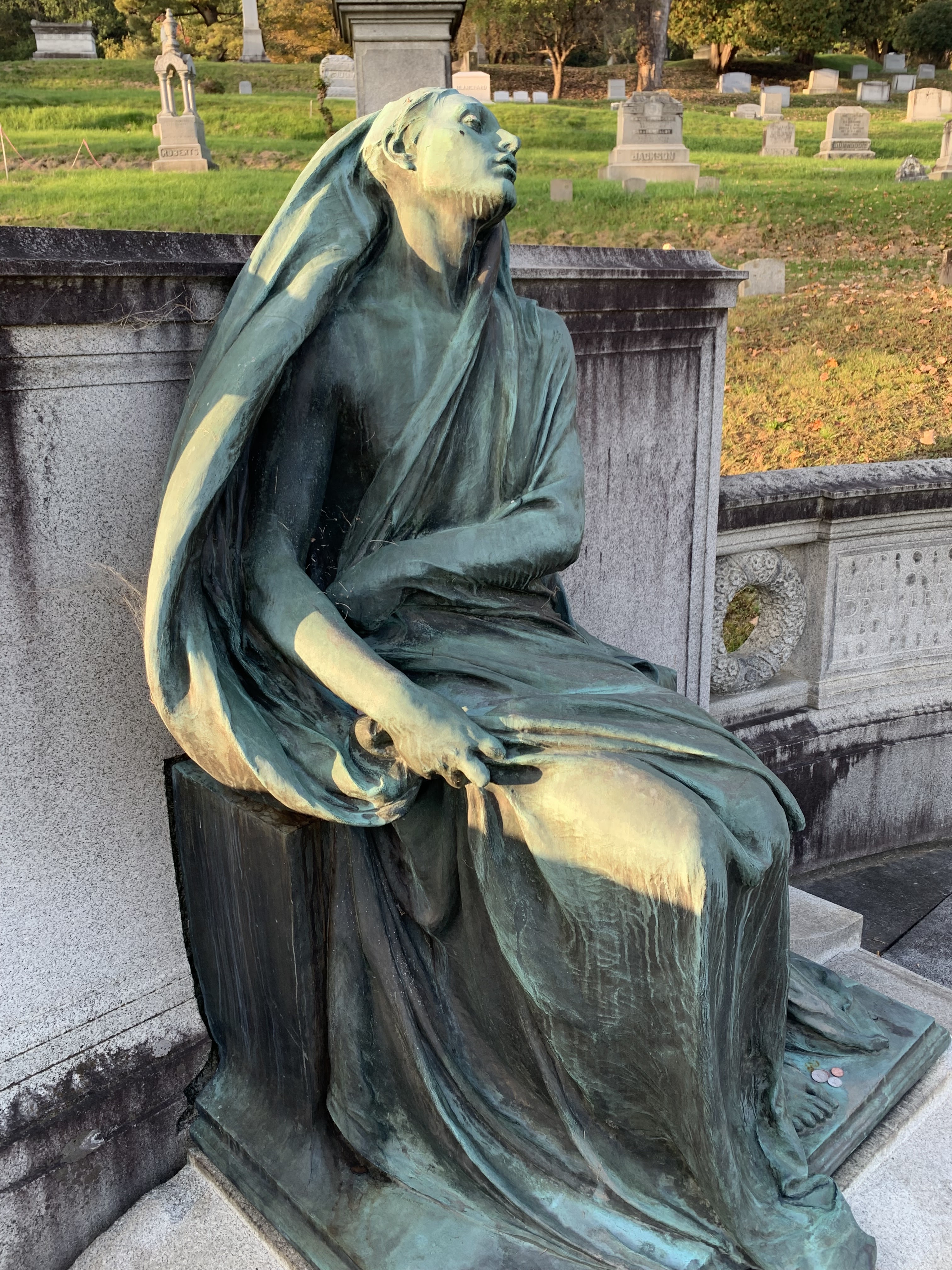
Towards the end of the tour, we reached the grave of John Erastus Hubbard (1847 - 1899), a wealthy Vermont businessman. Hubbard's grave features a spectacular bronze sculpture of a robed figure titled Thanatos. This statue is more popularly known as Black Agnes. 

According to legend, terrible luck comes to anyone who sits on Black Agnes's lap. Accounts differ as to what form the bad luck will take. Some say three unlucky things will occur to the person who sits on her lap, others say it will be an uncountable amount of bad luck. That doesn't sound good. Still another legend claims that anyone who sits on Black Agnes's lap will die within seven days, which is perhaps the worst luck of all. 

Many years ago, three teenage boys went to Green Mount Cemetery during a full moon. They dared each other to sit on the statue's lap. Not wanting to look cowardly, each boy took a turn sitting on Black Agnes. They all laughed. It was just a dumb statue, after all. Nothing to be afraid of. But within a week, one fell and broke his arm, one was in a serious car accident, and the third boy drowned while canoeing on the Winooski River. Some people said these misfortunes were just coincidences, but others said it was the curse of Black Agnes. 

Well, at least that's one legend. All the legends vary slightly, with some saying, for example, that you only suffer Black Agnes's wrath if you sit on her when the moon is full. Personally, I say why take the risk? Just don't sit on the statue, regardless of the moon phase. I don't recommend sitting or climbing on any cemetery statue. It is disrespectful to the dead, even if there isn't a death curse. 

Brian told us that the Black Agnes legend didn't exist when he was a kid, and that it must be relatively recent. That could very well be the case - new legends arise and old ones disappear all the time. There are in fact other allegedly cursed statues named Black Agnes around the United States. There is one in Washington, DC, which was originally a grave marker in Baltimore for a dead Civil War general in the Union Army named Felix Angus. It was apparently moved from Baltimore because too many fraternity and sorority pledges kept sitting on it as part of their rush process, daring each other to risk the death curse. It seems likely the Black Agnes legend traveled from the DC area to Montpelier, but I'm not sure how. 

Some folks, apparently in an attempt to debunk the Montpelier version of the legend, have pointed out that the statue is clearly of a male, so therefore the legend cannot be true. This argument doesn't hold up for me. It's 2023, and we all know that gender is a social construct. A statue of a male can easily be named Black Agnes. 

John Erastus Hubbard (1847 - 1899)

John Erastus Hubbard, upon whose grave Black Agnes sits, generated some controversy while he was alive. Hubbard came from a prominent Vermont family, and his wealthy aunt left a significant amount of money in her will to the city of Montpelier to build a library. Hubbard was unhappy about this, and managed to get his aunt's will overturned and inherit the money himself. Montpelier officials took him to court, and he eventually agreed to pay for the library. Upon his death, he left the majority of his fortune to Montpelier as well. However, this late generosity did not necessarily win him many fans among the city's citizens, some of whom noted that a terrible thunderstorm raged through Montpelier the night Hubbard died, which they took as an omen indicating the state of his soul. 

September 21, 2023

The Haunted Charlesgate: Ghosts, College Students, and Weird Engimas

Living someplace old and historic, like the Boston area, brings both perils and joys. Among its current perils is the decaying subway system, which has been well-documented elsewhere. To avoid the most hellish parts of the MBTA, lately my commute home from work has involved more walking. Which brings me to one of the joys of living in the Boston area: beautiful old architecture. 

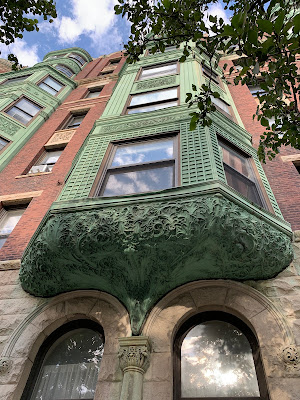
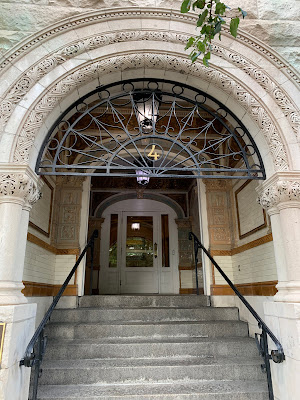
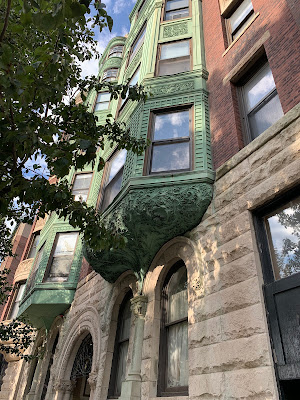
Most nights, I walk through parts of Back Bay on my way home. Among all the beautiful old brownstones and apartment buildings, one in particular stands out: the former Charlesgate Hotel, located at the corner of Beacon Street and Charlesgate East. The hotel was designed by John Pickering Putnam, a prominent local architect, and completed in the 1890s. Putnam apparently loved the building he created, and took up residence there with his own family. 

He died there on February 23, 1917 at the age of sixty. A legend claims it was suicide, but he really died of natural causes. Still, esotericists of a certain bent will notice he died on the 23rd, making his death an example of the 23 enigma, the idea that the number 23 is considered strange, somewhat sinister, and connected to unusual phenomena. So maybe Putnam's death date was a precursor of the weirdness that was to come...

The Charlesgate operated as a hotel until 1947, when it was sold to Boston University as a dorm. In 1981, it was sold to Emerson College, which also used it as a dorm until 1995. It was during those 14 years that the Charlesgate acquired its reputation as one of the most haunted buildings in Boston. Here are a few of the ghostly legends from that time..

The building was said to be haunted by the ghost of Elsa Putnam, John Pickering Putnam's daughter, who died as a little girl when she was playing with a ball on an upper floor. The ball rolled into an open elevator shaft, and Elsa ran after it and fell to her doom. This story is not true - Elsa Putnam lived until the 1970s and had several children of her own - but many Emerson students still reported seeing her ghost. 

Another legend claims that mobsters owned the building in the 1930s and murdered three people in the elevator. The ghosts of these gangland slaying victims were often seen wandering in the dormitory. Emerson students also claimed they saw the restless spirits of young women who had committed suicide in the building back when it housed female Boston University students. 

A phantom "Man in Black" was also seen lurking around the elevator. No one was quite sure who he was, but students were afraid to encounter this black-clad ghost, particularly late at night. 

Even when ghosts were not seen, Emerson students living in the Charlesgate experienced a variety of strange phenomena including unexplained cold spots, toilets flushing by themselves, and doors slamming shut. Some students also claimed the hotel had once been the headquarters for a demonic cult. According to an article in a 1990 issue of Fate magazine:

"Also at one point, a good part of Charlesgate Hall's residents allegedly belonged to a demonic cult. 

When Emerson College bought Charlesgate Hall as a dormitory in 1980, it was not completely filled by students. It was claimed that some members of the cult still lived there, and it was not unusual for students to walk by the open door of a room belonging to a cult member and find a group of them chanting."

Well, college is supposed to expose you to new experiences, isn't it? The same Fate article also claims that Emerson forbid students from using Ouija boards in the Charlesgate - and then goes on to describe a group of them using one to contact spirits in the dorm. I guess college is also about defying authority.

The Charlesgate's ghosts have been written about in many places: The Berkeley Beacon (Emerson's student paper), The Boston Phoenix, Emerson's official newsite, and various books about haunted locations in Boston. The building also appears in Scott Von Doviak's 2018 novel, Charlesgate Confidential, as do some of the ghost stories. The combination of a creepy old hotel, ghosts, and college students makes the Charlesgate an appealing subject for writers.

The Charlesgate is no longer a dormitory, but instead is filled with condos and apartments. I haven't heard of any ghosts appearing in the building since it became condos. Are any ghosts even there now? Maybe the ghosts were chased away during the renovations, or maybe they were conjured up by the Emerson students who lived there. College students tend to like ghost stories, and many local New England colleges are said to have haunted dormitories. 

I mentioned the 23 enigma at the start of this post. Although the concept first appeared in works by William S. Burroughs, it was popularized by the author Robert Anton Wilson. Wilson didn't necessarily believe the 23 enigma was real, but rather that it showed how people have the ability to find patterns in random occurrences. Some people starting seeing the number 23 in all kinds of unexpected places once they learn about the enigma. The number is only meaningful, though, because they think it is significant. They are creating a pattern out of random data.

Perhaps the ghost stories at the Charlesgate are something similar. Students heard rumors the dorm is haunted, and then noticed lights flickering, strange cold spots, and weird noises at night. These all could have perfectly rational explanations - old buildings often have bad fuses, drafty windows, and frisky rodents - but students interpreted them as ghostly phenomena because they had heard the rumors. 

This is, of course, all speculation on my part. The only way for me to know for certain would be to rent an apartment at the Charlesgate and see what happens. A one bedroom starts at $2,400/month, which is more than I have budgeted for ghost-hunting. Or then again, maybe I'm just scared that the legends are true? I don't want to encounter the Man in Black late at night, no matter what he is. 


August 08, 2023

A Nantucket Ghost Story: The Man with the Long Chin

Nantucket is a playground for the very wealthy these days, but that has not always been the case. In the past, the island has been home to Native Americans, Puritans, Quakers, whalers, and an assortment of artists and eccentrics. Nantucket has a very long history, and a long history usually means ghost stories. 

After the whaling industry collapsed in the mid-19th century, Nantucket became sparsely populated. There wasn't a lot of economic development on the island, which meant that very few of the old historic houses were torn down to make room for new ones. Those old houses are now mostly vacation homes for the wealthy, but there may be some unexpected guests stopping by to visit, as the following story indicates. 

The oldest house in Nantucket. 

It comes from Blue Balliett's 1984 book, The Ghosts of Nantucket: 23 True Accounts. I bought this at a used bookstore a few years ago, and really enjoy it. It's full of old-fashioned ghost stories, and also has some charming line drawings of old Nantucket houses. 

Back in July of 1981, a seven-year old girl named Jesse and her parents were invited to a dinner party at an old house on India Street in Nantucket. The adults were having a great time at the party, but Jesse was the only child there and quickly became bored. To keep her entertained, one of the hosts suggested she take a tally of interesting items in the house: candlesticks, mirrors, brass doorknobs, etc. 

The adults could hear her counting in a nearby room counting as they talked and ate dinner. But their dinner conversation was suddenly interrupted when Jesse ran into the dining room, terrified and exclaiming that she had seen a strange man in the house. Her parents and the hosts followed the frightened child into the room where she said she had seen the man, but there was no one there. 

Jesse said the man had a very large chin and was wearing a strange, dark blue suit. He had tipped his hat to her and then vanished into thin air. Although she had been scared, Jesse said he seemed friendly. She emphasized repeatedly that he had a long face and very large chin. Since Jesse was safe and unhurt, the adults at the party didn't take her story very seriously. After all, children do have active imaginations. 

Vintage photo from Ebay

A few weeks went by, and Jesse and her parents had mostly forgotten about her strange experience. One afternoon they were invited back to the old house on India Street, and the owners showed them something they had found in the attic. It was a line drawing that showed people attending a garden party at the house, probably from the 1940s or 1950s. 

When Jesse saw the drawing she said, "That's him! The man with the long chin." One of the people in the drawing was indeed a man with an unusually long chin. Some text on the back of the drawing identified everyone in it. The long-chinned man was William Hunt, a previous owner of the old house. 

After doing a little research, the current owners of the house learned that William Hunt had committed suicide in 1961, twenty years before he tipped his hat to Jesse. 

*****

This is a very satisfying ghost story to me. It has an old house, someone encountering the supernatural, and proof at the end that the encounter was real. That proof is often a major aspect of classic ghost stories. For example, think of phantom hitchhiker stories. Someone always has to independently verify and identify the hitch-hiking ghost. "That girl hitchhiking was my daughter, and she died on this night twenty years ago on the way to her prom. You saw her ghost!" Or this story, from Cape Cod: "That seaweed you found only grows on the bodies of people who drowned. You saw the sailor's ghost!" 

In these older, classic ghost stories, someone who did not witness the paranormal encounter has to confirm it was authentic, or someone finds a piece of outside evidence (a piece of seaweed, a drawing, etc.) that confirms the encounter. It's what makes these stories satisfying. If this story just ended with Jesse telling everyone she had seen a long-chinned man it wouldn't quite feel the same. 

January 30, 2023

Haunted Houses and Terrifying Specters: Ghost (?) Stories from Weare, New Hampshire

There are a lot of ghost stories from New England, and one of my favorite types is what I call the "Scooby-Doo" ghost story. In these stories, the ghost is rationally explained away at the end. There is nothing supernatural in these stories, although people in them initially think there is. I call them Scooby-Doo stories because each episode of the Scooby-Doo ended with the ghostly terror being revealed as someone impersonating a ghost, not something supernatural. These stories are similar, but without all the greedy real estate developers and smugglers.

You can find these Scooby-Doo ghost stories in a lot of the local town history books which were written in the 19th century. I found a bunch of them recently in William Little's The History of Weare, New Hampshire, 1735 - 1888 (1888). In one story, an early settler named John Hodgdon was riding home to Weare on horseback one night when he saw something creepy in his cornfield. As the hair on his neck stood up, he saw a large white object appear on a small knoll in the field. It disappeared with an uncanny sound, only to reappear again. Hodgdon dismounted and walked through the dark field to the knoll, determined to discover what this ghostly object (or entity) was. He learned it was not a ghost, but was instead a large basket some of his workers had left in the cornfield. When the wind blew it rolled up the hill, and when the wind subsided it rolled back down. Mystery solved!

William Little, author of The History of Weare, New Hampshire

In another tale, David and Betsy Purington lived in an old shanty, and "one winter were terribly troubled with ghosts." David Purington thought it was the spirit of his deceased father-in-law. One night, a neighbor came to visit the Puringtons. As they sat talking a strange rapping sound was heard from the attic loft above them. It grew louder and louder and louder. David screamed out for the ghost to desist, but the infernal rapping grew louder! Their neighbor was the only one brave enough to climb into the attic to confront the ghost. After climbing the rickety ladder, she saw a chicken whose legs and been frozen by the cold. It was unable to walk, and made a rapping sound as it tried to stand. "The hen was carried to the room below, and the ghost was laid." Mystery solved! Hopefully the hen recovered from being frozen. 

In East Weare, there was another house that was supposedly haunted. A minister had once lived there, but after he moved away the house stood abandoned. People reported hearing strange noises and even seeing strange lights at night. Some brave schoolboys once approached the house during the day, but fled when they heard an eerie noise and heard the doorknob rattle. Eventually the apparitions stopped. When someone finally went into the haunted house, they saw a dead cat lying on the middle of the floor. Apparently the minister had left it behind when he moved and it had caused all the noise. Mystery solved! 

Or is it? A cat doesn't create ghostly lights. And clearly people didn't take very good care of their animals then...

William Little does include at least one ghost story in The History of Weare that's slightly ambiguous. A man name Mr. Eaton was out hunting raccoons one misty autumn night with some friends. Mr. Eaton paused to rest, when out of the mists emerged a terrifying ghost. "He could see the sunken eye-balls, the worm-eaten face, the shriveled hands, and he shook with terror." One of his friend arrived and Mr. Eaton explained what he had seen. The ghost was not visible to the friend. Many people in Weare believed Mr. Eaton had truly seen a ghost, but others suspected that he had just been drunk. So that mystery was perhaps not completely solved. 

There are a lot of books like The History of Weare out there, histories of New England towns written in the mid-to-late 19th century by people who lived in these places. New England had become a modern industrial area by this time, and you can sense the pride the authors feel in the progress their towns had made. At the same time, they're fascinated by the earlier, pre-industrialized way of life that is vanishing and the supernatural worldview that went with it. Maybe these rationalized ghost stories are the authors' way of straddling both worlds, of indulging the wonders and terrors of the past but also explaining them away with the light of reason. 

January 02, 2023

Eli Wing's Ghostly Arm

 Eli Wing was born in Wayne, Maine sometime in the early 19th century. In the fall of 1837, Eli took a job at a sawmill in Chesterville. He had recently graduated from a nearby Methodist seminary and wanted to earn some money to attend law school. Unfortunately, fate had other plans for Eli.

One day the owner of the mill, Captain Bachelder, asked Eli to go down and clean the water wheel that powered the sawmill. It had been clogged by weeds and was slowing down the mill's work. Always eager to please, Eli did as he was asked. Since he was new at the job, Eli tried to clean the wheel as it was turning, which was a big mistake. His hand got caught in the turning wheel, and the powerful motion of the wheel tore his arm completely off.

Bachelder and the others rushed to the trap door in the floor. Below them they saw Eli lying face down in a pool of bloody water; his arm was going around and around the wheel, spattering the mill with blood. (Helen Caldwell Cushman, Along Thirty Mile River, 2016)

For a while it seemed like Eli would die, but he was taken to a physician and survived. He worked briefly as a portrait painter, and eventually did attend law school and become a lawyer. Despite only having one arm, he lived to the ripe old age of ninety and is buried in the Wing Family Cemetery in Wayne. 

Eli's severed arm was not taken to the physician on that gruesome fall day. Instead, Captain Bachelder buried it by the river bank that after Eli had been carried off. While Eli went on to become a reputable member of the community, his arm did not. Instead, it became a disruptive spectral force. 

A few days after Eli's accident, two of the Bachelder children went to the river to fetch water. They came back in tears, telling their parents that long white arm had emerged from the river and tried to pull them in. Captain Bachelder was skeptical.

But soon other people saw the arm near the river, including a man who said it poured cold water on him as he was trying to drink from the river. Business began to drop off at the sawmill because people were afraid of the ghostly arm, so Captain Bachelder dug it up and buried it in a stone wall, hoping to lay the arm to rest. 

It didn't work. People across the area began to see the ghostly arm. It knocked on windows in the middle of the night, locked people in outhouses (and occasionally tipped them over), rang church bells, and knocked people's hats off their heads. Although some people even believe the arm had strangled a local woman, many others doubted this, and said the Eli's ghostly arm sometimes did good deeds, like punishing a farmer who stole gravestones or helping people who were outcasts. 

Although the arm was allegedly taken from the wall and buried with Eli Wing after he died, there are some people who say it still haunts the woods and backroads. 

*****

I found this story in Helen Caldwell Cushman's book Along Thirty Mile River: Maine Campfire Tales of the Strange and Supernatural (2016). Caldwell Cushman lived most of her life in Maine, and collected local legends for newspaper articles and radio shows. She passed away in 1986. I first learned about her from Chris Packard, author of Mythical Creatures of Maine (2021).

I really like the idea of someone's ghostly arm flying around causing trouble (and possibly doing some good deeds). It's just such a weird and compelling image! I tried to find more information about Eli Wing, but couldn't find any. Caldwell Cushman claims he was buried in the Wing Family Cemetery, but Find-A-Grave does not list an Eli Wing being buried there. Of course, their listing may not be complete, or perhaps Eli was just a nickname and he's buried under a different name. 

In some ways this reads just like a ghost story, but I also wonder if there was a local tradition of blaming pranks on the arm. If some teenagers tipped over an outhouse, did they deflect blame onto the arm? If someone knocked off someone's hat, did they claim the arm did it? It may have been a joke that local people understood, even if they didn't like it. 

September 11, 2022

Ghosts and Graffiti at Fort Revere

Over Labor Day weekend Tony and I drove down to Hull, Massachusetts. Hull is of course a popular destination in the summer because of Nantasket Beach, but we had a different destination in mind. We wanted to visit a haunted fort. 

Fort Revere sits on top of Telegraph Hill, a promontory that looks out over the town and Boston Harbor. The views are amazing, and I can understand why someone would build a fort there. You definitely would be able to see any ships approaching Hull, as well as a view of the one road leading into town.

Hull was first colonized by the English in 1622, and they considered fortifying the hill as early as 1633. It wasn't until the American Revolution, though, that anyone actually built anything there. In 1775, General Joseph Palmer constructed the first fort and named it Fort Independence. After the war that name was given to the fort on Castle Island in Boston, and the Hull fort was demolished and buried. 


The current fort on Telegraph Hill was constructed from 1898 - 1906. Named Fort Revere, it housed troops during the Spanish-American war and was armed with multiple cannons. In 1948 the US Government finally decommissioned the fort and gave it to the Commonwealth of Massachusetts. It is now a public park. 

Where are the ghosts in all this history? Well, according to local legends, the fort is haunted by the spirits of 200 French soldiers who died of smallpox in 1778. The soldiers had been captured by the British while fighting in Nova Scotia, but had been freed in a prisoner exchange. They were sent to the fort in Hull, where French marines were garrisoned. Unfortunately, most of the freed prisoners died from smallpox. Their countrymen buried them somewhere on the hill's slopes. Local archaeologists tried to find their grave in 1976 but were unable to locate it. 


The smallpox victims were real, but are the ghosts? Tony and I didn't encounter anything odd, but we went during the daytime and didn't try to engage with any restless spirits. I'm not that brave! Maybe if we had we would have experienced some of the strange phenomena said to occur. People say unseen entities will throw a rock back to you if you throw it down one of Fort Revere's many dark tunnels. They also say shadowy shapes can be seen flitting by doorways and whispers are heard in empty rooms.

As my friend Sam Baltrusis notes in his book Haunted Boston Harbor, paranormal investigators have recorded strange EVPs (electronic voice phenomena) in the fort. Anne Kerrigan and Michael Markowicz, of the group East Bridgewater's Most Haunted, investigated the site in 2007. Markowicz recored an EVP that sounded like a choir singing, which is pretty freaky. They also captured voices saying, "What do you want with us, Michael?" and "Watch us, watch you." That's even freakier.


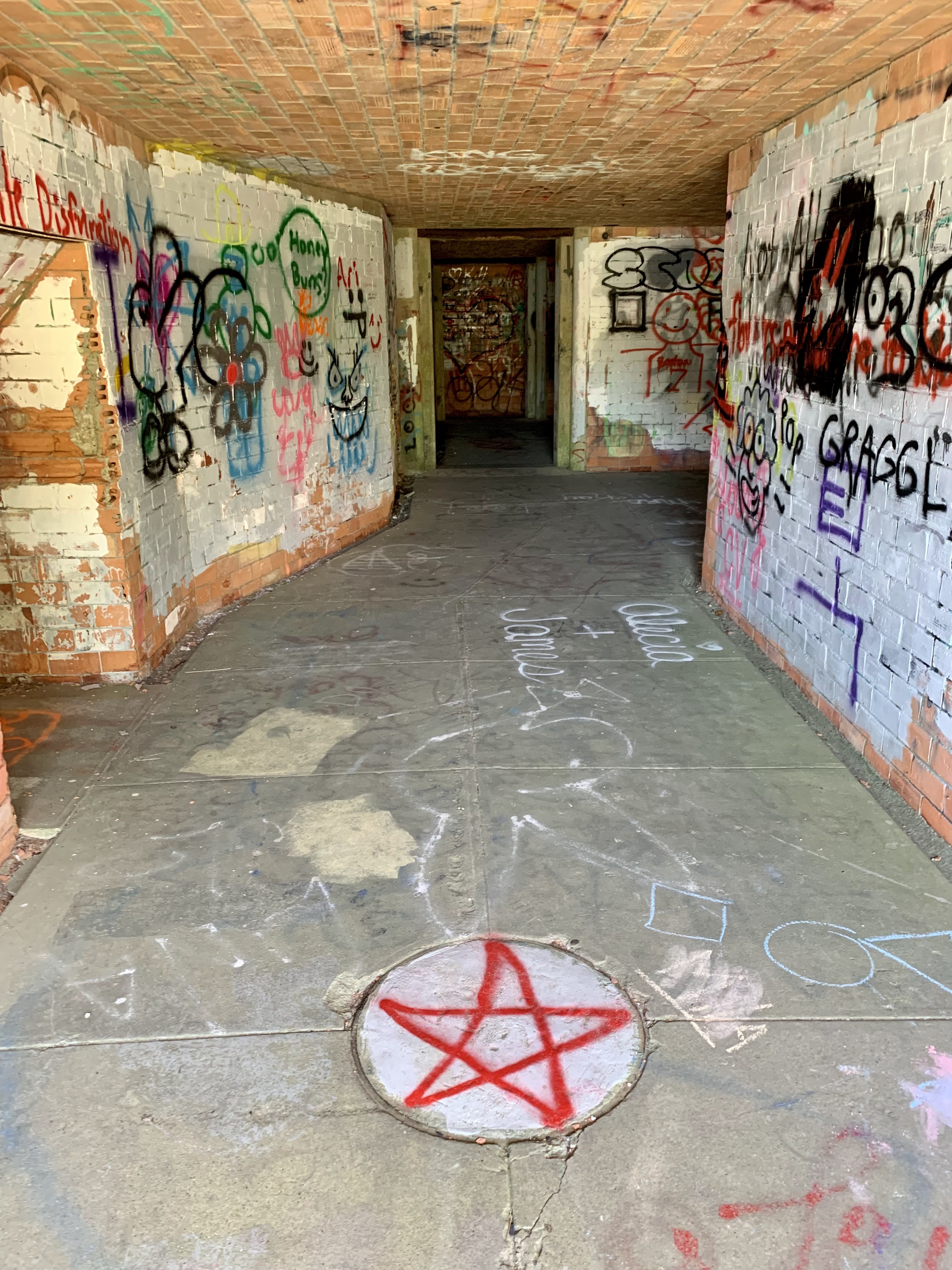
Happily, they didn't encounter any malevolent energy at the fort. Tony and I didn't either, although we did encounter a lot of graffiti. A lot!  Some of it is over 20 years old, so I don't think anyone has been cleaning the inside of the fort. The outside is almost spotless though (and has amazing views).

We had a good time exploring the fort. If you want to visit someplace historic, scenic, and possibly haunted, I'd recommend Fort Revere. 

March 06, 2022

The Ghost of Central Burying Ground

Boston is one of the oldest cities in America. It was first settled by the Puritans in 1630, and downtown Boston has some fine old cemeteries that reflect the city's age. Copp's Hill Burying Ground, the Granary Burying Ground, and King's Chapel Burying Ground are the resting places for patriots, Puritans, founding fathers, and possibly even Mother Goose. 

Those three cemeteries are amazing places to visit, and if you haven't been you should go today! They're also quite popular with tourists. But if you want a quieter, spookier, cemetery experience you should visit Central Burying Ground. It's the least popular of the four downtown cemeteries, but definitely has its own particular charms. 

I visited Central Burying Ground recently on a warm Saturday. I was meeting a friend downtown and arrived early, so I decided to kill some time wandering around the cemetery. It's located on Boston Common right next to the Boylston T station, but despite its convenient location very few visitors were there that day. There were only two people other than myself: someone feeding squirrels, and an Emerson student sitting on a crypt smoking a cigarette. 

At first I wasn't even sure it was open to tourists. Most of its gates were locked, and it took me a while to find the one open entrance. But once I was inside I had the cemetery mostly to myself. 

Central Burying Ground is the newest of the four old cemeteries. It was established in 1756, and is the resting place of British soldiers who died during the Revolution, American patriots from the Battle of Bunker Hill and the Boston Tea Party, composer William Billings, and painter Gilbert Stuart. Stuart is well-known for his portraits of George Washington, and is probably the most famous person buried there. 


According to local lore, Central Burying Ground is also home to at least one ghost. In the 1970s, a local dentist named Matt Rutger was walking through the cemetery on a pleasant spring day when he had a strange encounter. He was alone in the cemetery, but kept feeling someone tapping him on the shoulder. There was no one behind him when he turned around. The weird tapping continued, until finally he felt someone grab him by the collar and pull him backwards. Again, there was no one there. 

Rutger was understandably disturbed, so he began to walk quickly towards the cemetery gates. As he did, he saw something odd. 

"'I saw a young girl standing motionless in the rear corner of the cemetery, staring at me intently.' She wore a white dress, and her utter immobility in and of itself seemed eerie. Dr. Rutger turned in the opposite direction, but, to his amazement, the girl instantly relocated to the front of the cemetery, nearly fifty yards from where she'd stood only moments before. Dr. Rutger changed directions a couple more times, and each time the ghostly figure cropped up at a different station. Finally he made it to the sidewalk, but as he strode away he felt a hand slip into his pocket. He watched in amazement as his car keys levitated free of his pocket, dangled in mid-air, then fell with a jingle to the ground." (Holly Mascott Nadler, Ghosts of Boston Town, 2002).

That's quite the encounter. Rutger is not the only person who's encountered a ghost at Central Burying Ground. According to Sam Baltrusis's Ghosts of Boston (2012), other visitors have reported seeing a ghostly young girl in the cemetery, and one woman on a tour even became annoyed because she thought a fellow tourist was tapping her on the back. No one else had touched her, though. Some visitors have also said that someone (or something) grabbed their keys from their pockets. The ghost is apparently quite consistent. 

No one has identified the ghost who haunts Central Burying Ground. Many of the cemetery's graves have been disturbed by construction, so if you believe in ghosts perhaps that is what causes the alleged haunting. For example, in 1836 many bodies were moved to new tombs to accommodate a Boylston Street extension, and in 1895 many bodies were found in unmarked graves during construction of the subway line. They were re-interred in a large mass grave in the cemetery's northwest corner. No one likes to be awoken rudely from their sleep, right?

I did not see anything strange when I visited, but just had a peaceful cemetery stroll. I'd definitely recommend going to Central Burying Ground if you are interested in ghosts, or just want to enjoy a quiet space in the busiest part of the city. 

January 02, 2022

Two Phantom Houses Adrift in Time

I was browsing through my library of New England books and came upon two interesting stories. Both are supposedly true, and although they occurred more than 100 years apart they are very similar. They're about phantom houses that seem to travel through time. 

The first story comes from Footsteps in the Attic (2002), a book by paranormal investigator Paul Eno. In the summer of 1975, Eno was vacationing in Vermont when he met two local surveyors, Clement Ridley and Bud Harper. They told Eno about something strange they had seen. 

The previous summer, Ridley and Harper had been hired to survey a farmer's land in Johnson, Vermont. As they looked over the property they noticed an old wooden farmhouse that was not shown on any maps. The house was rundown but there was fresh laundry drying on the clothes line and smoke coming from the chimney. Someone was clearly living there. Oddly, there weren't any cars parked in the yard or any electrical or phone lines. 

The John Balch House, Beverly Massachusetts

Ridley and Harper saw a man in the yard. He carried an axe over one shoulder and wore an old-fashioned wide-brimmed hat. They called out to him, wanting more information on the property, but the man didn't hear or see them. They called out again and walked closer to the house. This time the axe-wielding man seemed to see hear something, but didn't see the surveyors even though they were only fifty feet away. 

Ridley and Harper got a little spooked. Why couldn't the man see or hear them? And should they be concerned he was carrying an axe?They decided to leave the area. 

They returned a few days later to continue surveying the land, but when they arrived they were surprised to find there was no old wooden house. Instead, they just found an overgrown cellar hole. Some of the stones looked blackened, as if they had been scorched in a fire long ago. 

Ridley and Harper were even more spooked than they had been when they encountered the man with the axe. A few days later, they learned from someone at Johnson's town hall that there had once been a house in that location - but it burned down in 1910.

Cue the spooky music.... 

Here's a very similar story, but from the 1840s. Caroline Howard King, a wealthy young woman from Salem, was vacationing in Beverly, Massachusetts with her family when she too encountered a house seemingly adrift in time. 

On a warm summer day King went for a walk in the woods with her cousin Nony and their maid Lucy Anne. People in Beverly called the woods Witches Woods, and said they were haunted. King and her companions didn't think anything strange would happen to them on a sunny afternoon, but they were wrong. 

After walking for only a short while they realized they were lost. It seemed as if the path they had followed into the woods had vanished. They wandered around for what seemed like hours until they finally came upon the ruins of an old farmhouse. King knew this was what the locals called the Homestead, and it was said to be haunted. Very little remained of the farmhouse – just a foundation, a chimney, and a stone stoop. An enormous lilac tree grew next to it. The trio explored the Homestead but there wasn’t much to see.

They soon located a path that climbed up a nearby hill. When they reached the top they could see a farmhouse below them where the ruined Homestead should have been, but this one was not in ruins. It was well-kept and smoke rose from its chimney. A small lilac shrub grew in front of it. As they watched a woman emerged and fed a flock of chickens in the yard from the stone stoop. Lucy Anne ran down to ask the farmwife for directions while King and her cousin waited at the top of the hill. 

Lucy Anne was dejected and confused when she returned. She couldn’t find the cozy little farmhouse anywhere, just the ruined Homestead and “hateful solemn old pine trees.” But now that she was back on the hill she once again could see the well-kept farmhouse with its smoking chimney. It was as if King, Lucy Anne, and Nony were looking backwards in time to a moment in history before the Homestead became a ruin. 

The threesome became even more eager to find their way home after they had this frightening realization. Luckily, they found a dry stream bed and after following it towards the ocean they emerged from the woods near their vacation house.  

Caroline Howard King includes that story in her memoir When I Lived In Salem (1822 - 1866), and I also include it in my new book Witches and Warlocks of Massachusetts. The similarities to Paul Eno's story are pretty obvious. One difference is that people in Beverly knew there was something weird about the Homestead, but no one in Johnson, Vermont seemed aware of the phantom house in their town. Also, the Homestead can only be seen in its original state from a distance, not up close, unlike the Johnson house.

I'm not really sure what to make of these stories. Neither one provides an explanation of why these houses seem to slip through time (if that's even what's happening). Or are the people who see them looking through some kind of window to the past? It's not clear.

If there's any lesson, it's that the past is not really gone and is here all around us. We live in one of the oldest parts of the US, with a rich history of strange phenomena. Maybe that history sometimes literally shows itself to the lucky few. And who knows, maybe 200 years from now someone will see a phantom McMansion appear along with its ghostly owner on a riding lawnmower. We too will become part of New England's weird and wonderful past. 

September 06, 2021

Last Room at the Inn: A Cape Cod Ghost Story

I just started watching the new season of American Horror Story, and the first half of the show is set in Provincetown, Massachusetts. It's not the first time the show has invoked New England's weird history. The second season was also set in Massachusetts (at an asylum full of dark secrets), and the show has invoked the myths and legends surrounding the Salem witch trials a few times. 

In the new season, a writer and his family move to Provincetown in the off-season so he can focus on his work. I'm sure nothing good will come of it, and it reminded me of a story I heard recently from a friend. Like the fictional writer, my friend moved to Provincetown in the off-season to do some writing. And like the writer, my friend also encountered something strange. There's one big difference though - my friend swears his story is true. 

In the 1980s, my friend (whom I'll call James) moved to Provincetown to work on a book. To cover his expenses, he took a job as the front-desk clerk at an inn in town. He worked the nightshift. The inn (which is still in business today) had multiple buildings and many rooms. 

On his first night on the job, the owner showed him where all the room keys were. They were all organized very neatly, but there was one key kept separate from all the rest. 

Not the haunted inn, just a motel I liked the looks of...

"That room," the owner said, "Don't let anyone stay there except as a last resort. It's not... a good room." The owner's stern expression discouraged James from asking any questions. 

Fall turned into winter, and James didn't need to think about the unrentable room. Business was slow, and the inn never became full. But that changed one holiday weekend in February. The weather became unseasonable warm, and all the rooms filled up - except that one. It was the only room left.

James was at the desk at midnight when a car pulled up. The driver came in, and asked if a room was available. "There's no place else in P-town with a vacancy," he said. "I'll take any room you have."

James rented him the last room.

The next morning he told one of the housekeeping staff he had rented the last room. The housekeeper, an older local woman, looked at him in horror. "You're never supposed to rent that room!" she said. 

"I know," James said. "But we were totally full. Can you tell me why we're not supposed to rent that room out?"

"Only if you help me clean it," she said. "I hate going there alone."

After the guest checked out, James and the housekeeper went to the unrentable room. James was disappointed when they opened the door. It looked just like any of the other rooms, with a large double bed and small bathroom. There was nothing strange at all. They set about stripping the sheets.

"Many years ago," the housekeeper said, "a young woman checked into this room by herself. No one thought much of it. She stayed one night, and then added another night. In the morning, she didn't check out. I came into this room to see if everything was OK."

"It wasn't. She had shot herself in the middle of the night. She had put a pillow over her head to mute the sound, and there was blood and brains and feathers everywhere. It was horrible. The worst thing I've ever seen."

The housekeeper explained that the young woman's ghost still haunted the room. People would hear her crying at night when the room was vacant, and the housekeepers heard her footsteps when they came in to clean. 

James and the housekeeper finished making up the bed, left the room, and closed the door. "And that's why," the housekeeper said, "the owner doesn't like to rent the room. That's also why he put twin beds in there. It discourages people from taking the room. No one likes to sleep in small beds these days." 

James was confused. "But there aren't twin beds in there," he said. "There's just one big bed. We changed the sheets on a double bed."

The housekeeper opened the door to the room. Inside were two twin beds.

*****

That's a great story, and it's perfect for Labor Day as the summer vacation season winds down and we move into fall. Thank you, "James" for sharing it with me!

I have a few updates. If you want to hear some interesting stories about witches (not ghosts), I'll be speaking Thursday, September 9 at 7:00 pm for the History Project about "Witches, Sex and Queer People: 1644 - 2021." The talk is free. You can register and find more details here. 


Also, my new book Witches and Warlocks of Massachusetts is now available wherever you buy books. It contains more than 70 stories about Bay State witchcraft, from witch trials in the 1600s to paranormal encounters in the 21st century. It's what you want to be reading this fall as the days grow short and the weather turns cool! I wouldn't suggest reading it at a haunted inn, though...