Showing posts with label Beverly. Show all posts

August 18, 2022

Vampires, Punk Rock and Local Legends in The Pallbearers Club

I don't often review novels here, but Paul Tremblay's new book The Pallbearers Club is based on an important piece of New England folklore. Tony gave it to me, thinking I might like it. He was right! It's creepy and very steeped in weird local history. 

The Pallbearer's Club tells the story of Art Barbara, a local rock musician, and his friendship with a mysterious woman named Mercy Brown. Art and Mercy first meet when Art is a high school student in Beverly, Massachusetts. He's tall, skinny, acne-ridden, and has a serious case of scoliosis. He's not the most popular kid in school and doesn't participate in any extracurricular activities. In order to beef up his college applications, he starts the Pallbearers Club, a group that attends funerals of people who don't have anyone to mourn them. Other than Art, only two other Beverly High students are members.  

And then Mercy joins. She's older than Art and is a student at Salem State. She introduces him to punk rock and alternative music. She has her own car. She helps him write a paper for a class on local history. The topic: the famous Rhode Island vampire Mercy Brown. 

Wait, what? The Pallbearers Club is presented as a memoir by "Art Barbara," but Art admits that this is a pseudonym. It's not his real name. "Mercy Brown" is not really his friend's name either. Art gives her that name in his memoir because... well, because he suspects she's a New England vampire.  

I've written about New England vampires before, and they're not like the vampires you see in pop culture. In the 19th century, tuberculosis was rampant across this area. No one knew what caused the disease, which was called 'consumption' at the time because it consumed people's lives and health. It often killed entire families, slowly and one person at a time. Some New Englanders believed the disease was actually caused by a dead family member feeding from the grave on the life force of their loved ones.

Artwork from The Pallbearers Club
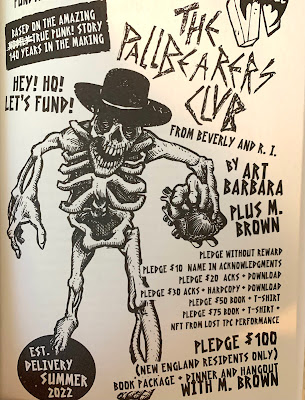
Mercy Brown is the best-known of the alleged New England vampires. Beginning in the 1880s, consumption began killing multiple members of the Brown family of Exeter, Rhode Island. The family's mother, Eliza, was the first to die, followed by her daughters Mary and Mercy. When young son Edwin grew ill, neighbors convinced his father George Brown to exhume their corpses to see if any showed signs of life in the grave. Mercy's corpse was undecayed and had blood in its hearts, which according to local folklore indicated she was feeding on Edwin. Her heart and liver were burned to ashes and mixed with water, which was given to young Edwin to drink. This was supposed to prevent Mercy's vampirism and save Edwin's life, but he died two months later. (Michael Bell's book Food for the Dead is the best non-fiction book about New England vampires.)

Is "Mercy Brown" in The Pallbearers Club really a vampire? Art certainly seems to think so and blames her for some unfortunate and unusual events in his life. Mercy vehemently disagrees. The Pallbearers Club is full of notes from Mercy in red pen, offering her perspective on events. Maybe, she suggests, Art is really a drug addict and incapable of moving on from the past. 
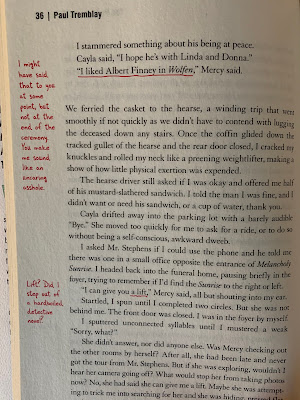
Who is right, Art or Mercy? I won't tell you. The Pallbearers Club is a creepy slow burn and keeps you guessing until the last page (and maybe even after). It doesn't have a lot of gore or violence, so when the weird stuff happens it's all the more effective. There are some nice twists, and I definitely was surprised by the ending. This is also very much a New England novel, set almost entirely in Providence, Rhode Island and Beverly. Tremblay lives north of Boston, and his love and knowledge of the region really shines through. If you like New England, weird folklore, and a twisty plot, add this to your reading list. 

January 02, 2022

Two Phantom Houses Adrift in Time

I was browsing through my library of New England books and came upon two interesting stories. Both are supposedly true, and although they occurred more than 100 years apart they are very similar. They're about phantom houses that seem to travel through time. 

The first story comes from Footsteps in the Attic (2002), a book by paranormal investigator Paul Eno. In the summer of 1975, Eno was vacationing in Vermont when he met two local surveyors, Clement Ridley and Bud Harper. They told Eno about something strange they had seen. 

The previous summer, Ridley and Harper had been hired to survey a farmer's land in Johnson, Vermont. As they looked over the property they noticed an old wooden farmhouse that was not shown on any maps. The house was rundown but there was fresh laundry drying on the clothes line and smoke coming from the chimney. Someone was clearly living there. Oddly, there weren't any cars parked in the yard or any electrical or phone lines. 

The John Balch House, Beverly Massachusetts

Ridley and Harper saw a man in the yard. He carried an axe over one shoulder and wore an old-fashioned wide-brimmed hat. They called out to him, wanting more information on the property, but the man didn't hear or see them. They called out again and walked closer to the house. This time the axe-wielding man seemed to see hear something, but didn't see the surveyors even though they were only fifty feet away. 

Ridley and Harper got a little spooked. Why couldn't the man see or hear them? And should they be concerned he was carrying an axe?They decided to leave the area. 

They returned a few days later to continue surveying the land, but when they arrived they were surprised to find there was no old wooden house. Instead, they just found an overgrown cellar hole. Some of the stones looked blackened, as if they had been scorched in a fire long ago. 

Ridley and Harper were even more spooked than they had been when they encountered the man with the axe. A few days later, they learned from someone at Johnson's town hall that there had once been a house in that location - but it burned down in 1910.

Cue the spooky music.... 

Here's a very similar story, but from the 1840s. Caroline Howard King, a wealthy young woman from Salem, was vacationing in Beverly, Massachusetts with her family when she too encountered a house seemingly adrift in time. 

On a warm summer day King went for a walk in the woods with her cousin Nony and their maid Lucy Anne. People in Beverly called the woods Witches Woods, and said they were haunted. King and her companions didn't think anything strange would happen to them on a sunny afternoon, but they were wrong. 

After walking for only a short while they realized they were lost. It seemed as if the path they had followed into the woods had vanished. They wandered around for what seemed like hours until they finally came upon the ruins of an old farmhouse. King knew this was what the locals called the Homestead, and it was said to be haunted. Very little remained of the farmhouse – just a foundation, a chimney, and a stone stoop. An enormous lilac tree grew next to it. The trio explored the Homestead but there wasn’t much to see.

They soon located a path that climbed up a nearby hill. When they reached the top they could see a farmhouse below them where the ruined Homestead should have been, but this one was not in ruins. It was well-kept and smoke rose from its chimney. A small lilac shrub grew in front of it. As they watched a woman emerged and fed a flock of chickens in the yard from the stone stoop. Lucy Anne ran down to ask the farmwife for directions while King and her cousin waited at the top of the hill. 

Lucy Anne was dejected and confused when she returned. She couldn’t find the cozy little farmhouse anywhere, just the ruined Homestead and “hateful solemn old pine trees.” But now that she was back on the hill she once again could see the well-kept farmhouse with its smoking chimney. It was as if King, Lucy Anne, and Nony were looking backwards in time to a moment in history before the Homestead became a ruin. 

The threesome became even more eager to find their way home after they had this frightening realization. Luckily, they found a dry stream bed and after following it towards the ocean they emerged from the woods near their vacation house.  

Caroline Howard King includes that story in her memoir When I Lived In Salem (1822 - 1866), and I also include it in my new book Witches and Warlocks of Massachusetts. The similarities to Paul Eno's story are pretty obvious. One difference is that people in Beverly knew there was something weird about the Homestead, but no one in Johnson, Vermont seemed aware of the phantom house in their town. Also, the Homestead can only be seen in its original state from a distance, not up close, unlike the Johnson house.

I'm not really sure what to make of these stories. Neither one provides an explanation of why these houses seem to slip through time (if that's even what's happening). Or are the people who see them looking through some kind of window to the past? It's not clear.

If there's any lesson, it's that the past is not really gone and is here all around us. We live in one of the oldest parts of the US, with a rich history of strange phenomena. Maybe that history sometimes literally shows itself to the lucky few. And who knows, maybe 200 years from now someone will see a phantom McMansion appear along with its ghostly owner on a riding lawnmower. We too will become part of New England's weird and wonderful past. 

November 16, 2020

Where the Witches Hid: Four Legendary Witch Locations in Massachusetts

When the Salem witch trials happened in 1692, most of the accused were arrested and put on trial. A handful, however, got wind of their arrest and fled Salem. Philip and Mary English escaped to New York, while John Alden either fled to either New York or Duxbury. Constable John Willard ran off to Lancaster, but was arrested there and ultimately executed in Salem. 

The Salem witch trials loom large in the history of Massachusetts, and many legends have developed around them. Here are four legendary locations where victims of the Salem witch trials supposedly hid from their persecutors. Is there any truth to these legends? Read on...

Witches Woods (Beverly)

There is a forested area in Beverly called Beverly Commons, but it was once known as Witches Woods. One explanation for this name is that Giles Corey, one of the more famous victims of the Salem witch trials, fled Salem Village home after being accused and hid in Beverly. 

I haven't found any evidence that Corey hid in Beverly before his arrest. Corey's fame rests on the fact that he was crushed to death with heavy stones while being interrogated by Salem's sheriff. Folklore claims that he stubbornly refused to answer any questions as the stones were piled on his body and his only dying words were, "More weight." His story and reputation grew over the years, and in the 19th century a poem called "The Ballad of Giles Corey" even claimed he was a sinister wizard and not a victim of injustice. But there's nothing to show he fled to Beverly. 

I certainly understand the temptation to connect an infamous historic personage like Giles Corey to a locale with an odd name. But I think Witches Woods got its name for an even stranger reason. According to Caroline King Howard, a wealthy Salem resident who vacationed in Beverly with her family in the 1840s, Witches Woods was said to the location of a haunted farmhouse. The farmhouse usually appeared as an old ruin, but at other times it seemed to be inhabited and in good repair. Travelers often got lost in the woods near the strange house, wandering for hours in an area that was not that large. A headless ghost also reputedly haunted the woods, wandering sadly among the trees with his head under one arm.

The Garrison Witch House (Rockport)

After farmer John Proctor of Salem Village was accused of witchcraft, his pregnant wife Elizabeth fled north to Rockport on Cape Ann. Her sons lived in that town and built a house to shelter their mother. The house, called the Witch House or the Garrison Witch House, is still standing today.

This is another legend that is probably not historically accurate. Elizabeth Proctor was imprisoned with her husband but her execution was delayed because she was pregnant. She was not executed and she and her child were released from prison in May of 1693. There's not evidence that she fled to Rockport.

The website Vintage Rockport points out that the Garrison Witch House was originally just called the Garrison House and may actually predate the Salem trials, possibly being built in the 1670s. But Vintage Rockport also points out that the house has been called the Witch House since at least the early 1900s. Here's a postcard from 1926 showing the Witch House:

I do wonder how and why the legend of Elizabeth Proctor became attached to this house. I also wonder if the house was originally associated with some other witch whose name has long been forgotten. Although the Salem witches are the most famous in the state, there were hundreds of witches in Massachusetts, both legendary and historical, who are less well known. 

It's also possible the term "Witch House" might have just meant "old creepy house." When I was a child in Haverhill there was a spooky looking Victorian house a few blocks from us. It loomed above the street on an embankment and was in perpetual disrepair. I sometimes heard people refer to it as the "Witch House." No one said a witch actually lived there, but it looked like one might. 

Witch Rock (Rochester)

Witch Rock is a large boulder in Southeastern Massachusetts. When I first wrote about it several years ago I was aware of four interconnected theories explaining its name:

1. The rock was originally the site of local Native American religious ceremonies. When the Puritans arrived they mistakenly identified these ceremonies (and the rock) with witchcraft.

2. When the Puritans arrived they noticed that the Native Americans avoided the rock and therefore they named it Witch Rock.

3. According to a Rochester legend, the soul of an executed witch is trapped inside the rock, along with some nefarious demons. The witch and demons can sometimes be heard howling from inside as they try to escape through the boulder's cracks.

4. The local Native Americans thought a witch was trapped inside the rock.

Commenters on my blog pointed out that there was also a fifth explanation. One of Rochester's early settlers was a man named Mark Haskell. According to tradition, Haskell was asked to be a juror in the Salem witch trials. He refused, and to avoid persecution he fled south to Rochester. He took shelter near a large boulder, which was named Witch Rock in commemoration. This story seems to be well-known among Haskell family genealogy buffs, and Mark Haskell is often referred to by them as Witchcraft Mark. 

I really don't know which of these theories is correct. Perhaps there is some truth to all of them? The boulder has been called Witch Rock since at least the late 19th century, and even today it is painted with the image of a witch and is often the site of Halloween festivities. The legend lives on!

Witch Caves (Ashland)

Many years ago Tony and I traveled out to Ashland to find the mysterious Witch Caves. 

After the witch trials ended in 1693, the families of those who were accused moved west out of Salem to Framingham. According to tradition, they sheltered in a series of caves while they built houses in their new home. The caves are now located in a large park in Ashland, which split from Framingham in the 1840s.

It took us a while, but I think we found the caves that day. They were filled with dead leaves a yard deep and didn't look that safe, but here are a couple photos from way back in 2012. Forgive the low quality!


Did refugees from the Salem witch trials live in these caves? It's possible. Families from Salem did settle in this part of the state - a Framingham street near the park is named Salem's End Road, and historians have confirmed that a house on that road was built by Sarah Clayse, who was the sister of Rebecca Nurse and Mary Easty. 

Rebecca and Mary were executed as witches during the Salem trials, while Sarah was only imprisoned. After the trials ended she and her husband Peter left Salem for Framingham. They didn't want to live near the people who had murdered their relatives. Several other Salem families followed them. So there is some basis to the Witch Caves legend. We don't know for certain that the refugees lived in the caves, but we do know that the settled in that area. 

Do you know any other legends about places where witches hid? Please leave a comment if you do. I'm curious to learn more.

December 29, 2013

Witches Woods in Beverly: A Headless Ghost, A Mystery Farm, and of Course Witches

I'm working on a book about North Shore folklore (which hopefully will come out in the fall of 2014), and I've found a lot of interesting stories. I'm saving most of them for the book, but I thought this was a good one to share for a gloomy early winter day.

In the town of Beverly, Massachusetts is a large wooded conservation area officially called Beverly Commons, but which has also been know for many years as Witches Woods. The story most currently told about the name is that Giles Corey supposedly hid out in these woods while trying to escape from the Salem witch trials. I'm not sure how true that story is. Giles Corey was quite elderly when he was accused of witchcraft and it wasn't easy to get from Salem Village to Beverly back in the 1600s. Still, it's a good story.

Even better stories about Witches Woods can be found in Caroline Howard King's When I Lived in Salem, 1822 -1866. This book, which is a collection of reminiscences about daily life on the North Shore in the early 19th century, is fascinating. Do you want to know what people ate for dessert in 1836? Marlborough pudding and cranberry pie, of course. What happened to a woman if she fell asleep during the interminable Sunday church services? A church official called the Tidy Man (aka the Tithing Man) would tickle her awake with a fox-tail mounted on a pole. Drowsy men weren't treated so gently - they were whacked back into consciousness with a wooden knob mounted on the other end.

Caroline Howard King's family owned a summer home in Beverly called Thisselwood, which abutted Witches Woods. She doesn't mention any stories about witches, but does write about some other spooky occurrences happening in the area.

Thisselwood, from the Harvard University Library.
 According to her book, the locals believed that a headless ghost wandered through the woods. Although they were reluctant to speak of him, many had seem him walking forlornly among the trees carrying his head under his arm. No one knew what tragedy had led him to this doom. Caroline King and her family jokingly named him Heady, but Caroline didn't laugh on late night carriage rides through the woods. She was quite afraid of seeing Heady.

She never did see the decapitated ghost, but had instead another odd experience in Witches Woods. One summer morning in 1841 Caroline (who was nineteen at the time) set off for a stroll in Witches Woods with her nine-year old cousin Nony and a maid named Lucy Anne. After walking for while the group decided to have a snack and rest under some hemlock trees a short distance from the path. When they were done eating they walked back to the path - but it wasn't there. Despite searching in all directions no path could be seen at all. It was if it had vanished.

Caroline and her companions wandered through the woods for hours, but somehow always came back to the exact same spot. They could hear the ocean and knew they weren't far from home but were unable to get there.

Trying one last time to find the path they stumbled upon a clearing in the woods, in the middle of which stood the remains of a long-abandoned house: a chimney, a cellar-hole, and a stone stoop with an enormous lilac bush growing next to it. This ruin, Caroline knew, was called by her neighbors the Homestead, and was shunned and said to be haunted.

A path led from the clearing up a small hill, and the group decided to follow it. From the top of the hill they had a view over the woods, and could see nearby at the foot of the hill a cozy farmhouse with smoke rising from the chimney. The house had a broad stone stoop, and as they watched a woman came outside and scattered feed for the chickens. Excitedly, Lucy Anne ran down towards the house to ask for directions home.

Caroline and her cousin waited, and waited, and finally a dejected Lucy Anne returned. No matter how many times she had walked around the hill she couldn't find the farmhouse. In fact, all she saw were "hateful solemn old pine trees." However, she had found a dry stream bed which they followed out of the woods to the beach and eventually home to Thisselwood.

James Russell Lowell, from Wikipedia.

The writer James Russell Lowell was staying with the King family at the time. Lowell claimed he had the second sight and had seen a ghost at Elmwood, his family's estate in Cambridge (now the home of Harvard University's president), so he set off into the woods determined to find the haunted farm. He never found either the abandoned ruin or the elusive farmhouse (which was clearly a ghostly image of the ruin as it formerly appeared).

What would have happened if he or Lucy Anne actually had found the house and asked the farm wife (if that's what she was) for directions? What if they went inside for a drink of water or a bite to eat? I think they should be thankful they never found they house, because fairy tales and ghost stories suggest they might still be inside today.

August 21, 2011

The Boogeyman of Beverly


Beverly Harbor

I like to think I'm too old to believe in the boogeyman. I'm assuming most of my readers feel the same way.

In the 1970s, a family bought an old decrepit mansion near the harbor in Beverly, Massachusetts. I'm sure they didn't believe in the boogeyman either - at least until they moved in.

Almost immediately upon moving in the family experienced some strange things. For example, the door that led from the house's kitchen into the backyard was found open every morning, even when it had been locked the night before. Items in the kitchen and pantry were often rearranged, and the kitchen table moved.

Suspecting local pranksters, the family's father tried to fix the situation by installing a new double lock on the door. I didn't work - the door was still found wide open each morning. Adding to the general creepiness, the family often felt like they were being watched while in the kitchen, and their dog refused to enter the room late at night.

Things got stranger.

One afternoon Steve, one of the family's sons, heard his mother yell, "Steve, stay out of your father's office!" Steve came out of the living room, and his mother looked shocked. They were both on the first floor; his father's office was on the second floor. But if if wasn't Steve, who was in the office? No one else was home.

As they started to call the police, they saw through the window a shadowy figure jump from the office's second floor balcony. The police came to investigate but no signs of an intruder were found.

That summer, most of the family retreated to their New Hampshire vacation house, but Steve, who worked as a lifeguard in Beverly, stayed behind. He slept with an antique WWII pistol on his nightstand, wrapped in a piece of old rabbit fur for protection.

One night, Steve awoke abruptly at 3:00 am. There was someone in his bedroom, and they were laughing maniacally at the foot of his bed. The room was pitch black. Terrified, Steve rolled onto the floor and reached for the gun.

He was surprised to find the items on the nightstand had been rearranged. The lamp and clock had been moved around, and the pistol was no longer wrapped in fur.

Still, Steve was able to find the pistol and he shouted at the intruder, telling him (it?) to leave or get shot. There was no answer. Steve finally got up enough nerves to run out of the room and out into the backyard. He got into his car and drove off, and kept driving until the sun came up.

When he went back home, he noticed something on the kitchen table.

...placed on the kitchen table, folded like a fancy napkin was the rabbit fur that had been on my bedroom nightstand.

Steve immediately got back in his car and drove to New Hampshire. He spent the rest of the summer at the vacation home, and then went off to college. The family sold the house a few weeks later.

That's the story as it appears in Robert Ellis Cahill's New England's Things That Go Bump in the Night. Cahill was a retired Salem sheriff, and published about a dozen small booklets of New England folklore and ghost stories. They're hard to find these days, but if you locate one buy it. You won't be sorry.

Cahill titled the chapter about the boogeyman, "The Boogeyman of Beggerly", using an old derogatory name for Beverly. Hey, it sounds better with boogeyman, so why not?

I was recently up in Beverly to see my college friend Lori, and we thought we'd try to find the house. I can't be 100% sure, but I think we found it.

And you know what? It really does look haunted.