Showing posts with label Providence. Show all posts

August 18, 2022

Vampires, Punk Rock and Local Legends in The Pallbearers Club

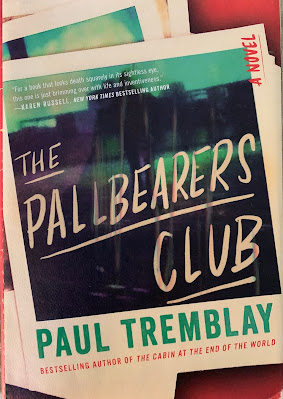
I don't often review novels here, but Paul Tremblay's new book The Pallbearers Club is based on an important piece of New England folklore. Tony gave it to me, thinking I might like it. He was right! It's creepy and very steeped in weird local history. 

The Pallbearer's Club tells the story of Art Barbara, a local rock musician, and his friendship with a mysterious woman named Mercy Brown. Art and Mercy first meet when Art is a high school student in Beverly, Massachusetts. He's tall, skinny, acne-ridden, and has a serious case of scoliosis. He's not the most popular kid in school and doesn't participate in any extracurricular activities. In order to beef up his college applications, he starts the Pallbearers Club, a group that attends funerals of people who don't have anyone to mourn them. Other than Art, only two other Beverly High students are members.  

And then Mercy joins. She's older than Art and is a student at Salem State. She introduces him to punk rock and alternative music. She has her own car. She helps him write a paper for a class on local history. The topic: the famous Rhode Island vampire Mercy Brown. 

Wait, what? The Pallbearers Club is presented as a memoir by "Art Barbara," but Art admits that this is a pseudonym. It's not his real name. "Mercy Brown" is not really his friend's name either. Art gives her that name in his memoir because... well, because he suspects she's a New England vampire.  

I've written about New England vampires before, and they're not like the vampires you see in pop culture. In the 19th century, tuberculosis was rampant across this area. No one knew what caused the disease, which was called 'consumption' at the time because it consumed people's lives and health. It often killed entire families, slowly and one person at a time. Some New Englanders believed the disease was actually caused by a dead family member feeding from the grave on the life force of their loved ones.

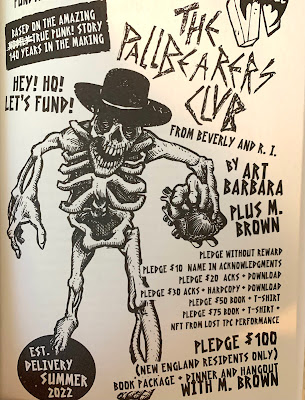
Artwork from The Pallbearers Club

Mercy Brown is the best-known of the alleged New England vampires. Beginning in the 1880s, consumption began killing multiple members of the Brown family of Exeter, Rhode Island. The family's mother, Eliza, was the first to die, followed by her daughters Mary and Mercy. When young son Edwin grew ill, neighbors convinced his father George Brown to exhume their corpses to see if any showed signs of life in the grave. Mercy's corpse was undecayed and had blood in its hearts, which according to local folklore indicated she was feeding on Edwin. Her heart and liver were burned to ashes and mixed with water, which was given to young Edwin to drink. This was supposed to prevent Mercy's vampirism and save Edwin's life, but he died two months later. (Michael Bell's book Food for the Dead is the best non-fiction book about New England vampires.)

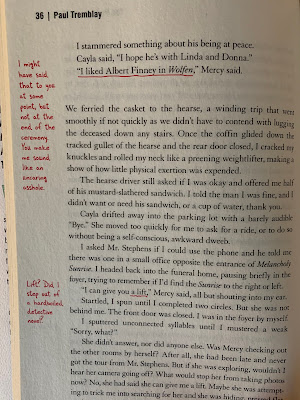
Is "Mercy Brown" in The Pallbearers Club really a vampire? Art certainly seems to think so and blames her for some unfortunate and unusual events in his life. Mercy vehemently disagrees. The Pallbearers Club is full of notes from Mercy in red pen, offering her perspective on events. Maybe, she suggests, Art is really a drug addict and incapable of moving on from the past. 

Who is right, Art or Mercy? I won't tell you. The Pallbearers Club is a creepy slow burn and keeps you guessing until the last page (and maybe even after). It doesn't have a lot of gore or violence, so when the weird stuff happens it's all the more effective. There are some nice twists, and I definitely was surprised by the ending. This is also very much a New England novel, set almost entirely in Providence, Rhode Island and Beverly. Tremblay lives north of Boston, and his love and knowledge of the region really shines through. If you like New England, weird folklore, and a twisty plot, add this to your reading list. 

October 14, 2020

Take A Tour of New England's Lovecraft Country

It's October, so let's take a tour. No, not a foliage tour - a tour of Lovecraft country.

We've been watching Lovecraft Country on HBO these past few weeks. It's a horror/fantasy series based on Matt Ruff's novel of the same name; the main character is a Black veteran of the Korean War who likes science fiction and fantasy literature. The series explores a variety of genres (occult horror, science fiction, ghost stories, Indiana Jones style adventures) to examine racism and what it's like to be Black in America.

Despite the title, there's not a lot of Lovecraft in the show. H.P. Lovecraft (1890 - 1937) was a Rhode Island native and is considered one of the world's most influential horror writers. In recent years a lot of critical attention has been paid to the racism in his work, and Lovecraft Country in some ways is the attempt of genre fans, like author Matt Ruff and show runner Misha Green, to grapple with the negative aspects of the stories they love.

In one sense, the title Lovecraft Country refers to the fictional genres the show explores, the worlds of fantasy and horror fiction. However, the term "Lovecraft Country" existed before either the novel or the show, and was coined by scholars to refer to the various towns and places Lovecraft repeatedly mentions to in his fiction. Most of those places are in New England, so New England is actually Lovecraft country.

One of the reasons Lovecraft's fiction remains effective is because he blends facts and fiction. For example, he'll slip a fictional book like the Necronomicon into a list of actual occult books in a story. He'll mention real people like Cotton Mather or Dr. John Dee while discussing fictional occultists. Its a technique that leaves the reader wondering what's real and what's not.

He used a similar technique when writing about geographic locations. The monster-haunted coastal town of Innsmouth is fictional, but it's supposedly located near Rowley and was inspired by Newburyport, both real towns in Massachusetts. Many of the fictional locations he mentions are actually based on real ones, so you could take an actual tour of Lovecraft country. It might be a nice way to spend an October day. Just watch out for those tentacled monsters.

And here's a word of practical caution - if you do visit any of these places please follow COVID-19 protocols. Wear a mask. Maintain six feet of distance. Wash your hands or use hand sanitizer. Stay healthy and keep the horror in your life fictional.

Arkham: 

This decaying city with a sinister history appears in many of Lovecraft's stories. It's the home of Miskatonic University, a prestigious school whose library contains a copy of the accursed Necronomicon. Arkham was the site of witch trials in the 17th century and residents believe that witchcraft still secretly happens there. 

Photo from StreetsOfSalem.com

Arkham's location was not clearly defined in Lovecraft's early stories, but in later stories the town is clearly an analogue of Salem, Massachusetts. The cemetery in his 1923 story "The Unnamable" was inspired by Salem's historic Charter Street Burying Ground, and some family names that Lovecraft uses (like Derby and Pickman) are old Salem family surnames. 

Featured in: The Unnamable (1923), The Dunwich Horror (1928), The Dreams in the Witch House (1933), The Thing on the Doorstep (1937).

Boston:

Boston is obviously a real place. According to Lovecraft, the Massachusetts capital is riddled with underground tunnels home to man-eating, dog-faced ghouls. Hopefully that isn't true. Lovecraft also claims there is an entrance to the realm of dreams in Granary Burying Ground on Tremont Street, which probably isn't true either but sounds nicer than ghoul tunnels.

Boston's North End. Photo courtesy Boston Public Library.

Featured in: Pickman's Model (1926), Dream Quest of Unknown Kadath (1927)

Chesuncook:

Ancient stone ruins can supposedly be found in this small Maine town. Hidden beneath the ruins is a stairway of 6,000 steps that leads to a pit full of shoggoths, hideous protoplasmic monsters. A secret cult of witches gathers there to celebrate their rituals. 

I don't think the pit of shoggoths is real, but Chesuncook is. It's actually a small lakeside town that Henry David Thoreau visited in the 1840s, and today is popular spot for rafting trips. The word "chesuncook" means "place of geese," which doesn't sound particularly frightening. 

Featured in: The Thing on the Doorstep (1937)

Dunwich:

"Outsiders visit Dunwich as seldom as possible, and since a certain season of horror all the signboards pointing towards it have been taken down..." According to Lovecraft, this central Massachusetts town is full of historic architecture, but "most of the houses are deserted and falling to ruin" while Dunwich's only church has been converted into a grimy general store. The inhabitants of Dunwich are rumored to be both inbred and abnormally intrigued by black magic. 

Wilbraham Methodist Meeting House, from LostNewEngland.com

Dunwich is totally fictional, but was inspired by a visit Lovecraft paid to a friend in Wilbraham, Massachusetts. He enjoyed the trip, and I'm sure he appreciated Wilbraham's historic town center. Some aspects of Dunwich were also inspired by a visit to Athol, Massachusetts. 

Featured in: The Dunwich Horror (1928)

Haverhill:

Haverhill, Massachusetts is the birthplace of two academics who learned things they'd rather forget. Walter Gilman studied theoretical physics while staying in an old 17th century Arkham house once inhabited by a witch and died a strange death. Nathaniel Wingate Peaslee, a professor at Miskatonic University, experienced a strange bout of amnesia for several years. When it subsided he claimed his mind had been kidnapped by monstrous alien beings from the past.

Haverhill is real, and is where I was born. As a child I was intrigued and yet terrified to see it referenced in Lovecraft's fiction. Lovecraft's friend William 'Tryout' Smith lived in Haverhill and he visited the city often. 

Featured in: The Dreams in the Witch House (1933), The Shadow Out of Time (1936)

Innsmouth:

According to Lovecraft, this decaying Massachusetts port city experienced a strange plague in 1846, although some residents say it was actually a massacre of some kind. Shortly thereafter a religious group called the Esoteric Order of Dagon took over Innsmouth. The Order was investigated by the US government in 1928 and many of its members arrested. The Navy also torpedoed an unknown target off the city's coast. 

Parker River Wildlife Refuge in Newburyport

Innsmouth is another fictional creation, but is very closely modeled on Newburyport, Massachusetts. Lovecraft visited that city in 1931, at the height of the Great Depression, and wrote that it was so run down "it is today locally known as the City of the Living Dead." When Lovecraft visited the business district was nearly abandoned and many of the buildings were falling into ruin. Today it's a thriving and renovated tourist destination.

Featured in: The Shadow Over Innsmouth (1936)

Kingsport:

Another Massachusetts town with strange secrets. Some residents are said to practice ancient rites during winter solstice. An elderly man who hates immigrants supposedly uses black magic against them. Locals discourage anyone from visiting a strange old house that sits on top of a nearby cliff. 


Another fictional town, but like Innsmouth also inspired by a real location, this time Marblehead, Massachusetts. Lovecraft was an enormous fan of Colonial architecture, and he wrote that his 1922 visit to Marblehead was "the most powerful single emotional climax experienced during my nearly forty years of existence." That must be some really good architecture. 

Featured in: The Terrible Old Man (1920), The Festival (1923), The Strange High House in the Mist (1926)

Providence:

Lovecraft was born in the Rhode Island capital and lived most of his life there. The epitaph on his monument in the Swann Point Cemetery reads: "I Am Providence." He clearly loved the city and set many of this stories there. In Lovecraft's world, an old house on Benefit Street was haunted by a life-sucking fungus, a church steeple on Federal Hill housed a mysterious giant crystal, and the city was home to psychic artists, reincarnated wizards, and nautical cult members. Those things may not be true, but Providence is still pretty amazing even in real life.

Featured in: The Shunned House (1924), The Call of Cthulhu (1926), The Case of Charles Dexter Ward (1927), and The Haunter of the Dark (1935).

September 11, 2019

The Ghost Who Falls Forever: A Haunted Providence Hotel

A couple weeks ago I posted about H.P. Lovecraft's ghost appearing at a house in Providence. Some Lovecraft fans responded to me that it was unlikely Lovecraft would appear as a ghost since he was a materialist who didn't believe in the afterlife. I jokingly replied that as a skeptic Lovecraft would just think himself back into non-existence if he came back as ghost.

All of this made me think a little bit about ghosts. If they do exist, what exactly are they? How does being a ghost work? It seems like three main types of ghosts are encountered:

1. Some ghosts are supposedly the souls of people who continue on after death. Although they are aware they are dead they maintain the personalities they had while they were living and are interested in the mortal life they left behind. These are often the ghosts that have unfinished business, or watch over a house or business they were attached to. Some of these ghosts are benevolent, acting like guardian angels for their loved ones who are still alive, and some are the exact  opposite, acting maliciously towards living people who "trespass" on property they still view as theirs.

Providence's Graduate Hotel, which is said to be haunted.
2. On the other hand, some ghosts are said to be the souls of people who don't know they're dead. They often died such sudden or violent deaths they didn't to realize they were dying. As a result their souls remain here in a confused and often very emotional state. These ghosts might be the souls of small children, murder victims, or the victims of sudden accidents. These are the ghosts that are supposedly seen sobbing, wailing, or wandering around in a confused state. Psychic mediums and other spiritual practitioners will often try to help these spirits move on to the afterlife.

3. Finally, some ghosts aren't quite the souls of people at all. Instead, they are simply spectral records of a traumatic act that happened in the past. For example, battle fields are often said to be haunted by phantom armies that replay old battles over and over. Sites of massacres or accidents that claim many lives are also supposedly haunted in similar ways. The smell of burning buildings and the cries of battlefield victims float through the air, but there is no soul, either intelligent or confused, behind these phenomena. They are simply like films that loop for eternity.


Well, at least that's what people say. Which brings me to the subject of this week's post: a ghost that supposedly haunts the Graduate Hotel in Providence, Rhode Island. The Graduate was built in 1922 and was originally called the Biltmore Hotel. The iconic "Biltmore" sign still remains on its roof.

Like most old hotels the Graduate is allegedly haunted. According to legend, on October 28, 1929 a wealthy businessman checked into the hotel and had a grand old time. He ate, drank and danced like he didn't have a problem in the world. The economy was good and he was making money hand over fist.

Everything changed the next day. The stock market crashed, precipitating the Great Depression. October 29, 1929 became known as Black Thursday. It certainly was a dark day for the businessman staying at the hotel. When he heard the news he realized he had lost everything in the crash. It was more than he could take and threw himself out the window of his 14th floor room. He died instantly when he hit the sidewalk.

His ghost supposedly still haunts that room on the 14th floor and he re-enacts his death repeatedly, over and over and over. Some guests who stay at the hotel have reported seeing someone falling past their window, but when they look outside there is nothing there. All of these guests have stayed in one of the rooms the businessman fell past as he plummeted to his doom. The businessman keeps throwing himself out the window, possibly forever.


So what type of ghost is this, if it exists? Personally, I think it would be type 3, a recording of a traumatic event that replays repeatedly. At least that's what I hope. It's depressing to think that someone is so traumatized that they keep trying to kill themselves over and over. That almost sounds like something that could be true and not just a fun legend. 

*****

My source for this week's post is Rory Raven's excellent book Haunted Providence. 

August 28, 2019

H.P. Lovecraft's Ghost Appeared at This House

In 1971 the ghost of H.P. Lovecraft appeared to a Brown University undergraduate living in an apartment at 10 Barnes Street in Providence, Rhode Island. Lovecraft, a well-known author of horror and weird fiction, lived in this building from 1926 until 1933. He died in 1937 from intestinal cancer exacerbated by malnutrition.

The appearance of Lovecraft's ghost is briefly mentioned, as if it were no big deal, on page 441 of L. Sprague de Camp's H.P. Lovecraft: A Biography (1975). No big deal?! It's the ghost of H.P. Lovecraft!

10 Barnes Street, Providence, Rhode Island.
I'm assuming that de Camp didn't believe the story, and probably no one else did since it doesn't appear in many places. Lovecraft himself was a staunch materialist and didn't believe in the human soul so he wouldn't believe this story either. But let's suppose for a moment this story is true and that Lovecraft's ghost really did manifest to a Brown student in 1971. Why would he appear at 10 Barnes Street and in that particular year?

Ghosts allegedly appear in places to which they have strong emotional connections. We've all heard stories about ghosts appearing in the places where they were murdered, but ghosts also appear at locations where they had positive emotional experiences. That might be the case here. Lovecraft spent his most productive and successful years as a writer at 10 Barnes Street. While living there he wrote some of his most famous stories, including "Call of Cthulhu," "The Dunwich Horror," and "At The Mountains of Madness." Perhaps his spirit had fond memories and didn't want to leave.

Ghosts are also said to appear when they have unfinished business. They show up when they want someone to bury their undiscovered body or send a message to their surviving loved ones. I don't think Lovecraft's ghost appeared in 1971 to reveal any dark secrets, but he probably had a lot of unresolved issues. His childhood and adolescence were like something from a Gothic novel: both parents dying in an insane asylum, the slow dissipation of his family's wealth, his mother telling him he was too hideous to be seen publicly, and a nervous breakdown in his teenage years.

A statue of Lovecraft at the Providence Art Club.
His adult life was also quite complicated and full of contradctions. Here a few examples:


  • Lovecraft was a racist and an anti-Semite, yet he married the Jewish immigrant Sonia Greene and was best friends with Samuel Loveman, a gay Jewish poet to whom he dedicated the homo-erotic short story "Hypnos."
  • Lovecraft seemed to have little interest in sex but his stories are full of bestiality, incest and intercourse with monsters.
  • Lovecraft lived most of his life in poverty but thought full-time work was beneath him. Towards the end of his life he survived on a near-starvation diet but spent his meager income on postage answering letters from anyone who wrote to him. According to one estimate he wrote up to 100,000 letters.
  • Lovecraft didn't believe in the supernatural, but based many of his stories on dreams and nightmares so vivid that some occultists are convinced he really had access to occult secrets. 


So, I think it's very likely that Lovecraft's ghost (if it exists) has some unfinished business.

Ghosts may also be vengeful, appearing because they are angry at the living. But why would Lovecraft be angry at a Brown undergrad? Maybe because Lovecraft always wanted to attend Brown University and study astronomy but couldn't even finish high school due to his fragile mental state. Perhaps after death his ghost appeared to berate whichever poor Brown student was living at 10 Barnes Street in 1971. I can also imagine that a student at that time could be a long-haired hippie, something that might also anger the conservative author. 

Of course this is all just speculation on my part. Lovecraft's ghost probably didn't even appear at Barnes Street. However, if you want to find out, you can rent an apartment there. Nothing is available right now, but it looks like they rent for around $1,200/month.  Maybe the next time one comes on the market someone will find out for sure if the ghost of H.P. Lovecraft is still lingering around Providence. 

*****
I was inspired to write this because this past weekend was I attending NecronomiCon 2019, the bi-annual H.P. Lovecraft convention in Providence. I was browsing through Rory Raven's Haunted Providence: Strange Tales From The Smallest State (2008) to prepare for my trip and read the story about 10 Barnes Street. Raven's book directed me back to the original source, de Camp's biography of Lovecraft. 

July 20, 2015

Celebrate H.P. Lovecraft's 125th Birthday This August

Cancel that clambake and skip the trip to the beach. This August you need to celebrate the 125th birthday of Howard Phillips Lovecraft!

H.P. Lovecraft, for those who don't know, was one of America's most influential fantasy and horror writers. Born into a wealthy Providence family on August 20, 1890, Lovecraft should have led a life of privilege and ease. Things didn't quite work out that way. His life is almost was almost as strange as his fiction.

After his father died in an insane asylum, little Howard and his mother went to live with her father in his Providence mansion. As a boy he was spoiled by his aunts and grandfather, but his mother told him he was too ugly to be seen in public and let him believe until he was three that he was a girl. Unsurprisingly, his mother also later died in an insane asylum and Lovecraft himself suffered from unspecified nervous and mental disorders throughout his early years.

H. P. Lovecraft
Lovecraft was quite intelligent. He never finished high school due to those nervous disorders but did read widely in his grandfather's extensive library. (It even included an original copy of Cotton Mather's Magnalia Christi Americana, which makes me jealous!) When his grandfather lost his money and died Lovecraft and his two aunts fell into poverty. Due to his many neuroses and his belief that he was of a superior social class Lovecraft never found full-time work. Instead, he dabbled in amateur journalism and wrote an estimated 100,000 letters. That's right - one hundred thousand letters. And they were long! At one point he sent one aunt a forty page letter every week.

Because he wrote so many letters, we know that he was quite racist. In his letters he railed against blacks, Jews, Mexicans, the Irish, French-Canadians, Asians, Italians, and even people from Finland. In short, he said didn't like anyone except white people of Anglo-Saxon descent. He also expressed strong homophobic opinions in some letters. On the other hand, he briefly married an Eastern European Jewish woman, and was good friends with several gay writers, including the poet Samuel Loveman, who served as his muse for several years. These actions seem to contradict all vitriol he included in his letters, and even the racism in those decreased as he grew older. He died in 1937 at the age of 47.

Lovecraft was a big tangle of neurotic contradictions, but in spite of this - or maybe because of this - he posthumously became the 20th century's most influential horror writer. He moved horror fiction away from the standard Gothic tropes of witches, ghosts and old castles into a new direction featuring extra-dimensional alien gods, hidden lost races, and secret tomes of blasphemous horror. He also liberally sprinkled New England history and folklore into his stories. If you've never read any of his fiction, "The Dunwich Horror," "The Shadow Over Innsmouth," and "Dreams In the Witch House" are good places to start and have a strong New England flavor.

The Call of Cthulhu (2005)

There are two big celebrations happening this August to mark Lovecraft's 125th birthday. For you cineastes, the Brattle Theater in Cambridge is holding an H.P. Lovecraft film festival from August 20 to August 24. They are showing a nice assortment of movies. Some are based closely on Lovecraft's writings, like the recently filmed but retro-spooky black and white films Call of Cthulhu (2005) and The Whisperer in Darkness (2011), which try to capture what a Lovecraft movie would look like if it were filmed during his lifetime.

The Crimson Cult (1968)
Other films update his stories and put them in a more contemporary setting. The Dunwich Horror (1970) takes Lovecraft into the Age of Aquarius, with Dean Stockwell as a dreamboat wizard aiming to destroy the world and Sandra Dee under attack by psychedelic hippies, while The Crimson Cult (1968) sets "Dreams In the Witch House" in swinging England, with Christopher Lee, Barbara Steele as a body-painted witch, and a brawny guy in a leather jockstrap. The New England flavor is gone, but these movies are so groovy it doesn't matter!

From Beyond (1986)
From Beyond (1986) gives Lovecraft the 1980s schlock treatment. When a group of scientists stimulate their pineal glands, they suddenly see the invisible extra-dimensional monsters that constantly surround us. Uh-oh! The monsters can see them as well. Rubbery special effects, leopard print lingerie, and lots of slime ensue.

In the Mouth of Madness (1994)

Other films are inspired by Lovecraft but aren't based on a specific story. Hellboy (2004) makes Lovecraftian monsters and sorcery into an action blockbuster. John Carpenter's In the Mouth of Madness (1994) features a book so terrifying it drives its readers insane - and maybe worse. Lovecraft's work is quite popular overseas; in the Japanese film Marebito (2004), a lonely man exploring tunnels below the Tokyo subway system encounters a mysterious woman with strange appetites.

I'm sure that diehard fans will be flocking to Providence for NecronomiCon, a convention about all things Lovecraftian happening August 20 - 23. The convention features a wide variety of activities. If you're feeling brainy, you can listen to panelists discuss topics like "The Undying Leaders’: Ultraterrestrial Demonologies, Cthulhoid Conspiracies and the Rise of Lovecraftian Parapolitics." And when your brain tires out, there are games, an art show, the Eldritch Ball, and readings from horror authors. A good spooky time for everyone!

June 22, 2014

Three Haunted Buildings in Providence

Last week I was down in Providence for a conference. I had some free time one afternoon so I stopped by the Brown University Bookstore and left with a pile of new folklore books. One of them was Haunted Providence: Strange Tales from the Smallest State by Rory Raven.

As walked back to my hotel I had the sudden realization that my route could be taking me past various haunted locations. I pulled Haunted Providence out of my bag, and with just a quick scan found three haunted buildings that were on the way back to my hotel.


First up was the Nightingale-Brown House, which is located on Benefit Street. The house was built in 1792 by Captain John Nightingale, a Providence merchant who made his money trading sugar, rum and slaves in the notorious Triangle Trade. The house was sold to the Brown family in 1814, and is now part of Brown University.


Raven tells the following story about the Nightingale-Brown House. One night a new custodial worker was assigned to work in the large, rambling building. He and an older, more experienced co-worker were the only two people in the house, and the new custodian felt a little creeped out as he cleaned the old, empty rooms.

Towards the end of the shift he had to clean a room that had a large portrait on one wall. The eerie sensation he had experienced all night intensified as he vacuumed and dusted under the grim and watchful eyes of the painting. He completed his work as quickly as he could and turned off the light as he left the room.

As soon as he shut off the light a sepulchral voice said, "DON'T TURN THAT LIGHT OUT."

The  new custodian ran out and found his co-worker. After he told him what happened, the older man said, "Yeah, strange things happen in that room. Don't worry about it, but whatever you do, don't turn out that light!"


Near the Nightingale-Brown House is the Providence Athenaeum, a private library that has been in operation since the early 1700s. Today it is housed in an imposing stone building built in 1836. The ghost of Edgar Allan Poe has been sighted several times in the Athenaeum. Shortly before his death Poe spent time in Providence wooing the poet Sarah Helen Whitman, who lived just down the street from the Athenaeum and was a member. Either Poe liked Providence so much his ghost refuses to leave, or he was so traumatized by his broken engagement with Whitman that his ghost is trapped there forever. Knowing Poe's life, it's probably the latter.

The last haunted building on my list was the beloved Biltmore  Hotel. I've been to a lot of events there, but never knew it was haunted. According to Raven, the Biltmore is haunted by the ghost of a financier who lost his fortune when the Depression started on Tuesday, October 29, 1929.


The financier was staying in a room on the fourteenth floor when he received word that all his wealth had disappeared in the crash. Overwhelmed by the news, he threw himself out the window to his death. Interestingly, his ghost supposedly haunts not only the room he was staying, but also every room he passed by as he fell. Guests staying in these rooms sometimes report seeing someone falling past their windows, but never see a body on the street when they look down to the sidewalk.

August 04, 2013

Lovecraft, Poe, and Ghosts in St. John's Churchyard

Last week while we were down in Providence we stopped by St. John's churchyard. Because it was a beautiful day and we all like visiting cemeteries we had a nice time. But if we went at night it seems like I might be telling a different story.


St. John's dates back to the early 18th century, and it's reflected in the gravestones. Rather than the grim skulls you see in older New England cemeteries, the monuments here are decorated with smiling cherubs, urns, and weeping willows. Providence was a well-established commercial port by the 1700s, and people were feeling a lot better about life (and the afterlife).


However, horror writer H.P. Lovecraft (1890 - 1937) reports having a different experience. He wrote the following to a friend:

"About the hidden churchyard of St. John's - there must be some unsuspected vampiric horror burrowing down there & emitting vague miasmatic influences, since you are the third person to receive a definite creep of fear from it ... the others being Samuel Loveman and H. Warner Munn. I took Loveman there at midnight, & when we got separated among the tombs he couldn't be quite sure whether a faint luminosity bobbing above a distant nameless grave was my electric torch or a corpse-light of less describable origin."

Lovecraft also admitted to a friend that he once sat on a tomb in St. John's to write rhyming acrostics of Edgar Allan Poe's name. What's the Poe connection? Well, Poe lived in Providence in the late 1840s while he was courting the poet (and Spiritualist) Sarah Helen Whitman, whose house was behind the cemetery.


Lovecraft wrote in another letter, "...Poe knew of this place, & is said to have wandered among its whispering willows during his visit here 90 years ago." Although the willows have been replaced by a giant beech tree, St. John's is still an evocative place, rich with history and literary tradition. Oh, and maybe something emitting "vague miasmatic influences," if you're into that type of thing.


Next week I won't be posting about H.P. Lovecraft, but if you want to learn more about him be sure to  check out NecronomiCon, a convention dedicated just to this master of horror! I think the word "miasmatic" will be used often.  It take place August 22 - 25 in Providence and passes are still available.

I got my information for this post from Michael Bell's Food for the Dead, and from Dark Destinations.

July 28, 2013

The Shunned House: Facts As Strange As Fiction

Tony and I were in Providence visiting our friends Bill and Ed, and we decided to stroll down Benefit Street. If you've never been it's a worth checking out for the beautiful architecture.

Look at this photo of 135 Benefit Street. It's such a charming, well-maintained, historic house. Since it's near Brown University, you can also bet it's worth a lot of money.


That wasn't always the case for this particular property. Providence has definitely gentrified in the past few decades, but before that some of these beautiful 18th century homes were downright wrecks. Here's how H.P. Lovecraft describes this house in his story "The Shunned House":

In my childhood the shunned house was vacant, with barren, gnarled, and terrible old trees, long, queerly pale grass, and nightmarishly misshapen weeds in the high terraced yard where birds never lingered. We boys used to overrun the place, and I can still recall my youthful terror not only at the morbid strangeness of this sinister vegetation, but at the eldritch atmosphere and odour of the dilapidated house, whose unlocked front door was often entered in quest of shudders.

Lovecraft's short story relates how a prosperous merchant named William Harris builds the house in the 1700s, but he, his family, and his servants slowly sicken and die. Strangely, his wife goes insane before dying and raves wildly in an obscure dialect of French - a language she never learned. Perhaps even more strange is the giant human-shaped patch of phosphorescent mold that grows on the damp cellar floor, which everyone seems to take for granted. Shouldn't they try to remove it? They didn't have dehumidifiers back in the 1700s, obviously.

Virgil Finlay illustration for "The Shunned House" in the October 1937 issue of Weird Tales.Thank you Wikipedia!


One maid employed by the Harrises, a Rhode Islander from someplace wonderfully named Nooseneck Hill, thinks all the suffering might be caused by a vampire of some kind. In her part of Rhode Island people exhume, burn and then consume the hearts of suspected vampires, but the tasteful merchant family fires her for expressing her crazy ideas. They should have listened to her. All the mysterious deaths give the house such a bad reputation that no one, even the indigent, is willing to live there. The house becomes abandoned. 

Don't try to go inside - the house is private property and someone's home.
 In the 1920s, a professor named Elihu Whipple and his nephew decide to investigate the house's unsavory history. They find that a Huguenot (French Protestant) family lived in the same spot in the 1600s. The Huguenot family, who were occultist descendants of an accused werewolf from the French town of Caude, were slain by a mob of their angry Providence neighbors and buried in unmarked graves near their home.

Professor Whipple and his nephew, armed with the latest 1920s scientific devices, decide to spend the night in the shunned house's cellar. I won't give away the final ending of the story, but since it was written by Lovecraft you can bet someone turns into a puddle of slimy yellow grease.

Lovecraft's "The Shunned House" is fiction, but given the sensational nature of this story it's surprising to learn much of  it is actually based on fact. OK, maybe some of those facts are a little legendary...

Convenient street-level access to a cellar haunted by vampiric mold.
 FACT: According to Charles Skinner in Myths and Legends of Our Own Land, there was indeed a human-shaped mold that sucked the life out of people. It seems likely Lovecraft used Skinner's story as an inspiration. Breathe easy, Providence. The vampiric mold was actually found in a house on Green Street in Schenectady, New York and is no longer malevolently active.

FACT: Up until the 1890s, many New Englanders thought consumption (tuberculosis) was caused by the recently dead feeding on their surviving family members from the grave. The cure was to burn and eat one or more of the vampire's internal organs. There were many documented cases of this alleged vampirism in Rhode Island, including most famously one Mercy Brown. The best book about this practice is Michael Bell's Food for the Dead. He also devotes a chapter to "The Shunned House."

FACT: There is a village called Nooseneck in Rhode Island. I hope they sell t-shirts!

FACT: There was a werewolf from the French town of Caude. Jacques Roulet was accused of transforming into a wolf and murdering a young boy in 1598. He was convicted and sent to an insane asylum. As far as we know, none of his ancestors moved to Providence.

FACT: A family graveyard was located at 135 Benefit Street before the Harris House was built. All the remains were moved to the North Burial Ground, but legend claims a few bodies were left behind, including those of a French Huguenot couple. 

FACT: The house on Benefit Street was inhabited by a merchant named Harris, but his real name was Stephen, not William. According to Quahog.org, the Harris family did suffer some bad luck after building the house, including poverty, infant deaths, and the insanity of Mrs. Harris. Mrs. Harris was known to shout wildly in French - a language she had never learned.

September 20, 2010

H.P. Lovecraft's Grave

My recent posts have been about a trip Tony and I took along Route 44. Our appropriately final stop on the trip was Swan Point Cemetery in Providence, Rhode Island. We went to see the grave of H.P. Lovecraft.

Howard Phillips Lovecraft, one of the most influential horror writers of the twentieth century, reinvented this Gothic genre for the modern world by combining New England folklore, science, and a grim materialist worldview. He was born in Providence, Rhode Island in 1890 to Sarah Susan Phillips Lovecraft and Winfield Scott Lovecraft, a traveling salesman. Winfield was hospitalized when H.P. was three years old, apparently for a mental breakdown, and died in 1898 from syphilis. (A lot of critics speculate this influenced most of H.P.'s fiction.)Lovecraft and his mother were later supported by his maternal grandfather and aunts, but the death of his grandfather in 1904 placed the family into near poverty.

The man himself.

Lovecraft eked out a living as a pulp writer. Stories with titles like "The Thing on the Doorstep" and "The Haunter of the Dark" appeared in pulp magazines like Weird Tales, Amazing Stories and Astounding Stories. Although he was popular with readers and loved writing, he never made much money. He died in 1937 from intestinal cancer, possibly exacerbated by a poor diet.

Unlike a lot of pulp writers, Lovecraft's work has grown in popularity. Hollywood makes movies influenced by it, and writers continue to emulate it. But why?

Swan Point in Providence.

In some ways, his work is repetitive and cliche ridden. Most tales involve a WASPy introverted narrator who stumbles upon unspeakable ancient evil and is driven insane or transformed into a hideous goopy mess. (See note above about insane syphilitic father.) Personally, I think his work remains popular partly because he created his own pantheon of monstrous deities for the modern world. These extradimensional entities, including the enormous squid-like Cthulhu and the sinister Nyarlathotep, and the mysterious books about them, like the fabled Necronomicon, comprise what fans label the Cthulhu Mythos.

A mournful monument.

Lovecraft himself was an atheist, and was quite explicit that he was writing fiction. But not everyone believes him. Some modern occultists like Phil Hine and Kenneth Grant claim they use his work in real, effective magic. Perhaps, they say, Lovecraft was really a sinister mage who encoded his dark knowledge in fiction. Or maybe he thought he was making things up but in reality was unconsciously accessing occult knowledge through his dreams. Who knows? Maybe the Lovecraftian gods really are lurking out there somewhere. Maybe someday Cthulhuism will become a major world religion, and Providence will be its Vatican City.

Offerings at Lovecraft's grave.

Lovecraft loved Providence and all of New England, and included lots of local folklore in his stories. He used witch lore frequently, but also referenced more obscure folklore as well. For example, "The Dunwich Horror" includes references to whippoorwills, the mysterious Moodus Noises and the standing stones on Burnt Hill. He really liked to ground his cosmic terror in the specific New England milieu. So, if you're out looking for Cthulhu or some other hideous Lovecraftian creature, you don't need to travel very far. A hideous unspeakable horror could be residing behind a gift shop on the Mohawk Trail even as we speak!

His tombstone, which reads "I am Providence", is in his family plot. When we visited it was surrounded by grave side offerings of stones, coins, and crow feathers placed there by fans of this New England original.

"I AM PROVIDENCE"

The cemetery is lovely, and you can visit Lovecraft's grave yourself following the directions on Quahog.org, a Rhode Island tourist site.

Remember that Swan Point is an operational cemetery, so if you go please be respectful. And don't even think of going on Halloween. My friend Matt, who is a Lovecraft expert, says the cemetery posts extra guards that night.