Showing posts with label consumptive vampirism. Show all posts

August 18, 2022

Vampires, Punk Rock and Local Legends in The Pallbearers Club

I don't often review novels here, but Paul Tremblay's new book The Pallbearers Club is based on an important piece of New England folklore. Tony gave it to me, thinking I might like it. He was right! It's creepy and very steeped in weird local history. 

The Pallbearer's Club tells the story of Art Barbara, a local rock musician, and his friendship with a mysterious woman named Mercy Brown. Art and Mercy first meet when Art is a high school student in Beverly, Massachusetts. He's tall, skinny, acne-ridden, and has a serious case of scoliosis. He's not the most popular kid in school and doesn't participate in any extracurricular activities. In order to beef up his college applications, he starts the Pallbearers Club, a group that attends funerals of people who don't have anyone to mourn them. Other than Art, only two other Beverly High students are members.  

And then Mercy joins. She's older than Art and is a student at Salem State. She introduces him to punk rock and alternative music. She has her own car. She helps him write a paper for a class on local history. The topic: the famous Rhode Island vampire Mercy Brown. 

Wait, what? The Pallbearers Club is presented as a memoir by "Art Barbara," but Art admits that this is a pseudonym. It's not his real name. "Mercy Brown" is not really his friend's name either. Art gives her that name in his memoir because... well, because he suspects she's a New England vampire.  

I've written about New England vampires before, and they're not like the vampires you see in pop culture. In the 19th century, tuberculosis was rampant across this area. No one knew what caused the disease, which was called 'consumption' at the time because it consumed people's lives and health. It often killed entire families, slowly and one person at a time. Some New Englanders believed the disease was actually caused by a dead family member feeding from the grave on the life force of their loved ones.

Artwork from The Pallbearers Club
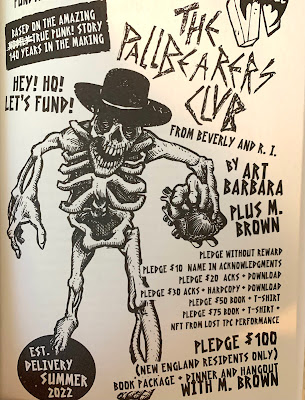
Mercy Brown is the best-known of the alleged New England vampires. Beginning in the 1880s, consumption began killing multiple members of the Brown family of Exeter, Rhode Island. The family's mother, Eliza, was the first to die, followed by her daughters Mary and Mercy. When young son Edwin grew ill, neighbors convinced his father George Brown to exhume their corpses to see if any showed signs of life in the grave. Mercy's corpse was undecayed and had blood in its hearts, which according to local folklore indicated she was feeding on Edwin. Her heart and liver were burned to ashes and mixed with water, which was given to young Edwin to drink. This was supposed to prevent Mercy's vampirism and save Edwin's life, but he died two months later. (Michael Bell's book Food for the Dead is the best non-fiction book about New England vampires.)

Is "Mercy Brown" in The Pallbearers Club really a vampire? Art certainly seems to think so and blames her for some unfortunate and unusual events in his life. Mercy vehemently disagrees. The Pallbearers Club is full of notes from Mercy in red pen, offering her perspective on events. Maybe, she suggests, Art is really a drug addict and incapable of moving on from the past. 
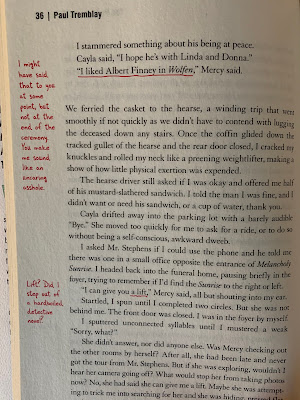
Who is right, Art or Mercy? I won't tell you. The Pallbearers Club is a creepy slow burn and keeps you guessing until the last page (and maybe even after). It doesn't have a lot of gore or violence, so when the weird stuff happens it's all the more effective. There are some nice twists, and I definitely was surprised by the ending. This is also very much a New England novel, set almost entirely in Providence, Rhode Island and Beverly. Tremblay lives north of Boston, and his love and knowledge of the region really shines through. If you like New England, weird folklore, and a twisty plot, add this to your reading list. 

November 11, 2021

The Plymouth Vampire of 1807

Thanksgiving is fast approaching, and many people associate the holiday with Plymouth, Massachusetts. This is where the Pilgrims held a feast in 1621 that is sometimes said to be the "first Thanksgiving." That may not really be the case, but it's still a beloved American myth that is remembered every year around this time. 

But why does no one talk about the Plymouth vampire in November?

Most people don't associate vampires with Plymouth, but maybe they should. According to folklorist Michael Bell's excellent 2001 book Food for the Dead: On the Trail of New England's Vampires, there was at least one documented case of vampire belief in Plymouth.

Note that I coyly wrote "documented case of vampire belief." There were no real vampires in New England, but according to Bell's research some people did believe they existed. The New England vampires were not like the Hollywood, pop-culture bloodsuckers we know today. Hollywood vampires kill their victims by drinking blood. New England vampires killed people with tuberculosis, and only killed members of their own families. 

Tuberculosis, or consumption as it was called in earlier centuries, is an infectious bacterial disease that affects the lungs. People with latent tuberculosis show no symptoms, but those with active tuberculosis are afflicted with violent (and often bloody) coughing, fever, and severe weight loss. About 50% of people with active tuberculosis die if the disease is not treated. Tuberculosis spreads when an infected person coughs, sneezes, or even speaks. It spreads easily in crowded conditions, like prisons, asylums, or small New England farm houses inhabited by large families. 

If one member of a family died from the disease, quite often other members would slowly waste away and die from it as well. People had many false ideas about what caused tuberculosis until Robert Koch identified mycobacterium tuberculosis in 1882. In some parts of New England, people believed it was caused by a dead person feeding off their living relatives. If one person in a family died from the disease and then others developed symptoms afterwards, the still-living relatives might blame the person who died. They thought the dead person was feeding off their living family members from the grave. 

Michael Bell documents 18 cases of New England vampirism in Food for the Dead, from 1793 to 1892. I assume there were more that went unrecorded. The Plymouth vampire case occurred in 1807, and was first mentioned in an 1822 Philadelphia newspaper article which was reprinted in a Plymouth newspaper. The author of the article writes about Plymouth as if it were a superstitious backwater:

In that almost insulated part of the State of Massachusetts, called Old Colony or Plymouth Colony, and particularly in a small village adjoining the shire town, there may be found relics of many old customs and superstitions which would be amusing, at least to the antiquary... 

There was, fifteen years ago, and is perhaps at this time, an opinion prevalent among the inhabitants of this town, that the body of a person who died of a consumption, was by some supernatural means, nourished in the grave of some one living living member of the family; and that during the life of this person, the body remained, in the grave, all the fullness and freshness of life and health...

The author goes on to explain that in 1807, of a Plymouth family of 14 children and two parents, only the mother and son had not died of tuberculosis - and they were both extremely ill with it. Some neighbors decided to help the family by digging up the grave of the daughter who had most recently died. They suspected she was feeding on her mother and brother. If the sister's corpse looked fresh and alive, this would confirm she was the one causing the illness. To stop her from feeding, they would turn her corpse face down in its coffin. This would prevent her from stealing the vitality of her brother and mother. 

At the appointed hour they attended in the burying yard, and having with much exertion removed the earth, they raised the coffin upon the ground; then, displacing the flat lid, they lifted the covering from her face, and discovered what they had had indeed anticipated, but dreaded to declare. Yes, I saw the visage of one who had long been the tenant of a silent grave, lit up with the brilliancy of youthful health. 

Sadly, the exhumation did not work. The shock of seeing his sister's corpse was too much for the surviving brother - he died two weeks later. The mother lived for a year before finally succumbing to the disease as well. 

A local physician wrote a rebuttal in the next issue of the Plymouth newspaper. He claimed no family of sixteen had died of tuberculosis, and also tried to argue that the people in Plymouth were not superstitious:

During a residence of nearly forty years in the district referred to, and favoured with opportunities of correct observation regarding this subject, the writer of this reply has not been made acquainted, with but one solitary instance of raising the body of the dead for the benefit of the living; and this was done purely in compliance with the caprice of a surviving sister...

You can see why I said he "tried to argue," because he states that at least once a body was exhumed to prevent it feeding on the living. But you know, only once.

That local physician might have found some comfort knowing that the vampire belief in Plymouth was not as extreme as it was in other parts of New England. The people in Plymouth believed simply turning the corpse face down would stop it from feeding. In other places, people believed the vampiric corpse's lungs and liver had to be burnt to ashes, and then ingested by their living relatives. Yes, you read that right. In order to prevent their vampiric relative from sucking their life out, people would eat or drink the ashes of their liver and lungs. 

It sounds almost unbelievable, but Bell has very good documentation in Food for the Dead. If you're interested in the topic I recommend his book highly. It would make interesting reading material before you get together to dine with your family at Thanksgiving.

*****

Thanksgiving is the start of the holiday shopping season. Might I suggest buying copies of my new book Witches and Warlocks of Massachusetts for the people in your life? It's available wherever you buy books online. 


June 01, 2014

A Case of Consumptive Vampirism in Plymouth

Today I was researching an old story about a witch's curse, but came upon something so gruesome I thought I'd share it this week. The witch's curse will show up next week.

What I came upon was a newspaper account of consumptive vampirism in early 19th century Plymouth County, Massachusetts. Consumption, or what we now call tuberculosis, was an untreatable scourge at that time. The article states,

It is well known to those who are acquainted with that section of our country, that nearly one half of its inhabitants die of a consumption, occasioned by the chilly humidity of their atmosphere, and the long prevalence of easterly winds. The inhabitants of the village (or town, as it is there called) to which I allude, were particularly exposed to this scourge; and I have seen, at one time, one of every fifty of its inhabitants gliding down to the grave, with all the certainty which characterizes this insiduous foe of the human family.

The article, which appeared in an 1824 edition of a Philadelphia publication called The United States Gazette, goes on to describe a large family in an unnamed village which suffered particularly hard from consumption. There were fourteen children in the family, but by 1809 all members except the mother, youngest daughter, and one burly son had died from the disease. The daugher, who was sixteen, died later that year and her brother soon contracted consumption as well.

Many New Englanders of the time believed that the corpse of someone who died of consumption would feed on a living family member, giving that person the disease while the corpse remained fresh and vibrant in the grave. Several villagers came to the mother and expressed their fear to her - that her dead daughter was feeding on her remaining son.

I should have added, that it was believed, that if the body thus supernaturally nourished in the grave, should be raised and turned over in the coffin, its depredations upon the survivor would necessarily cease. The consent of the mother being obtained, it was agreed that four persons, attended by the surviving and complaining brother, should, at sunrise the next day, dig up the remains of the last buried sister. 

The author of the article seems to have accompanied the son and the four villagers to the dead daughter's grave, because he relates what he saw when they opened the coffin:

Yes, I saw the visage of one, who had been long the tenant of a silent grave, lit up with the brilliancy of youthful health. The cheek was full to dimpling, and a rich profusion of hair shaded her cold forehead, while some of the richest curls floated upon her unconscious breast. The large blue eye had scarcely lost its brilliancy, and the livid fullness of her lips seemed almost to say "loose me and let go."

Although they apparently turned the sister's corpse face down, this ritual action had no effect on the brother's illness. The shock of seeing his sister was more than he could bear and he died two weeks later. The mother survived for only another year before she too died from the disease. The author notes that the family's fourteen graves were often shown to visitors.

We now know that tuberculosis is caused by bacteria, but I think it's interesting that the author of the article thinks it is caused by damp New England weather. He calls the villagers superstitious even though his explanation of the disease is equally wrong.

Turning the corpse face down or is an ancient tradition found around the world. Murderers and other criminals were often buried this way, and I think the symbolism is obvious. By pointing the face downwards, the community is directing the dangerous dead person to go down into the land of the dead and leave the world of the living alone. Unfortunately for this Plymouth County family it didn't work.

Rhode Island folklorist Michael Bell has an entire book about New England vampirism called Food for the Dead. In some parts of New England, people believed that turning a corpse over was not sufficient to stop it from feeding on a relative. Instead, the living person suffering from consumption needed to incinerate and eat their vampiric dead relative's heart, lungs, or liver. Yikes! It seems hard to believe that something like that happened here, but Bell documents dozens of cases. Sometimes the good old days weren't that good.