Showing posts with label Krampus. Show all posts

December 17, 2023

Spooky Holiday Reading: Merry Christmas, or Scary Christmas?

I'm sure you've heard the 1963 song, "It's the Most Wonderful Time of the Year." Andy Williams croons in his soothing voice,"...there'll be scary ghost stories, and tales of the glory of Christmases long, long ago." Although modern Americans tend to associate ghosts with Halloween, in Victorian England ghosts were associated with Christmas. I suppose this makes sense in some ways. After all, Christmas occurs at the darkest point of the year, which seems like a good time for ghosts to be out haunting. 

In the spirit of a spooky Christmas, here are four things you can read to get you in the holiday spirit. Two of them are even available free online, if you're feeling cash-strapped after holiday shopping. 

1. The Fright Before Christmas: Surviving Krampus and Other Yuletide Monsters by Jeff Belanger

This is the latest book by Jeff Belanger, a local author, paranormal investigator, and host of the New England Legends podcast and TV show on PBS and Amazon Prime. Full confession: the publisher sent me a copy of this book to review, and I've appeared on Jeff's podcast in the past. This is a great book for anyone interested in learning about the spooky folklore of Christmas. 

Me holding my copy of Fright Before Christmas!

I think by now most people are familiar with Krampus, the horned Austrian monster who terrorizes folks at this time of year, but Jeff also writes about many other strange Christmas creatures that are less well-known. For example, have you heard of Hans Von Trapp, the Cannibal Christmas Scarecrow of Alsace, France? Merry Christmas - but sleep with the lights on.

2. NOS4A2 by Joe Hill

The protagonist of this novel by Joe Hill (Stephen King's son) is Vic McQueen, a psychic, ass-kicking, biker mama who grows up in Haverhill, Massachusetts (my hometown). The villain is a creepy vampire named Charles Talent Manx III. Imbecilic yet cunning, child-like yet predatory, Manx travels around the country in an old Rolls Royce. 

Armed with gingerbread-scented laughing gas, Manx abducts small children and brings them to Christmasland, a creepy holiday-themed amusement park that exists just beyond the border of our reality. He and Vic battle it out in this book that will make you gasp out "Merry Christmas..." as you slip into a vampiric, gingerbread slumber.

3."The Festival" by H.P. Lovecraft (free online)

One of my favorite stories by this Rhode Island master of weird horror.  A young man visits his family's ancestral Massachusetts hometown to participate in its traditional winter solstice celebration for the first time. Although he's charmed by the town's Colonial-era architecture, he's unnerved by its residents' silent, expressionless demeanors. 

He's even more unnerved when he follows a crowd of celebrants into a church, then into its crypt, then down ancient stone steps deep into the earth... Is he really entering a subterranean realm, or just his own fetid subconscious? Either way, he discovers a fungus-filled, maggoty hellscape. You'll scream "Merry Christmas!" before losing your sanity. 

4. The Collected Ghost Stories of M.R. James by M.R. James (free online)

If "The Festival" sounds too lurid for you, may I suggest the ghost stories of M.R. James? James was an Englishman and Anglican priest who wrote ghost stories every Christmas to entertain his friends. His stories often feature bookish academics or lonely clergymen visiting old historic sites and encountering supernatural evil. 

It's all very proper and British. But while his stories are subtle and heavy on the atmosphere, they often end with shocking violence and death. Nothing says "Merry Christmas!" like an undead Satanic nobleman devouring your face. 

Enjoy your holidays, and I hope all your horrors are confined to the printed page this December.  

December 17, 2022

Christmas Chaos: Puritans, Saturnalia, and Lords of Misrule

On December 25, 1621, some young men in Plymouth, Massachusetts wanted to celebrate Christmas. Their celebration sounds pretty meager by modern standards – just playing a few ball games in the street. However, when William Bradford, Plymouth’s governor, saw what was happening he shut their little party down. He told them they shouldn't be celebrating Christmas, but he was willing to let them observe the day by praying piously indoors. They could not have any fun, however, particularly not in public.

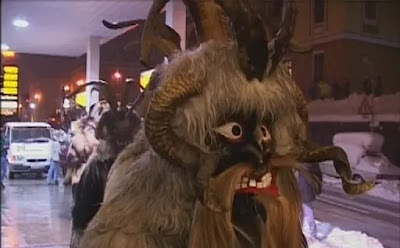
A still from Kranky Klaus (2003), a film by Cameron Jamie.

This sounds like a Grinchy move, and it was. Unlike Governor Bradford and many other Plymouth colonists, the game-players weren’t Puritans. They hadn’t realized how strongly the Puritans hated and feared Christmas. In 1659, the Massachusetts legislature even passed a bill banning Christmas - that's how much they hated the holiday. The bill was repealed in 1681 by Sir Edmund Andros, a much-despised governor appointed by the English king, but Christmas was still not widely celebrated in Massachusetts, or New England in general, until the mid-19th century. Schools and business remained open, and churches did not hold religious services on Christmas. A few  people on the margins of New England society celebrated Christmas, but most didn't.

Puritans hated Christmas for two reasons. First, they thought it was just a pagan holiday that had become thinly Christianized. There’s probably some truth in that. The Bible does not indicate the date of Christ’s birth, so the early Church fathers decided it should be celebrated on December 25, a time when people across the Roman Empire were already celebrating various winter holidays like the Saturnalia and the birthday of Sol Invictus, the sun god. It made good political sense for the new religion to piggyback on already popular holidays.

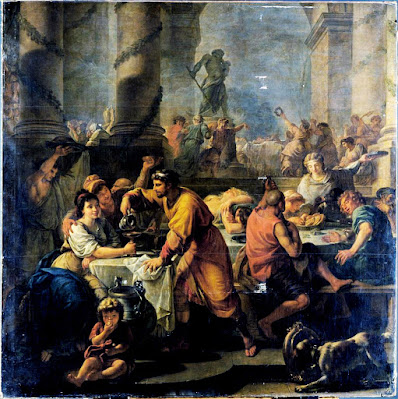
Saturnalia by Antoine Callet

Puritans also hated Christmas because it was celebrated very differently in the 17th century than it is now. Christmas was a raucous and chaotic holiday that featured lots of drunken public revelry and social disorder. There is still some heavy drinking at Christmas these days, but in the 17th century Christmas was associated with large, drunken, disorderly mobs roaming through the streets and countryside. This can be traced back to the Roman Saturnalia, which celebrated the god Saturn, who had supposedly ruled over Earth’s Golden Age. During Saturn’s reign, everyone had been equal. There were no slaves and no masters, no kings and no subjects, no bosses and no employees. It was blissful and idyllic anarchy, with the Earth providing bountiful food so no one needed to work. These beliefs about the Golden Age were reflected in the Saturnalian celebrations holiday, with masters waiting on their slaves, men dressing as women, and much public drinking and ribaldry. All boundaries were dissolved. 

Saturnalia was a season of misrule, a time when society’s rules were temporarily inverted or suspended. It was a release valve, a way for the lower classes to temporarily let off some steam and a way for the upper classes to buy some good will. After the Roman Empire collapsed, this pattern continued in Europe through the Middle Ages and into the Renaissance, but Christmas became the holiday of misrule, not Saturnalia. In many European towns and cities, prominent lower class men were appointed the Lord of Misrule by their fellows to preside over the holiday debauchery, leading crowds that mocked priests, noblemen, and the wealthy with impudence. Carolers, often drunk and in costume, demanded food and drink at wealthy homes. Once the celebrations ended, the Lord of Misrule stepped down and the old hierarchical relationships reasserted themselves until Christmas came around again. 

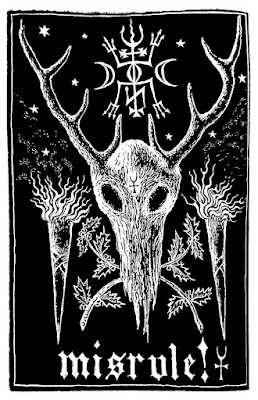
Illustration from Masks of Misrule (1996) by Nigel Aldcroft Jackson

The misrule of Christmas was antithetical to the Puritan values of hard-work, moderation, and self-control, but some modern Americans have recently have shown interest in bringing back a little of the old Christmas chaos. Some contemporary witches and occultists acknowledge a Lord of Misrule in their winter solstice rituals, and the Krampus, a monstrous Yule creature associated with misrule from northern Europe, has become increasingly popular, appearing on t-shirts, tree ornaments, and in movies. Krampus celebrations are a long-standing tradition in Germany and Austria, and some Americans are trying to bring it here.

Idyllic holiday anarchy sounds like fun, but there was definitely a dark side to Christmas misrule. The threat of violence lurked beneath the surface, and vandalism sometimes occurred, even in Puritan New England. For example, a group of young men in Salem, Massachusetts harassed 72-year-old John Rowden on Christmas night in 1679. The men forcibly entered Rowden's home, caroled, and then demanded wine as payment for their performance. Rowden refused, and in retaliation the young men pelted his house with stones and branches for 90 minutes, knocked down a stone wall, and stole six pecks of apple from his cellar. Something similar happened in Deerfield, Massachusetts in 1794, when shopkeeper John Birge was awoken at 2:00 am on December 22 by a group of drunken men demanding entrance to his home. He refused, and the men broke his windows.

Perhaps if Rowden and Birge had played along, their property wouldn't have been damaged. Much like Halloween's trick-or-treat, if you gave out food, liquor or money at Christmas you and your home would escape unharmed. The threat of violent retaliation was an integral part of the holiday.

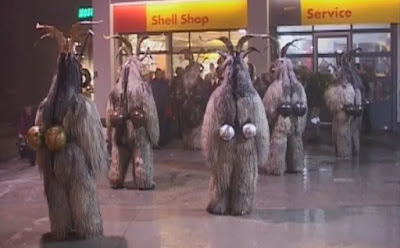
A still from Kranky Klaus (2003), a film by Cameron Jamie.

Back in 2007, I saw a short documentary by Cameron Jamie called Kranky Klaus, which follows a group of Krampuses as they roam around an Austrian town in a pre-Christmas celebration. The movie is unsettling. The Krampuses are aggressive and violent. They try to break into a pizza shop, and when a female employee stops them they push her into a snow bank. They enter a nightclub, where they knock over tables, wrestle patrons to the floor, and whip people. The Krampuses terrify a group of children, and then shove snow into pedestrians' faces in the street. No one stops them because it's a holiday tradition, but a lot of folks seem unhappy and terrified. You can watch Kranky Klaus on YouTube for yourself. What are your thoughts? Misrule and Christmas chaos sound like fun on paper, but the reality looks pretty scary.

I love weird old traditions, but I'm happy with the tamer, milder Christmas we now celebrate. The Puritan's anti-Christmas attitude wasn't defeated by misrule, but by 19th-century capitalism and a kinder, gentle approach to raising children. The prospect of happy children opening presents under a tree won out over the Puritan's "bah humbug" attitude, and over Christmas misrule as well. Feel free to celebrate Christmas (or not) as you see fit, but I'll be sitting by the tree, drinking eggnog, and listening to Mariah Carey, trying to find that happy medium between grumpy Puritan and kranky Krampus. 

*****

My favorite book about the history of Christmas is Stephen Nissenbaum's The Battle for Christmas: A Cultural History of America's Most Cherished Holiday. I got much of this post's information from it. 

February 12, 2017

Pot Sasquatch, The Boston Yeti, and The Return of The Wildman

Before I delve into this week's topic, I wanted to let you know I will be speaking at Boskone, New England's longest running science fiction and fantasy convention. Boskone 54 takes place February 17 - 19 at the Westin Boston Waterfront at 245 Summer Street. On Saturday afternoon I'll be moderating a panel titled "New England: The Legend, The Lore, The Mystery," and on Sunday at noon I'll be participating in a panel on how fiction writers use mythology in their work. If you are attending Boskone be sure to say hello! I am sure it will be a great convention.

Now, onto this week's topic. The groundhog saw his shadow, predicting six more weeks of winter, and that certainly seems to be the case in New England. We just had a blizzard last week, and now another storm AND a blizzard are on track for today and tomorrow. Nature's fury has been unleashed, and along with ice and snow our region has been visited by some mysterious creatures.

On February 9, Channel 22 meteorologist Janille Paglie was reporting from Springfield about that day's blizzard when she and her crew noticed something odd behind her. Someone dressed in a Sasquatch costume covered in pot leaves was cavorting around in the snow. At first the "creature" played some hide and seek, and then frolicked openly in the street. Channel 22 dubbed it Pot Sasquatch, and it became an internet sensation.

Pot Sasquatch reminded me of the Boston Yeti, who roamed the deserted streets of Boston during the Snowmageddon blizzards of 2015. Like Pot Sasquatch, Boston Yeti was clearly a human in a cryptid costume who appeared during inclement winter weather. The yeti was eventually revealed to be Someville resident John Campopiano, who said in an interview with The Improper Bostonian that he was always fascinated with UFOs and Bigfoot as a child. The yeti outfit was an old Halloween costume he owned which he felt compelled to don during the 2015 snowstorms. There was very little snow here in 2016, but the Boston yeti did emerge from hibernation for the February 9 blizzard.

OK, so what's going on here? Why did Massachusetts see not one but two cryptid impersonators playing in the same blizzard? Some photos might help explain the situation a little bit.

Boston Yeti (Somerville, Massachusetts)
Pot Sasquatch (Springfield, Massachusetts)
Krampus (Ischgl, Austria)
European winter mummer, photo by Charles Freger
Many regions of Europe have traditions of people in monstrous costumes parading at winter. Krampus is probably the one best known in the United States, but there are other similar traditions across Europe. The costumed celebrants in these processions often represent the cold dark forces of winter, although sometimes they instead represent the powers of spring that ultimately banish winter for another year. These mythical creatures are frightening, magical, and sometimes playful, and they are an important part of local seasonal celebrations.

We don't have those traditions in the United States. Some folklore-minded Americans are trying to create Krampus processions here in the States, but I am not sure if it will ever catch one. Most Americans associate spooky costumes with Halloween, not the winter. But when I see Pot Sasquatch and Boston Yeti, I can't help but wonder if our own indigenous version of these traditions might be forming spontaneously. Krampus needs a lot of explanation, but most Americans know what Sasquatch and the Yeti are.

Even if Sasquatch processions don't become a tradition, I think Pot Sasquatch and Boston Yeti show that some people yearn to dress up like monsters in the winter, and that other people repond to them. It just feels right somehow. Maybe the winter makes us wish we could sprout fur and run wild.

Humans have been dressing up as monsters for thousands of years. The ancient Greeks paraded around in satyr costumes, Medieval Europeans dressed like leaf-covered wildmen, and Austrians still disguise themselves as Krampus. Now someone in Springfield has dressed like Pot Sasquatch. He may just seem like a weirdo looking for attention, but he's really the latest incarnation of an ancient time-honored tradition.