Showing posts with label Windham. Show all posts

December 05, 2022

Bewitched in the Woods: Old Rif and the Rabbit

A few weeks ago I went to the Boston Athenaeum and found lots of old witch stories in various in old New Hampshire history books. A few weeks ago I wrote about Mother Carr from Weare, New Hampshire. Here's another witch story I found, this time from the town of Windham. As the days grow shorter I find myself drawn more and more to these stories!

Many years ago, an enslaved Black man named Old Rif and a man named George Simpson were out hunting in the woods near Windham. After hunting for a while they became lost.

The sun was sinking behind the western hills, and they came to a halt. At that moment they saw a rabbit standing upon its hind legs, looking at them; they tried to frighten it away, but it would not away at their bidding. Old Rif knew that the rabbit was bewitched, and he had heard that to shoot silver sleeve-buttons at a rabbit would destroy the witch. So he loaded his gun, putting in his silver sleeve-buttons, and shot the rabbit. The witch was instantly killed, their minds immediately became clear, the ground at once became familiar, the pathway was plain before them, and they readily and quickly found their way home. He (Old Rif) was said to be the last slave in New Hampshire, and died not far from 1842 (L.A. Morrison, History of Windham in New Hampshire, 1719 - 1883 (1883))

There are lots of interesting things about this story. First of all, there's Old Rif. He's a reminder that there was slavery in New England. I am not an expert on the history of New England slavery, but it seems that although the New Hampshire legislature banned slavery in 1789, it was not completely abolished until the 1850s. Was Old Rif really the last slave in New Hampshire? I will leave that to a better historian than me to determine. Regardless, Old Rif is clearly the hero of this story. He knows that he and George Simpson are bewitched, and he knows how to end it.
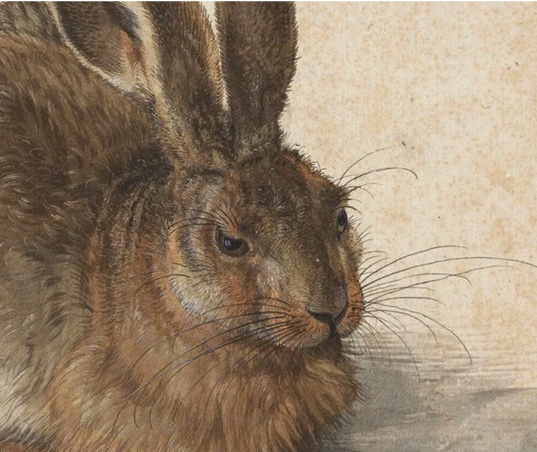
Young Hare, by Albrecht Durer

He ends the witch's spell in a traditional way - by shooting a silver button at an animal that is actually a witch in bestial form. Silver bullets are familiar to modern readers from Hollywood werewolf movies, but any silver object would do the trick. If you don't have a bullet, use a button. 

Maybe the most famous story of a witch being shot with a silver button is the one about Peg Wesson from Gloucester, Massachusetts, who had taken the form of a crow to harass a group of soldiers. It's unclear in either story if the witch is possessing an actual animal, or if the witch has merely sent out their soul in the shape of an animal. Either way, the result of the silver button/bullet is the same - the animal is injured or killed, as is the witch. 

In the Peg Wesson story, Peg is only injured after a soldier shoots the crow with a silver button. But in this story about Old Rif, the witch dies as soon as the rabbit is shot. I wish there was more information about the witch in this story. Who were they? Did they just keel right over in their house? Did anyone find a silver button embedded in their corpse? I suppose we'll never know.

It's a little strange that the witch is never identified in Old Rif's story, but the witch is almost never the main character in these stories. These stories are instructional tales, intended to tell the listener or reader how to fight witchcraft. The witch's identity didn't really matter to the person in Windham who first told this story. What did matter was instructing people how to stop a witch.

I will end with a couple disclaimers. One, your neighbors are not evil witches hexing you. Two, please don't go around shooting random animals if you get lost in the woods. That little bunny just wants to eat some grass in peace. 

June 17, 2012

God of Wine Part I: The Windham Bacchus

One of the archetypal images of New England is the white steepled church standing next to the town common. These churches can be seen all over the region, and are a testament to early settlers' devotion to Christianity.

Sometimes, though, a little bit of paganism crept in, as this story illustrates. 

On June 10 in the year 1776 the British ship Bombrig was captured by American naval forces in Long Island Sound. Four of the ship's crew were sent to a crude jail in Windham, Connecticut.

The four men were Edward Sneyd, the ship's commander; John Coggin, the ship's Irish boatswain, who supervised the deck crew; John Russell, the ship's carpenter; and a fourth sailor named William Cook. Although the men were not tortured or particularly mistreated, prisons and jails in the 18th century were grim places where prisoners were confined in small, poorly ventilated cells and fed poorly.

Luckily for the sailors, the owner of a tavern on the other side of Windham's Green (the town common) took pity on them and provided them with good food and plenty of alcohol. Very little is known about the owner except her name - Widow Carey. Who Mr. Carey was and how he passed away is unknown. History is also mute about why she acted so charitably towards the prisoners, but it doesn't take much imagination to guess why a lonely woman might be drawn to four needy sailors. Some people just love a man in uniform!

To repay Widow Carey's charity the sailors asked their wardens for a large log, which they were given. Using just their jackknives they carved from it an image of Bacchus, the Roman god of wine.

The Windham Bacchus


Roughly two feet tall, the Windham Bacchus portrays the god as a naked chubby man astride a keg of wine. Bacchus holds a bowl of grapes and apples in front of his unmentionables, and he has chubby cheeks and a big smile. Widow Carey accepted the carving from the sailors and mounted it in front of her tavern.

In November the sailors escaped from Windham's jail and made their way to Norwich, Connecticut, where they stole a canoe. While paddling their way towards Long Island, the canoe capsized and Sneyd, Russell and Cook drowned. John Coggin survived but was recaptured.

The sailors met a grim fate, but their masterpiece lived on. Widow Carey kept it in front of her tavern for many years, until she married another tavern owner and moved it to his establishment. From there Bacchus was sold in 1827 to Lucius Albee, who ran the Staniford House tavern. Albee hung Bacchus from a giant elm tree, where it remained for many years until a large storm blew the sculpture down, breaking one of its arms. After languishing in a woodshed Bacchus was purchased for twenty-five cents, repaired, and celebrated as an iconic image from the Revolutionary War. You can now see it (or should I say him?) in the Windham Free Library.

I like to read about ancient Greco-Roman religion, so this story made my antennas perk up. I don't know much about the history of New England taverns, but it's interesting that tavern owners in Puritan-founded Connecticut would exhibit a statue of a pagan god. It's also interesting how the historical events surrounding the carving parallel ancient Bacchic myths and rituals.

Bacchus is the Roman name for Dionysos, the primordial god of wine and ecstasy. It makes sense for him to be associated with a tavern, but what about those British sailors? Dionysos was associated with water and the sea, and in some Greek rituals a statue of the god was pulled through the streets in a wagon shaped like a ship. In many myths Dionysos seeks refuge in the sea from his oppressors, and also emerges from it to triumph over his enemies. In one famous myth, Dionysos is kidnapped by sailors who want to sell him into slavery. He transforms them into dolphins and they leap into the sea.

Dionysos was also associated with trees and even was addressed as Dionysos Dendrites ("Dionysos of the Trees"). Paintings from Greece show people worshiping his image attached to a tree, and he also guarded orchards. It's only fitting that Lucius Albee hung him from an elm.

Unfortunately there is a dark side to many of Dionysian myths. People who introduced his worship into an area or city often died by drowning, much like the sailors. For example, Dionysos taught Icarius of Athens to make wine, but Icarius was drowned in a well by drunken shepherds who erroneously thought he poisoned them. As an infant Dionysos was nursed by his aunt Ino, but she was driven mad by the jealous goddess Hera and drowned herself and her son Melicertes in the sea. At the god's sanctuary in Lerna a lamb was thrown into an allegedly bottomless lake as an offering to underworld deities. 

Was there some supernatural or divine force at work in 18th century Windham? I don't want to speculate too much. After all I don't want to sound too paranoid. Maybe historic events just sometimes follow ancient mythic patterns.

On the other hand, there was an actual Bacchus cult in Windham County in the 19th century. But that's my post for next week!

************************

I got my information from History of Windham County, Connecticut (1889) by Richard Bayles, and The Story of Bacchus (1876) by Brigham Payne, William Lawton Weaver, and Samuel Peters.