
A few weeks ago I went to the Boston Athenaeum and found lots of old witch stories in various in old New Hampshire history books. A few weeks ago I wrote about Mother Carr from Weare, New Hampshire. Here's another witch story I found, this time from the town of Windham. As the days grow shorter I find myself drawn more and more to these stories!
Many years ago, an enslaved Black man named Old Rif and a man named George Simpson were out hunting in the woods near Windham. After hunting for a while they became lost.
The sun was sinking behind the western hills, and they came to a halt. At that moment they saw a rabbit standing upon its hind legs, looking at them; they tried to frighten it away, but it would not away at their bidding. Old Rif knew that the rabbit was bewitched, and he had heard that to shoot silver sleeve-buttons at a rabbit would destroy the witch. So he loaded his gun, putting in his silver sleeve-buttons, and shot the rabbit. The witch was instantly killed, their minds immediately became clear, the ground at once became familiar, the pathway was plain before them, and they readily and quickly found their way home. He (Old Rif) was said to be the last slave in New Hampshire, and died not far from 1842 (L.A. Morrison, History of Windham in New Hampshire, 1719 - 1883 (1883))
There are lots of interesting things about this story. First of all, there's Old Rif. He's a reminder that there was slavery in New England. I am not an expert on the history of New England slavery, but it seems that although the New Hampshire legislature banned slavery in 1789, it was not completely abolished until the 1850s. Was Old Rif really the last slave in New Hampshire? I will leave that to a better historian than me to determine. Regardless, Old Rif is clearly the hero of this story. He knows that he and George Simpson are bewitched, and he knows how to end it.
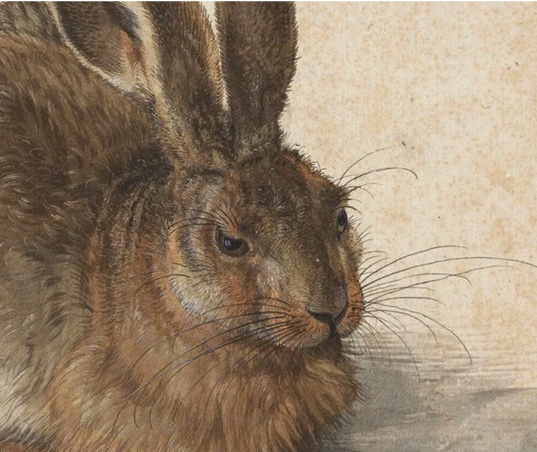 |
| Young Hare, by Albrecht Durer |
He ends the witch's spell in a traditional way - by shooting a silver button at an animal that is actually a witch in bestial form. Silver bullets are familiar to modern readers from Hollywood werewolf movies, but any silver object would do the trick. If you don't have a bullet, use a button.
Maybe the most famous story of a witch being shot with a silver button is the one about Peg Wesson from Gloucester, Massachusetts, who had taken the form of a crow to harass a group of soldiers. It's unclear in either story if the witch is possessing an actual animal, or if the witch has merely sent out their soul in the shape of an animal. Either way, the result of the silver button/bullet is the same - the animal is injured or killed, as is the witch.
In the Peg Wesson story, Peg is only injured after a soldier shoots the crow with a silver button. But in this story about Old Rif, the witch dies as soon as the rabbit is shot. I wish there was more information about the witch in this story. Who were they? Did they just keel right over in their house? Did anyone find a silver button embedded in their corpse? I suppose we'll never know.
It's a little strange that the witch is never identified in Old Rif's story, but the witch is almost never the main character in these stories. These stories are instructional tales, intended to tell the listener or reader how to fight witchcraft. The witch's identity didn't really matter to the person in Windham who first told this story. What did matter was instructing people how to stop a witch.
I will end with a couple disclaimers. One, your neighbors are not evil witches hexing you. Two, please don't go around shooting random animals if you get lost in the woods. That little bunny just wants to eat some grass in peace.


