Showing posts with label defensive magic. Show all posts

July 31, 2022

Hiding Shoes to Bring Luck and Avert Evil

I’m always excited when some local folklore appears in the news, as it did this week. Several Boston-area news outlets reported that archaeologists working at the historic Tilden House in Canton, Massachusetts unearthed some shoes buried underneath the kitchen floor. Why all the excitement over some shoes? Because they could possibly be a form of protective magic. 

The Tilden House was built in 1725 by David and Abigail Tilden in what was then part of Dorchester, Massachusetts. That part of Dorchester ultimately became a separate town, Canton, in 1797. A strange and interesting fact: it was named Canton because Elijah Dunbar, one of the town’s leading citizens, thought it was on the exact opposite side of the planet from Canton, China. This is not the case, but the name stuck. 

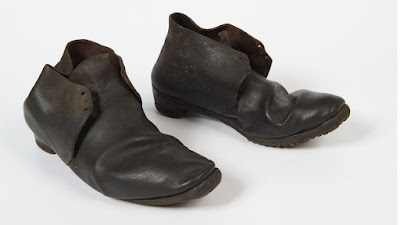
A photo of hidden shoes from England. 
For those of you not from the Boston area, please note the names of the two cities are not pronounced the same. The town in Massachusetts is said CANT-in, or more often CAN’-in, with some kind of glottal stop instead of the “t”. The city in China is often pronounced can-TAWN, but it’s true Chinese name is Guangzhou. It’s also important to note that Cantonese cuisine originates from Guangzhou, not the Massachusetts town. 

The Tilden House is currently owned by the town of Canton, and leased to the Canton Historical Society, who are restoring and modernizing it so it can be used as a history center. After archaeologists removed the kitchen floor, they found several pairs of shoes, along with bottles, plates, and other items, all of which seemed to date from the mid-19th century. All these items could just be trash that past residents discarded, but it’s also possible the shoes were placed there to protect the house from witches or evil spirits. 

Hidden shoes are often found in the walls, ceilings, or under the floors of old buildings in England and North America, and historians suspect it was a form of protective magic. For example, back in 2013 archeologists found shoes hidden under the floor of the Old Colony House in Newport, Rhode Island. But why did our New England ancestors think hiding shoes would defend against evil magic? Historians  Matthew Cochran and Jeanne Ward explain it this way:

This well-documented practice dates from the l5th to the early 20th century. The underlying premise of using concealed shoes as a means of personal or household protection lies both in the shoe’s shape as well as the personal qualities imbued in a shoe by the wearer. Shoes take on the literal shape of the wearer and therefore can act as a form of proxy for the wearer. If a malicious entity is presumed to be haunting you, the concealment of the shoe in a relatively inaccessible space, such as the cellar or the attic, may draw the malicious entity to the shoe instead of you. And, if luck holds, the malicious entity may become trapped in the shoe (from the Maryland Archeology Newsletter, quoted here.)

This explanation makes sense to me, since it matches another important type of protective magic in New England: the witch bottle. I've written about witch bottles before. When someone thought they were being cursed by a witch, they would fill a bottle with their own urine, and then add nails, broken glass, and other sharp items to it. The urine acted as a substitute or proxy for the victim. The witch's evil magic would be drawn to the urine, which came from their victim, rather than to the actual intended target. To make things worse for the witch, the sharps objects would send pain and physical harm back to the witch. 

I suppose you should always have some old shoes, a bottle and some nails on hand just in case things start getting weird? It's like a supernatural form of recycling. But please, don't go around accusing your neighbors of witchcraft.

April 11, 2021

Mountain Ash, or the Witch-Wood Tree

Although it's now socially acceptable to be a witch, that wasn't always the case, particularly here in New England. Many people today identify as witches, which usually means they are interested in the occult, folk magic, and possibly paganism. These are all good things, and most modern witches are lovely people who just want to be left alone with their candles and dried herbs. 

In the past, though, no one wanted to be called a witch. The activities we associate with modern witches today - fortune telling, herbal magic, protection magic - were widely practiced across New England, sometimes by specialists called cunning folk, conjurers or seers, but more often just by average people. Curious to know if you were going to marry the boy next door? Grandma would break out the Bible, bind a key inside it, and start asking questions. Troubled by bad dreams? The farmer next door would tell you to place a knife under the bed. Everyone knew a charm or two, but no one called themself a witch.

This is because people believed witches used magic for evil: ruining crops, killing farm animals, making children sick, and causing death. Sometimes witches were motivated by jealousy, sometimes revenge, and sometimes they were working for the Devil himself. No one wanted to be a witch. Calling yourself a witch in the past would be like saying, "Hi! I'm a serial killer" today. 

Image from the Arbor Day Foundation. 

A community might accuse its most unpopular members of being witches, but these accusations were always false and motivated by the need to blame someone for life's misfortunes. Crops failed? Blame the mean old widow down the road and call her a witch. Child sick? Blame the crotchety guy who swears at everyone - he must be a witch. 

These people weren't really witches, but there was plenty of magic for protecting one's home and family from the imaginary threat. A horseshoe placed above the front door was the most popular method, but there were others, including this one I found in Clifton Johnson's What They Say in New England (1896):

It is well to have a piece of a branch cut from a mountain ash in the house. It is as good to keep to witches as a horseshoe nailed over the door. 

The practice seems to have been relatively widespread. John McNab Currier was a physician and folklorist who lived in New Hampshire in the 19th century. Currier knew a woman who blamed witches for all the misfortunes in her life and wore a necklace of mountain ash beads to deflect their evil influence:

They were cut about three eighths of an inch in length, the bark being left on, and strung on string running through the pith. She was careful to keep them concealed, but sometimes they would work up above her collar and be conspicuous. This species of tree was once quite popular among New England witch-believers as a charm against witches... (“Contributions to New England Folk-Lore,” The Journal of American Folklore, Vol. 4, No. 14 (Jul – Sep. 1891)

Folklorist Fanny Bergen also notes that many people carried pieces of mountain ash wood in their pockets and the tree was sometimes called the "witch-wood" tree (“Some Bits of Plant-Lore”, The Journal of American Folklore, Vol 5, No. 16 (Jan – Mar, 1892).

Image from the Arbor Day Foundation

Although many folks still hang lucky horseshoes over their doorways, I haven't encountered anyone who carries around pieces of mountain ash, let alone wears a necklace made of it. Partly it's because we don't practice as much folk magic as our ancestors did, and even when we do the meaning has changed. People who hang horseshoes today usually do so to bring luck, not to keep out witches. We just aren't as afraid of witches as we once were, which is a good thing.

I also think New Englanders, and Americans in general, are less familiar with trees and plants than we were were a century ago. Very few of us work in agriculture or even outdoors, so we don't need to be well-acquainted with what's growing around us. Industrial and scientific progress has made us less superstitious (and less likely to hang our neighbors as witches), but it's also disconnected us from our immediate environment. 

Even if I wanted to make a mountain ash necklace, I probably couldn't identify the tree. They tend to grow in higher elevations, and I've lived most of my life in the coastal regions. The mountain ash (sorbus americana) is a small tree that bears orangey red berries. Sorbus Americana is very similar to the European rowan tree, which has a lot of magical lore attached to it, and I assume that's why magical powers are ascribed to the mountain ash. 

There's a mountain ash tree nearby me in Arnold Arboretum. I've been meaning to visit if for years. Maybe this spring I'll finally do it!

March 06, 2021

Vermont Witchcraft: Wax Images, Thornapple, and the Bible

I've been on a monster kick for the last few weeks here, so I thought I'd add a little variety and write about witchcraft. Here's a witch story from the small town of Newbury, Vermont. 

Many years ago, in the early 19th century, a Newbury farmer believed he was being harassed by a witch. He had seen strange phantom shapes dancing in his fireplace at night, and his cattle suffered from strange ailments. He suspected a woman who lived nearby was the witch causing these mishaps. 


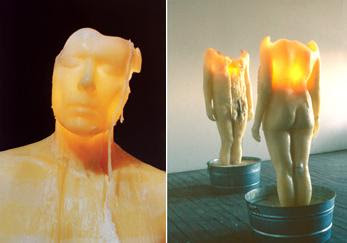
Candles by artists Walter Martin and Paloma Munoz.


Remembering the adage to "fight fire with fire," the farmer decided to use magic against the alleged witch:

With a mixture of tallow and beeswax he moulded what he considered to be an image of the offending woman, which he hung up before the fireplace. As the effigy slowly melted, he stuck it full of thorns from the thornapple, and at the same hour the woman who had cast an evil spell upon his cattle fell down stairs and broke her arm. (Frederic Palmer Wells, History of Newbury Vermont, 1902.)

There were lots of stories in the 19th century about how to defeat witches; this is one of them. The protagonists in these stories usually employ witch bottles, horseshoes, or cruelty to animals to defeat a witch. I haven't seen many that involve poppets (a.k.a. small human images), like this one does. In 17th century New England, it was believed that witches often used poppets to harm their victims, but their victims didn't usually fight back with another poppet. I also haven't read many stories that involve melting a wax image. So this story is kind of unusual. 

The reference to the "thornapple" in New England witch stories is also new to me. There are two plants called thornapple in North America. One of them is more commonly known as jimsonweed (datura stramonium in Latin), a hearty nightshade that grows across most of the continent. Jimsonweed, a.k.a. devil's weed or the devil's cucumber, produces small fruits that have spiky shells. Jimsonweed is a dangerous hallucinogen, and probably got the name "jimsonweed" after several soldiers in Jamestown, Virginia ate the plant and hallucinated for eleven days in the 17th century. The term "Jamestown weed" slowly evolved into the modern word "jimsonweed." And yes, you read that right. The soldiers hallucinated for eleven days. Do not mess with this plant. 

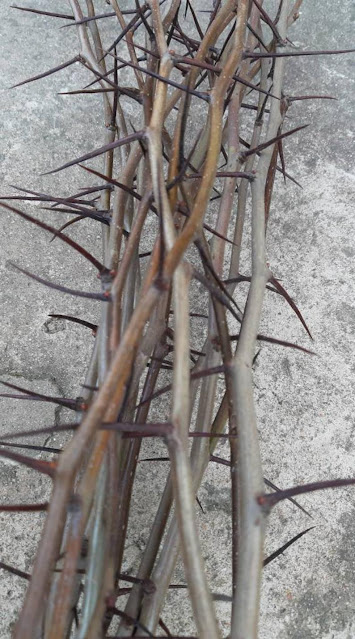
I don't think the Newbury farmer stabbed his wax effigy with jimsonweed. I suspect he used the other thornapple, which is the hawthorn tree (crataegus in Latin). There is a lot of European folklore connected to this tree - it is planted near holy wells, it is associated with fairies, its wood is used to kill vampires, etc. That heritage alone makes it a strong candidate, and its branches are also thorny, which makes it even more likely the farmer used the hawthorn tree. It's easier to stab melting wax with a branch than with a small spiny fruit. 


Hawthorn branches from Etsy.


This particular farmer remained concerned about witches until he died. When he grew old he became quite ill and bedridden. He put the family Bible under his pillow to protect himself from witches. The local doctor, one Dr. Carter, thought this was nonsense and tried to secretly replace the Bible with a pile of old almanacs. The farmer discovered the substitution and became livid and agitated. Fearing he would die from agitation, Dr. Carter replaced the Bible. It remained under the old farmer's pillow until he died several weeks later. 

April 09, 2020

Molly Bridget and the Bewitched Pigs: A New Hampshire Witchcraft Story


Molly Bridget lived in Portsmouth, New Hampshire during the 1700s. Molly made her living telling fortunes for sailors and young lovers (as fortune tellers do) but over time she developed a reputation for being a witch. People in Portsmouth grew to fear and hate her.

Molly was never wealthy to begin with, and as she grew older she slipped into poverty. Sometime around the Revolutionary War she wound up living in Portsmouth's almshouse (or poorhouse). This was not to her liking so she decided to move south to Boston for a fresh start.

Unfortunately her reputation preceded her and when she arrived in Boston the following occurred:

Finding her way to Boston, the police gave her warning to leave the city forthwith.
"Why?" she asked.
"Is not your name Molly Bridget?"
"No, sir," she replied. "Do you think I am such a despicable creature as Molly?"
(Charles W. Brewster, Rambles About Portsmouth. Second Series. 1869)

The police weren't fooled. Molly realized that she wouldn't be able to leave her old identity behind so with a heavy heart she returned to Portsmouth and the almshouse.

An English woodcut of a witch from 1643
The almshouse was managed by a man named Clement March. One day in 1782 Mr. March noticed that the almshouse's pigs were acting strangely. His thoughts immediately turned to his resident witch, Molly Bridget. Had she bewitched the pigs?

There was only one way to find out. Like many people at that time, Mr. March believed that when a witch cursed something (or someone) they created a magical connection with the object of their curse. If Molly had cursed the pigs there was a connection between her and the animals. Molly's evil magic flowed from her into the pigs through this connection, but Mr. March thought he could use the connection to his advantage. He could make pain flow from the pigs back into Molly. If Molly felt enough pain she would stop cursing the animals.

Putting his plan into action, Mr. March took a knife out to the stye and cut off the pigs' ears and tails. He thought that this would be enough pain to cure the pigs of their strange behavior, but that was not the case.* He then decided to up the ante and burn their severed ears and tails, but when he went to gather them up the ears and tails were missing. Clearly this was more witchcraft! He surmised that Molly had made them disappear somehow.

Not willing to give up, Mr. March gathered the dead leaves and wood chips that were in the pig stye. These were soaked in the pigs' urine, feces, and blood, and therefore still had a connection to the animals and to the witch who had theoretically cursed them. He then burned the chips and leaves in the almshouse's various fireplaces.

The fires had a sudden and violent effect on Molly Bridget:

After the fires were kindled, Molly hastened from room to room in a frenzied manner. She soon went to her own room, and as the flames began to subside her sands of life began to run out, and before the ashes were cold, she was actually a corpse. (Brewster, Rambles About Portsmouth, 1869)

Mr. March and the residents of the Portsmouth almshouse took this as proof that Molly had indeed cursed the pigs. On the day of her funeral a violent storm struck Portsmouth, which was taken as further evidence that she was a witch.

*****

Like last week's post about the witch of Pepperell, this story shows how the belief in witchcraft lingered in New England well past the witch trials of the 1600s. Also like last week's legend, there's no official documentation about Molly Bridget and her witchcraft. The only account I've found is in Charles W. Brewster's Rambles About Portsmouth (1869). 

So is this story true or just a legend? Brewster has the following to say on the matter:

These are facts - how far the results were induced by the superstitious feelings of that day, the reader is left to judge. The poor creature might have believed herself a witch, and the expectation expressed that the burning of the pigs' tails would kill the witch, might have so wrought upon her mind as to produce the result.

I might also suggest that stories like these tend to become more legend-like over time. Perhaps Molly Bridget just died from natural causes and people in Portsmouth created the legend about her death over the years. By the time Brewster wrote down the story 80 years later it had become the traditional witch legend it is now. 

* I don't think cutting off an animal's ears and tail will ever improve its behavior. Be kind to animals!

January 17, 2018

Cat, Crow and Cream: Perils of Being A Witch

Lots of younger people are interested in traditional forms of witchcraft these days, as a quick search through Tumblr will demonstrate. I think that's fine. Many people dabble in the occult and it's definitely an interesting topic. However, be aware that witchcraft is not all fun and games.  


For example, here is a little folk story about witches from late 19th century Western Massachusetts:

BEWITCHED CREAM
Daniel Smith was churning. He looked into the churn and then to see what progress he was making, but the butter was no nearer to coming the last time he looked than it was the first. The suspicion grew on Mr. Smith that there was something uncanny about this fact. The more he thought about it the more certain he became that there was a witch in the cream. To expel the evil spirit he dipped up a little of the cream, and threw it into the fire. Immediately after that the butter came. That same day it was reported that Widow Brown had burned herself. Then Mr. Smith knew it was the Widow Brown who had bewitched his cream. (Clifton Johnson, What They Say in New England, 1896)

Now compare that with this story collected in the 1930s in Peterborough, New Hampshire about a witch named Mrs. Stinson:

A cat somewhere in town was observed to act strangely; hot water was thrown upon her and straightaway Mrs. Stinson's back was dreadfully afflicted with St. Anthony's (erysipelas). On another occasion a good man near Sharon shot at a crow many times, but the bird only flew around and laughed at him. He at last took off a silver sleeve button and with it broke the crow's wing; immediately Mrs. Stinson was found to have a broken arm. (Eva Speare, New Hampshire Folk Tales, 1932)

Although we tend to think of folk stories about witches as spooky or creepy, most of them are actually instructional tales about how to defeat witches. They usually end with the the wise farmer or clever housewife defeating the witch through a little defensive magic, as the stories above illustrate. The heroine of these tales is not the witch.


Witches were believed to work their mischief by sending their souls out of their bodies and into food, animals, or farm implements. This was a cool magical power, but left the witches very vulnerable because their bodies experienced any harm inflicted on the food or animal. A silver object (a button or a bullet) could injure or kill even the toughest witch. 

So just a word of caution for young people thinking about practicing traditional forms of witchcraft. Watch out! Someone might throw the cream into the fire.

September 20, 2017

A Weed That Cures Witchcraft and Elf-Sickness

Today is cloudy and dark. A hurricane is churning off the coast. Autumn officially starts in a few days. All this puts me in the mood for some witchcraft. So here goes!

Whenever I walk around the Boston area, I see a lot of plants growing wild. They grow in yards, they grow in parks, they grow in empty lots and along the sidewalks. I suppose you might call them weeds, but that term seems a little derogatory, doesn't it? Many of these plants are actually herbs that historically have been associated with healing. We've just forgotten what they were used for.

Some of them I recognize, like mugwort, dandelion, and mullein, but I'm still learning the names of others. For example, I believe this inconspicuous looking plant growing on Memorial Drive is actually dock weed (or dock). I'm glad to know where it is. It might come in handy in case I am bewitched or afflicted by elves.


According to Pamela Jones's book Just Weeds: History, Myths and Uses (1994), the Medieval Anglo-Saxons valued dock weed as a cure for "elf-sickness." Like many other Europeans, the Anglo-Saxons believed that elves shot people with invisible arrows and made them sick. Many Anglo-Saxon sources also link elves with witches since they were both sources of illness and suffering.

For example, one Anglo-Saxon book of cures contains a recipe for an herbal salve to treat sickness caused by "the elfin race and nocturnal goblin visitors and for the women with whom the devil hath carnal commerce." Another such book has a chapter dedicated to cures against "every evil wisewoman and the elfin race," while another, the Lacnunga, lists witches, elves, and Norse gods as possible causes for illness.

The Puritans who colonized New England did not worry about Norse gods, and they didn't really worry much about elves either. But they worried about witches a lot. A lot. The Salem witch trials of 1692 are the most famous New England trials, but there were many others before them, and even a few afterwards. For the Puritan settlers, witches were a real concern and they were always looking for ways to combat their malevolent magic.

For example, in 1685 a woman living in East Hampton, Connecticut* named Elizabeth Howell became strangely ill. She felt sharp piercing pains as if being stuck with pins, and claimed to see a strange black creature lurking at the foot of her bed. She also supposedly vomited up a pin. Before she died, Howell cried out that she was being bewitched by a neighbor, Elizabeth Garlick.

Goody Garlick was arrested and brought to trial for witchcraft. Several people testified against her, including one Goodwife Simons, who claimed that while suffering from fits two neighbors arrived with dock weed to cure her illness. When she learned that the dock weed had been provided by Goody Garlick she threw it onto the fire. She suspected that Goody Garlick was bewitching her and didn't trust the dock weed. Perhaps it would just make her feel worse! But it's clear that her neighbors thought the dock weed would help cure her. I think it's fascinating that a centuries-old belief dating back to the Anglo-Saxons appeared in 17th century Connecticut.

So there you go. Random weeds growing near the sidewalk actually have a connection to witchcraft, and perhaps even elves. New England is a great place to live!

*****

* East Hampton is now part of New York but for a time in the 1600s it was part of Connecticut. 

I got most of my information about Goody Garlick and the dock weed from this Smithsonian article and this article in the East Hampton Star. I also found another Anglo-Saxon leech book that mentions burning herbs as a cure for elf-sickness, but historians don't seem to think that is why Goodwife Simons threw the dock weed into her fire. 

January 18, 2017

A Ritual Cat Burial In Charlestown, Massachusetts?

Last month as a Christmas gift I received the book A History of Boston in 50 Artifacts (2016) by Joseph Bagley. Bagley is the official archeologist for the City of Boston, and a couple years ago I went one a tour he led of an ancient Native American quarry in the Blue Hills.

I was pretty excited to read his book. The fifty artifacts Bagley examines range from prayer books to feminine hygiene devices, but the one that really caught my attention was a cat skeleton unearthed in Charlestown. Many, many cats have lived and died in Charlestown over the last 400 years, but this cat was possibly killed as part of a magic spell.

Its skeleton was found buried in a small pit underneath the main entrance to the former Three Cranes Tavern in Charlestown's City Square. The tavern operated from 1635 until 1775, but the archaeologists who found the cat skeleton estimated it was buried sometime in the early 1700s. The cat was killed by a blow to the back of its head. The blow punctured the poor cat's skull, and its body was buried in one piece. Also buried near the cat was a large pot.

Bagley speculates that the cat was buried there to magically protect the tavern, either from witchcraft or from vermin. This certainly seems possible, since it's unlikely the tavern owners would just randomly bury a cat under the front stoop. Archeologists have found many instances of cats buried under foundations or inside walls of old buildings in Europe. Occasionally dead mice or rats are also found placed inside the cats' mouths.

There are a few theories that try to explain this practice. An older theory, popular with the Victorians, is that these animals were killed to appease land spirits. That may have been the case in the distant pagan past, but the English colonists certainly didn't believe in land spirits that needed appeasing.

A more recent theory is that the cats were killed to prevent rats and mice from entering the house. This seems counter-intuitive (wouldn't a live cat be more effective?), but I think the idea is that the cat's spirit will somehow continue to hunt mice after death. This might explain why some buried cats are found with mice inserted in their mouths.
The Three Cranes cat skeleton. Photo from The Boston Globe.
A final theory is that burying a cat under the doorstep was believed to deter witches or their familiar spirits from entering the house. That sounds like a plausible explanation, since we know our New England ancestors were very concerned about protecting their homes from witches. Some of the most well-documented methods include nailing a horseshoe over the door and putting bay leaves around the windowsills, but there were many other methods as well. It seems possible that killing and burying a cat might be another one. Archaeologists in England also often find pots buried under old house foundations or doorsteps, and they theorize that they were believed to deter witches from entering, possibly by trapping the witches spirits in them. This would explain why the Charlestown cat was buried near a pot.

There is a whole field of archaeology that deals with magic. Its foundational text is Ralph Merrifield's The Archaeology of Ritual and Magic (1987), which should probably be on my reading list. It should probably be on everyone's list! If you find this topic interesting, you may want to read this interview with Brian Hoggard, a British archaeologist working on this topic today.

My cat is sitting nearby as I write this post, and he tells me that a live cat is definitely better at averting evil than a dead one. I would have to agree. After all, the cat skeleton didn't do much to protect Three Cranes Tavern on June 17, 1775. The Battle of Bunker Hill happened that day, and the British troops burned the tavern and the rest of Charlestown to the ground. The tavern foundations were excavated prior to the Big Dig and can now be visited in City Square.

Although I enjoy writing about these old folk magic practices, I don't recommend ever hurting or killing animals. Not only is it cruel, it is illegal.

September 18, 2016

Defending Your House Against Evil Magic

Do you ever feel like your house is being attacked by evil witches? Do you sometimes think that malevolent demonic forces are targeting your homestead?

I would suggest that healthy skepticism is usually the best defense against these feelings, but the Puritans of New England thought otherwise. They felt the world was a battleground between good and evil, and the Devil and his minions (human and otherwise) were out to cause trouble for the good people of New England.

To keep evil forces out of the home, the Puritans used some very simple forms of defensive magic. Local ministers thought that all magic was evil, but the average New Englander knew that sometimes you needed to fight fire with fire. If your house was under magical attack, you needed some magical defenses. These magical practices lingered well into the 18th and 19th centuries, well after the Puritans had faded away.

These practices tend to focus on doors, windows, and chimneys. These openings were obviously necessary for a functioning home, but they could also allow access to unwanted spirits or witches. I've written a few times before about horseshoes, which were one of the main ways to guard the house against attack, but there were others as well.


For example, a coin put under the door sill would prevent a witch from entering the house. This was pretty simple to do, providing you had money to spare. I suppose the symbolism here is two-fold. Coins obviously represent abundance and financial security, which are things a witch would hate. They are also made of metal, which tends to repel supernatural entities (think of silver bullets and werewolves, or iron and fairies). This type of magic is still widely practiced today. As this discussion on Snopes.com indicates, many people put pennies on their window sills. The practice is now said to be done for "good luck," but has it's origin as protection from witches or demons.

Fireplaces were central to the colonial home. Cooking was done there, and families gathered around fireplaces in the winter for warmth. While chimneys let smoke out, they unfortunately also could let evil beings into the home. People would often enclose shoes in the walls near the chimney to protect it. There is a lot of speculation about why this was done, but the predominant theory seems to be that somehow the witch or evil spirit would get trapped in the shoe and would be unable to escape.

If you were feeling crafty, you might want to carve a daisy wheel above a doorway, window or fireplace. The daisy wheel looks like this:

From a church in England.
Daisy wheels were easily made by carpenters using a compass, and have been found in many old homes in New England. For example, the 1699 Winslow House in Marshfield, Massachusetts has several carved above the fireplace, while the home of Salem historian Emerson Baker has one carved above the front door. They are also known as witch marks, hexafoils, or apotropaic marks, if daisy wheel sounds too silly for you. People aren't quite sure why daisy wheels were supposed to avert evil, but some historians have speculated it is because they represent the sun.

So again, if you really, really think your house is under attack by evil forces you might want to try some of this magic. I do think skepticism is the best defense, but as the days grow shorter and colder sometimes that skepticism is hard to muster.

*****
I found some of this information in Emerson Baker's book A Storm of Witchcraft, and in a few places on the web.

I hope those readers who practice Wicca or other forms of modern witchcraft realize that when I refer to "evil witches" I am referring to how witches were viewed by the Puritans and other early inhabitants of New England. I know that Wiccans and modern witches are not evil!

May 08, 2016

How To Make A Witch Bottle (And How They Work)

Last fall I gave a talk in Rowley, Massachusetts about New England witchcraft. As part of my program I showed the audience how to make a traditional New England witch bottle. Most people hadn't seen this before, which made me wonder: what are the public schools teaching kids these days?

I'm just kidding about the public school thing. I don't really think the schools need to teach children how to make witch bottles. But if you are interested in knowing how to make one read on. Maybe if you are a home schooler you can work it into your curriculum!

Witch bottles are an old European form of defensive magic, and were brought to New England by the English colonists when they crossed the Atlantic in the 1600s. The Puritan leadership frowned on any form of magic, considering it all diabolic, but many people in New England still practiced various forms of divination and defensive magic. They believed there were witches among them using malevolent magic, and it was best to fight fire with fire.

Witch bottles work on a very basic magic principle. The English colonists believed that a magical connection was made between a witch and their victim when the witch cursed them. The witch's malevolent magic would flow through this connection, causing illness, pain, and various other torments to their victim.

However, the magical connection was a two way channel. The witch sent pain and suffering through it, but the clever person could send pain along it right back to the witch. This could be done without even knowing who the witch was.

The witch bottle was designed to send pain or even death to an attacking witch. Surprisingly, for something so powerful, it could be made using common items found in any home.

There are only three ingredients: a bottle, pins or nails, and urine of the bewitched person. That last one is kind of gross, but I'll explain why it was considered necessary.


It's more of a jar, really, but it's what I had available...

A few notes about the bottle. In some European countries special bottles were sold specially for making make witch bottles. They were usually imprinted with an ugly face, and were often called Greybeards or Bellarmines. Bellarmine was a particularly notorious Catholic Inquisitor, so you can understand why you'd want his image on a bottle that was supposed to defeat witches. I haven't seen any records of Bellarmines here in New England. The early colonists did not have a lot of material luxuries and would have just used whatever bottles were available.


The nails and pins were used to send pain back along the magical connection to the attacking witch. I've seen some modern recipes for witch bottles that include special herbs and things like that. I suppose you could include herbs if you want to, but again I haven't seen any records of that being done in New England. The colonists just used sharp, metal items like needles, pins and nails. If you're feeling creative you could add some broken glass or thorns. Really anything that will cause pain will suffice.

Note: this isn't really urine in this photo, but Red Bull.

The final and grossest ingredient is urine from the bewitched person. A couple years ago I bought a cute little souvenir witch bottle from a Salem gift shop. It contains herbs, salt, a nail, and a little scroll with a spell. It is sealed with wax. It's really nice, but it wouldn't pass muster in the 1600s because it doesn't have any urine in it.

The urine is absolutely necessary for a witch bottle to function. Again, according to the theory behind witch bottles, a witch establishes a magical connection with their victim. This connection links to the victim's physical body. The connection is also linked to any product of the victims body, like their hair, fingernail clippings, or urine.


Many witch narratives from New England tell how a farmer notices that one of his farm animals is acting strangely. Suspecting witchcraft, the farmer will cause pain to his animal by doing things like cutting off an ear or beating it with a stick. The pain he causes to the animal travels along the magical connection back to the witch. Usually these stories end with a mean neighbor being seen the next day with bruises right where the farmer beat his animal or with a missing ear. It was gruesome proof that they were the witch.


Happily, even the early colonists realized they shouldn't beat the hell out of a bewitched child or cut off a bewitched spouse's ear. But because the magic connection is linked to products of the body, not just the body itself, they didn't need to. Instead they just needed to put urine from the suffering bewitched person into the bottle along with the nails. The urine served as a substitute for the bewitched person's body, and mixing it with the nails had the same effect as actually driving nails into that person's body. Pain from the nails would shoot back along the magical connection to the witch, causing harm to them and forcing them to stop bewitching the victim.


In Europe people would usually bury a witch bottle for safe keeping once it was assembled, and many have been unearthed by archaeologists. Not many have been found here in New England, though, even though historians know they were used. One reason might be that the early colonists often added a final special twist to their bottles. Rather than bury them, they would set them in the fireplace until the urine heated up and exploded, which was believed to send extra pain and suffering back at the witch.

DISCLAIMER: Obviously, don't try this at home. Even if you decide to try making a witch bottle, heating it up will just fill your house with boiling urine, broken glass, and hot nails. It might even be worse than being cursed by a witch.