Showing posts with label Puritan. Show all posts

May 14, 2023

The Possession of Martha Robinson

Today is a beautiful sunny day, but I'm sitting inside the house reading about demonic possession in colonial New England. I'm fascinated by the story of Martha Robinson, a young Bostonian who became possessed by the Devil in December of 1740. Well, at least people thought she was possessed. Long after the Salem witch trials had ended, people in New England still thought the Devil was trying to lead people astray...

Martha was the twenty-something daughter of Samuel and Mary Robinson. Her parents were members of the Old South Church, but Martha was ambivalent about religion until she heard the famous minister George Whitefield preach. Whitefield was an evangelist who preached to huge crowds across the American colonies in the 1700s, moving people with his emotional sermons. After hearing Whitefield preach in Boston, Martha decided to join the Old South Church. 

William Blake, The Ghost of A Flea, 1819 - 1820

Her move to godliness did not proceed according to plan. After joining the church, Martha went to hear a sermon by Gilbert Tennent, another traveling evangelist. She was impressed with his preaching, and arranged a private meeting with him. But as she began to talk with Tennent, she was suddenly filled with incredible anger:

"The Devil filled me with such rage and spite against [Tennent] that I could have torn him to pieces and I should have torn his clothes off if my friends had not held me."(quoted in D. Brenton Simons, Witches, Rakes and Rogues. True Stories of Scam, Scandal, Murder, and Mayhem in Boston, 1630 - 1775, 2005)

A shocked Tennent said Martha was possessed by the Devil, and immediately began to pray over her, with the assistance of other ministers who were present. Their prayers didn't work. After that encounter with Tennent, Martha frequently blasphemed, used obscenities, and sang nonsense songs. She, her family, and friends all believed she was possessed by the Devil.

Our main source of information about the possession of Martha Robinson is the diary of Joseph Pitkin, a wealthy merchant from East Hartford, Connecticut. Pitkin was visiting Boston for business in March, 1741, and during that visit he was invited to meet Martha Robinson. She had heard that Pitkin was a devout Christian, and wanted to talk with him. Pitkin visited Martha twice during his 1741 visit, both times accompanied by local Bostonians. 

Martha displayed a wide variety of behavior during Pitkin's two visits to her home. At times she was polite and pleasant, speaking cordially with Pitkin. She prayed with him. At other times she raged, screamed, and said "There is no God" and other blasphemous statements. Martha also told Pitkin of a strange occurrence the previous night. She and her aunt had heard the noise of a large goat bleating from the inn where Pitkin was staying. The eerie bleating was then swept away by a strong wind. 

Joseph Pitkin went home to Connecticut, but returned to Boston in 1743, and once again visited Martha Robinson. She no longer acted strangely, and said she was no longer possessed by the Devil. Martha said that "God had gradually delivered her from that distress" (quoted in Simons, Witches, Rakes, and Rogues, 2005). She was apparently cured of her strange ailment. In 1746, she married a Charlestown man and settled into a more traditional life. 

Was Martha Robinson really possessed by an evil spirit? As many historians have noted, Puritan New England was not a great place to be a young woman. Young women and girls were near the bottom of the social hierarchy, having little freedom or power. Their behavior was also restricted by social norms that said women should be modest, moderate-tempered, and well-behaved. Much like the allegedly bewitched girls in 1692 Salem, acting as if she was possessed may have given Martha an opportunity to misbehave, openly express anger at authority figures, and even question the existence of God, one of the foundations of New England society. She may have consciously faked her possession, or perhaps she was acting out the role unconsciously, simultaneous defying society's restrictions but also enacting the expected social behaviors of someone who was possessed.

Joseph Pitkin's diary is available online, but I've based this blog post on material from D. Brenton Simons's excellent 2005 book, Witches, Rakes and Rogues. True Stories of Scam, Scandal, Murder, and Mayhem in Boston, 1630 - 1775. It's a great book!

December 17, 2022

Christmas Chaos: Puritans, Saturnalia, and Lords of Misrule

On December 25, 1621, some young men in Plymouth, Massachusetts wanted to celebrate Christmas. Their celebration sounds pretty meager by modern standards – just playing a few ball games in the street. However, when William Bradford, Plymouth’s governor, saw what was happening he shut their little party down. He told them they shouldn't be celebrating Christmas, but he was willing to let them observe the day by praying piously indoors. They could not have any fun, however, particularly not in public.

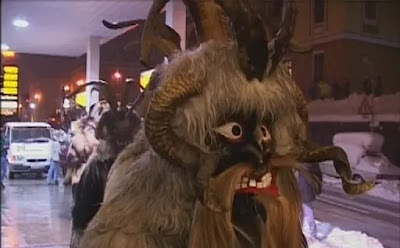
A still from Kranky Klaus (2003), a film by Cameron Jamie.

This sounds like a Grinchy move, and it was. Unlike Governor Bradford and many other Plymouth colonists, the game-players weren’t Puritans. They hadn’t realized how strongly the Puritans hated and feared Christmas. In 1659, the Massachusetts legislature even passed a bill banning Christmas - that's how much they hated the holiday. The bill was repealed in 1681 by Sir Edmund Andros, a much-despised governor appointed by the English king, but Christmas was still not widely celebrated in Massachusetts, or New England in general, until the mid-19th century. Schools and business remained open, and churches did not hold religious services on Christmas. A few  people on the margins of New England society celebrated Christmas, but most didn't.

Puritans hated Christmas for two reasons. First, they thought it was just a pagan holiday that had become thinly Christianized. There’s probably some truth in that. The Bible does not indicate the date of Christ’s birth, so the early Church fathers decided it should be celebrated on December 25, a time when people across the Roman Empire were already celebrating various winter holidays like the Saturnalia and the birthday of Sol Invictus, the sun god. It made good political sense for the new religion to piggyback on already popular holidays.

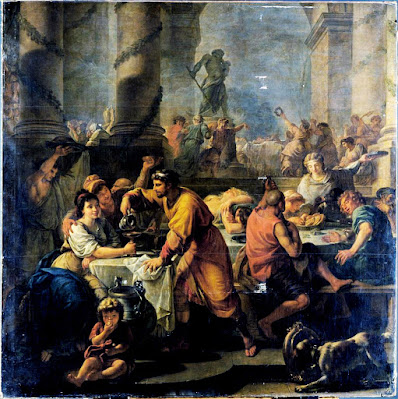
Saturnalia by Antoine Callet

Puritans also hated Christmas because it was celebrated very differently in the 17th century than it is now. Christmas was a raucous and chaotic holiday that featured lots of drunken public revelry and social disorder. There is still some heavy drinking at Christmas these days, but in the 17th century Christmas was associated with large, drunken, disorderly mobs roaming through the streets and countryside. This can be traced back to the Roman Saturnalia, which celebrated the god Saturn, who had supposedly ruled over Earth’s Golden Age. During Saturn’s reign, everyone had been equal. There were no slaves and no masters, no kings and no subjects, no bosses and no employees. It was blissful and idyllic anarchy, with the Earth providing bountiful food so no one needed to work. These beliefs about the Golden Age were reflected in the Saturnalian celebrations holiday, with masters waiting on their slaves, men dressing as women, and much public drinking and ribaldry. All boundaries were dissolved. 

Saturnalia was a season of misrule, a time when society’s rules were temporarily inverted or suspended. It was a release valve, a way for the lower classes to temporarily let off some steam and a way for the upper classes to buy some good will. After the Roman Empire collapsed, this pattern continued in Europe through the Middle Ages and into the Renaissance, but Christmas became the holiday of misrule, not Saturnalia. In many European towns and cities, prominent lower class men were appointed the Lord of Misrule by their fellows to preside over the holiday debauchery, leading crowds that mocked priests, noblemen, and the wealthy with impudence. Carolers, often drunk and in costume, demanded food and drink at wealthy homes. Once the celebrations ended, the Lord of Misrule stepped down and the old hierarchical relationships reasserted themselves until Christmas came around again. 

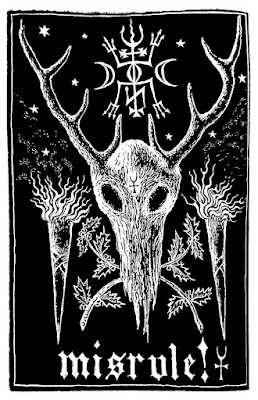
Illustration from Masks of Misrule (1996) by Nigel Aldcroft Jackson

The misrule of Christmas was antithetical to the Puritan values of hard-work, moderation, and self-control, but some modern Americans have recently have shown interest in bringing back a little of the old Christmas chaos. Some contemporary witches and occultists acknowledge a Lord of Misrule in their winter solstice rituals, and the Krampus, a monstrous Yule creature associated with misrule from northern Europe, has become increasingly popular, appearing on t-shirts, tree ornaments, and in movies. Krampus celebrations are a long-standing tradition in Germany and Austria, and some Americans are trying to bring it here.

Idyllic holiday anarchy sounds like fun, but there was definitely a dark side to Christmas misrule. The threat of violence lurked beneath the surface, and vandalism sometimes occurred, even in Puritan New England. For example, a group of young men in Salem, Massachusetts harassed 72-year-old John Rowden on Christmas night in 1679. The men forcibly entered Rowden's home, caroled, and then demanded wine as payment for their performance. Rowden refused, and in retaliation the young men pelted his house with stones and branches for 90 minutes, knocked down a stone wall, and stole six pecks of apple from his cellar. Something similar happened in Deerfield, Massachusetts in 1794, when shopkeeper John Birge was awoken at 2:00 am on December 22 by a group of drunken men demanding entrance to his home. He refused, and the men broke his windows.

Perhaps if Rowden and Birge had played along, their property wouldn't have been damaged. Much like Halloween's trick-or-treat, if you gave out food, liquor or money at Christmas you and your home would escape unharmed. The threat of violent retaliation was an integral part of the holiday.

A still from Kranky Klaus (2003), a film by Cameron Jamie.

Back in 2007, I saw a short documentary by Cameron Jamie called Kranky Klaus, which follows a group of Krampuses as they roam around an Austrian town in a pre-Christmas celebration. The movie is unsettling. The Krampuses are aggressive and violent. They try to break into a pizza shop, and when a female employee stops them they push her into a snow bank. They enter a nightclub, where they knock over tables, wrestle patrons to the floor, and whip people. The Krampuses terrify a group of children, and then shove snow into pedestrians' faces in the street. No one stops them because it's a holiday tradition, but a lot of folks seem unhappy and terrified. You can watch Kranky Klaus on YouTube for yourself. What are your thoughts? Misrule and Christmas chaos sound like fun on paper, but the reality looks pretty scary.

I love weird old traditions, but I'm happy with the tamer, milder Christmas we now celebrate. The Puritan's anti-Christmas attitude wasn't defeated by misrule, but by 19th-century capitalism and a kinder, gentle approach to raising children. The prospect of happy children opening presents under a tree won out over the Puritan's "bah humbug" attitude, and over Christmas misrule as well. Feel free to celebrate Christmas (or not) as you see fit, but I'll be sitting by the tree, drinking eggnog, and listening to Mariah Carey, trying to find that happy medium between grumpy Puritan and kranky Krampus. 

*****

My favorite book about the history of Christmas is Stephen Nissenbaum's The Battle for Christmas: A Cultural History of America's Most Cherished Holiday. I got much of this post's information from it. 

October 31, 2021

The Devil and Elizabeth Knapp: Demonic Possession and Witchcraft in 1671

Have you ever been to Groton, Massachusetts? It's a really beautiful old town, with historic houses, quaint churches, and some bucolic farmland. And one October night 350 years ago, teenager Elizabeth Knapp met the Devil in Groton. 

Knapp worked as a servant girl for Reverend Samuel Willard. In October 1671, Reverend Willard noticed that Knapp was acting strangely. Sometimes she would shriek loudly for no apparent reason. Sometimes she would laugh hysterically at nothing. When asked why, she just shrugged and continued with her chores. 

Her behavior became stranger as the month wore on. On October 30, Knapp acted as if she were being attacked by an invisible assailant. The following night, October 31, she fearfully told the household that she had seen two strange people lurking in the cellar. Reverend Willard and others searched, but found no intruders. Willard wondered if perhaps she was pulling a prank on him.

Eugene Delacroix, “Mephistopheles Flying over the City” (1828)

It was no prank, however. On November 2, Elizabeth Knapp told the reverend that the Devil had approached her repeatedly, asking her to sign her name in his book with her blood. He said he'd give her fine silk clothes, money, and a life of idleness if she did. In return, all she had to do was kill her parents, her neighbors, and Reverend Willard’s family. The Devil was quite specific in his instructions regarding Willard's family. Knapp was to throw his youngest child into the fire and kill Reverend Willard with a hook as he slept. 

Yikes.

If I were Reverend Willard, I would have removed Knapp from my house ASAP and had her locked up. But Willard was a kinder, braver, and more tolerant person. He was concerned for Elizabeth Knapp's soul and thought there was still hope. After all, Knapp told him she had not yet signed the Devil’s book. She just liked to walk with the Devil at night and listen to his sweet promises. And perhaps she was not really even talking with Satan - a local physician said her behavior was the result of a sour stomach and corrupted blood. 

The physician prescribed lots of bed rest, and at first Knapp's symptoms improved, but then they worsened as November progressed. She barked like a dog, bleated like a calf, and skipped around uncontrollably. Knapp also said she still had not yet signed the Devil’s book, but only because she couldn’t find a knife to draw her blood with. Upon hearing this the physician changed his diagnosis to diabolical possession. 

On December 2, Knapp screamed out in terror. She had seen a dog with a human head entering the house. Other members of the household saw a large, doglike footprint in the fireplace's ashes. Knapp also claimed that a local Groton woman was bewitching her, but Reverend Willard and others ignored this claim. The woman was not arrested or charged with witchcraft. 

By December 8, Elizabeth Knapp confessed that she had indeed signed the Devil’s book but refused to practice witchcraft or kill the reverend’s family. It was for these reasons the Devil tormented her. Several ministers were called in to pray over her, and as they did Knapp shouted obscenities in a voice that was not her own. Reverend Willard said the voice could be heard even though Knapp’s mouth did not move. He believed it was the Devil himself speaking through her. 

And then... it all stopped at some point in January of 1672. Most of what we know about Elizabeth Knapp's possession comes from a letter Samuel Willard wrote to Reverend Cotton Mather in Boston. Unfortunately, he didn't explain why the possession ended, just that it did. Happily, it didn't seem to have any long-term effects on Elizabeth Knapp. She later got married and had several children. She didn't throw them - or anyone else - into the fire. 

A portrait of Samuel Willard (1640 - 1707)

I have a few thoughts on this incident from Groton's past. First of all, it is spooky. Every time I read about the Devil telling her to kill Samuel Willard with a hook and throw his child into the fire I get creeped out. It's like something out of a very gory horror movie. 

The story is true, but was Elizabeth Knapp really possessed by the Devil? I suppose it's possible, if you believe in a literal Devil who possesses people, but it's important to also think about some of the sociological aspects of Puritan society. Most possession cases from 17th century Massachusetts involved young women or girls. Sadly, young women and girls were usually at the bottom of the Puritan social hierarchy because they were female and unmarried. They had little power or influence. 

Elizabeth Knapp said the Devil promised her wealth, nice clothes, and free time - all things she didn't have. He also told her to kill the people she spent her days working for. Maybe this wasn't demonic possession, but just Knapp expressing her repressed hopes and anger? If she said these things herself she would have been punished, but when she said the Devil was saying them she got the sympathy and support of her community. Maybe it was a way for her to vent her anger and frustration.

It's also interesting how her symptoms worsened as fall turned into winter. The Puritans didn't celebrate Halloween, but I was definitely struck by the October 31 date. Late fall and early winter was the time during the agricultural cycle when people had the most leisure time and the most fresh food. This is why so many major Western holidays (Halloween, Thanksgiving, Christmas) happen during the period, and I also wonder if that's why Knapp experienced her possession then. She had more leisure time to express herself, and her community had more time to pay pay attention to her. I suppose it could also have been some time of seasonal affective disorder? Groton would have been very dark and very cold in 1671.

Lastly, I will point out there were many ways this situation could have been much worse. The people in Groton could have jailed or physically punished Elizabeth Knapp. They could have accused the local woman she named for witchcraft. But they didn't do any of those things. Instead, they took care of Knapp until her possession (whatever it was) ended. The Massachusetts Puritans have a bad reputation, which is perhaps justified, but in this case they responded calmly to a situation that must have been very unsettling. 

Samuel Willard may have remembered his experiences with Elizabeth Knapp when he opposed the Salem witch trials 20 years later, writing that it was hard to prove the existence of the Devil in a courtroom.

*****

I write about Elizabeth Knapp and several other cases of alleged demonic possession in my new book Witches and Warlocks of Massachusetts. It's available wherever you buy books online. Happy Halloween!


September 28, 2020

Pale, Ghastly, Deadly: An Old Boston Ghost Story and The Politics Behind It

On May 2, 1687, Joseph Beacon was sound asleep in his Boston, Massachusetts home when suddenly someone appeared in his bedroom. It was 5:00 a.m. in the morning.

It was Joseph's brother. Joseph, who couldn't tell if he was asleep or awake, was puzzled by this since his brother was thousands of miles away in London, England. He was also concerned since his brother's "countenance was very pale, ghastly, deadly and he had a bloody wound one side of his forehead."

"Brother!" says the affrighted Joseph.

"Brother!" answered the apparition. 

Said Joseph, "What the matter brother? How came you here."

The apparition replied, "Brother, I have been most barbarously and injuriously butchered, by a debauched and drunken fellow, to whom I never did any wrong in my life."

The bloody apparition went on to say that his murderer was trying to flee London and would sail to New England on one of two ships, either the Foy or the Wild. The apparition urged Joseph to get an order from the governor if either ship arrived and have the murderer arrested. "I'll stand by you and prove the indictment," the apparition said. Then it vanished.  

At the end of June, Joseph Beacon received word from London that his brother was dead. While trying to hail a coach he had been attacked by a drunk stranger. The drunkard hit him on the head with a fire iron, and Joseph's brother lay unconscious until he died on May 2nd. The murderer was arrested and brought to trial but managed to escape execution. 

Cotton Mather, 1663 - 1728

That story appears in Wonders of the Invisible World (1693), which was written by the Reverend Cotton Mather of Boston, one of the most prominent Puritan clergymen in New England. Wonders is mainly concerned with defending the legitimacy of the Salem witch trials, which had just occurred the previous year. Many people questioned the trials even when they were happening, and after they ended public opinion began turning against everyone involved. Mather was trying to counteract that:

We cannot but with all thankfulness, acknowledge the success which the Merciful God has given unto the sedulous and assiduous endeavors of our honorable rulers, to detect the abominable witchcrafts which have been committed in the country... If in the midst of the many dissatisfactions among us, the publication of these trials, may promote such a pious thankfulness unto God for justice being so far executed among us, I shall rejoice that God is glorified...

It might seem weird to include a ghost story in a book defending the Salem witch trials, but I think it was part of Mather's strategy for the book. "See? There are ghosts, so therefore there must be witches too..."

Or, to break it down step by step, his strategy might look like this: 

A. Do you believe in ghosts? If yes, then...

B. You have to believe in witches. And if you believe in witches, then...

C. You have to believe the Salem trials were legitimate and not a tragedy.

I don't think it's the best argument. Believing in ghosts doesn't necessarily mean you have to believe in witches. And even if you do believe in witches, it doesn't mean the Salem trials were legitimate. For example, Reverend John Hale, another Puritan clergyman, argued in his 1697 book A Modest Enquiry into the Nature of Witchcraft that it's impossible to prove witchcraft in a trial. Hale believed that witches might exist but argued that the the Devil can take the form of an innocent person. That time you saw your neighbor tormenting you with witchcraft? It may really have been the Devil in disguise. 

Ultimately Cotton Mather lost the argument and his reputation was ruined for defending something indefensible. He was on the wrong side of history. The lesson of the Salem trials was pretty clear: don't accuse your neighbors of being part of a supernatural conspiracy. 

Sadly, the lesson didn't really stick. In the 1980s hundreds of people were accused of being part of a child-abusing Satanic conspiracy. The Satanic Panic, as it was called, destroyed families and led to prison terms for many innocent people. It was all based on sham psychology but no one stopped the Satanic Panic until it was too late. 

Now we have the Q Anon conspiracy theory, which has been spreading online for several years. Basically, this theory claims that a cabal of wealthy and powerful Satanists are abducting children for nefarious purposes and that Donal Trump will defeat them with mass arrests of his political opponents and journalists. It's obviously a fake rumor designed to rile up sentiment against the Democrats, but many people still believe it. 

Folks, you can put on the brakes. Liking or believing in one weird thing doesn't mean you have to believe all of them. Just because you like crystals doesn't mean you have to be an anti-vaxer. Just because you believe in UFOs doesn't mean you have to buy into Q Anon or any other conspiracy that is going to harm actual, living humans. The paranormal should be something fun to explore. It shouldn't be a slippery slope leading to mob violence and witch trials. 

June 03, 2020

A Charlestown Minister Brought the Illuminati to America

There's a lot going on in our country right now and it feels strange to write this blog at the moment. But some of you may want distraction from our latest crises, and it gives me something to do other than just obsess over the news. So here we go...

Jedidiah Morse, 1761- 1826
Do you remember when everyone on the Internet was concerned about the Illuminati? I'm thinking back to 2012, before our current president was elected and we had a lot less to worry about. That was the year that Beyonce and Jay-Z named their newborn daughter Blue Ivy. According to some people on the Internet, this was not just an eccentric pop-star child's name. No, her name was an acronym for "Born Living Under Evil; Illuminati's Very Youngest." 

Skeptical about that claim? Well, 2012 was the same year that Ke$ha released the video for her song "Die Young," in which Ke$ha and some sexy Goths gyrate and grope each other in front of a light-up pentagram as pink inverted crosses flash on the screen. Shocking reveal: Ke$ha has the Eye in the Pyramid symbol on the seat of her unitard! Commenters on YouTube said the video proved she was one of the Illuminati. Or maybe she was just trying to spice up a pop song with a controversial video...


Or perhaps you remember 2009, when Lady Gaga's video for "Bad Romance" caused a stir. It's mostly remembered for its vinyl costumes, choreographed dancing, and shoes by Alexander McQueen. But perhaps it was secretly about Lady Gaga dedicating herself to the will of the Illuminati and the goat-god Baphomet? Well, at least that's what some people online thought.


I probably just revealed a lot about my taste in music and also my skepticism about the Illuminati. I can hear some of you ask: "But who are the Illuminati?" Many people believe they are a secret organization determined to rule the world, but their real history is less impressive. The Order of the Illuminati was a secret society (similar to the Masons) founded in Bavaria in 1776. Based on the principles of the Enlightenment, the Illuminati were dedicated to reason, rationality, and the end of political tyranny. They were opposed to monarchy, religion, and superstition. Membership in the group grew for several years until the ruler of Bavaria banned secret societies in 1785.

That was the end of the Illuminati, but their reputation lived on in two books: John Robison's Proof of a Conspiracy Against All the Religions and Governments of Europe (1797) and Augustin Barruel's Memoirs Illustrating the History of Jacobinism (1797). Both books claimed the Illuminati were secretly behind the French Revolution, and that they wanted to overthrow the established social order in Europe. It wasn't true, but the shadowy, elusive (and non-existent) Illuminati gave the elites of Europe something to project their fears on.


We can blame a man named Jedidiah Morse for spreading the concept of the Illuminati to the United States. Morse was a conservative Congregationalist minister in Charlestown, Massachusetts and delivered a sermon warning against the Illuminati in May of 1798. It was only the first of several sermons he wrote about them. Here is a sample of his April 25, 1799 sermon, titled "A Sermon Exhibiting the Present Dangers and Subsequent Duties of the Citizens of the United States":
"It has long been suspected that Secret Societies, under the influence and direction of France, subversive of our religion and government, existed somewhere in this country. This suspicion was cautiously suggested from this desk... with a view to excite a just alarm, and to put you on your guard against their secret artifices. Evidence that this suspicion was well founded, has since been accumulating, and I now have in my possession complete and indubitable proof that such secret societies do exist, and have for many years existed in the United States. I have my brethren, an official, authenticated list of the names, ages, places of nativity, professions, etc. of the officers and members of a Society of Illuminati..."
Morse didn't actually reveal any names in that sermon, though. Still, sermons were a form of popular literature at the time and Morse's sermons about the Illuminati were published in multiple editions, gaining a wide readership. He was instrumental in spreading the idea of the Illuminati, and conspiracy theories in general, to the United States. I guess it's another of those historic firsts we always like to brag about in Massachusetts.

Although Morse was wrong about the Illuminati, I do think it's helpful to understand the time he wrote in. The American Revolution had ended but there was a lot of internal conflict in the United States. The Puritan church had split into warring conservative and liberal factions, which eventually gave us the Congregational and Unitarian churches. Ministers were losing the influence they once had over New England society and the mercantile and laboring classes gaining more power. On a national level, the country was split between Federalists who wanted a strong central government and anti-Federalists who wanted the states to have more power. 

There was a lot of conflict, Jedidiah Morse was anxious, and he needed someone to blame. In 1692 the Puritans blamed Satan and a conspiracy of witches for their problems; a century later Morse blamed the Illuminati.

Some of these conflicts persist into the present day, as does the idea of a shadowy group of Illuminati who are trying to manipulate world affairs. The Illuminati were not widely discussed for most of the 20th century, but Robert Anton Wilson and Kerry Thornley changed that in 1968. Wilson and Thornley were Discordians, members of a parody religion dedicated to Eris, the Ancient Greek goddess of chaos. They two men decided
“...that the world was becoming too authoritarian, too tight, too closed, too controlled”. They wanted to bring chaos back into society to shake things up, and “the way to do that was to spread disinformation. To disseminate misinformation through all portals – through counter culture, through the mainstream media, through whatever means. And they decided they would do that initially by telling stories about the Illuminati.” 
At the time, Wilson worked for the men’s magazine Playboy. He and Thornley started sending in fake letters from readers talking about this secret, elite organisation called the Illuminati. Then they would send in more letters – to contradict the letters they had just written. (BBC.com, "Accidental invention of the Illuminati conspiracy")
Wilson also later wrote Illuminatus!, a trilogy of comedic novels about the Illuminati and other secret societies trying to take over the world. Wilson and Thornley wanted people to question their reality and think for themselves. Unfortunately, their prank had the opposite effect. People took their joke seriously and began to believe the Illuminati were real. 


And they still do. There are people in America who secretly believe the Illuminati control the media, the government, and the economy. They also think the Illuminati reveal themselves through the secret symbols that they use, many of which are from Freemasonry or ceremonial magic. They'll probably even think I wrote this blog post because I am an Illuminatus.

I'm not, but we live in a society that increasingly believes in conspiracy theories. And it all started with a minister in Charlestown, Massachusetts.

March 05, 2020

Pyewacket: A Familiar Spirit with Origins in New England

Matthew Hopkins was a notorious witch-finder who terrorized the East Anglia region of England from 1644 to 1647. His short but infamous career happened during the English Civil War, when there was a lot of social unrest, and Hopkins made money by charging different towns to find the witches who supposedly caused it. It is estimated he was responsible for the deaths of 300 innocent people.

Hopkins died at the age of 27 in 1647 from tuberculosis, but before his death he published an influential witch-finding manual titled The Discovery of Witches (1647). In the book he claims he got started in the witch-finding business because there were several women in his home town of Manningtree who were witches. Here (writing about himself in the third person) he explains what happened:

... In March 1644 he had some seven or eight of that horrible sect of Witches living in the Towne where he lived, a Towne in Essex called Maningtree, with divers other adjacent Witches of other towns, who every six weeks in the night (being alwayes on the Friday night) had their meeting close by his house and had their severall solemne sacrifices there offered to the Devill...

Hopkins goes on to write that he heard one of the witches calling out to her familiar spirits. Familiar spirits were allegedly magical entities that witches commanded to do their bidding. They often appeared in the form of animals, and many people believed they were demons loaned to witches by the Devil and that they nourished themselves by sucking the witches' blood.

An illustration from The Discovery of Witches
Hopkins wrote down the names of the familiar spirits the Manningtree witch called. Those names were Holt (who appeared as a white kitten), Jarmara (a fat legless spaniel), Vinegar Tom (a greyhound with the head of an ox), Sack and Sugar (a black rabbit), and Newes (a polecat or ferret). She summoned other familiar spirits as well: Elemanzer, Peckin the Crown, Grizzel Greedigut and Pyewacket. It's quite a list of names, and in case you suspect Hopkins just made them up he writes that their names were such as "no mortall could invent."

I don't think he's quite right. I think Hopkins or his associates actually did invent most of those names, but he didn't invent the name Pyewacket. That's the name of a Native American tribe that lived in New Hampshire and Maine in the 17th century. Matthew Hopkins never visited New England, but he probably did hear about the explorations of Darby Field.

Darby Field was an Irishman who came to New England in the 1630s and settled in New Hampshire around 1638. Many of the colonists were focused on work, family and God, but Field apparently had a more inquisitive spirit. Although he worked as a ferryman he could also speak the local Alonquin dialects and was interested in exploring the area around him. In 1642 he decided to climb the White Mountains and hired some local Native guides from a village called 'Pigwacket' to help him. Pigwacket was Field's rough English transcription of Pequawket, a name of one of the Abenaki groups that lived in New Hampshire and Maine. 

Field's mountain-climbing expedition was well-known at the time and appears in both Massachusetts governor John Winthrop's journal and in a book by the explorer Ferdinando Gorges. It seems likely that Matthew Hopkins heard the name Pigwacket and incorporated it as "Pyewacket" into The Discovery of Witches. The Puritans erroneously believed that Native Americans worshipped the Devil so it makes that Hopkins would use a Native American word as a demon's name.

The Pequawket sadly no longer exist as a distinct group - they've merged with other Abenaki tribes - but the name Pyewacket continues on long after Hopkins's death. Pyewacket is the name of Kim Novak's cat in the movie Bell, Book and Candle (1958), has appeared as a character in several novels, and is the title of a recent horror film. I searched Tumblr and saw a lot of photos of animals named Pyewacket, while Instagram has over 7,000 posts with the hashtag #pyewacket. The dominant colonial culture's use of the word has outlived the actual indigenous people who inspired it. 

I don't think Pyewacket's origins in New England (and in Puritan xenophobia) is well-known. I just stumbled on it recently in Emerson Baker's excellent book A Storm of Witchcraft: The Salem Trials and The American Experience (2015). There's always something new to learn about our region's weird history. 

June 16, 2019

The Venus Glass, or Fortune-Telling with An Egg

The Puritan ministers who dominated early New England really hated magic. Their hatred of witchcraft is well known, but they didn't even like simple folk magic or fortune-telling. 

They warned their parishioners against using magic in sermons and  pamphlets, and from these documents we know what type of magic was being practiced at the time. Because the ministers weren't just complaining about an imaginary problem. They were complaining about forms of magic that people were actually using. 

Various forms of fortune-telling were common because, like all humans, the early New Englanders were interested in learning about their futures. Palm-reading and astrology were as popular in the 17th century as they are now, but some other types of divination popular then are barely practiced at all today. For example, here is what Reverend Deodat Lawson complained about in 1692: "the Sieve and the Scissors, the Bible and the Key, and the White of an Egg in a Glass."


Cotton Mather had preached against those same types of magic three years earlier:
This is the Witchcraft of them, that with a Sieve, or a Key will go to discover how their lost Goods are disposed of. This is the Witchcraft of them, that with Glasses and Basins will go to discover how they shall be Related before they die. They are a sort of Witches who thus employ themselves. 
A sieve and scissors. A Bible and a key. An egg in a glass. Your average 21st century psychic is more likely to use Tarot cards, but those other three types of magic were very popular in the 17th century. They were discussed by many ministers and also come up in the witchcraft trial records. I've written about the Bible and key and sieve and scissors before, so today I'm focusing on using an egg and a glass. 

Technically, fortune-telling with an egg is called ovomancy but the New England Puritans called the practice "the Venus glass." Venus is the planet that astrologically rules matters of love, and the English colonists used an egg in a glass to predict who they would marry. Therefore the practice was called the Venus glass. It was used primarily by young women. 

It worked something like this. You would separate the egg's white from its yolk and then slip the white into a glass of water. Being a colloid, the white would form shapes as it floated in the water. These shapes would be examined to determine the career of one's future husband. For example, if the egg white looked like a ship, your husband would be a sailor. If it looked like a plow, your husband would be a farmer, etc.

You get the picture. It seems pretty harmless to me, but not to the ministers of the 17th century. Reverend John Hale of Beverly, Massachusetts described two times when using the Venus glass went horribly, horribly wrong. 

In the first case a young woman "did try with an Egg and a Glass to find her future Husband's calling; till there came up a Coffin, that is a Spectre in the likeness of a Coffin. And she was afterward followed with a Diabolical molestation to her death; and so died a single person. A just warning to others, to take heed of handling the Devil's weapons, lest they get a wound thereby."

Take note. Not only did this poor woman die after using a Venus glass, she died single, which was one of the worst things that could happen to a woman in patriarchal Puritan society. 

In the other case, Reverend Hale spoke with one of the afflicted girls of the Salem witch trials. This girl confessed that before she had become afflicted by witches she had used a Venus glass to learn about her future husband. After she confessed this to Reverend Hale she was "speedily released from those bonds of Satan." At least this time there was a happy ending. 

So consider yourself warned. If you get tempted to use the Venus glass, maybe you should just make an omelet instead. 

******

My sources for this week's post: Richard Godbeer's The Devil's Dominion: Magic and Religion in Early New England and John Hale's A Modest Enquiry Into the Nature of Witchcraft

May 07, 2019

America's First UFO Was A Flying Hog

Boston is a modern city. It's home to world-class universities, tech companies and a highly-educated workforce. New office towers and condo buildings keep appearing on what used to be empty lots. The streets are filled with Ubers and Lyfts. The future is now!

Although Boston seems shiny and sleek these days, every now and then I get a reminder that it's an old city with a weird history. Maybe it's when I turn the corner and see a centuries-old graveyard, or maybe it's when I stumble on a really old house hidden away down an alley. Sometimes it's just smelling the salt air that blows in from the harbor on a misty day.

The other day I was reminded of Boston's strange past when I encountered this artwork along the Muddy River near the Longwood MBTA stop. It's a giant hog floating in the air, and commemorates what is believed to be North America's first recorded sighting of a UFO.


The sculpture is by A+J Art+Design, and is part of an annual exhibit of outdoor art along the Riverway. Jeremy Angier and Ann Hirsch (who make up A+J Art+Design) were inspired by this account from the journal of Governor John Winthrop. The date was March 1, 1639:
In this year one James Everell, a sober, discreet man, and two others, saw a great light in the night at Muddy River. When it stood still, it flamed up, and was about three yards square; when it ran, it was contracted into the figure of a swine: it ran as swift as an arrow towards Charlton [Charlestown], and so up and down about two or three hours. They were come down in their lighter about a mile, and, when it was over, they found themselves carried quite back against the tide to the place they came from. Divers other credible persons saw the same light, after, about the same place."
We tend to think of UFOs as some type of vehicle, but I suppose technically they are any unidentified flying object. A flaming light that turns into a giant pig fits that loose definition. Certainly it fits into a 17th century Puritan worldview better than a metal flying saucer would, and I think our experience of strange phenomena are influenced by our culture and upbringing. Someone in the 21st century would see a spaceship from another world; a Puritan sees a flying pig, which might be an omen or visitor from the demonic realm.

One aspect of James Everell's experience matches some modern UFO encounters - the experience of missing time. Many people who see UFOs realize afterwards that a significant piece of time is missing from their memory. For example, they will see a strange light in the sky for five minutes at 8:00 pm. After they stop watching they realize three hours have passed and it's now 11:000 pm. But they only watched the UFO for five minutes! What happened during the two hours and fifty-five minutes they've forgotten? Some UFO researchers believe personal encounters with the UFO's passengers happen during this missing time and they try to recover memories of these abductions through hypnosis.

It's a controversial theory, even among the UFO community, and there's nothing to indicate that James Everell and his companions were abducted. However, something strange did happen to them because after watching the light for several hours they found themselves back where they had started on the river. They were carried there against the tide without knowing how it happened. How did they get there without remembering it? It sounds similar to a missing time experience to me.


Perhaps the gap between old Boston and new Boston isn't really that great after all. The strange phenomena that once appeared as flaming swine now appear as spacecraft, but they still do the same thing: cause amazement, wonder, and a little bit of confusion. If you want to experience a little of this feeling you can take the D Line (a modern convenience) to the Longwood T stop and walk along the Muddy River (which has been there for thousands of years). The exhibit will be up until June 2.

June 27, 2018

Colonel Buck and The WItch's Curse

I've read a lot of New England folklore in my time, and here's one thing I've learned: if a gravestone looks weird it will probably have a strange story attached to it. Is there a cage around the grave? The occupant must be a vampire. Is there a giant slab covering the entire grave? It must be there to keep the occupant down.

One of the area's most famous strange graves can be found in Bucksport, Maine. It is the grave of Colonel Jonathan Buck, who founded Bucksport in 1763. Buck was born in Woburn, Massachusetts in 1719 but grew up in Haverhill, Massachusetts (which coincidentally is my hometown). Buck attempted but failed to start a shipbuilding business in Haverhill and eventually headed north to Maine where he founded a settlement. Buck fought against the British in the Revolutionary War, and as he grew older the settlement was named after him. He died in 1795. In 1852 his descendants honored him with a larger, more impressive funerary monument.


Colonel Buck's monument, with boot stain. Edited from Wikimedia.
So here's the weird thing about Buck's large, impressive gravestone: it is marred by a strange stain in the shape of a boot. By the 1880s a rumor began to circulate that Buck had been cursed back when he was alive, and a story to that point appeared in a Philadelphia newspaper. The story was reprinted a few months later in The Haverhill Gazette on March 22, 1899:

Buck was a severe and Puritannical judge who once ordered the execution of a woman accused of witchcraft. The woman went to her death cursing Buck, who stood unmoved. At the moment of her death she allegedly shouted this prophecy: 
"Jonathan Buck, listen to these words, the last my tongue will utter. Is is the spirit of the one and only true living God which bids me speak them to you. You will die soon. Over your grave they will erect a stone, that all may know where your bones are crumbling into dust. But listen, upon that stone the imprint of my foot will appear, and for all time, long after you and your accursed race has vanished from this earth, will the people from far and near know that you murdered a woman." (Haverhill Gazette article quoted in Leslye Bannatyne's Halloween: An American Holiday, An American History.)

This is the most popular version of the tale, but several variations have appeared since then. In some, the witch says she will dance on Jonathan Buck's grave when he is dead (Lisa Rogak, Stones and Bones of New England, 2004). In others, the woman is not even a witch at all. For example, Joseph Citro cites one version in Cursed In New England (2004) that claims Buck impregnated a young Indian woman. To hide his infidelity he burned the young woman (and her unborn child) alive. As her corpse burned one her legs rolled out from the fire in accusation. The woman's mother, a shaman, cursed Buck for killing her daughter. 

An even more lurid version can be found in Oscar Morrill Heath's Composts of Tradition: A Book of Short Stories Dealing with Traditional Sex and Domestic Situations (1913). In this version, Colonel Buck has secretly had an illegitimate son with a young woman who is the town pariah. When he once again impregnates her against her will he accuses her of witchcraft. The citizens of Bucksport tie her to her house and light it on fire, but as the flaming body falls apart her son grabs one of her burning legs and strikes Buck with it. Yikes! Later, Colonel Buck paints an image of her leg on his own tomb using his blood before he dies.

Heath's version is pure fiction, but all of the other versions are probably fictional as well. There is no record of Jonathan Buck ever convicting a woman of witchcraft, either in Maine or Haverhill. New England's last witchcraft executions occurred in the 1692 Salem trials, many years before Buck was even born. There's also no evidence that he executed an illicit lover either.

But like the stain itself, the story of the vengeful witch endures to this day. It helps to explain the mysterious stain, which is perhaps caused by a vein of iron in the stone reacting with the atmosphere. It also attests to the power that the archetypal image of the witch holds over the local imagination. New Englanders know there were witches in this region, and we know they were executed by Puritans. Can you really fault someone for wanting to ascribe a strange phenomenon to a witch? New England is a weird and wonderful place, and stories like these try to explain why. 

May 13, 2018

The Devil and Elizabeth Knapp: Demonic Possession in Groton

"She is a monument of divine severity; and the Lord grant that all that see or hear, may fear and tremble. Amen." (Reverend Samuel Willard, from a 1672 letter titled A Brief Accout of a Strange and Unusual Providence of God Befallen to Elizabeth Knapp of Groton.)

 In October of 1671, a teenage girl named Elizabeth Knapp began to show symptoms of a strange disorder. At first they were minor. Knapp would emit sudden shrieks with no apparent cause, and shrug when anyone asked her about them. At other times she would laugh uncontrollably as if at a private joke, sometimes to the point of falling to the ground in hysterics. She didn't tell anyone what she laughed at.

Her behavior got even stranger as the month continued. On October 30 Knapp was siting by the fireplace when she began to scream that she was being tormented:

In the evening, a little before she went to bed, sitting by the fire, she cried out, oh my legs! and clapped her hands on them, immediately, oh, my breast! and removed her hand thither: and forthwith, oh I am strangled, and put her hands on her throat; those that observed her could see what to make of it; whether she was earnest or dissembled...

Knapp was a maidservant in the home of Groton's minister Samuel Willard, and he scrupulously documented her situation in a long letter sent to Reverend Cotton Mather in Boston. Willard wrote that on the night of October 31 Knapp went into the cellar to fetch something. She screamed and ran back up, claiming she had seen two people down in the cellar. Other members of the household searched but saw nothing and wondered if Knapp had merely played a prank on them.


On November 2nd, Knapp delivered a shocking confession to Reverend Willard and other assembled neighbors: she was being tormented by Satan. Knapp claimed that over the last three years the Devil had frequently visited her, urging her to sign a covenant with him. The Devil promised to give her money, silk clothes, and release from the hard work she had to perform. In return for these things, the Devil simply asked her to sign her name (in blood) in a book. Oh, and also to murder her parents, her neighbors, and Reverend Willard's children. The Devil had even suggested she toss the Willards' youngest child into the oven and kill the reverend with a hook while he slept. Knapp denied signing the Devil's book, but did confess that she had often delayed leaving the Willard household until after sunset so the Devil could walk with her in the dark. She was drawn to the Devil even though she knew it was wrong.

Willard and other local ministers received her confession with concern but also some skepticism. Was her story true?

Her symptoms increased in the early days of November. A physician was called in, "who judged a main part of her distemper to be natural, arising from the foulness of her stomach and corruptness of her blood, occasioning fumes in her brain, and strange fantasies." You have to love that seventeenth century medicine! Knapp was briefly relieved from her duties at Reverend Willard's home and sent to rest at her parents' house.

Her fits lessened and she returned to the Willards, but as the month went on and the days grew darker her symptoms became worse. At times her tongue was stuck to the roof of her mouth, at other times she barked like a dog or bleated like a calf. She ran around the house yelling and skipping and no one was able to restrain her. Reverend Willard wrote that the physician changed his diagnosis and "consented that the distemper was diabolical, refused further to administer, and advised to extraordinary fasting." Multiple ministers were called in to pray for her. Knapp still claimed she had not signed the Devil's book, but did say she had been sorely tempted to but was foiled because she couldn't find a knife to cut her finger.

On December 2, Knapp became highly agitated and said she saw a dog with a woman's head outside the house. It was a witch and was trying to get in. The Willards did not see the creature, but did see a strange canine paw-print in their fireplace. Knapp claimed that if the witch were apprehended her fits would stop. She identified the witch as a local woman, but after investigating the authorities dismissed her claim.


On December 8, Knapp finally confessed to what the Reverend Willard had secretly suspected: she had signed her name in the Devil's book. She said that one day shortly after coming to work for the Willards she had looked out the window and seen the Devil in the shape of an old man walking across  a meadow towards her. He carried a large book in his hands. She heard his terms and then...
...with a knife cut her finger, he caught the blood in his hand, and then told her she must write her name in his book, she answered that she could not write, but he told her that he would direct her hand, and then took a little sharpened stick and dipped in the blood and put it into her hand, and guided it, and she wrote her name with his help.
She agreed to serve the Devil for seven years, but balked at working witchcraft for him. This was why the Devil tormented her so violently with fits.

On December 17th the Devil took complete control of her body. He began to speak through her, insulting her family and the ministers who gathered around her. He insulted God and threatened violence agains the people who were praying over Knapp. Willard believed that it was truly the Devil speaking through her, claiming that Knapp's mouth and lips were immobilized even though words came out.


During January Knapp was silent for long periods of time, although she now claimed that her confession of signing the Devil's book was false and that she had never been tempted to murder the Willard family. She said that although the Devil controlled her body she prayed that he would not take her soul.

And then...

Willard's letter ends there, at mid-January, 1672. He closes his letter with some arguments why, despite the claims of skeptics, he thinks Knapp's possession was authentic. His key arguments are that he thought the strength she displayed during her fits was beyond what was natural, and that her mouth did not move when the Devil spoke. She also used words and phrases while possessed that she had never used before.

Still, Willard writes that he found her multiple contradictory stories about signing the Devil's book puzzling, and admits that other explanations for her behavior may be possible.

Although this information is not included in his letter, it seems that Knapp was eventually cured of her demonic possession (whatever it may have been). Historian David Hall notes that Knapp married in 1674 and had at least six children. Let's hope she wasn't tempted to throw any of them in the oven.

It's interesting that Knapp's symptoms appeared in the dark months of the year. In England, the months of October through mid-January would have been celebrated with harvest festivals, dances and the lavish feasting and misrule of Christmas. Those holidays were suppressed in Puritan New England but it seems like the Devil still wanted to have a little fun.

It's also fascinating to compare this case with the Salem witch trials. Groton's leaders dismissed Elizabeth Knapp's claim that another member of the community had bewitched her. The town might have had a full-blown witch hunt, like Salem, if they hadn't.

Samuel Willard's letter is a fascinating document. I found a copy of it in David Hall's fantastic book Witch-Hunting in Seventeenth-Century New England. The letter is about fifteen pages long and really goes into detail about the case and what Willard and others thought of it. It's a window into the lives and minds of people who lived here over three centuries ago.

September 20, 2017

A Weed That Cures Witchcraft and Elf-Sickness

Today is cloudy and dark. A hurricane is churning off the coast. Autumn officially starts in a few days. All this puts me in the mood for some witchcraft. So here goes!

Whenever I walk around the Boston area, I see a lot of plants growing wild. They grow in yards, they grow in parks, they grow in empty lots and along the sidewalks. I suppose you might call them weeds, but that term seems a little derogatory, doesn't it? Many of these plants are actually herbs that historically have been associated with healing. We've just forgotten what they were used for.

Some of them I recognize, like mugwort, dandelion, and mullein, but I'm still learning the names of others. For example, I believe this inconspicuous looking plant growing on Memorial Drive is actually dock weed (or dock). I'm glad to know where it is. It might come in handy in case I am bewitched or afflicted by elves.


According to Pamela Jones's book Just Weeds: History, Myths and Uses (1994), the Medieval Anglo-Saxons valued dock weed as a cure for "elf-sickness." Like many other Europeans, the Anglo-Saxons believed that elves shot people with invisible arrows and made them sick. Many Anglo-Saxon sources also link elves with witches since they were both sources of illness and suffering.

For example, one Anglo-Saxon book of cures contains a recipe for an herbal salve to treat sickness caused by "the elfin race and nocturnal goblin visitors and for the women with whom the devil hath carnal commerce." Another such book has a chapter dedicated to cures against "every evil wisewoman and the elfin race," while another, the Lacnunga, lists witches, elves, and Norse gods as possible causes for illness.

The Puritans who colonized New England did not worry about Norse gods, and they didn't really worry much about elves either. But they worried about witches a lot. A lot. The Salem witch trials of 1692 are the most famous New England trials, but there were many others before them, and even a few afterwards. For the Puritan settlers, witches were a real concern and they were always looking for ways to combat their malevolent magic.

For example, in 1685 a woman living in East Hampton, Connecticut* named Elizabeth Howell became strangely ill. She felt sharp piercing pains as if being stuck with pins, and claimed to see a strange black creature lurking at the foot of her bed. She also supposedly vomited up a pin. Before she died, Howell cried out that she was being bewitched by a neighbor, Elizabeth Garlick.

Goody Garlick was arrested and brought to trial for witchcraft. Several people testified against her, including one Goodwife Simons, who claimed that while suffering from fits two neighbors arrived with dock weed to cure her illness. When she learned that the dock weed had been provided by Goody Garlick she threw it onto the fire. She suspected that Goody Garlick was bewitching her and didn't trust the dock weed. Perhaps it would just make her feel worse! But it's clear that her neighbors thought the dock weed would help cure her. I think it's fascinating that a centuries-old belief dating back to the Anglo-Saxons appeared in 17th century Connecticut.

So there you go. Random weeds growing near the sidewalk actually have a connection to witchcraft, and perhaps even elves. New England is a great place to live!

*****

* East Hampton is now part of New York but for a time in the 1600s it was part of Connecticut. 

I got most of my information about Goody Garlick and the dock weed from this Smithsonian article and this article in the East Hampton Star. I also found another Anglo-Saxon leech book that mentions burning herbs as a cure for elf-sickness, but historians don't seem to think that is why Goodwife Simons threw the dock weed into her fire.