Showing posts with label demon. Show all posts

October 17, 2021

Jack-O-Lanterns: Demons, Gemstones, and New England Origins

The jack-o-lantern is a ubiquitous symbol of Halloween. All across America, people carve faces into pumpkins, placing them on doorsteps and windowsills as part of the holiday celebrations. Despite New England's modern connection with Halloween because of Salem's annual October festivities, Halloween really only became popular in New England in the latter half of the 19th century as more Irish and Scottish immigrants arrived here. The English Puritans and their descendants did not celebrate before then. 

Still, despite this, the jack-o-lantern has deep roots in New England. It seems likely that people were carving jack-o-lanterns well before Halloween was even celebrated here, and that pumpkin carving became associated with the holiday only later. Read on if you dare...

Nathaniel Hawthorne: Giant Gems and Enchanted Scarecrows

Massachusetts author Nathaniel Hawthorne was apparently the first person to ever use the term "jack-o-lantern" in print. His 1835 story "The Great Carbuncle" is about a group of adventurers searching for a giant, glowing gemstone in the White Mountains. One of the adventurers tells his companions he will hide the gem inside his tattered cloak if he finds it.

‘Well said, Master Poet!’ cried he of the spectacles. ‘Hide it under thy cloak, sayest thou? Why, it will gleam through the holes, and make thee look like a jack-o’-lantern!’

It's not entirely clear what Hawthorne means by jack-o-lantern here. It sounds like it could be our familiar carved pumpkin lit by a candle, but the term jack-o-lantern also was used to mean ignis fatus, the glowing swamp gas phenomena also called willow-the-wisp. Either usage makes sense in the story. Halloween is not mentioned at all in "The Great Carbuncle," which was published before the holiday was celebrated in New England.

Nathaniel Hawthorne

However, a carved pumpkin does appear in Hawthorne's 1851 story "Feathertop," when a New England witch named Mother Rigby uses one as a head for her scarecrow:

Thus we have made out the skeleton and entire corporosity of the scarecrow, with the exception of its head; and this was admirably supplied by a somewhat withered and shrivelled pumpkin, in which Mother Rigby cut two holes for the eyes and a slit for the mouth, leaving a bluish-colored knob in the middle to pass for a nose. It was really quite a respectable face.

Mother Rigby is so pleased with her handiwork that she brings the scarecrow to life, and since this is a Hawthorne story the scarecrow learns a lot about human morality. Hawthorne does not use the term jack-o-lantern in the story, though, and Halloween is not mentioned. 

John Greenleaf Whittier: Boyhood Memories?

The Massachusetts poet John Greenleaf Whittier mentions a carved pumpkin in his poem, "The Pumpkin," which was first published in 1846 (according to Cindy Ott's 2012 book The Pumpkin: The Curious History of An American Icon).

Oh, fruit loved of boyhood! the old days recalling, 
When wood-grapes were purpling and brown nuts were falling! 
When wild, ugly faces we carved in its skin, 
Glaring out through the dark with a candle within! 

Whittier was born in 1807. If he really carved faces into pumpkins when he was a boy, it would have been very early in the 19th century, long before Halloween was celebrated in New England. Whittier only refers to Thanksgiving in "The Pumpkin," but not Halloween, and he doesn't call the carved pumpkin a jack-o-lantern.
John Greenleaf Whittier

It's a little confusing, isn't it? The earliest instance historian Cindy Ott found where "jack-o-lantern" refers to a carved pumpkin comes from 1846. It appeared in a South Carolina publication called Tales for Youth, but again with no apparent connection to Halloween. It sounds as though people were carving pumpkins and using the term jack-o-lantern well before Halloween was celebrated, even if not always together.

A Demon and A Pumpkin in Rhode Island

Enough with the history, let's turn to the spooky stories. Many years ago, during the Revolutionary War, two young women named Hannah Maxson and Comfort Cottrell were staying at the Westerly, Rhode Island home of one Esquire Clark. One day while the Esquire was away on business, and his wife was sick in bed, the two young ladies decided to practice a little love magic. 

They took a ball of yarn, and tossed it repeatedly down a well and then pulled it back up. As they did, they chanted some psalms backwards. The goal of this magic spell? To find the men they would marry. 

As the sun set, Hannah and Comfort saw a tall figure walking up the road towards the house. They ran eagerly towards it, but their excitement turned to terror as they saw the figure had an enormous, misshapen head with two glowing, fiery eyes. This was no dream lover, but a demonic monster. 

Hannah and Comfort ran into the Clarkes' house and locked the door, but the hideous creature pounded on it insistently. The young women hid behind Mrs. Clarke's bed in fear, listening with the sick woman as the monster tried to break into the house. The supernatural assault only stopped when Esquire Clark returned home. Seeing a demonic creature clawing at his front door, he said some prayers against evil, which sent the monster slinking off into the woods.

This story first appeared in a November 1860 issue of The Narragansett Weekly, and the author, Deacon William Potter, notes that Mrs. Clarke died from all the excitement. Hannah and Comfort vowed never to use magic again. But Deacon Potter includes a strange epilogue. He claims that the demon was really a hoax played by a young many who lived near the Clarkes. He put a carved pumpkin on his head to scare Hannah and Comfort, not anticipating his joke's deadly results. The neighbor only revealed his role in the story seventy years later. 

It's a good spooky, cautionary tale. Young ladies - don't mess around with the occult. Young men - don't play stupid pranks that kill people. But despite the carved pumpkin, the story doesn't reference Halloween. And it's not called a jack-o-lantern.

The Sea Captain and Satan

Captain Snaggs was a wealthy sea captain who lived in Barnstable on Cape Cod. He had earned his riches the old-fashioned way: by selling his soul to the Devil. He had been young and foolhardy when he signed Satan's contract, but as an old man on his deathbed he was filled with regret. He could hear the Devil's hooves coming up the walkway towards his house, and Captain Snaggs didn't want to go to Hell. So he jumped out of bed, climbed out the window, and ran like... well, he ran like hell. 

He ran down the length of Cape Cod to Orleans, where he hid in a hollow tree. But the Devil was hot on his heels, and could smell Captain Snaggs's soul. So Captain Snaggs ran again, this time to Wellfleet, where he hid in a cemetery. 

The Devil was not far behind, so Captain Snaggs grabbed a pumpkin from a nearby pumpkin patch, carved a face in it, and set it up on a tall, white gravestone. Then he lit a candle inside of it and ran towards Truro.

When the Devil arrived in the cemetery he said to the pumpkin, "Your contract is up, Snaggs. I've come to take your soul." When the pumpkin didn't answer, the Devil poked the gravestone with one talon. "Do you hear me Snaggs? Ouch! You're awfully tough for an old man! Where'd you get those muscles?" He grabbed the gravestone and gave it a mighty shake. The pumpkin fell to the ground and shattered. Realizing he had been tricked, the Devil ran towards Truro with a demonic roar. 

Captain Snaggs, meanwhile, had run all the way to Provincetown. He had reached the end of the Cape. There was no place left to go. When the Devil finally caught up with him, sulfurous smoke billowing from his nose and ears, Captain Snaggs stood there in terror.

With a tremor in his voice, he said, "All right, I'm ready. You can take me to Hell now."

The Devil looked puzzled and said, "Take you to Hell? We're in Provincetown, aren't we? We're already there."

As Elizabeth Renard notes in her 1934 book The Narrow Land, there are many variations on this story. The comedic ending always remains the same, but the name of the captain, the Cape Cod towns he visits, and the number of pumpkins involved all vary. You can listen to an excellent audio version of this tale at New England Legends, where the sea captain is named Jedidy Cole. 

Renard also notes that this story is probably of late origin, so perhaps it was first told after Halloween became a popular holiday here. It's hard to say. Have a happy Halloween!

*****

My new book, Witches and Warlocks of Massachusetts, was just released on Kindle recently. So now you can enjoy it either in paperback or on your device of choice. You can buy it wherever books are sold online


June 06, 2021

The Devil Made Me Do It: Is The New Conjuring Film True?

I'm a big horror movie fan, and enjoyed the first two Conjuring films, The Conjuring (2103) and The Conjuring 2 (2016). Both films are based on supposedly true cases examined by Ed and Lorraine Warren, Connecticut paranormal investigators. Played by Patrick Wilson and Vera Farmiga, in these films the Warrens are portrayed as clean-cut, devout Catholics who are deeply in love with each other. I think their relationship is one of the reasons the Conjuring movies stand out in the crowded horror field. Ed and Lorraine are so wholesome it's almost comical at times. 

The real-life Warrens are now deceased, and a 2017 article in The Hollywood Reporter suggests they may not have been as wholesome as their film counterparts. According to the Reporter, Ed Warren initiated a relationship with a 15-year old girl when he was in his 30s and married to Lorraine. The girl eventually moved in with the Warrens and lived with them for forty years. At one point, the girl became pregnant with Ed's child and Lorraine arranged for her to have an abortion, something clearly at odds with the Warrens' public image as strict Catholics. 

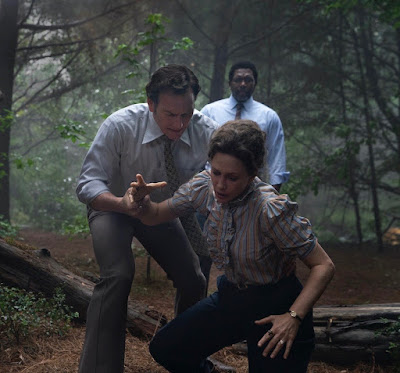
A scene from The Conjuring: The Devil Made Me Do It.

So what does it mean when a movie like The Conjuring says it's "Based on a true story?" Very little, I think. It's marketing, and not a legally defensible claim. Take it with a big grain of salt. You certainly won't see Ed Warren having sex with teenage girls in the Conjuring movies, or his wife arranging for an abortion. And I think that's OK, as long as you realize the movies are basically fiction.

The newest Conjuring movie has just been released: The Conjuring: The Devil Made Me Do It. It's a great title, and once again it's supposedly based on a true case investigated by the Warrens. 

Here are the facts of the case. On February 16, 1981, nineteen-year old Arne Cheyenne Johnson of Brookfield, Connecticut, stabbed his landlord, Alan Bono, several times in the chest with a knife. Johnson's fiancee, Debbie Glatzel, watched as it happened and later testified that Johnson growled like an animal as he did it. 

Johnson was arrested and charged with murder. When asked why he killed Bono, Johnson said, "The Devil made me do it." He claimed he was possessed by a demon. 

The Conjuring: The Devil Made Me Do It

It had started the previous summer. On July 3, 1980, Debbie Glatzel's brother, 11-year old David, woke up in a panic. He said he had seen a demon in his sleep, "a man with big black eyes, a thin face with animal features and jagged teeth, pointed ears, horns and hoofs." David continued to see the demon throughout the summer, and a house-blessing by the a local priest did nothing to stop his visions. David sometimes even saw the demon in the daytime, when it appeared as an old man wearing a flannel shirt and jeans. According to People magazine:

In desperation, the Glatzels called on a couple from nearby Monroe, Conn. who are self-styled “demonologists.” Ed and Lorraine Warren, both 54, were professional artists until 1968, when they decided to pursue what was until then an avocation, the occult. Though they accept no fees for conducting demonic investigations, they lecture indefatigably (at up to $1,000 per), and once hosted a weekly local TV show, Ghost Hunting With Ed and Lorraine Warren.

Lorraine, who also claims the gift of clairvoyancy, describes her first encounter with David Glatzel: “While Ed interviewed the boy, I saw a black, misty form next to him, which told me we were dealing with something of a negative nature. Soon the child was complaining that invisible hands were choking him—and there were red marks on him. He said that he had the feeling of being hit.” ("In a Connecticut Murder Trial, Will (Demonic) Possession Prove Nine-Tenths of the Law?", People, October 26, 1981)

The Warrens believed there were 43 demons inside David, and coordinated several exorcisms. They had little effect. At one point, in desperation, Arne Cheyenne Johnson taunted the demons to enter his body instead. Again, it had little effect. David was eventually sent to a private school for "disturbed children."

Johnson seemed changed, though. After his taunt during the exorcism, he too claimed to see the demon that David had seen, and Debbie later testified he fell into trances in the months leading up to Bono's murder. 

On February 16, Johnson and Debbie Glatzel were taken to lunch by Alan Bono, who was Debbie's boss at a kennel and was also their landlord. Johnson's sister Wanda and Glatzel's nine-year old cousin Mary joined them. Bono supposedly drank heavily during lunch, and later that day became agitated and grabbed Mary. Johnson argued with Bono, and stabbed him several times in the chest and stomach. Johnson then walked into the woods, where he was found by the police. It was the first murder in Brookfield's 193-year history. Johnson was convicted of first-degree manslaughter and served five years of a 10 - 20 year prison sentence. 

After the trial ended, an author named Gerald Brittle published a book about the case, The Devil in Connecticut, which was written with help from Lorraine Warren. When the book was republished in 2006, Brittle was sued by David Glatzel and his brother Carl for misrepresenting them in the book. Carl also claimed his brother's possession had been a hoax created by the Warrens to take advantage of David's mental illness. Arne Cheyenne Johnson and Debbie Glatzel, who were by this point married, stood by the Warrens and author Brittle, claiming they accurately presented the situation. 

The Conjuring: The Devil Made Me Do It

So there you go. Were David Glatzel and Arne Cheyenne Johnson really possessed by demons, or were the Warrens taking advantage of a mentally ill boy? I can't say, but it's interesting that David, the subject of the Warrens' exorcisms, now claims he was not possessed. 

The judge in Johnson's trial didn't accept his claim of demonic possession. As we all learned from the 1692 Salem witch trials, it's impossible to prove the Devil's existence in court.

'Demon' defense rejected in Conn. murder trial.

Danbury, Conn. - A Superior Court judge yesterday refused to allow a much-publicized "demon defense" to be used in the murder trial of a Connecticut man. 

The defense strategy was to try to prove that Arne Cheyenne Johnson was possessed by demons when he allegedly stabbed a neighbor to death eight months ago. 

The jury process had just begun when Judge Robert Callahan said the defense that attorney Martin Minnella planned was "irrelevant and I am not going allow it, period." (Boston Globe, October 29, 1981)

I haven't seen The Conjuring: The Devil Made Me Do It yet, but have seen the trailer. It shows Arne Cheyenne Johnson walking down the road covered in blood, Lorraine Warren being dragged off a cliff by a monstrous arm, a little boy getting pulled into a waterbed, and Lorraine Warren saying, "It's a witch's totem. We think your family was cursed, and that connection is still open." 

It looks like a great horror movie, but is it a true story? Probably not. Horror movies require literal monsters, but the real situation in Brookfield seems complicated and nuanced. 

February 17, 2021

ZoZo the Demon in Massachusetts: Ouija Boards, UFOs, and Led Zeppelin

On September 1, 1994, Mona Kempka woke up in her bedroom in Framingham, Massachusetts. It was 3:15 a.m. She had been sound asleep but felt someone pressing on her hands. Kempka was quite surprised when she opened her eyes. 

A reptilian entity was materializing in her bedroom. It was large and covered in scales. And did I mention it was large?

Its torso put the most proficient bodybuilder to shame, its legs were like giant frog's legs only more developed muscularly, there was mist covering its face so she could not see it...

The creature had large claws on its hands. As it appeared the entire room was lit with a strange pinkish light, and the creature told Kempka repeatedly its name was "ZoZo." It didn't speak but communicated with her telepathically. And then the creature disappeared.


From the 1977 movie SPECTRE.


This terrifying encounter was not the first time Kempka had heard the name "ZoZo." She had been using a Ouija board earlier and contacted an entity that said its name was ZoZo. She had also encountered a gray alien around this time as well.

I found this story in Albert Rosales's book Humanoid Encounters: 1990 - 1994, The Others Among Us. The Humanoid Encounters series is a great source of strange stories and I highly recommend them. Rosales doesn't give a lot of context, though, so I did a little digging to learn more about ZoZo. Some of you may already know about him but he was a relatively new demon to me. 

ZoZo seems to have entered America's cultural consciousness around 2009, when an Oklahoma man named Darren Evans posted about his Ouija board experiences in an online forum called True Ghost Tales. Evans said he had contacted a demonic being named ZoZo, who liked to swear at him through the Ouija board and threatened to take Evans's girlfriends off to Hell. Evans thought it was all talk, until one night his young daughter nearly drowned in the bathtub after ZoZo threatened her during a Ouija session. She also suffered from a nearly fatal infection shortly afterwards.

From that point on, Evans's house was plagued with strange phenomena. Objects moved on their own, voices were heard in empty rooms, and lights turned themselves on and off. Evans eventually moved to Michigan, but the weird occurrences started in his new home as soon as he started to use a Ouija board again. And the board spelled out ZoZo...

In 2016, Evans wrote The Zozo Phenomena with Rosemary Ellen Guiley, and has also appeared on Ghost Adventures and other paranormal TV shows. The book's name is accurate: ZoZo did become a phenomena, and there are now thousands of videos on YouTube of people trying to contact the demon. There have also been several horror films made about him as well. Many other people on the True Ghost Tales forum have confirmed Evans's experiences and said they too have encountered ZoZo.

I am a little late to the ZoZo party, but as soon as I saw the name I immediately thought of Led Zeppelin. I grew up in the 1970s, when Led Zeppelin was one of the biggest bands in the world. They had a reputation for dabbling in the occult, and children were warned that demonic messages would be revealed if they played Led Zeppelin albums backwards. The band's fourth album, Led Zeppelin IV, featured four occult symbols on the record sleeve, one for each band member. 

Guitarist Jimmy Page's symbol was the following:


There is some truth behind the band's occult reputation. Jimmy Page became fascinated by the occult after reading Aleister Crowley's Magick in Theory and Practice when he was a teen, and he later bought Crowley's former home Boleskine House (located on the shores of Loch Ness!) with part of his Led Zeppelin fortune. He also briefly owned an occult bookstore and publishing company in London. 

Led Zeppelin fans have argued for years about the meaning of the Zoso symbol. It seems it originated in an Italian Renaissance alchemical grimoire, and probably refers to Saturn, the planetary ruler of Capricorn, Page's zodiac birth sign. It doesn't refer to a demon, and probably isn't even meant to be pronounced at all. It's simply a symbol.

Darren Evans is aware of the Led Zeppelin symbol, but he claims ZoZo has much older roots. For example, a demon named ZoZo is mentioned in 1818 French book called Le Dictionaire Infernal, and was mentioned in some other French texts in the 19th century. But some scholars claim that ZoZo is described as part of a fake possession case in Le Ditcionnaire Infernal and is not meant to be taken seriously. The name ZoZo has appeared in a few other places, including John Waters's 2000 movie Cecil B. Demented, where a character played by Maggie Gyllenhall says her father is "Zo-Zo, the three headed guard dog at the gate to hell."

The Ouija board has its origins in the 19th century, when spiritualism was sweeping across the country and Americans were eager to contact their dead loved ones, particularly those who died in the Civil War. For many years Ouija boards (also called spirit boards or talking boards) were mostly seen as a form of wholesome entertainment and a party game. For example, the couple in this Norman Rockwell painting don't seem too concerned about demons as they play with their board:


Ouija boards got a more sinister reputation in 1973, when the movie The Exorcist was released. In it, a young girl contacts a spirit named Captain Howdy using a spirit board. Although at first he seems harmless, it soon turns out that Captain Howdy is actually a Babylonian demon named Pazuzu. Oops! Ouija boards became a horror movie staple after that, and as the Satanic panic swept the country in the 1980s concerned parents warned their children against using them. This of course only made kids want them even more, and today Ouija boards are more popular than ever.

ZoZo. Zoso. Pazuzu. Led Zeppelin. The Satanic Panic. Linda Blair and Ouija boards. It's a potent mix of pop culture, the occult, and forgotten religious tidbits. You can see how the idea of a Ouija demon named ZoZo would take shape from all these different pieces, and why it would resonate. I'm not going to judge the truth or falsehood of Evans's claims, and I do think we can have powerful spiritual experiences even of things that have fairly recent origins. 

Now, back to Mona Kempka and her ZoZo sighting in Framingham, Massachusetts. Kempka said she saw the reptilian creature in 1994, years before Darren Evans had his experiences with ZoZo. Kempka discussed her sighting on a 2005 episode of World's Strangest UFO Stories, which was also several years before Evans shared his experiences. 

However, you've probably noticed she appeared on a UFO show, not a show about demons. I watched the episode, and she doesn't say the reptilian creature was a demon or that it was named ZoZo. She simply says it appeared and then disappeared, and that David Icke's theory that reptoid aliens are taking over the planet may be right. (I don't share her opinion on that.) The creature was only in her room for six seconds. She seems like a UFO believer, not someone involved in the occult. 

My guess is that Kempka's story probably changed a little over time. Rosales's Humanoid Encounters: 1990 - 1994 was not published until 2016, many years after Kempka's initial encounter with the creature and more than 10 years after she appeared on TV. She probably reevaluated her experience in light of new information, including the stories about ZoZo. I don't think she identified the musclebound reptoid as ZoZo until after Darren Evans' book came out. Does this mean she lied? 

Not necessarily. People around the world have experienced strange nighttime phenomena for millennia. If Mona Kempka lived in 17th century Massachusetts, she probably would have blamed this strange visitation on a witch. Explaining the creature as an alien visitor made sense in the late 20th century, but with our culture's current occult resurgence maybe a demonic explanation came to seem more meaningful. Maybe the concept of ZoZo made more sense to her than the concept of aliens. A skeptic might say she was just experiencing sleep paralysis or night terrors. Explanations come and go, but the experiences remain the same. 

One final note. Sadly, Mona Kempka passed away in 2015, so we'll never know more about her encounter that night in 1994. I'm glad she shared her stories. 

September 01, 2020

Chicken Blood and Steel Rods: Magic and Treasure in 18th Century Vermont

In the 18th and early 19th centuries many New Englanders believed the area was riddled with buried treasure. I've written about this a few times before, but basically people thought pirates, or sometimes Spanish explorers, had buried gold and silver all over New England. It was in fact a very common pastime for people to dig for treasure. All you needed was spare time and a shovel - and some magic.

Before you could dig for treasure you had to find it. Sometimes local legends provided the location where the treasure was buried. For example, that's the case with Dungeon Rock in Lynn, Massachusetts, which according to legend collapsed onto a pirate and his treasure during an earthquake and was subsequently the site of a famous attempt to unearth the buried booty. The treasure was never found.

However, if local legends were no help you'd need some magic to locate the treasure. Many people turned to dowsing rods for assistance. Traditionally dowsing rods were made from forked witch hazel branches, but in some cases they were made of various metals, sometimes expensively. They were most often used to find water but in theory could also find buried gold. Well, at least in theory.


If the dowsing rod wasn't working out you could always try following your dreams, and I mean that literally. There are many accounts of New Englanders dreaming about the location of buried treasure. For example, Silas Hamilton (1736 - 1816) of Whitingham, Vermont, kept a notebook where he recorded dozens of tips and stories he'd heard about buried treasure across New England. Many of them involved dreams:

... Mrs. Woodbury and her daughters have dreamed sundry times in a remarkable manner of money or  hid (sic) treasure in Brookfield on her husband's farm in Brookfield in the Bay State. 
Ebenezer Felton of New Salem dreamed of money hid.  
Mr. Lamb informs that Bezalel Pierce informs that his brother of South Hadley dreamed of a large quantity of money hid near Mount Tom on the West Side of the Connecticut River.  
Also Capt. Doneson dreamed of hid money on Fisher's Island on Mount Prospect near a rock not the bigness of a haycock. Said Prospect is on on the west end of the island. 

You get the idea. But still, learning where the treasure was hidden (or "hid" as Hamilton would say) was really just the start of the process. You still had to dig it up, which sounds easier than it was. Yes, New England soil is stony, but that's not why it was hard to get the treasure. It was hard because the treasure was almost always protected by supernatural guardians and magic spells.

Various legends tell of the eerie guardians that watch over the hidden gold. Giant ghosts on horseback, armies of black cats, devilish hounds, and undead pirates - these were just a sample of the demonic beings a treasure-digger might encounter. Certain magical precautions had to be taken to ward them off. Treasure-digging should only take place at midnight, for example, and strict silence must be observed by all participants. Some stories also claim the digging had to be doe within a protective circle drawn on the ground.

Breaking any of these rules would allow the demonic guardians to attack, but even worse it would make the treasure move. That's right - even after you found the treasure, it could still move to a new location. Many treasure-diggers claimed they had the hidden gold within reach, just a single shovelful of dirt away, only to see it disappear or sink deeper into the earth when someone spoke or made too much noise. Imagine their frustration. It's like being one number away from winning PowerBall. The whole process of finding the treasure had to begin all over again.

Silas Hamilton believed that he had a solution to this problem. It involved animal blood:

Take nine steel rods about ten or twelve inches in length, sharp or piked to pierce into the earth, and let them be besmeared with blood from a fresh hen mixed with hogging. The make two circles around  the hid (sic) treasure. One of the said circles a little larger in circumference than the hid treasure lays in the earth, the other circle some larger still, and as the hid treasure is wont to move to North or South or East or West place your rods as described on the other side of this leaf (page).

Silas Hamilton's illustration from Green Leaves from Whitingham

In essence, the rods created a cage around the treasure which prevented it from moving away. The circular formation is reminiscent of the magical circles that have been cast by ceremonial magicians for centuries.

Just a few words about Silas Hamilton. He was a wealthy landowner, and helped found Whitingham in the 1770s. He was an important and reputable person, yet he was writing about smearing steel rods with chicken blood to prevent buried treasure from moving around in the ground. I think it shows how prevalent and normal magic was in New England at  the time.

I don't think Silas Hamilton ever found any pirate gold, and I don't think many people ever did. That didn't stop them from trying, though. Treasure digging sounds like a fun activity to me. You got to run around late at night in the woods with your friends, hoping to get rich while simultaneously scared of encountering a ghost or some demonic animal. It sounds like a lot of the paranormal shows that are on TV right now, or even some weird legend trips I've been on myself. Perhaps finding the treasure wasn't really the point. No one ever got rich, but I'm sure people kept doing it because they wanted to hang out with their friends and have some spooky fun.

One closing thought. Whitingham, Vermont is a small town on the Massachusetts border, and one of its most famous residents was Brigham Young, the second leader of the Mormon Church. The Mormon Church was founded by Joseph Smith, who was also born in Vermont and later said he was led by an angel to unearth a book written on golden plates buried in a hill.

*****

I got the information about Silas Hamilton from Clark Jillson's 1894 book Green Leaves from Whitingham, Vermont: A History of the Town.

March 05, 2020

Pyewacket: A Familiar Spirit with Origins in New England

Matthew Hopkins was a notorious witch-finder who terrorized the East Anglia region of England from 1644 to 1647. His short but infamous career happened during the English Civil War, when there was a lot of social unrest, and Hopkins made money by charging different towns to find the witches who supposedly caused it. It is estimated he was responsible for the deaths of 300 innocent people.

Hopkins died at the age of 27 in 1647 from tuberculosis, but before his death he published an influential witch-finding manual titled The Discovery of Witches (1647). In the book he claims he got started in the witch-finding business because there were several women in his home town of Manningtree who were witches. Here (writing about himself in the third person) he explains what happened:

... In March 1644 he had some seven or eight of that horrible sect of Witches living in the Towne where he lived, a Towne in Essex called Maningtree, with divers other adjacent Witches of other towns, who every six weeks in the night (being alwayes on the Friday night) had their meeting close by his house and had their severall solemne sacrifices there offered to the Devill...

Hopkins goes on to write that he heard one of the witches calling out to her familiar spirits. Familiar spirits were allegedly magical entities that witches commanded to do their bidding. They often appeared in the form of animals, and many people believed they were demons loaned to witches by the Devil and that they nourished themselves by sucking the witches' blood.

An illustration from The Discovery of Witches
Hopkins wrote down the names of the familiar spirits the Manningtree witch called. Those names were Holt (who appeared as a white kitten), Jarmara (a fat legless spaniel), Vinegar Tom (a greyhound with the head of an ox), Sack and Sugar (a black rabbit), and Newes (a polecat or ferret). She summoned other familiar spirits as well: Elemanzer, Peckin the Crown, Grizzel Greedigut and Pyewacket. It's quite a list of names, and in case you suspect Hopkins just made them up he writes that their names were such as "no mortall could invent."

I don't think he's quite right. I think Hopkins or his associates actually did invent most of those names, but he didn't invent the name Pyewacket. That's the name of a Native American tribe that lived in New Hampshire and Maine in the 17th century. Matthew Hopkins never visited New England, but he probably did hear about the explorations of Darby Field.

Darby Field was an Irishman who came to New England in the 1630s and settled in New Hampshire around 1638. Many of the colonists were focused on work, family and God, but Field apparently had a more inquisitive spirit. Although he worked as a ferryman he could also speak the local Alonquin dialects and was interested in exploring the area around him. In 1642 he decided to climb the White Mountains and hired some local Native guides from a village called 'Pigwacket' to help him. Pigwacket was Field's rough English transcription of Pequawket, a name of one of the Abenaki groups that lived in New Hampshire and Maine. 

Field's mountain-climbing expedition was well-known at the time and appears in both Massachusetts governor John Winthrop's journal and in a book by the explorer Ferdinando Gorges. It seems likely that Matthew Hopkins heard the name Pigwacket and incorporated it as "Pyewacket" into The Discovery of Witches. The Puritans erroneously believed that Native Americans worshipped the Devil so it makes that Hopkins would use a Native American word as a demon's name.

The Pequawket sadly no longer exist as a distinct group - they've merged with other Abenaki tribes - but the name Pyewacket continues on long after Hopkins's death. Pyewacket is the name of Kim Novak's cat in the movie Bell, Book and Candle (1958), has appeared as a character in several novels, and is the title of a recent horror film. I searched Tumblr and saw a lot of photos of animals named Pyewacket, while Instagram has over 7,000 posts with the hashtag #pyewacket. The dominant colonial culture's use of the word has outlived the actual indigenous people who inspired it. 

I don't think Pyewacket's origins in New England (and in Puritan xenophobia) is well-known. I just stumbled on it recently in Emerson Baker's excellent book A Storm of Witchcraft: The Salem Trials and The American Experience (2015). There's always something new to learn about our region's weird history. 

April 17, 2019

Vale End Cemetery: A Blue Lady, Terrifying Encounters, and Pukwudgies

Recently we took a trip to New Hampshire. We met up with our old friend Pasha, and then we did what anyone does on a beautiful early spring day: we went to look at haunted cemeteries.

Our first stop was Vale End Cemetery in Wilton, New Hampshire. Wilton is a beautiful town but Vale End has acquired an ominous reputation, particularly in the last few years. Demons, malevolent ghosts and pukwudgies have all been reported at this historic cemetery. To be honest I was a little scared as we drove up to New Hampshire!

HISTORY AND A BLUE LADY

The oldest grave in the cemetery, that of Phebe Cram, dates from 1752. The cemetery is first mentioned in town records in 1772, when the town voted to "fence the burying ground." In 1780 the town voted to upgrade the fence to a stone wall and to build a road to the cemetery. Someone donated more land to the burying ground in 1869, and in 1871 it was named Vale End Cemetery. 


I found that information in 1888's History of the Town of Wilton, Hillsborough County, New Hampshire by A.A. Livermore and Sewell Putnam. The authors don't mention anything about ghosts, demons or troll-like creatures at all. Not many town histories do but I was hoping to find some mention of Vale End's most famous ghost, the Blue Lady.

According to legends the Blue Lady has haunted Vale End cemetery for generations, but some of Wilton's older residents (and members of Wilton's historical society) say the story only dates to the 1970s. The Blue Lady is said to be the ghost of Mary Ritter Spaulding, who died at age 35 and was buried in the cemetery in 1808. Mary was the first wife of Captain Isaac Spaulding and shares a grave with his second wife, also named Mary Spaulding.

Mary Ritter Spaulding's grave
By all accounts Mary Ritter Spaulding was a kind and loving wife and good mother to her seven children. Some people even say that Mary worked as a healer in Wilton and cured illness with herbal remedies.  Her benign nature while alive is reflected in her activities as a ghost. The Blue Lady manifests primarily as a column of blue light above her grave and more infrequently as a woman in old-fashioned attire wandering through the cemetery. Does she have unfinished business? Is she watching over the loved ones buried around her? Most people who see the Blue Lady say the encounter is spooky and odd but not terrifying.

I do find the Blue Lady interesting. The column of light is so impersonal but also feels almost religious somehow. Her title, the Blue Lady, reminds me of the many times people have seen the Virgin Mary as an apparition in blue. I'm not saying that the Virgin Mary is appearing in this cemetery, but maybe people's experiences of paranormal phenomena are colored by pre-existing cultural patterns. Maybe the first person who reported seeing the Blue Lady at Vale End made an an unconscious connection between two kind, loving mothers named Mary.

A SHOCKING DEATH AND... DEMONS?

Up until the early 2000s legends about Vale End focused on the Blue Lady. That changed and the cemetery has since acquired a more sinister reputation. The change seems to date back to November 1999, when paranormal investigator Fiona Broome and some associates were investigating hauntings at Nashua's Gilson Road Cemetery. Broome's photographer Nancy had brought her teenage daughter along, but the daughter became frightened during the investigation. Nancy and her daughter left and decided to visit a friendlier cemetery: Vale End in Wilton. After all, the Blue Lady was quite benign compared to the restless spirits at Gilson Road.

Nancy and her daughter drove to Vale End that same night. Unfortunately their experience there was terrifying. As they walked towards the Blue Lady's grave they saw something dark rise up from a nearby grave. They ran back to the car in terror and drove off so quickly one mirror was knocked off as they swiped a tree.


Later that night the daughter called Fiona Broome. She was scared, and wondered if anything ever follows people home from graveyards. Fiona assured her nothing does.

Five days later Nancy the photographer was found dead in her car in a Wilton parking lot. A coroner claimed it was a sudden heart attack. Nancy wasn't known to have any heart disease, though, and Fiona Broome and other paranormal investigators wondered if something sinister really had followed her home from Vale End.

In the spring of 2000 Fiona and some colleagues decided to investigate Vale End at night. As they made their way towards the Blue Lady's grave Fiona saw a three-foot tall hairy red humanoid. She said the creature reminded her of a muppet like Elmo or Grover. As she walked towards it she slammed into what felt like an invisible force field - and an unmistakably evil presence. Dozens more of the small humanoids began to appear and she and her colleagues fled the cemetery, but not before taking photos. Only when she was ten miles away did the feeling of evil fade.

When Fiona developed the photos they were completely black and showed nothing, except for one with a vaguely humanoid red blob. Was it one of the small humanoids? Perhaps, but when one of Fiona's friends turned the image around she thought it looked like a classic image of Satan.

OUR VISIT TO VALE END

You can read Fiona Broome's full account on her website. She discourages anyone from visiting Vale End, particularly at night, but her story of demons and small humanoids has of course had the opposite effect. A lot of people have a hunger for the supernatural, and what better place to feed that hunger than a cemetery possibly haunted by demons?

Some people have recently speculated that those small humanoids she saw were actually pukwudgies, one of the names for New England's local magical little people. If you read the comments on this page, you'll see that someone even claimed to have successfully photographed one at Vale End.

Many cultures make connections between fairies and the dead, so I suppose it's not surprising that someone would see pukwudgies at a cemetery. I have written about them before, and hearing that people have seen them at Vale End was one reason I wanted to visit. So I don't know whether I am disappointed or relieved that we didn't see any when we were there. Probably relieved!


As I wrote earlier, I was a little scared on the way to Vale End, but nothing unusual or bad happened to us. The weather was beautiful and we all found the cemetery to be quite peaceful. There are a lot of interesting stones to see, like that of Samuel Greele, who was "suddenly killed by the fall of a tree on the 25th of September, 1798", or the marker for Edward Herrick which has this rhyming epitaph:


Afflictions sore longtime I bore
Physicians were in vain
Till God did please, and death did seize
To ease me of my pain

We of course also visited the grave of Mary Ritter Spaulding. Her gravestone is easy to find since it has been dramatically broken. We did not see a column of blue light but we noticed that people leave coins on her grave, probably as a way to honor the cemetery's resident ghost.

Vale End Cemetery is open during daylight hours only, not at night, which decreases your chances of encountering a malevolent entity. The Wilton Police patrol the cemetery and will remove you from the cemetery if they find you there after dark. You may not see a pukwudgie but you will see a patrol car! If you visit obey the rules and please don't disturb any of the stones. And you might want to leave a coin for the Blue Lady.

October 21, 2018

Halloween Love Magic and Summoning Demons

People in 19th century New England often celebrated Halloween by performing love magic. Halloween did have the spooky supernatural aspect we love today but it was also a time for romance and discovering your future spouse. This was particularly true for girls or young women, who would perform a variety of rituals aimed on Halloween night designed to identify who they would marry.

These rituals were often called "projects," which sounds much less threatening than ritual, rite, or even magic spell. Still, they are clearly folk magic and folklore books from the 19th century contain many accounts of Halloween projects. They were performed with simple ingredients that almost anyone could acquire, like a cabbage, cornmeal, or a small dish of dirt.

One popular project requires nothing more than a ball of string. To find out the identity of your true love, do the following at midnight on Halloween. Take a ball of string and walk to a well, an old barn or an abandoned house. If none of those are available even a cellar or basement will do. You just need an empty structure of some kind. 

Turn your back and throw the ball of string over your shoulder into the barn, well or cellar. Then, with your back still turned, began to wind the string back into a ball. As you wind it, recite the following rhyme:

I wind, I wind, my true love to find,
The color of his hair, the clothes he’ll wear,
The day he is married to me.

Your true love should appear and wind the string with you. 

Someone in Maine contributed that to Fanny Bergren's 1896 book Current Superstitions. I can see why it would be appealing to a young person. You get to go someplace spooky at midnight (on Halloween no less), there's a special rhyme, and love is involved. It all sounds like harmless fun, right?


I think so, but apparently not everyone shares my opinion. A cautionary tale about this type of "project" appears in Frederic Denison's 1878 book Westerly (Rhode Island) and Its Witnesses. According to Denison, during the Revolutionary War two young women named Hannah Maxson and Comfort Cottrell were staying at the Westerly home of one Esquire Clark. One day while Mrs. Clark was bed-ridden from illness and the Esquire was away on business the two young ladies had to entertain themselves.

They decided to do some magic. Taking two balls of yarn, Hannah and Comfort went to a well and "tried to bring their beaus, by throwing each her ball of yarn into the well, and winding them off while they severally repeated a verse from the Scriptures, backwards." Completing their project, they proceeded to the front of the house to await the arrival of their true loves.

As the sun began to set they saw a tall figure walking down the road towards them. At first they were excited. Was it a rich handsome man? But as the figure drew nearer their excitement became terror. The tall figure was a monster! "It was some eight or ten feet high, and marched with a stately step, but with eyes, as they said, 'as big as saucers,' and breathing flame from his distended jaws." Hannah and Comfort fled into the house and hid behind the bed where Mrs. Clark lay ill and incapacitated. 

At this time Esquire Clark arrived home, entering through the back door. He could see through the glass panes over the front door "the steady unmistakable gaze of the demon" looking into the house.  Being a pious man, Esquire Clark immediately began to pray. At the sound of the holy words the monster departed into the darkness. Alas, its departure was too late for Mrs. Clark, whose weakened constitution could not endure the supernatural excitement and who died soon afterwards. The two young women gave up their experiments in magic and became devout Christians.

Frederic Denison found this story in a November 1860 issue of The Narragansett Weekly. It's author was one Deacon William H. Potter, a former resident of Westerly. Being a religious man, I guess his aim was to show the dangers of toying with the supernatural. I'm sure you noticed that the women in this story don't recite a cute little rhyme while winding the yarn. Instead, they recite Christian psalms backwards, a practice associated with summoning the Devil. The moral: folk magic will really summon the Devil, so don't do it!

Deacon Potter adds a strange epilogue to the story. Not being content to illustrate the dangers of magic, he goes on to claim the magic was not even real. According to Potter, the demon was actually a young neighbor, Daniel Rogers, who had seen Hannah and Comfort working on their project and decided to play a prank on them. Once it began to get dark he put a large pumpkin on his head and walked towards their house. He initially planned to reveal his identity but decided not to after seeing the terror he caused and learning of Mrs. Clark's death. Only seventy years later did he tell the truth about what had happened.


Gladys Tantaquidgeon, an anthropologist and Mohegan medicine woman, recorded a similar story from the Wampanoag of Martha's Vineyard in 1928. In this version of the story, a minister on Martha's Vineyard had four daughters. One night while he was away preaching they decided to try a "project." The details are not given, but it involved removing their undergarments and hanging them by the fireplace. Once they complete their spell a storm erupts and they hear something clawing at the door. The four sisters hide in terror. When their father comes home he sees a large monster, "part human and part animal" trying to enter the house, which departs upon his arrival. He warns his daughters to never play with magic again. 

Tantaquidgeon also recorded a version of the string project in 1928, but with a slightly different rhyme: "Here I wind, here I wind, here I hope my true love find." Her informant told her that your beloved would emerge from the well or cellar holding the other end of the string. 

The Puritan clergy who led New England's 17th century colonization were opposed to magic in all its forms, and you can still see that mentality lingering centuries later in these stories. I think you can also see concerns about women's independence and sexuality as well. These stories say, "See what happens when women try to control their own love lives? The Devil gets involved." Sadly I think that's another mentality that still lingers today. 

*****
Note: I found the Tantaquidgeon material in William Simmons's Spirit of the New England Tribes.