May 14, 2023

The Possession of Martha Robinson

Today is a beautiful sunny day, but I'm sitting inside the house reading about demonic possession in colonial New England. I'm fascinated by the story of Martha Robinson, a young Bostonian who became possessed by the Devil in December of 1740. Well, at least people thought she was possessed. Long after the Salem witch trials had ended, people in New England still thought the Devil was trying to lead people astray...

Martha was the twenty-something daughter of Samuel and Mary Robinson. Her parents were members of the Old South Church, but Martha was ambivalent about religion until she heard the famous minister George Whitefield preach. Whitefield was an evangelist who preached to huge crowds across the American colonies in the 1700s, moving people with his emotional sermons. After hearing Whitefield preach in Boston, Martha decided to join the Old South Church. 

William Blake, The Ghost of A Flea, 1819 - 1820

Her move to godliness did not proceed according to plan. After joining the church, Martha went to hear a sermon by Gilbert Tennent, another traveling evangelist. She was impressed with his preaching, and arranged a private meeting with him. But as she began to talk with Tennent, she was suddenly filled with incredible anger:

"The Devil filled me with such rage and spite against [Tennent] that I could have torn him to pieces and I should have torn his clothes off if my friends had not held me."(quoted in D. Brenton Simons, Witches, Rakes and Rogues. True Stories of Scam, Scandal, Murder, and Mayhem in Boston, 1630 - 1775, 2005)

A shocked Tennent said Martha was possessed by the Devil, and immediately began to pray over her, with the assistance of other ministers who were present. Their prayers didn't work. After that encounter with Tennent, Martha frequently blasphemed, used obscenities, and sang nonsense songs. She, her family, and friends all believed she was possessed by the Devil.

Our main source of information about the possession of Martha Robinson is the diary of Joseph Pitkin, a wealthy merchant from East Hartford, Connecticut. Pitkin was visiting Boston for business in March, 1741, and during that visit he was invited to meet Martha Robinson. She had heard that Pitkin was a devout Christian, and wanted to talk with him. Pitkin visited Martha twice during his 1741 visit, both times accompanied by local Bostonians. 

Martha displayed a wide variety of behavior during Pitkin's two visits to her home. At times she was polite and pleasant, speaking cordially with Pitkin. She prayed with him. At other times she raged, screamed, and said "There is no God" and other blasphemous statements. Martha also told Pitkin of a strange occurrence the previous night. She and her aunt had heard the noise of a large goat bleating from the inn where Pitkin was staying. The eerie bleating was then swept away by a strong wind. 

Joseph Pitkin went home to Connecticut, but returned to Boston in 1743, and once again visited Martha Robinson. She no longer acted strangely, and said she was no longer possessed by the Devil. Martha said that "God had gradually delivered her from that distress" (quoted in Simons, Witches, Rakes, and Rogues, 2005). She was apparently cured of her strange ailment. In 1746, she married a Charlestown man and settled into a more traditional life. 

Was Martha Robinson really possessed by an evil spirit? As many historians have noted, Puritan New England was not a great place to be a young woman. Young women and girls were near the bottom of the social hierarchy, having little freedom or power. Their behavior was also restricted by social norms that said women should be modest, moderate-tempered, and well-behaved. Much like the allegedly bewitched girls in 1692 Salem, acting as if she was possessed may have given Martha an opportunity to misbehave, openly express anger at authority figures, and even question the existence of God, one of the foundations of New England society. She may have consciously faked her possession, or perhaps she was acting out the role unconsciously, simultaneous defying society's restrictions but also enacting the expected social behaviors of someone who was possessed.

Joseph Pitkin's diary is available online, but I've based this blog post on material from D. Brenton Simons's excellent 2005 book, Witches, Rakes and Rogues. True Stories of Scam, Scandal, Murder, and Mayhem in Boston, 1630 - 1775. It's a great book!

April 22, 2023

A Pukwudgie Sighting in Massachusetts

Sometimes people write to me about strange experiences they've had. Just a few weeks ago, a woman I'll call Mary sent me an email about a weird encounter she had while walking a dog. 

Mary lives in Norwell, and was taking care of a friend's large Labrador retriever while the friend was traveling. The dog would wake Mary up every morning between 4 and 5 am to take it for a walk. Mary would usually bring the dog to a small nearby watershed - a patch of woods and swamp - for its morning perambulation. 

Mary and the dog went on these early morning walks for a few weeks without anything strange happening, but that changed on March 1. It was pitch black, and as they walked on a road near the watershed the dog stopped in its tracks and let out a low growl. Had it seen a raccoon, or maybe a coyote? Feeling nervous about being alone in the dark with a wild animal nearby, Mary looked around to see what startled the dog. It was not a raccoon, or a coyote. It was something much stranger. 


Crouched near the woods was a small humanoid creature. It was covered in what looked like matted, black fur. Mary thought the creature stared at her with glowing green eyes, but isn't sure if she just imagined this detail. Whatever the creature was, it was something she had never seen before. She and the dog ran home. 

A few days later the dog went home to its owner, and Mary thought that was the end of her strange experience. But on the night of March 13, Mary heard some unusual sounds coming from outside her house. It sounded as though something were quietly but insistently tapping on the side of her house, or possibly on the window. At first Mary thought maybe her daughter had locked herself out of the house, but that was not the case - she was safely inside. Nervously, Mary's thoughts then turned to the small humanoid she had seen near the woods. Was it outside her house, tapping on the walls and windows?

The next day she talked with some people at work about what had been happening, and one of them suggested she had encountered a pukwudgie. Pukwudgie is a one name for the small, hairy, magical humanoids that are said to live in the woods in New England. Basically, they are a type of fairy. Not a pretty, tutu-wearing fairy like Tinkerbell, but a scragglier, rough-around-the-edges fairy. They're the type of fairy you'd expect to see in the woods around here, which are rough, rocky, and filled with poison ivy. 

Pukwudgie is something of a modern term, at least in New England. The Native Americans in New England had other names for these beings, like makiawisug, mekumwasuck, or mikumweswack. Pukwudgie was originally a word used by the Ojibwa Indians of the Midwest to describe the small magical beings they encountered, but it has since became a popular word in New England, and particularly in Massachusetts. (You can read more about the history of the term pukwudgie here.)


Pukwudgies are believed to be mischievous at best, and malevolent at worst. Traditionally, the local Native Americans believed that the little people would help humans if treated with respect. That is not the case with pukwudgies, who supposedly like to shoot people with darts, lure them off cliffs, and in general lurk around and frighten anyone who encounters them. If I can speculate, perhaps this change in behavior is because most New Englanders don't know how to treat them with the respect they deserve? 

Mary's encounter is similar to several other well-known pukwudgie encounters. For example, in 1990 a Raynham, Massachusetts man named Bill Russo was walking his dog late at night near some woods when he saw a small hairy humanoid creature, which tried to lure him into the woods. He declined the offer. And Christopher Balzano describes a very similar situation in his 2007 book Dark Woods: Cults, Crime and the Paranormal in the Freetown State Forest. A woman named Joan was walking her dog in the Freetown State Forest when she noticed someone watching her. It was a small, grey-skinned humanoid with hairy arms and a hairy head, and it stared at her with deep green eyes. After encountering the pukwudgie in the woods, Joan noticed the pukwudgie lurking around her house several times. Apparently it had followed her home. Creepy!

After I got the email from Mary, I asked Balzano if he had any advice for people who encounter pukwudgies, particularly if the pukwudgie seems to be lurking around their house. He said the best thing to do is just ignore them. Eventually, they'll go away and the strange phenomena will stop. That sounds like good advice to me. I think that the more attention you give to weird phenomena, the more of it you'll notice. You can just get sucked down the rabbit hole!

In a subsequent email, Mary told he that she had some lucky things happen to her on the day she encountered the creature in the woods. So maybe seeing it had been a fortuitous event, even if it was spooky? In the end, the situation was oddly ambiguous, much like the pukwudgies themselves. 

March 29, 2023

A Visit to Medfield State Hospital: Charming and a Little Spooky

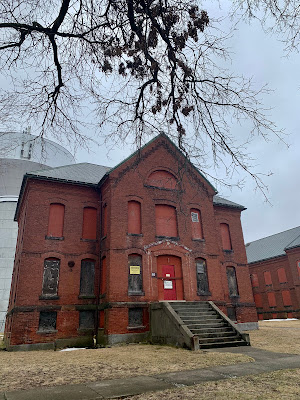
A few weeks ago Tony and I visited Medfield State Hospital, in charming Medfield, Massachusetts. Originally known as the Medfield Insane Asylum, the hospital is now a park open to the public. Intrigued? Read on. 

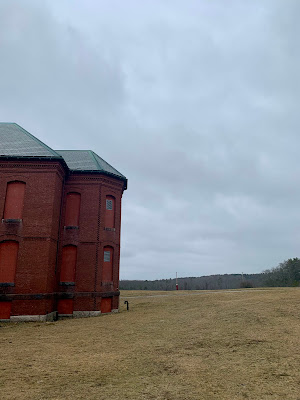
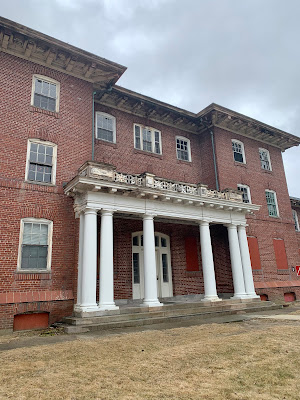
Medfield State Hospital opened in 1896, and was one of the state's first hospitals to deal with long-term patients with mental disorders. It was designed in the "cottage style," according to an informational sign erected at the hospital, with more than 50 buildings spread across 1.4 square miles. Many of the buildings are still standing, although they are now boarded up and public cannot access them. Medfield State today looks a lot like a small, traditional New England liberal arts college - but with absolutely no people. It's both charming and maybe a little spooky. 

Tony and I visited on a cold, snowy day, and there weren't many other visitors. A few people were walking their dogs, but that was about it. The hospital was quite bustling in the past, however. During World War II, almost 2,300 people lived at Medfield State. The hospital finally closed in 1993. 

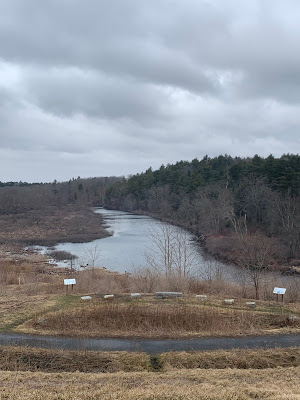
In the early part of the 20th century, the hospital was self-sufficient. Patients grew crops on hundreds of acres of farmland, and tended more than 1,000 cattle and 3,000 chickens. That's quite an operation! Medfield State Hospital even was able to supply food to the other state hospitals in eastern Massachusetts. Even today there is still quite a bit of open land at Medfield State, including a bluff overlooking the Charles River. It has a great view!


You'd think there would be some weird legends associated with an abandoned insane asylum, but that's not really the case here. The only possible ghost story is quite recent. In 2017, the movie The New Mutants was filmed at Medfield State. Part of the X-Men series, The New Mutants tells the tale of five young mutants imprisoned in a spooky hospital. The movie wasn't released until 2020, and the director suggested The New Mutants might have been cursed by being filmed at the abandoned insane asylum. 

The director, Richard Boone, told The Boston Globe the following on August 20, 2020:

It was during the press push for the first trailer that Boone first spoke of “weird” things happening to crew members at Medfield State Hospital during filming. 

“Literally every single person on my crew — all my grips — all those people had weird things happen to them while they were there,” Boone told IGN of the abandoned state hospital, which also served as a filming location for “Shutter Island” in 2009. “I even told the behind-the-scenes crew to go interview everyone who had weird stuff happen to them for an extra on the Blu-ray.”

I would like a little more detail, but I don't want to buy the Blu-Ray. Not everyone was freaked out, though. Actor Anya Taylor-Joy said the following:

"I've shot in four abandoned mental institutions, so it's kind of a second home for me," Taylor-Joy said (ABC Seven.com)

That's a good attitude to have! Soon the hospital will be home to hundreds of people again. The town of Medfield will be developing Medfield State into apartments and an arts center, which is probably a good use of the property. Maybe some more ghost stories will emerge once people start living there full time again?


March 15, 2023

HP Lovecraft and the Witch's Familiar

In 1648, the healer Margaret Jones became the first person executed for witchcraft in Massachusetts. She was accused of various things, like making her clients sick just so they would buy her medicine, but also of having a small demonic spirit that did her bidding. This demon, or familiar spirit, took the form of a small child. Her accusers said they saw it around her Charlestown home, and in her jail cell after she had been arrested. The familiar spirit supposedly suckled on Jones's blood for nourishment, a grotesque parody of the mother/child relationship. 

The Devil also allegedly gave many other New Englanders accused of witchcraft familiar spirits (or familiars, for short). John Godfrey, who was accused of witchcraft four times between 1658 and 1669, was said to have a mysterious teat under his tongue, which he used to suckle his familiar spirit, which appeared large black bird. The testimony from the 1692 Salem witch trials is full of accounts of familiars in a bewildering variety of shapes: wolves, yellow birds, cats. Some were more monstrous, like the creature with a monkey's body, rooster's feet and human face that crept into John Louder's bedroom while he slept, or the three-foot tall humanoid ("all over hairy, all the face hairy") that supposedly did Sarah Osborn's bidding. Even in the late 19th century, people in Truro, Massachusetts told stories of a dune-dwelling witch who cursed local sailors and was attended to by a small black goat. 

Brown Jenkin, from Dreams in the Witch House (2005)

There's something particularly nightmarish about the idea of the familiar spirit. Local witchcraft accounts and legends are full of horrific imagery, but to me there's something extra spooky about these small demons. In animal form, they possess a demonic intelligence and malevolence at odds with their mundane, or even cute, appearance. As monstrous hybrids, they're the type of thing that makes you wake up screaming. Familiars are like something from a horror movie or story. 

At least one local horror writer wrote about witches' familiars. Rhode Island native H.P. Lovecraft (1890 - 1937) often drew on New England folklore for his weird tales. Witches make appearances in several of his stories, and a very nasty familiar spirit appears in his 1932 story "The Dreams in the Witch House." The story describes what happens to hapless graduate student Walter Gilman when he moves into a house once inhabited by Keziah Mason, a 17th century witch. Keziah supposedly was served by a familiar named Brown Jenkin: 

Witnesses said it had long hair and the shape of a rat, but that its sharp-toothed, bearded face was evilly human while its paws were like tiny human hands. It took messages betwixt old Keziah and the devil, and was nursed on the witch’s blood—which it sucked like a vampire. Its voice was a kind of loathsome titter, and it could speak all languages. Of all the bizarre monstrosities in Gilman’s dreams, nothing filled him with greater panic and nausea than this blasphemous and diminutive hybrid...

Brown Jenkin is a weird and ambiguous creature. Lovecraft is clearly using the classic image of the familiar from the 17th century witch trials, but he takes the concept much further. In the story, witchcraft is a form of advanced science. Keziah can travel through space and time via a hyperspace wormhole, and she wants to bring Walter Gilman with her to the center of the universe to meet Azathoth, the daemonic ruler of the world. The story is strange and unsettling mix of science fiction and folk horror. Sure, you can use the wormhole to visit alien planets, but there are also witches and books signed in human blood. So what is Brown Jenkin - an emissary from an alien world, or a servant of evil? Or maybe both? Even though Gilman manages to escape Keziah's clutches, Brown Jenkin manages to get the last laugh (or loathsome titter, to be more accurate). 

In addition to horror stories, Lovecraft also wrote poetry, much of it as scary as his fiction. Some if might even be scarier, like this poem simply called "The Familiars," from his sonnet collection Fungi from Yuggoth

XXVI. The Familiars

John Whateley lived about a mile from town,
Up where the hills began to huddle thick;
We never thought his wits were very quick,
Seeing the way he let his farm run down.
He used to waste his time on some queer books
He’d found around the attic of his place,
Till funny lines got creased into his face,
And folks all said they didn’t like his looks.

When he began those night-howls we declared
He’d better be locked up away from harm,
So three men from the Aylesbury town farm
Went for him—but came back alone and scared.
They’d found him talking to two crouching things
That at their step flew off on great black wings.

That's a pretty creepy poem, and the ending packs quite a wallop. Everyone thought John Whateley was insane, but (surprise!) he wasn't. In that poem and "The Dreams in the Witch House," Lovecraft imagines the witch's familiar in the modern world, where they're even more anomalous and frightening. Winged demons and human-faced rats belong in the semi-mythical past, not in industrialized New England.

A 16th century illustration of a witch and her familiars

If you believe in familiar spirits, you might wonder what happens to them after their witch dies. Do they go back to some infernal realm, or do they linger here in the physical realm? Here's another Lovecraft poem from Fungi which might be about that very topic:

XII. The Howler

They told me not to take the Briggs’ Hill path
That used to be the highroad through to Zoar,
For Goody Watkins, hanged in seventeen-four,
Had left a certain monstrous aftermath.
Yet when I disobeyed, and had in view
The vine-hung cottage by the great rock slope,
I could not think of elms or hempen rope,
But wondered why the house still seemed so new.

Stopping a while to watch the fading day,
I heard faint howls, as from a room upstairs,
When through the ivied panes one sunset ray
Struck in, and caught the howler unawares.
I glimpsed—and ran in frenzy from the place,
And from a four-pawed thing with human face.

So what's scarier, Lovecraft's familiars or the familiars from local folklore and trial documents? It's hard for me to decide. I suppose the scariest thing is that people once took this all very literally and executed people for supposedly working with familiar spirits. I enjoy reading Lovecraft and learning about local witch legends, but am happy to be living in an era where familiar spirits remain fictional. 

February 26, 2023

Visiting the Gates of Hell in Newburyport

A couple weeks ago Tony and I drove up to Newburyport. It's always a pleasure to visit Newburyport - so charming! so historic! - but we weren't looking for charm or history. We were looking for the GATES OF HELL. Cue the ominous music...

The gateway to Hell?

The gates of Hell are supposedly located in Maudslay State Park, 450 acres of woods, meadows and gardens situated on the banks of the winding Merrimack River. The park used to be the private estate of the Moseley family, and takes its name from the family's ancestral home in England. The grounds once included two mansions, a castle, greenhouses, stables, and other buildings. Most of these structures are now long gone. 

The Moselelys sold their estate for $5 million dollars in 1985 to the state of Massachusetts, and the state turned it into a park. I've wandered through a lot of parks in eastern Massachusetts, and Maudslay is quite different than most. Most parks around here are woodsy and often quite rocky. That's not the case with Maudslay. Although parts of it are heavily wooded, the landscape is more manicured, with open fields and some ornamental gardens that are still maintained. We could definitely tell it used to be an estate. There are also some ruins scattered around as well. 

It was a very pleasant park, even on a cold windy day. But according to local legends the gateway to Hell is said to be located there. I'm not sure why this is. There aren't any shocking scandals surrounding the Moseley family - no murders, no rumors of witchcraft, nothing. Nothing really creepy seems to have happened in the park either to caused these legends.  

Two structures in Maudslay State Park are alleged to be the gate into Hell. The first is the formal gate that once led into the estate. This is located right on Curzon Mill Road, just past the parking area if you drive towards the river. People who pass by this gate at night report seeing severed heads stuck on the spikes. Yikes. I've heard that adventurous young folks will park by the gate late at night, hoping (dreading?) to see the apparitions. Not being young or adventurous, we went there during the daytime. Happily we did not see any ghostly heads. Some people also report seeing the ghosts of small children playing in the park. 

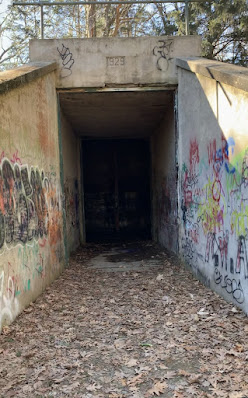
Or is this the gateway to Hell?


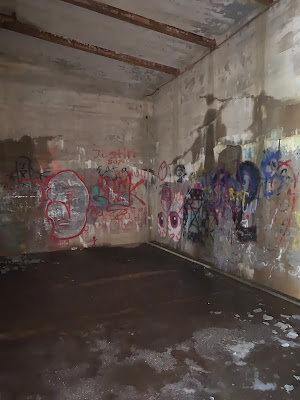
The second structure that may be the gates of hell is a little spookier. Buried in the side of a small hillside is some kind of large underground room that was built in 1929. Was it a garage, perhaps? A large storage bunker? I don't know, but it's big, dark, and filled with graffiti. A large doorway, perhaps 15 - 20' high, leads into the underground room from the outside. It's definitely impressive, and maybe a little creepy. It was really dark inside, and very slippery since the floor was covered in ice. Again, happily we did not see any ghosts. 

I'm not sure why either of these gates are the gates of Hell, instead of just being haunted gates. Do they lead to the underworld? Do demons come out at night? Or maybe the ghosts hang around before heading through the gates to the underworld? I just don't know. The legend is a little vague.

The legend about the gates of Hell seems to be pretty recent. The estate only became a park in 1985, so I'm guessing it only appeared since then. That's just speculation on my part. If you have any information about the history of this legend please share it. 

I have noticed that anomalous or weird structures often attract equally strange legends. A house that looks like its sinking into the earth? Maybe it's because of Satanic rituals. A large iron cage around a grave? It must be intended to imprison a restless ghost. A cemetery gate that looks like spiders? Surely the cemetery must be haunted. I'll note that the Spider Gates cemetery may also contain a gateway to hell, so there are several convenient paths to Hell if you live in Massachusetts.

You get the idea. There are rational explanations for all these things, just as there are rational explanations for the two gates in Maudslay. With the estate long gone, the formal gates and the giant underground chamber now seem a little weird, though. Their original purpose has been forgotten, so people make up new legends to explain why they're there. At least I hope that's what's happening. Otherwise, we've got two gates to Hell in one small park, and that's not good.