Showing posts with label Newburyport. Show all posts

February 26, 2023

Visiting the Gates of Hell in Newburyport

A couple weeks ago Tony and I drove up to Newburyport. It's always a pleasure to visit Newburyport - so charming! so historic! - but we weren't looking for charm or history. We were looking for the GATES OF HELL. Cue the ominous music...

The gateway to Hell?

The gates of Hell are supposedly located in Maudslay State Park, 450 acres of woods, meadows and gardens situated on the banks of the winding Merrimack River. The park used to be the private estate of the Moseley family, and takes its name from the family's ancestral home in England. The grounds once included two mansions, a castle, greenhouses, stables, and other buildings. Most of these structures are now long gone. 

The Moselelys sold their estate for $5 million dollars in 1985 to the state of Massachusetts, and the state turned it into a park. I've wandered through a lot of parks in eastern Massachusetts, and Maudslay is quite different than most. Most parks around here are woodsy and often quite rocky. That's not the case with Maudslay. Although parts of it are heavily wooded, the landscape is more manicured, with open fields and some ornamental gardens that are still maintained. We could definitely tell it used to be an estate. There are also some ruins scattered around as well. 

It was a very pleasant park, even on a cold windy day. But according to local legends the gateway to Hell is said to be located there. I'm not sure why this is. There aren't any shocking scandals surrounding the Moseley family - no murders, no rumors of witchcraft, nothing. Nothing really creepy seems to have happened in the park either to caused these legends.  

Two structures in Maudslay State Park are alleged to be the gate into Hell. The first is the formal gate that once led into the estate. This is located right on Curzon Mill Road, just past the parking area if you drive towards the river. People who pass by this gate at night report seeing severed heads stuck on the spikes. Yikes. I've heard that adventurous young folks will park by the gate late at night, hoping (dreading?) to see the apparitions. Not being young or adventurous, we went there during the daytime. Happily we did not see any ghostly heads. Some people also report seeing the ghosts of small children playing in the park. 

Or is this the gateway to Hell?
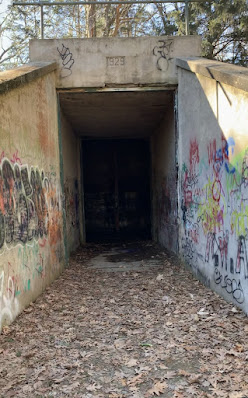

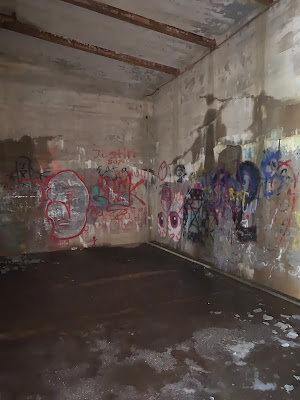
The second structure that may be the gates of hell is a little spookier. Buried in the side of a small hillside is some kind of large underground room that was built in 1929. Was it a garage, perhaps? A large storage bunker? I don't know, but it's big, dark, and filled with graffiti. A large doorway, perhaps 15 - 20' high, leads into the underground room from the outside. It's definitely impressive, and maybe a little creepy. It was really dark inside, and very slippery since the floor was covered in ice. Again, happily we did not see any ghosts. 

I'm not sure why either of these gates are the gates of Hell, instead of just being haunted gates. Do they lead to the underworld? Do demons come out at night? Or maybe the ghosts hang around before heading through the gates to the underworld? I just don't know. The legend is a little vague.

The legend about the gates of Hell seems to be pretty recent. The estate only became a park in 1985, so I'm guessing it only appeared since then. That's just speculation on my part. If you have any information about the history of this legend please share it. 

I have noticed that anomalous or weird structures often attract equally strange legends. A house that looks like its sinking into the earth? Maybe it's because of Satanic rituals. A large iron cage around a grave? It must be intended to imprison a restless ghost. A cemetery gate that looks like spiders? Surely the cemetery must be haunted. I'll note that the Spider Gates cemetery may also contain a gateway to hell, so there are several convenient paths to Hell if you live in Massachusetts.

You get the idea. There are rational explanations for all these things, just as there are rational explanations for the two gates in Maudslay. With the estate long gone, the formal gates and the giant underground chamber now seem a little weird, though. Their original purpose has been forgotten, so people make up new legends to explain why they're there. At least I hope that's what's happening. Otherwise, we've got two gates to Hell in one small park, and that's not good. 

October 14, 2020

Take A Tour of New England's Lovecraft Country

It's October, so let's take a tour. No, not a foliage tour - a tour of Lovecraft country.

We've been watching Lovecraft Country on HBO these past few weeks. It's a horror/fantasy series based on Matt Ruff's novel of the same name; the main character is a Black veteran of the Korean War who likes science fiction and fantasy literature. The series explores a variety of genres (occult horror, science fiction, ghost stories, Indiana Jones style adventures) to examine racism and what it's like to be Black in America.

Despite the title, there's not a lot of Lovecraft in the show. H.P. Lovecraft (1890 - 1937) was a Rhode Island native and is considered one of the world's most influential horror writers. In recent years a lot of critical attention has been paid to the racism in his work, and Lovecraft Country in some ways is the attempt of genre fans, like author Matt Ruff and show runner Misha Green, to grapple with the negative aspects of the stories they love.

In one sense, the title Lovecraft Country refers to the fictional genres the show explores, the worlds of fantasy and horror fiction. However, the term "Lovecraft Country" existed before either the novel or the show, and was coined by scholars to refer to the various towns and places Lovecraft repeatedly mentions to in his fiction. Most of those places are in New England, so New England is actually Lovecraft country.

One of the reasons Lovecraft's fiction remains effective is because he blends facts and fiction. For example, he'll slip a fictional book like the Necronomicon into a list of actual occult books in a story. He'll mention real people like Cotton Mather or Dr. John Dee while discussing fictional occultists. Its a technique that leaves the reader wondering what's real and what's not.

He used a similar technique when writing about geographic locations. The monster-haunted coastal town of Innsmouth is fictional, but it's supposedly located near Rowley and was inspired by Newburyport, both real towns in Massachusetts. Many of the fictional locations he mentions are actually based on real ones, so you could take an actual tour of Lovecraft country. It might be a nice way to spend an October day. Just watch out for those tentacled monsters.

And here's a word of practical caution - if you do visit any of these places please follow COVID-19 protocols. Wear a mask. Maintain six feet of distance. Wash your hands or use hand sanitizer. Stay healthy and keep the horror in your life fictional.

Arkham: 

This decaying city with a sinister history appears in many of Lovecraft's stories. It's the home of Miskatonic University, a prestigious school whose library contains a copy of the accursed Necronomicon. Arkham was the site of witch trials in the 17th century and residents believe that witchcraft still secretly happens there. 

Photo from StreetsOfSalem.com

Arkham's location was not clearly defined in Lovecraft's early stories, but in later stories the town is clearly an analogue of Salem, Massachusetts. The cemetery in his 1923 story "The Unnamable" was inspired by Salem's historic Charter Street Burying Ground, and some family names that Lovecraft uses (like Derby and Pickman) are old Salem family surnames. 

Featured in: The Unnamable (1923), The Dunwich Horror (1928), The Dreams in the Witch House (1933), The Thing on the Doorstep (1937).

Boston:

Boston is obviously a real place. According to Lovecraft, the Massachusetts capital is riddled with underground tunnels home to man-eating, dog-faced ghouls. Hopefully that isn't true. Lovecraft also claims there is an entrance to the realm of dreams in Granary Burying Ground on Tremont Street, which probably isn't true either but sounds nicer than ghoul tunnels.

Boston's North End. Photo courtesy Boston Public Library.

Featured in: Pickman's Model (1926), Dream Quest of Unknown Kadath (1927)

Chesuncook:

Ancient stone ruins can supposedly be found in this small Maine town. Hidden beneath the ruins is a stairway of 6,000 steps that leads to a pit full of shoggoths, hideous protoplasmic monsters. A secret cult of witches gathers there to celebrate their rituals. 

I don't think the pit of shoggoths is real, but Chesuncook is. It's actually a small lakeside town that Henry David Thoreau visited in the 1840s, and today is popular spot for rafting trips. The word "chesuncook" means "place of geese," which doesn't sound particularly frightening. 

Featured in: The Thing on the Doorstep (1937)

Dunwich:

"Outsiders visit Dunwich as seldom as possible, and since a certain season of horror all the signboards pointing towards it have been taken down..." According to Lovecraft, this central Massachusetts town is full of historic architecture, but "most of the houses are deserted and falling to ruin" while Dunwich's only church has been converted into a grimy general store. The inhabitants of Dunwich are rumored to be both inbred and abnormally intrigued by black magic. 

Wilbraham Methodist Meeting House, from LostNewEngland.com

Dunwich is totally fictional, but was inspired by a visit Lovecraft paid to a friend in Wilbraham, Massachusetts. He enjoyed the trip, and I'm sure he appreciated Wilbraham's historic town center. Some aspects of Dunwich were also inspired by a visit to Athol, Massachusetts. 

Featured in: The Dunwich Horror (1928)

Haverhill:

Haverhill, Massachusetts is the birthplace of two academics who learned things they'd rather forget. Walter Gilman studied theoretical physics while staying in an old 17th century Arkham house once inhabited by a witch and died a strange death. Nathaniel Wingate Peaslee, a professor at Miskatonic University, experienced a strange bout of amnesia for several years. When it subsided he claimed his mind had been kidnapped by monstrous alien beings from the past.

Haverhill is real, and is where I was born. As a child I was intrigued and yet terrified to see it referenced in Lovecraft's fiction. Lovecraft's friend William 'Tryout' Smith lived in Haverhill and he visited the city often. 

Featured in: The Dreams in the Witch House (1933), The Shadow Out of Time (1936)

Innsmouth:

According to Lovecraft, this decaying Massachusetts port city experienced a strange plague in 1846, although some residents say it was actually a massacre of some kind. Shortly thereafter a religious group called the Esoteric Order of Dagon took over Innsmouth. The Order was investigated by the US government in 1928 and many of its members arrested. The Navy also torpedoed an unknown target off the city's coast. 

Parker River Wildlife Refuge in Newburyport

Innsmouth is another fictional creation, but is very closely modeled on Newburyport, Massachusetts. Lovecraft visited that city in 1931, at the height of the Great Depression, and wrote that it was so run down "it is today locally known as the City of the Living Dead." When Lovecraft visited the business district was nearly abandoned and many of the buildings were falling into ruin. Today it's a thriving and renovated tourist destination.

Featured in: The Shadow Over Innsmouth (1936)

Kingsport:

Another Massachusetts town with strange secrets. Some residents are said to practice ancient rites during winter solstice. An elderly man who hates immigrants supposedly uses black magic against them. Locals discourage anyone from visiting a strange old house that sits on top of a nearby cliff. 


Another fictional town, but like Innsmouth also inspired by a real location, this time Marblehead, Massachusetts. Lovecraft was an enormous fan of Colonial architecture, and he wrote that his 1922 visit to Marblehead was "the most powerful single emotional climax experienced during my nearly forty years of existence." That must be some really good architecture. 

Featured in: The Terrible Old Man (1920), The Festival (1923), The Strange High House in the Mist (1926)

Providence:

Lovecraft was born in the Rhode Island capital and lived most of his life there. The epitaph on his monument in the Swann Point Cemetery reads: "I Am Providence." He clearly loved the city and set many of this stories there. In Lovecraft's world, an old house on Benefit Street was haunted by a life-sucking fungus, a church steeple on Federal Hill housed a mysterious giant crystal, and the city was home to psychic artists, reincarnated wizards, and nautical cult members. Those things may not be true, but Providence is still pretty amazing even in real life.

Featured in: The Shunned House (1924), The Call of Cthulhu (1926), The Case of Charles Dexter Ward (1927), and The Haunter of the Dark (1935).

April 11, 2016

Fish Monsters From Newburyport: Are the Deep Ones Real?

Last week I wrote about the Frogman of Silver Lake. It's interesting to think there might be a humanoid frog creature lurking in Plymouth County, but could there also be humanoid fish people hiding in the waters off the North Shore of Massachusetts?

Most people would say no, but a few people say yes.

The legend of these particular fish people started in the fall of 1931, when the Rhode Island horror writer H.P. Lovecraft visited Newburyport, Massachusetts. These days Newburyport is an expensive and upscale coastal community, but in 1931 the city was run-down and full of crumbling old houses. The downtown was full of boarded-up businesses.

Things were so bad that some locals jokingly called Newburyport the "City of the Dead." It sounds like a grim place, but Lovecraft of course loved it and used his visit as inspiration for one of his most famous stories, "The Shadow Over Innsmouth."

"The Shadow Over Innsmouth" tells how a young man from the Midwest comes to Massachusetts to research his family's genealogy. His search leads him to Innsmouth, a depressed and decaying coastal town. Most of the town's businesses are shut down, and many houses are boarded up (but still seem to be occupied). Some people in Innsmouth also share the same strange physical deformities: receding foreheads, bulging eyes, and creased necks. To make things even creepier, Innsmouth's churches have been closed and replaced by a Masonic-style cult called the Esoteric Order of Dagon.

A priest of the (fictional) Esoteric Order of Dagon from Propnomicon.
The young man encounters an elderly drunkard who tells him about Innsmouth's unusual history.  Innsmouth was once a prosperous fishing and mill town, but overfishing and bad economic times led to hardship for Innsmouth's citizens. As the town's leaders debated what to do, a sea captain named Obed Marsh proposed an unusual solution.

While Captain Marsh was sailing in the South Seas he learned about a group of aquatic humanoids called the Deep Ones. In return for the occasional human sacrifice, the Deep Ones provided local South Seas islanders with gold and bountiful catches of fish. Well, they actually wanted more than just sacrifices. The Deep Ones also liked to mate with attractive islanders. The hybrid offspring of these unusual couplings were born looking human, but as they aged they slowly turned into Deep Ones themselves.

Perhaps, Captain Marsh suggested, the people of Innsmouth could strike a similar bargain with the Deep Ones, who quite conveniently had a large underwater city just off the coast of Innsmouth? The citizens of Innsmouth were at first repulsed by the idea, but many of them changed their minds after seeing the gold Captain Marsh brought back from the South Seas - and after learning that their hybrid offspring would be immortal, like the Deep Ones themselves. Those citizens who didn't support Captain Marsh became the first human sacrifices...

That would have been a great town meeting to attend, wouldn't it? "My plan to revitalize the downtown business district stands on two pillars: human sacrifice and sex with scary fish people." I won't rehash the rest of the story, but it involves an encounter with a horde of hideous monsters, a daring escape, and a surprise twist ending.

A human/Deep One hybrid from Propnomicon.

"The Shadow of Innsmouth" is of course fiction. Lovecraft wrote horror stories, not history. But a few readers have always wondered if there was some kernel of truth behind what he wrote. When Lovecraft was alive his friend William Lumley told Lovecraft that he thought his stories were accounts of actual occult events. Lovecraft laughed it off. A woman also wrote to Lovecraft and said she was the descendant of a Salem witch. If Lovecraft would share his magical secrets she would share hers. Lovecraft thought he was nuts.

Despite Lovecraft's lifelong denial that his stories were anything but fiction, many practicing occultists have believed otherwise. This trend only accelerated after his death in 1937, and multiple books have been written that allegedly contain the secrets of "true" Lovecraftian magic. Several claim to be authentic versions of the Necronomicon, the terrible tome of blasphemous knowledge he created for his stories.

The British occultist Kenneth Grant (b.1924 - d. 2011) believed quite strongly that Lovecraft had tapped into a source of authentic magical power through his fiction. Grant claimed that Lovecraft accessed true occult knowledge - and supernatural entities - while dreaming and unknowingly incorporated them into his fiction.

Based on this supposition, Grant conducted many Lovecraftian rituals during his life, and several of them involved the Deep Ones. During one, a priestess in Grant's occult lodge descended into a tank of water where the Deep Ones materialized and attacked her. Another of his priestesses died when the plane she was on crashed over the ocean. Grant speculated that the Deep Ones were responsible.

It all may sound crazy to you (or perhaps not!), but Grant is not alone in trying to summon the Deep Ones through magic rituals. Here in the U.S., Episcopal-priest-turned-occultist Michael Bertiaux claims to have successfully summoned the aquatic humanoids in an isolated Midwestern lake (possibly Devil's Lake in Wisconsin). Sadly, Bertiaux hasn't offered up a detailed descriptions of how he did it, but perhaps that's a blessing. Do we really want our lakes infested with amorous fish monsters?

If you have encountered the Deep Ones please let me know. I don't think anyone has yet reported seeing them near Newburyport, but I suppose if people keep summoning them it's only a matter of time before they pop up on some Plum Island beach. The borders between fact, fiction and the occult are always blurry, particularly here in New England.

*****

My sources for this week's post include The Necromicon Files (2003) by Daniel Harms and John Wisdom Gonce III, and my own book, Legends and Lore of the North Shore (2014). Thanks also to the reader who used the word "Lovecraftian" in their comment last week, which inspired me to write this post.

By the way, I filmed a segment for the Travel Channel's show Mysteries at the Museum last summer about the Melonheads, and it should be airing this Thursday, April 14 at 9:00 pm. I hope you are able to tune in!

November 29, 2011

Jerusalem Artichokes


Although Thanksgiving is gone, I still want to write about food. I'm not ready yet for Christmas blogging! So here's an ode to an under-appreciated local food item: the Jerusalem artichoke.

This nutty tasting little tuber is native to eastern North America, and with the sunflower may be the only crops domesticated by the Indians of North America. (Corn, squash and beans were domesticated in Central and South America first, and then made their way north.)

Jerusalem artichoke Image from this blog.

The Jerusalem artichoke is not really an artichoke but is actually related to the sunflower. It also is not associated with the city of Jerusalem in any way. Then how the heck did it get its name?

In 1605, the French explorer Samuel Champlain came to Cape Cod looking to establish a French colony, but he abandoned the idea because the local Indians were somewhat hostile. Although the Indians weren't to his liking, he did appreciate their food, particularly a small tuber which they added to their stews. Champlain thought it tasted like an artichoke.

Bon appetit Champlain!

Champlain brought some of these "artichokes" back to France where they were quite popular. French farmers began to grow them, and they quickly spread to other countries including Italy. The Italians referred to both sunflowers and Champlain's artichokes with the word girasole, which means "turning towards the sun." When these girasole artichokes spread to England, their name gradually became corrupted to Jerusalem artichoke. They're still known by that name today, although they're sometimes also sold as sunchokes.

You can find Jerusalem artichokes in supermarkets (obviously!), but they do grow well in New England. I planted some next to my driveway a few years ago and they still come back each spring.

Special bonus Jerusalem artichoke fun fact: the Artichoke River in Newburyport, Massachusetts is an ancient Indian area named after this scrappy tuber!

The Artichoke River.

I found this information in Howard Russell's Indian New England Before the Mayflower.

October 30, 2011

Witchcraft in Rocks Village and Beyond


When I was in grade school in Haverhill, I spoke with some kids who lived in the Rocks Village neighborhood. They said that on Halloween night, they were going to wait at a crossroads to see if a dead countess buried in a nearby graveyard would walk down the street. I'm not sure what they'd do if they did see her, but the story really impressed me. At the time, I didn't wonder too much about why a countess would be buried in Massachusetts.

When I was in high school, I drove with my friends Christine and Cesar to the countess's grave one night after we saw Nightmare on Elm Street at the movie theater. We were spooked to see that her grave was surrounded by an iron cage! Then Cesar scraped his hand across the roof of the car a la Freddy Krueger, we all screamed, and drove home.

It was only later I learned why there was a cage around Countess Mary Ingalls's grave. She was the first countess in the US, a Rocks Village native who married refugee Count Francois Vipardi in the 1700s. Their romance became the subject of a popular poem by John Greenleaf Whittier, and the cage was to protect the gravestone from souvenir seekers. The stone is now kept in a building to protect it from vandalism.

I don't know where the spooky story about the countess originated. Perhaps it's just that when Americans of a certain generation see the word "count", they think of vampires.

The countess may not be a ghost or vampire, but there is some interesting folklore about witches in Rocks Village. Charles Skinner in Myths and Legends of Our Own Land relates the following stories:

Some people having a party one night in Rocks Village were pestered by a large beetle. The beetle flew in their faces relentlessly, buzzing its wings angrily. Finally, one of the partygoers swatted the insect and crushed it with his foot. At that very moment, Goody Mose, a local woman with a sinister reputation, fell down the stair in her house. Clearly, the beetle had been sent by her to disrupt the party.

Goodman Nichols, another Rocks Village inhabitant, cast a spell on a neighbor's son, "compelling him to run up one end of the house, along the ridge, and down the other end, troubling the family extremely by his strange proceedings..." Skinner doesn't share what caused Nichols to cast the spell, or how the bewitchment was resolved.

Rocks Village lies along the shore of the Merrimack River, and some neighboring towns also had their share of alleged witches. In Amesbury, Barrow Hill was supposedly where both Indian shamans and witches gathered. (The two were identical to the Puritans.) Fires burned on top of the hill late at night, and figures could be seen dancing around it. Even in the 19th century some locals said strange lights could be seen on the hill at night. Amesbury was also the home of Goody Whitcher, whose loom kept moving and making noise long after she was dead.

In West Newbury, Goody Sloper had a reputation as a witch, but redeemed herself when she rescued two people from drowning in the river. And in Newburyport, Goodwife Elizabeth Morse was accused of witchcraft in 1679 by neighbors who had grudges against her. One neighbor even claimed that she made his calves dance on their hand legs and roar. She was sentenced to death but ultimately pardoned by the governor.

I feel lucky to live someplace where there is so much folklore waiting to be discovered. Have a great Halloween!

April 23, 2011

A Pickle for the Knowing Ones: Lord Timothy Dexter


Lord Timothy Dexter (1748 - 1806)


Work has been super busy, so unfortunately I didn't get to update my blog last week. So here, delayed a little bit, is my final post inspired by our trip to Newburyport. It's a town that has a lot to offer: ghosts, Bigfoot, and a famous American "nobleman."

Timothy Dexter was a Newburyport merchant who lived in the 18th century. The town had lots of merchants at the time, so that's not why he's famous. It's because he was so very, very, very eccentric.

When Dexter started his mercantile career his rivals, thinking him an idiot, deliberately gave him bad advice. Apparently being an idiot, Dexter took it, but through good luck things always worked out to his benefit.

For example, he sent a ship full of bed-warming pans to Jamaica, a tropical island where obvioulsy no one needed warm beds. However, the locals bought them as molasses dippers for the sugar plantations. On the same trip he also sent dozens of cats. Luckily, the island was experiencing a plague of rats and people snatched them up at high prices.

He later sent a shipment of mittens to Jamaica. Again, this would normally be a terrible decision, but Asian merchants visiting the port bought them to re-sell in Siberia.

Have you heard the saying, "Selling coals to Newcastle?" Newcastle was a coal producing area in England, so it means doing something pointless or doomed to fail. Dexter actually did ship coals to Newcastle. Once again, he was lucky. The miners were on strike, and his coal sold at a high price.

Dexter soon became one of the wealthiest merchants in Newburyport, which enfuriated the town's wealthy elite. They ostracized him, and in return Dexter, who was always a little eccentric, became downright outlandish.

For example:

He declared that he was a Lord, a title that was totally meaningless in the U.S. The title stuck, though, and most local historians now refer to him as Lord Timothy Dexter.

Lord Timothy's first large home in Newburyport

He bought a large house in town (now part of the public library), but when he upgraded to an even larger house he filled its garden with 40 statues of important historical figures like Adam and Eve, Napoleon, and himself.

He told everyone his wife had died, and the nagging woman they saw in his house was just her ghost. His wife was still very much alive.

He hired a large retinue of servants, which included a personal fortune teller, poet laureate, and a professional idiot.

An inscription outside his house read: "I am the first in the East, the first in the West, and the greatest philosopher in the Western World."

To prove his philosophical learning, Dexter eventually wrote a book, A Pickle for the Knowing Ones or Plain Truth in a Homespun Dress. Here's a brief sample from this rambling tome, which contains no punctuation:

IME the first Lord in the younited States of A mericary Now of Newburyport it is the voise of the peopel and I cant Help it and so Let it goue Now as I must be Lord there will foller many more Lords pretty soune for it dont hurt A Cat Nor the mouse Nor the son Nor the water Nor the Eare then goue on all is Easey...

Although it's almost incomprehensible, it went through multiple editions. Was it Dexter's luck again? You can decide for yourself by reading the full thing online.

Later in life, Lord Timothy staged his own funeral so he could see how it would all play out when he really shuffled off this mortal coil. Although thousands (!) of people came, it didn't go to his liking. His wife didn't cry, which angered him so much he beat her. Honestly, what did he expect after telling everyone she was just a ghost?

Lord Timothy Dexter died in 1806, a few years after his mock funeral. There's no record of whether his wife cried, but I'm guessing she didn't.

I got a lot of this information from Joseph Citro's book Weird New England, and also from Wikipedia. This site, LordTimothyDexter.com, has a ton of information as well.

April 03, 2011

Newburyport's School for Ghosts

Being a school teacher is a tough job. You need to deal with unruly kids, dissatisfied parents, and inadequate resources.

For Lucy Ann Perkins, Newburyport's school mistress in in the 1870s, the job was extra tough. In addition to the usual problems, she also had to deal with a school house that was haunted. It wasn't haunted in a gently spooky, "Oh! I saw a shadowy figure" type of way. Miss Perkins had to deal with full blown poltergeist activity.

Newburyport - quaint or haunted? You decide!

Here are a few of the things she had to face:

  • As the schoolboys recited their morning prayers, the one-room school house would be filled with deafening rapping sounds.
  • Someone could be heard pounding on the school's door, but when Miss Perkins answered no one was outside.
  • The lid of the wood stove would float in the air, only to come down with a loud rattle.
  • The hand bell on her desk would also float and ring by itself.
  • An eerie golden light would fill the building. Bystanders walking by would see it streaming out from the school's windows.
  • Howling winds would buffet the school, even on the calmest days.
  • A phantom boy appeared in the room, and as Miss Perkins reached for him "the form disappeared entirely, like the baseless fabric of a vision."

Miss Perkins tried to instruct her students as best she could, but the supernatural happenings wore her nerves down. She was not alone. The janitor refused to enter the building, and many of the students were often terrified. Word eventually spread about the strange activities, and many visitors came to the school house. They were often rewarded with mysterious noises and seeing objects move on their own.

Eventually, Miss Perkins was sent on a vacation, and her duties at the school house were permanently given to one Nathan Moulton. The hauntings stopped.

What caused all the activity? Was there a real ghost or spirit involved? After investigating, the school authorities claimed the haunting was a hoax by Amos Currier, a ten year old student. However, local newspapers and pamphlet publishers claimed the hauntings were caused by an actual ghost.

Shortly after this, the schoolhouse was shut down and eventually converted to a single family home. When Tony and I visited Newburyport we unsuccessfully to locate it.

Poltergeist or hoax? Personally, I can't decide. It's always good to be skeptical about things like this, but I do wonder how a ten year old boy could have fooled so many adults, and created a phantom that disappeared when touched. And what about that howling wind?

My two main sources for this were Holly Mascott Nadler's Ghosts of Boston Town and John James Currier's History of Newburyport, 1764-1905.

March 27, 2011

Bigfoot on the Beach

This weekend Tony and I went up to Newburyport for a day trip. It's such a great town - beautiful colonial architecture, charming stores, and a great location on the ocean.

However, ask anyone who's ever read Stephen King, H.P. Lovecraft, or any other New England gothic writer and they'll tell you this: quaint small towns are always full of weird surprises.

Just off the coast of Newburyport at the mouth of the Merrimac river is Plum Island, an eleven mile long sandy barrier island. The north part of the island has a small beachfront community, but the southern part is largely undeveloped and includes the Parker River Wildlife Refuge.

We didn't see any Hellcats, but who knows what's hiding in those marshes?

In the summer it's a popular place to go the beach, but on a cold March day we found the Wildlife Refuge empty and desolately beautiful. We climbed up an observation tower that overlooked the marshes and explored the walkways that wind through them.

We saw a few geese and ducks, but no other wildlife. But in April of 1978, four young people had a very different experience in the exact same spot. They saw some wildlife they didn't expect.

After climbing the observation tower and hanging around for a while, they heard some strange clicking sounds coming the marshes. They thought they might have been from a bird, but oddly none could be seen.

The clicking sounds were followed by some high pitched screaming. Again, no birds or animal were visible. Things were starting to feel a little creepy, so they hurried back to their car. It was the only one in the parking lot.


The marshes were beautiful and more than a little desolate...

As they were driving north back towards Newburyport, someone emerged from the bushes and ran across the road. Someone, or something?

The figure that crossed was huge, 7 feet or more, very wide, all black from head to toe. It was a little hunched forward as it walked upright. I noticed its arms were longer than average and they swung as it walked. It took only three steps to cross the road.

As quickly as it appeared the creature was gone. The teenagers slowed down the car and saw the path it had trampled through the bushes, but they couldn't see the creature itself. They quickly drove back into town.

That's the end of the story. As in so many Bigfoot sightings, the creature erupts into view and then vanishes. The witnesses get just a brief exhilarating flash of the unknown.

Tony and I didn't see any monsters, but in such a bleak and isolated setting I wouldn't have been surprised if we did.

Who's that crossing the road up ahead?

If you want to read more Bigfoot stories like this one, you can find them on the Bigfoot Field Researchers Organization website. It's organized by state and county so you can find the stories from your own hometown. Just don't read it before you head into the woods, or even the beach!

November 11, 2010

Satan, the Pope and a Cross Dresser: Guy Fawkes Day


This week I have the post Halloween blues, so I'm writing about another raucous holiday. Halloween wasn't really celebrated in New England until the 19th century, when Irish and Scottish immigrants brought it to this area. However, before that people here did have a holiday with costumes, door-to-door begging, and even jack-o-lanterns: Guy Fawkes Day.

Guy Fawkes was an English Catholic who plotted to blow up the predominantly Protestant British parliament on November 5, 1605. Unfortunately for him, he was seen leaving the basement of the Parliament building, and officials soon discovered the gunpowder kegs he hoped to ignite. He and his co-conspirators were executed. November 5 became a holiday in England known as Guy Fawkes Day or Bonfire Night - it celebrated the foiling of the gunpowder plot.

Guy Fawkes Day didn't become popular in New England until the late 1600s. As I've mentioned many times, the area's Puritan leaders frowned on nearly all holidays, but surprisingly tolerated this one. I think its anti-Catholic tone supported their own theocratic agenda.

To celebrate gangs of boys and men would create one or more effigies, usually of Guy Fawkes, the Pope, and sometimes Satan. Once night fell they'd get drunk, put on costumes and parade around town with their effigies asking for money. At the end of the night they'd burn the effigies and set off fireworks. (It's not expressly documented, but the next morning everyone probably nursed a really bad hangover.)

A 1769 woodcut showing a Boston wagon with Satan and the Pope.

In large cities the celebrations were be quite elaborate. For example, in Boston gangs of lower-class men and boys pulled their effigies around town on large wagons. The gang members also wore matching devil or choirboy costumes and hired musicians to accompany them. Engravings from the 18th century show these wagons topped with large effigies of the Pope and Satan. What they don't show is that one gang member often dressed in drag and danced on the wagon while lasciviously caressing the effigies.

In addition to the anti-Catholic bigotry, Guy Fawkes Day celebrations usually involved violence. Gang members would sometimes abuse people who didn't give them money, and rival gangs often battled to destroy each others effigies. In Boston, the North End and South End gangs were notorious rivals and frequently ended the night clubbing each other senseless. Innocent bystanders often got injured or worse during the festivities - in 1764 an infant in the North End was killed when it fell under the wagon's wheels. That year the constables dispersed the marchers, but they regrouped a few blocks away and continued.

After the American Revolution Guy Fawkes Day celebrations started to fade away. One theory is that New Englanders didn't want to offend their Catholic French allies who helped them in the war against the British, but a more plausible reason is that they no longer wanted to celebrate a holiday commemorating the salvation of the British government.

Guy Fawkes Day was still celebrated as late as 1893 in Newburyport, Massachusetts where boys paraded around an effigy while blowing horns and carrying jack-o-lanterns. (Jack-o-lanterns, which we now associate exclusively with Halloween, were originally used at any autumn party or celebration.) But by this time Halloween was popular in the U.S., and it eventually absorbed the costumes and general mischief of Guy Fawkes Day. The door-to-door begging for money became our modern practice of trick or treat.

I got most of this information and from an essay by Peter Benes in New England Celebrates: Spectacle, Commemoration and Festivity.

November 04, 2008

Guy Fawkes Day


Halloween is a relatively new holiday in New England, and wasn't widely celebrated here until the 19th century when immigrants from Ireland and Scotland brought their traditions with them.

However, Guy Fawkes Day (a.k.a Pope Day or Pork Day) was celebrated annually on November 5, until it was eclipsed by Halloween. The two holidays have some interesting similarities. (FYI - Guy Fawkes was a Catholic conspirator who plotted to kill the King and Parliament of England with a hidden keg of gun powder, but was foiled. The holiday celebrates the survival of the King and the Parliament.)

Guy Fawkes Day was celebrated as late as 1893 in Newburyport, MA and Newcastle and Portsmouth, New Hampshire. Men and boys in costume would parade through the streets carrying straw effigies (called either "guys" or "popes") which they would burn on a bonfire. Boys also carried lanterns carved from pumpkins, blew horns, and went begging for money and food from door to door. (B.A. Botkin quotes various sources on this).

The pumpkin lanterns, bonfires, costumes and the begging all became Halloween traditions. The anti-Catholic sentiment of Guy Fawkes Day happily died out, presumably because of the waves of Catholic immigration, but also possibly because the Catholic French were instrumental in helping the American Colonies in their war against England.

Interestingly, Alice Morse Earle in her 1893 book Customs and Fashions in Old New England writes that the begging of "ragged fantastics" (i.e. kids in costumes) on Thanksgiving Day (!) was a holdover from Guy Fawkes Day. Lesley Pratt Bannatyne notes that costumed begging was common in New York City for Thanksgiving as well. I guess it's only recently that trick or treating has been confined to Halloween.