May 27, 2018

The Ghostly Nuns of Dudley Road

Haunted roads. Doesn't that phrase sound magical? There's just something really evocative about combining those two words. There's real synergy there; the whole is greater than its parts.

Haunted roads are appealing because they remind me of my adolescence, driving around aimlessly with friends waiting for something to happen. The lure of a haunted road has stuck with me into adulthood, and I've been to a few different haunted roads recently: Route 44, Albino Road, and Ghost Road. But just recently I went to what is supposed to be the most haunted road in Massachusetts: Dudley Road in Billerica.


There are several legends associated with Dudley Road, many of them focused on nuns. The most lurid story claims that back in the 19th century a group of nuns from a local convent decided to worship Satan. They would sneak out of the convent at night and gather in an abandoned house for their sinister rituals. Eventually the locals figured out what was happening and hanged the nuns in a nearby field.
St. Thecla's Retreat Center, run by the Sisters of St. Paul, is on Dudley Road
Apparently the spirits of Devil-worshipping nuns don't rest easily, because according to local legends they have been seen wandering around the road at night, and in particular haunt the field where they were hanged. Since their deaths the house where they celebrated the Black Mass has slowly been sinking into the ground. Is it descending to Hell? Strange smells and sounds emanate from the building at night.

Creepy stuff! There are also other legends about ghost nuns. One claims that a nun was hit by a car late one night while walking home to the convent. She was killed instantly when the impact knocked her into a tree, but her ghost still haunts Dudley Road. Some say she can be seen lurking under the tree her body was thrown against, while others say that she wanders the road at night asking for directions back to the convent. She is, quite literally, a lost soul.

Is this house sinking into the earth?
Another legend claims that a nun from the convent became pregnant after having an affair with a priest. She hanged herself in shame and her ghost can still be seen haunting the tree where she died. These stories share similar elements - ghosts, nuns, trees, hangings - but are all slightly different. Everyone seems to agree that something bad happened but the legends differ over what it was.

Not all the ghosts are nuns. A man dressed like a farm-worker is also said to haunt the road at night. He stands by the side of the road just under the trees, his face perpetually hidden in shadow. Don't stop if you see him. Just keep driving.

When Tony and I drove down Dudley Road I was surprised how nice it was. There are a lot of large well-maintained homes and quite a few horse farms, but I guess even upscale neighborhoods have ghosts. Parts of the road seemed new but other parts were older. The older parts were narrow and quite twisty with Colonial era homes and bordered by lichen-encrusted stone walls. I can easily see how creepy legends could get attached to this street. We only visited during the day - I imagine it is much spookier at night.

The stories about Dudley Road seem to be at least several decades old. Commenters on this post claim they heard the stories at least thirty years ago, and others say they were told the story by their parents. A few commenters even say the stories are true and that they have seen some of the ghosts.


I am not a debunker; people may very well see strange things on this road. However, I don't think the story about the hanged nuns is corroborated by any historical records. The last people executed for witchcraft in Massachusetts were hanged in Salem in 1692, so it's very, very unlikely that anyone was  killed in the early nineteenth century for Devil worship. And the house that is supposedly sinking into the ground looks a lot like a storage building to me. It also has big "No trespassing" signs posted on it so please stay away.

So if the nun legend isn't true why do people see ghost nuns? I don't know for sure, but I do think New England has it's own psychic landscape which is influenced by history, the people living on it, and the land itself. New England has it's own folkloric personality. Some people might find old houses, stone walls and dense woods charming, but other might experience them as creepy, particularly at night. A commenter on that post claimed that his teenage son went to Dudley Road with some friends on a lark, but things didn't go quite as planned. He returned home terrified and in tears. Was it all in the boy's head, or did he encounter something that only manifests to people who have the right mindset?

Please let me know your thoughts in the comments. I would love to hear from some people who have seen strange things on Dudley Road.

May 21, 2018

Odds Are Good You'll See A UFO in New England

A group called Casino.org has analyzed decades of UFO sightings and come up with some fascinating data about those strange objects we see in the sky. Casino.org usually analyzes data about the gambling industry, but I'm glad they've broadened their scope.

According to their study, these are the ten states where you are most likely to see a UFO:

1. Wyoming
2. VERMONT
3. Montana
4. North Dakota
5. Alaska
6. Hawaii
7. New Mexico
8. RHODE ISLAND
9. NEW HAMPSHIRE
10. MAINE

It's interesting that four of the top ten states are in New England, and I wonder why that is. My first thought was "Oh, they are all rural states," but is that true? Rhode Island has some very dense urban areas, and other states that are more rural than these four didn't make the list. Where's South Dakota, for example?

I was a little disappointed that Connecticut and Massachusetts didn't make the top-ten list, but they also didn't make the list of states were you are least likely to report a UFO. So there is something about New England that makes it a good region for UFO sightings, but I am not sure what.  I would be happy to hear your thoughts.

You can see the interactive map here
Since Casino.org usually looks at gambling, they express your likelihood of seeing a UFO in terms of odds. Vermont has a population of 623,657 and more than 2,493 UFOs have been sighted there in the last 78 years, so the odds of a Vermonter seeing a strange object in the sky is 250/1. In that same period Rhode Island has reported 3,088 sightings (odds: 324/1), while 3,627 UFOs have been seen in New Hampshire (odds: 369/1). Mainers have seen 3,605 weird flying objects, giving you a 370/1 chance of seeing one in the Pine Tree State.

Quantifying things like this really provides a good idea of how widespread the phenomena is. Casino.org claims there have been 259,691 reported UFO sightings in the United States since the last century. That seems like a lot to me, and the authors of the study say the US is one of the countries where people are most likely to see a UFO.

Personally, I would love to see a UFO as an adult. I think it would be cool! Some of my fellow citizens apparently have more negative feelings about UFOs. In fact, some 40,000 Americans have taken out insurance against alien abduction. According to trade publication Business Insurance, you can purchase a policy from a company in Florida:
The Palm Beach Post contacted Mike St. Lawrence, who has been operating The Alien Abduction & Casualty Insurance Co. out of his home in Altamonte Springs, selling $20 policies since 1987. “People buy them for somebody else,” Mr. St. Lawrence told a reporter. “They usually just make themselves the beneficiary.”
I wonder if anyone has ever tried to collect on their policy?

This all sounds like light-hearted fun, but The New York Times did recently publish an article about how the US government has been studying UFOs for years. Someone in the Pentagon takes it all very seriously. Maura Sullivan, a Democrat running for congress in New Hampshire, recently gave The Conway Daily Sun her thoughts on the topic:
Asked if she would address news reports about military footage of UFOs, including a New York Times story from a retired Navy pilot who now lives in New Hampshire, Sullivan said she would look into it as part of her job on Armed Services Committee. 
"I would be asking questions about digging deeper into the UFO issue," said Sullivan, who said she also would ask the Pentagon about its personnel and training budget because she is concerned about military accidents like the recent helicopter crash that killed a soldier from New Hampshire.
Will candidates in the other top-ten UFO states also address this issue? I guess we'll have to watch the election coverage to find out.

May 13, 2018

The Devil and Elizabeth Knapp: Demonic Possession in Groton

"She is a monument of divine severity; and the Lord grant that all that see or hear, may fear and tremble. Amen." (Reverend Samuel Willard, from a 1672 letter titled A Brief Accout of a Strange and Unusual Providence of God Befallen to Elizabeth Knapp of Groton.)

 In October of 1671, a teenage girl named Elizabeth Knapp began to show symptoms of a strange disorder. At first they were minor. Knapp would emit sudden shrieks with no apparent cause, and shrug when anyone asked her about them. At other times she would laugh uncontrollably as if at a private joke, sometimes to the point of falling to the ground in hysterics. She didn't tell anyone what she laughed at.

Her behavior got even stranger as the month continued. On October 30 Knapp was siting by the fireplace when she began to scream that she was being tormented:

In the evening, a little before she went to bed, sitting by the fire, she cried out, oh my legs! and clapped her hands on them, immediately, oh, my breast! and removed her hand thither: and forthwith, oh I am strangled, and put her hands on her throat; those that observed her could see what to make of it; whether she was earnest or dissembled...

Knapp was a maidservant in the home of Groton's minister Samuel Willard, and he scrupulously documented her situation in a long letter sent to Reverend Cotton Mather in Boston. Willard wrote that on the night of October 31 Knapp went into the cellar to fetch something. She screamed and ran back up, claiming she had seen two people down in the cellar. Other members of the household searched but saw nothing and wondered if Knapp had merely played a prank on them.


On November 2nd, Knapp delivered a shocking confession to Reverend Willard and other assembled neighbors: she was being tormented by Satan. Knapp claimed that over the last three years the Devil had frequently visited her, urging her to sign a covenant with him. The Devil promised to give her money, silk clothes, and release from the hard work she had to perform. In return for these things, the Devil simply asked her to sign her name (in blood) in a book. Oh, and also to murder her parents, her neighbors, and Reverend Willard's children. The Devil had even suggested she toss the Willards' youngest child into the oven and kill the reverend with a hook while he slept. Knapp denied signing the Devil's book, but did confess that she had often delayed leaving the Willard household until after sunset so the Devil could walk with her in the dark. She was drawn to the Devil even though she knew it was wrong.

Willard and other local ministers received her confession with concern but also some skepticism. Was her story true?

Her symptoms increased in the early days of November. A physician was called in, "who judged a main part of her distemper to be natural, arising from the foulness of her stomach and corruptness of her blood, occasioning fumes in her brain, and strange fantasies." You have to love that seventeenth century medicine! Knapp was briefly relieved from her duties at Reverend Willard's home and sent to rest at her parents' house.

Her fits lessened and she returned to the Willards, but as the month went on and the days grew darker her symptoms became worse. At times her tongue was stuck to the roof of her mouth, at other times she barked like a dog or bleated like a calf. She ran around the house yelling and skipping and no one was able to restrain her. Reverend Willard wrote that the physician changed his diagnosis and "consented that the distemper was diabolical, refused further to administer, and advised to extraordinary fasting." Multiple ministers were called in to pray for her. Knapp still claimed she had not signed the Devil's book, but did say she had been sorely tempted to but was foiled because she couldn't find a knife to cut her finger.

On December 2, Knapp became highly agitated and said she saw a dog with a woman's head outside the house. It was a witch and was trying to get in. The Willards did not see the creature, but did see a strange canine paw-print in their fireplace. Knapp claimed that if the witch were apprehended her fits would stop. She identified the witch as a local woman, but after investigating the authorities dismissed her claim.


On December 8, Knapp finally confessed to what the Reverend Willard had secretly suspected: she had signed her name in the Devil's book. She said that one day shortly after coming to work for the Willards she had looked out the window and seen the Devil in the shape of an old man walking across  a meadow towards her. He carried a large book in his hands. She heard his terms and then...
...with a knife cut her finger, he caught the blood in his hand, and then told her she must write her name in his book, she answered that she could not write, but he told her that he would direct her hand, and then took a little sharpened stick and dipped in the blood and put it into her hand, and guided it, and she wrote her name with his help.
She agreed to serve the Devil for seven years, but balked at working witchcraft for him. This was why the Devil tormented her so violently with fits.

On December 17th the Devil took complete control of her body. He began to speak through her, insulting her family and the ministers who gathered around her. He insulted God and threatened violence agains the people who were praying over Knapp. Willard believed that it was truly the Devil speaking through her, claiming that Knapp's mouth and lips were immobilized even though words came out.


During January Knapp was silent for long periods of time, although she now claimed that her confession of signing the Devil's book was false and that she had never been tempted to murder the Willard family. She said that although the Devil controlled her body she prayed that he would not take her soul.

And then...

Willard's letter ends there, at mid-January, 1672. He closes his letter with some arguments why, despite the claims of skeptics, he thinks Knapp's possession was authentic. His key arguments are that he thought the strength she displayed during her fits was beyond what was natural, and that her mouth did not move when the Devil spoke. She also used words and phrases while possessed that she had never used before.

Still, Willard writes that he found her multiple contradictory stories about signing the Devil's book puzzling, and admits that other explanations for her behavior may be possible.

Although this information is not included in his letter, it seems that Knapp was eventually cured of her demonic possession (whatever it may have been). Historian David Hall notes that Knapp married in 1674 and had at least six children. Let's hope she wasn't tempted to throw any of them in the oven.

It's interesting that Knapp's symptoms appeared in the dark months of the year. In England, the months of October through mid-January would have been celebrated with harvest festivals, dances and the lavish feasting and misrule of Christmas. Those holidays were suppressed in Puritan New England but it seems like the Devil still wanted to have a little fun.

It's also fascinating to compare this case with the Salem witch trials. Groton's leaders dismissed Elizabeth Knapp's claim that another member of the community had bewitched her. The town might have had a full-blown witch hunt, like Salem, if they hadn't.

Samuel Willard's letter is a fascinating document. I found a copy of it in David Hall's fantastic book Witch-Hunting in Seventeenth-Century New England. The letter is about fifteen pages long and really goes into detail about the case and what Willard and others thought of it. It's a window into the lives and minds of people who lived here over three centuries ago.

May 02, 2018

Gibbet Hill: Ghosts, A Ruined Castle and A Forgotten Execution?

The other day Tony and I took a road trip out to Groton, Massachusetts. Groton is an old town that was founded in 1655. It's really a beautiful place, with lots of old Colonial homes, charming white churches, and large farms. Looming just outside the town center is a big hill called Gibbet Hill.

A view up Gibbet Hill
As we all know from watching horror movies, every small town has to have at least one spooky location, and in Groton that location is Gibbet Hill. The word "gibbet" can mean a few things but none of them are pleasant. It can mean a gallows (for executions) or it can mean a metal cage used to publicly display dead bodies after execution. The "g" in gibbet is soft, so it is pronounced "jibbet."

The excursion was not without its dangers.
Gibbet Hill was quite pretty to visit on a sunny spring day, but with a name like that you know there must be some strange phenomena attached to it. According to local legends, ghosts have been seen lurking on the hill. Most of them wear Colonial attire, and some of them are missing limbs. Someone reported just seeing a dismembered foot wearing a green sock. That's it, just a foot. Stories like this are why I only visit haunted places during the day.


On top of Gibbet Hill are the ruins of a stone castle, which just adds to the spooky vibe. According to one local legend the castle dates from the 19th century. A wealthy man built it for his new wife, but unfortunately she died before it could be completed. He abandoned the project in sorrow and it was never finished.


I like that story, but it's not true. Historical records indicate the castle was constructed in 1906 by William Bancroft, a retired general and a politician, as his retirement home. Unfortunately Bancroft ran out of money and couldn't complete it. He sold the castle to a local physician and in time it became a tuberculosis sanitarium. Patients hoped that Groton's fresh air would help cure their ills.


In the 1920s the castle became a private hunting club until it finally burned down in the 1930s in a Fourth of July fireworks mishap. The property was owned for many years after that by the owners of the nearby Gibbet Hill Grill but became town conservation land in 2002. There is a spot on Route 40 where you can park and then hike up a short trail to the castle.


Kate Webber, co-owner of the Gibbet Hill Grill claimed in a 2006 Lowell Sun article that there no ghosts at the castle:
A lot of people are determined that the whole hill is haunted. Before the castle was public property, someone had snuck in and said when they looked through a window, (they) saw a severed foot with a green sock on it. People have reported seeing old colonial couples walking up and down the hills, a man in an old soldier's uniform who walks the property, and a Native American who was rumored to be chased down and killed. I'm convinced there aren't any ghosts roaming. But people look at the stone tower and think there has to be some wonderful and terrible Gothic stories that go with it.
So do ghosts haunt Gibbet Hill? I didn't see any, but I may not be the most psychically sensitive person around. We also visited during the day, and during the day I am always skeptical about all paranormal phenomena. If I had visited at night it would be a completely different matter. I would be convinced each creaking branch was a ghost and I'd be terrified of seeing that severed foot. The castle wasn't too spooky when we went, although there were some really large crows croaking in the trees.


The story behind the hill's name is a little murky. Samuel Green's 1894 book An Historical Sketch of Groton Massachusetts, 1655 - 1890 tells us the following about Gibbet Hill:
It is mentioned in the land-grant of Sergeant Jame Parker, which was entered in the town records of Richard Sawtell, the first town clerk who filled the office from June 1662 to January 1664-65. The tradition is that the hill was so called from the fact that once an Indian was gibbeted on its top. If this ever occurred, it must have happened before Sawtell's term of office.
Various sources on the web, including the Lowell Sun interview with Kate Webber, argue that since there is no proof of an execution the hill was probably named after a hill back in England. I guess that is possible, but we also know that the English settlers were not kind to local Indians, and that Groton was attacked and burned by local tribes during King Philip's War in 1676 and again in 1694 during King William's War. I wouldn't be surprised if there was an unrecorded Indian execution somewhere in the town's past.


While the ghosts at Gibbet Hill are open to debate, there is at least one well-documented weird story in Groton's history. In the 1600s a young serving girl who worked for the town's minister was possessed by Satan. It's an interesting story and I'll write about it next week.

April 26, 2018

The Maypole of Merrymount: Religion, Sex and Money

When I was in elementary school, way back in the 1970s, we had to make May Day baskets as an art project. I don't remember what grade it was, but I do remember thinking "May Day? That's not really something we celebrate here." I knew it was a holiday in other countries, but was it something celebrated in Haverhill, Massachusetts? Still, I made my basket from construction paper and dutifully left it on a neighbor's doorstep like the teacher suggested.

Apparently I was on the dying end of a tradition, because May Day baskets were quite popular in the nineteenth and early twentieth century. Maybe I would have been more enthusiastic about May Day if I had been allowed to dance around a Maypole, but that was not part of my school's curriculum.

*****

The first and most famous Maypole erected in Massachusetts was the one put up by Thomas Morton at his colony of Merrymount in 1624. Morton was a well-educated English lawyer who had come to Massachusetts as part of a colonial expedition. Their colony, in what is now the city of Quincy, was initially called Mount Wollaston after Captain Wollaston, the commander of the expedition's ship. When Morton learned the captain was selling indentured servants to another colony in Virginia he encouraged the other servants to rebel. Wollaston fled, and Morton became the new leader of the calling. Preferring to call himself the colony's "host," he renamed it Merrymount.

Since Thomas Morton was an educated, literary type of guy, the name Merrymount had a variety of meanings to it. First, it indicated that the colony was to be a place of happiness now that Captain Wollaston was gone. Second, it was a play on the Latin word for the sea, mare, since the colony was on the coast. Ma-re-mount, get it? Finally, there was a sexual connotation to the colony's name, indicating it was someplace where the mounting (aka sex) was merry.
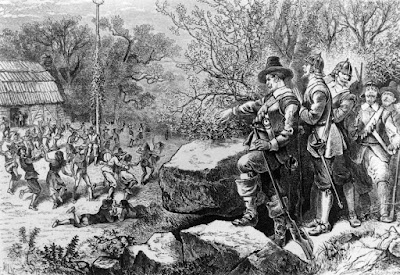
Puritans disapprovingly watching Maypole festivities at Merrymount.
As May 1st approached the colonists Merrymount erected an 80' Maypole topped with a pair of deer antlers. They fired rifles and pistols in celebration, and Morton composed a poem that was nailed to the pole. Morton's poem mentions various Roman sea deities like Neptune, Amphitrite and Triton, and ends with these lines:

With proclamation that the first of May
At Ma-re-Mount shall be kept holiday

Morton and the other colonists invited the local Indians to join them at their celebration, particularly the Indian women. Beer flowed, people got drunk, and a good time was had by all. The Merrymount men sang a song that was composed in honor of the celebration. Here are some of the lyrics:

Drink and be merry, merry, merry boys;
Let all your delight be in Hymen's joys
Iô to Hymen, now the day is come,
About the merry Maypole take a roam. 
Make green garlands, bring bottles out
And fill sweet Nectar freely about.
Uncover thy head and fear no harm,
For here's good liquor to keepe it warm. 
Give to the Nymph that's free from scorn
No Irish stuff nor Scotch overworn.
Lasses in beaver coats come away,
Ye shall be welcome to us night and day

The "Hymen" mentioned in this poem is the Greco-Roman god of marriage, but again I am sure there is a double entrendre intended. 

Hymen, god of marriage
I suppose if Merrymount had survived as a colony the history of New England would have been quite different, but it didn't survive. Shortly after the May Day celebration the Pilgrims from Plymouth Colony marched on Merrymount. They chopped down the May Pole, arrested Thomas Morton, and exiled him from New England. Morton made his way back to Merrymount in 1630, but most of the inhabitants had scattered by then. This time, the Puritans of Boston arrested Morton and burned Merrymount to the ground. Morton was sent back to England.

Back in England, Morton and his wealthy patron Fernando Gorges successfully sued to revoke the Plymouth Colony charter, but Morton's victory was short-lived because the English Civil War started. Morton fled from the chaos back to New England, where he died penniless in York, Maine in 1647. I believe he is buried somewhere in York, but I couldn't find a location for his grave. Perhaps it has been lost?

The New England Puritans and Thomas Morton came into conflict for three big reasons:

RELIGION

The Puritans followed a very strict version of Christianity that had rigid rules about how people should behave. They also didn't celebrate holidays like May Day or even Christmas, which they associated with the Catholic and Anglican Churches. Holidays were one of the things they were trying to purge from the English church.

Thomas Morton, on the other hand, was an Anglican who clearly enjoyed a good holiday. He was also well-educated and appreciated the ancient paganism of Greece and Rome. I don't think he was a practicing pagan, but he did enjoy the literature and mythology of the Classical World, as evidenced by his poem's references to Roman gods. This was quite common for educated people of his time. For example, Shakespeare's late romances Cymbeline, Pericles and The Tempest all include pagan gods.

The Puritans specifically cast Morton as a sinful pagan, calling Merrymount Mount Dagon (after the ancient Canaanite sea god) and saying the maypole was a modern version of the Golden Calf. Morton took up this mantle proudly. He titled his book about New England The New English Canaan, and urged readers to help protect the new Canaan from the invading Puritans.

SEX

As mentioned above, the Puritans expected people to follow very strict codes of behavior. Sex was intended for married couples. Morton and the settlers at Merrymount had a more relaxed view on these matters.

I think it is useful to note that many of the Puritan settlers were already married and brought their families to New England with them, while most of the Merrymounters were unmarried men with no problem enjoying the company of the local Indian women or possibly even marrying them. Intermarriage between European colonists and indigenous people was common in parts of the New World where the colonists were single men, but the Puritans took a dim view of this practice.

Some historians have also suggested that homosexuality may have been tolerated at Merrymount. For example, the authors of the Boston History Project's book Improper Bostonians point out that Morton mentions Jupiter, the king of the gods, and Ganymede, his male mortal lover, when writing about Merrymount. Of course, Ganymede was also Jupiter's cupbearer so he may have been mentioned because of his connection with getting drunk. Still, male homosexuality was somewhat tolerated among educated Englishmen like Morton. For example, the character of Antonio in Shakespeare's Twelfth Night is clearly in love with Sebastian, something the other characters do not question.

Morton himself never married, for whatever reason, so he would have personally benefited from "hosting" a sexually liberal colony.

MONEY

The Merrymounters were trading with the local Indians for beaver pelts, which brought them into direct conflict with the Puritans, who wanted to corner the trade in pelts. Morton and his men were also giving the Indians guns in return for the pelts, which the Puritans definitely didn't want. This just gave the Pilgrims one more good reason to shut down Morton's colony.

*****

What would I have learned about Maypoles in elementary school if Thomas Morton had succeeded? Probably more than I did (which was nothing). Maybe in some alternate universe he did succeed, and happy New England school children descended from both English and Algonquin Indian ancestors frolic around Maypoles and learn their history. That's not the universe we live in, but Merrymount is still fondly remembered as a brief glimpse of what might have been.