Showing posts with label legends. Show all posts

September 01, 2025

Book Review: Wicked Strange by Jeff Belanger

Is New England one the weirdest parts of the United States? With all the strange stories and legends we have, sometimes it seems that way,  

It's hard to measure weirdness, but New England is certainly one of the oldest parts of the country. The first English colonists arrived in the early 1600s, bringing folklore about witches, ghosts, and the Devil with them. To put that in perspective, consider this: some of those early Pilgrims and Puritans would have once been Queen Elizabeth's subjects, and could have seen the first performances of Shakespeare's plays. Not that the Puritans approved of theater, but maybe a few of them snuck in a matinee or two...

Those stories about ghosts, witches and the Devil lingered here long after the Puritan church disappeared. They're still remembered in place names, old legends, and even urban folklore. Other weird stories arose over time as well. Some incorporated elements from the local Algonquin cultures, others came from the mass media or more recent immigrant groups. 

Today, four-hundred years after the Pilgrims set foot on Cape Cod, New England is just chock-full of weird legends and folklore. It's not surprising that Poe, Lovecraft, and King, the three greatest American horror writers, were all born here. 

There are more stories and legends here than can fit into one book, and authors have been collecting them for years. Many local town histories from the 19th century included chapters about ghosts and witches, which were often described as "something our ancestors believed in, but we don't now." Some broader collections of New England folklore appeared then as well. For example, in 1884, Charles Godfrey Leland wrote Algonquin Legends of New England, while Charles Skinner included dozens of New England legends in Myths and Legends of Our Own Land (1896). 

Those authors may have garbled some of the details, but 20th century folklorists like Richard Dorson tried to do better in books like Jonathan Draws the Longbow (1946). Later authors, like Vermont's Joseph Citro, followed in this same vein while keeping their books entertaining. After all, what's the point of telling a ghost story if it's not spooky?

Happily, a new collection of New England legends has just come out. It's called Wicked Strange: Your Guide to Ghosts, Monsters, Oddities and Urban Legends from New England. The publisher sent me a free review copy, and I'm glad they did, because it's a great book. 

The author is Jeff Belanger, who is well-known in the paranormal scene. He's written other books, like Weird Massachusetts and The Fright Before Christmas, and has worked on TV shows like Ghost Adventures and Paranormal Challenge, and co-hosts The New England Legends podcast. In other words, he knows his stuff! The book has beautiful photos by Frank Grace, which add to the weirdness. 

Here are three reasons I like this book:

It Covers All Six States: Wicked Strange includes over 100 short chapters on different topics, evenly divided among the six New England states. Little Rhode Island gets as much coverage as Maine, and the division by state lets you find stories closest to you, which is useful. This past weekend, Tony and I visited a nearby haunted site after reading about it in Wicked Strange. 

Topical Variety: There are some different ways to write about local legends. You can focus on one topic, like I did with Witches and Warlocks of Massachusetts, or you can write about a variety of topics. That's the approach that Jeff Belanger takes in Wicked Strange. He covers some of the classic topics, like America's Stonehenge in New Hampshire, Montpelier's Black Agnes, and Boston's Great Molasses Flood, but also less well-known ones like the Woonsocket werewolf, the Devil's Baked Beans in Lyndeborough, New Hampshire, or the Hoodoo Hearse of Holden, Maine. The book covers haunted locations, cryptids, weird crimes, and a lot of uncategorizable weird happenings.

Beautiful Photography: Frank Grace's photos are beautiful and unsettling. They make the subjects look as strange as the stories that are told about them. The press release for the book says, "Frank has been photographing weird and wonderful New England for the last thirteen years." Thirteen is sometimes considered unlucky, but that's not the case here!

I'm glad to add Wicked Strange to my library, and I think you'll enjoy it, too. 

May 26, 2024

Rutland's Abandoned Prison Camp: Ruins, Graffiti, and Maybe A Ghost or Two?

Back in March, Tony and I took a road trip to Rutland, Massachusetts to visit an abandoned prison camp located in Rutland State Park. Rutland is located west of Worcester, and we had never been there before. It's a very beautiful part of the state and I recommend visiting. 

One small caveat, though. I don't recommend visiting when there's been a huge ice storm, like we did! A big nor'easter had hit the state the day before our trip, and while it brought only rain to Boston, Rutland had been hit with ice, which we didn't realize until after we were beyond Worcester. All the trees in Rutland were covered with glittering ice, making them very sparkly and captivating, but the two mile walk from the Rutland State Park parking lot to the prison camp was treacherously slippery. It took us a lot longer than we anticipated to walk to the camp. I have learned my lesson to check the local weather forecast before heading on a road trip! 

Solitary confinement cells. 

According to the signs in the park, the prison was conceived in 1898 as a "temporary industrial camp for prisoners... to rehabilitate them for their return to society while reclaiming wasteland and abandoned property..." Four years later, a Rutland farm from the 1700s was repurposed and used as a kitchen, dining area, and housing for the camp. The inmates also built additional structures, and an abandoned schoolhouse was incorporated into the prison as well. 


In 1905, a tuberculosis outbreak necessitated the construction of a hospital, which remained in use throughout the prison's history. The park's signage notes the following: "While most of the prisoners of the camp were minor offenders, some patient prisoners in later years were 'lifers' and murderers, so the hospital was a secure facility." The camp also had 150 acres of farmland which were used to raise livestock (including prize winning horses) and grow enough fruits and vegetables to feed the inmates. They even produced excess to sell locally. The fruits and vegetables were stored in an enormous underground root cellar, which still exists. 

The entrance to the root cellar.

Inside the root cellar.

Sometimes in old movies, prisoners are shown breaking big rocks into little rocks. There is some truth to that, at least at the Rutland prison, which had a rock crushing plant that made concrete, gravel, and sand for road repairs. It sounds a little grim. The solitary confinement cells, the ruins of which are still standing, are also very small and grim. They're covered with colorful graffiti and don't have any bars on them now, but it was easy to imagine how dark and confining they would have been in the prison's heyday. We didn't visit the nearby cemetery of unmarked prisoner graves, but I think that sounds grim as well. 

The prison camp was closed in 1934 because the land it stood on was part of the watershed of the newly created Quabbin Reservoir. There certainly is a lot of fresh water in Rutland State Park, including a giant beaver pond that we walked past on the way to the prison's ruins. We didn't see a beaver, but we did see some of their lodges. 

Beaver pond with a beaver lodge. 

Just in case you don't know where you're going...

I couldn't easily find any spooky legends associated with the prison camp. The blog Haunted New England mentions a legend that the ghost of the warden's wife still haunts the prison, but they couldn't find many other details. And in the comments on Abandoned Wonders, I found the following comment from 2019:

This place is incredibly haunted. Within the last 10 years, a group opened something in the tunnel area and called a non-human entity into the camp. Be advised! It followed me home and stuck around for about 3 months. Not fun.

Those were the only legends I could find about the camp. Overall, I found the prison camp interesting but not really spooky. We were the only people there for most of our visit, which was great, but also be aware that the area is isolated. As always, travel with a friend if you're wandering out in the woods, particularly to the ruins of an abandoned prison. 

A view inside the root cellar.


March 15, 2023

HP Lovecraft and the Witch's Familiar

In 1648, the healer Margaret Jones became the first person executed for witchcraft in Massachusetts. She was accused of various things, like making her clients sick just so they would buy her medicine, but also of having a small demonic spirit that did her bidding. This demon, or familiar spirit, took the form of a small child. Her accusers said they saw it around her Charlestown home, and in her jail cell after she had been arrested. The familiar spirit supposedly suckled on Jones's blood for nourishment, a grotesque parody of the mother/child relationship. 

The Devil also allegedly gave many other New Englanders accused of witchcraft familiar spirits (or familiars, for short). John Godfrey, who was accused of witchcraft four times between 1658 and 1669, was said to have a mysterious teat under his tongue, which he used to suckle his familiar spirit, which appeared large black bird. The testimony from the 1692 Salem witch trials is full of accounts of familiars in a bewildering variety of shapes: wolves, yellow birds, cats. Some were more monstrous, like the creature with a monkey's body, rooster's feet and human face that crept into John Louder's bedroom while he slept, or the three-foot tall humanoid ("all over hairy, all the face hairy") that supposedly did Sarah Osborn's bidding. Even in the late 19th century, people in Truro, Massachusetts told stories of a dune-dwelling witch who cursed local sailors and was attended to by a small black goat. 

Brown Jenkin, from Dreams in the Witch House (2005)

There's something particularly nightmarish about the idea of the familiar spirit. Local witchcraft accounts and legends are full of horrific imagery, but to me there's something extra spooky about these small demons. In animal form, they possess a demonic intelligence and malevolence at odds with their mundane, or even cute, appearance. As monstrous hybrids, they're the type of thing that makes you wake up screaming. Familiars are like something from a horror movie or story. 

At least one local horror writer wrote about witches' familiars. Rhode Island native H.P. Lovecraft (1890 - 1937) often drew on New England folklore for his weird tales. Witches make appearances in several of his stories, and a very nasty familiar spirit appears in his 1932 story "The Dreams in the Witch House." The story describes what happens to hapless graduate student Walter Gilman when he moves into a house once inhabited by Keziah Mason, a 17th century witch. Keziah supposedly was served by a familiar named Brown Jenkin: 

Witnesses said it had long hair and the shape of a rat, but that its sharp-toothed, bearded face was evilly human while its paws were like tiny human hands. It took messages betwixt old Keziah and the devil, and was nursed on the witch’s blood—which it sucked like a vampire. Its voice was a kind of loathsome titter, and it could speak all languages. Of all the bizarre monstrosities in Gilman’s dreams, nothing filled him with greater panic and nausea than this blasphemous and diminutive hybrid...

Brown Jenkin is a weird and ambiguous creature. Lovecraft is clearly using the classic image of the familiar from the 17th century witch trials, but he takes the concept much further. In the story, witchcraft is a form of advanced science. Keziah can travel through space and time via a hyperspace wormhole, and she wants to bring Walter Gilman with her to the center of the universe to meet Azathoth, the daemonic ruler of the world. The story is strange and unsettling mix of science fiction and folk horror. Sure, you can use the wormhole to visit alien planets, but there are also witches and books signed in human blood. So what is Brown Jenkin - an emissary from an alien world, or a servant of evil? Or maybe both? Even though Gilman manages to escape Keziah's clutches, Brown Jenkin manages to get the last laugh (or loathsome titter, to be more accurate). 

In addition to horror stories, Lovecraft also wrote poetry, much of it as scary as his fiction. Some if might even be scarier, like this poem simply called "The Familiars," from his sonnet collection Fungi from Yuggoth. 

XXVI. The Familiars

John Whateley lived about a mile from town,
Up where the hills began to huddle thick;
We never thought his wits were very quick,
Seeing the way he let his farm run down.
He used to waste his time on some queer books
He’d found around the attic of his place,
Till funny lines got creased into his face,
And folks all said they didn’t like his looks.

When he began those night-howls we declared
He’d better be locked up away from harm,
So three men from the Aylesbury town farm
Went for him—but came back alone and scared.
They’d found him talking to two crouching things
That at their step flew off on great black wings.

That's a pretty creepy poem, and the ending packs quite a wallop. Everyone thought John Whateley was insane, but (surprise!) he wasn't. In that poem and "The Dreams in the Witch House," Lovecraft imagines the witch's familiar in the modern world, where they're even more anomalous and frightening. Winged demons and human-faced rats belong in the semi-mythical past, not in industrialized New England.

A 16th century illustration of a witch and her familiars

If you believe in familiar spirits, you might wonder what happens to them after their witch dies. Do they go back to some infernal realm, or do they linger here in the physical realm? Here's another Lovecraft poem from Fungi which might be about that very topic:

XII. The Howler

They told me not to take the Briggs’ Hill path
That used to be the highroad through to Zoar,
For Goody Watkins, hanged in seventeen-four,
Had left a certain monstrous aftermath.
Yet when I disobeyed, and had in view
The vine-hung cottage by the great rock slope,
I could not think of elms or hempen rope,
But wondered why the house still seemed so new.

Stopping a while to watch the fading day,
I heard faint howls, as from a room upstairs,
When through the ivied panes one sunset ray
Struck in, and caught the howler unawares.
I glimpsed—and ran in frenzy from the place,
And from a four-pawed thing with human face.

So what's scarier, Lovecraft's familiars or the familiars from local folklore and trial documents? It's hard for me to decide. I suppose the scariest thing is that people once took this all very literally and executed people for supposedly working with familiar spirits. I enjoy reading Lovecraft and learning about local witch legends, but am happy to be living in an era where familiar spirits remain fictional. 

July 13, 2022

Dog Days and Dog Lore

The other day while browsing through The Old Farmer's Almanac, I saw this notation for July 3rd: Dog Days Begin. I experienced the dog days quite viscerally today myself. I was out walking around during my lunch and noticed that it was blindingly bright, unpleasantly hot, and extremely humid. I felt a little stupefied. 

The dog days of summer begin on July 3rd and end on August 11th. They are said to be the hottest days of summer in the Northern Hemisphere, and get their name from the star Sirius, which rises in conjunction with the sun during this time. Sirius is part of the constellation Canis Major (Latin for the Greater Dog), which follows Orion through the sky. 

A mosaic of a dog from Pompeii

The ancient Greeks were the first people to call this time of year the dog days. For example, in The Iliad, the poet Homer has the following to say: 

...all radiant as the star which men call Orion's Hound, and whose beams blaze forth in time of harvest more brilliantly than those of any other that shines by night; brightest of them all though he be, he yet bodes ill for mortals, for he brings fire and fever in his train... (Homer, The Iliad, Book 22, translated by Samuel Butler)

Some Greeks tried to appease Sirius the Dog-star (and the heat it brought) with sacrifices, a practice taught to them by Aristaios, the divine son of Apollo. 

The Dog-star Sirius was scorching the Minoan Islands from the sky, and the people could find no permanent cure for the trouble till the Archer-King Apollon put it in their heads to send for Aristaios. So, at his father's command, Aristaios ... left Phthia, and settled in Keos. He raised a great altar to the Rain-god Zeus and made ritual offerings in the hills to the Dog-star and to Zeus himself, the Son of Kronos. In response, Zeus gave his orders - and the Etesian Winds refresh the earth for forty days. The priests of Keos still make yearly sacrifice before the rising of the Dog. (Apollonius Rhodius, Argonautica)

The ancient Romans also believed that Sirius rising created the hottest days of summer. Here is what Pliny the Elder wrote on the matter:

Who is there that does not know that the vapour of the sun is kindled by the rising of the Dog-star? The most powerful effects are felt on the earth from this star. When it rises, the seas are troubled, the wines in our cellars ferment, and stagnant waters are set in motion... There is no doubt that dogs, during the whole of this period, are peculiarly disposed to become rabid. (Pliny the Elder, Natural History, Chapter 40)

An interesting side note about Pliny the Elder: he died while trying to save people from the eruption of Mount Vesuvius that destroyed Pompeii and Herculaneum. His Natural History was only published after his death. 

From the Greeks and Romans, the concept of the dog days has been passed down to us. I think most modern Americans are still familiar with the idea, even if they don't know the exact dates that comprise the dog days. They might also know the song by Florence and the Machine, "Dog Days Are Over." Fire, fever, rabid dogs, troubled seas, and stagnant waters. The dog days don't sound like much fun. No wonder Florence is so glad they're over. 

I can hear someone out there saying, "But I love summer! Summer is awesome! The beach! Cookouts! School vacation! Trips to Europe!" Yes, all those things are amazing parts of the summer season. We don't live in the ancient Mediterranean world, where summers were inescapably hot and hellish. We live in a world with ice cream and air-conditioning. Of course, with climate change, people around the world are once again experiencing the sometimes terrifying power of summer - wildfires, heatwaves, and droughts are increasing every year. And not everyone is fortunate enough to have air-conditioning and ice cream.

An interesting side note about trips to Europe: I read today that an American tourist was injured when he tried to retrieve his phone after dropping it into Mount Vesuvius. Happily, the volcano was not erupting at the time.

Thinking about the dog days made me curious to see if I could find some New England lore about dogs. I found a few intriguing tidbits in What They Say in New England (1896), Clifton Johnson's collection of local folklore. Although Johnson notes that it was considered healthier to have dogs than cats as pets, he does include some sinister lore about dogs. For example, he writes about a dog in Hadley, Massachusetts that howled every night when the 9:00 pm church bell rang. The citizens of Hadley assumed this was an omen of something bad, but they weren't quite sure what. 

They probably thought the dog's howling foretold someone's death, because Johnson also writes that it was believed a dog howling under a window foretold a death in the house. 

There was a dog went and howled under the window of a house up near where I lived. He howled and howled; and they drove him off, but no sooner done it than he was right back again. And in two or three days an old lady that lived there died. (Clifton Johnson, What They Say in New England (1896))

Johnson also writes about a related belief. If a dog howls in the yard, the first person who walks through the front door will soon die. Dogs are man's best friend, but also an omen of doom. I suppose they're like the dog days of summer in that respect. Some people think they're lovable and fun, while others look at them with dread. 

September 29, 2021

Book Review: Mythical Creatures of Maine

If you ever find yourself in the lonely woods of far northern Maine, be careful going out at night. According to legends, headless giants are sometimes seen wandering the roads in the darkness. Are they dangerous? Probably, but no one has ever gotten close enough to one to find out. No one has been that brave - or that stupid. 

I hadn't heard about the headless giants of Maine until I read Christopher Packard's Mythical Creatures of Maine, which was recently published by Down East Books. Mythical Creatures is a handsome little hardcover book, with full-color illustrations, that describes dozens of strange and wonderful creatures from Maine folklore. The publisher sent me a copy to review, but it was too late - I had already bought a copy for myself. 


Some of the creatures described in this book will definitely be familiar to you, like mermaids (seen in Casco Bay in 1639) and Bigfoot (seen since at least the 1950s, and probably much earlier). Others might be moderately familiar, like the loup-garou, the French-Canadian werewolf, or the Turner Beast, aka the Maine mutant, a strange dog-like animal that was hit by a car in 2006. And some will be downright obscure, like the dungavenhooter, a mouthless crocodile that appeared in tall tales told by lumberjacks. Or those headless giants that roam around at night. 

Packard includes quite a few creatures from the tall tales of lumberjacks and other woodsmen. These are creatures like the aforementioned dungavenhooter or the wamfahoofus, a one-armed monster that lurks in muddy puddles and likes to eat boots. I don't know if anyone really ever believed in these "fearsome critters of the lumber woods," and they may just have been jokey explanations for things like losing your boot in a big mud puddle. Still, they're interesting to read about.

Packard's book is arranged like an encyclopedia or dictionary, with entries for the different creatures listed in alphabetical order, and it's fun to browse through descriptions of creature like the Ice Hornet or Will-O-The-Wisp. But Mythical Creatures also explains which cultures these creatures originated from, like the indigenous Wabanaki tribes, the French, and the English. (Note: legends about the headless giants come from the Maliseet, a Native American tribe found in Maine and New Brunswick). 

An appendix at the end of the book gives a brief but helpful overview of Wabanaki languages and culture, topics probably new to some readers, and Packard describes many creatures and beings from Wabanaki mythology in the book, including Pamola, the guardian spirit of Mt. Katahdin, various little people like the river-dwelling manogmasak and the forest-dwelling mikumwesuk, and the fearsome man-eating giants known variously as the wendigo, chenoo, or kiwakw. 
Much like the headless giants, you don't want to meet a wendigo.

I would recommend this book for anyone who likes folklore, New England history, or even just stories about monsters. So really, probably most people who read this blog!

*****

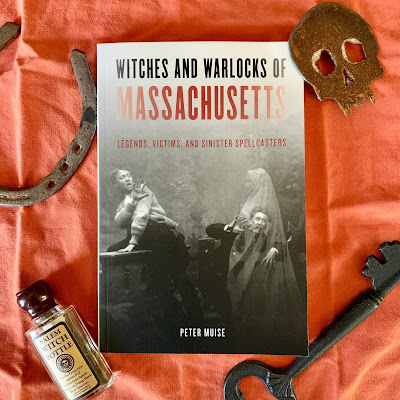
Speaking of books, I will give a shameless promotion for my own new book, Witches and Warlocks of Massachusetts. I've been appearing on a lot of podcasts recently; I was recently on the Weird Tales radio show, which was a lot of fun. 

Witches and Warlocks of Massachusetts is available wherever you buy books online!


May 20, 2020

I Am Giving a Free Online Witchcraft Talk on May 27, 2020

I will be giving a free online talk about Massachusetts witchcraft legends on Wednesday, May 27, 2020 at 7:00 p.m. Eastern time. Learning about spooky New England legends is the perfect way to spend a quarantine evening, isn't it?

Don't be like these folks - practice social distancing!

The event is sponsored by the Tewksbury Public Library but is open to everyone. If you want to attend you'll need to register in advance. 

I'll be talking about everything from the first witchcraft trials in the 1640s to modern 21st century legends about witch-haunted places. Massachusetts has such a rich history of witch legends - I hope you can join me!

October 24, 2019

Pickets, Cabbages, and the Pigman: Halloween Lore

I used to have a neighbor from Detroit, Michigan. One day in the fall while we were discussing the neighborhood trick-or-treaters he told me that he wasn't a big fan of Halloween.

When he was a kid in Detroit the night before Halloween was called Devil's Night, and it was a night for arson and vandalism. Teenagers would light fires across the city and burn down abandoned buildings, of which there were a lot at the time. In 1984, there were more than 800 fires in Detroit on October 30. Yikes! Happily things have gotten much better since then and in 2018 there were only four fires on Devil's Night.

His experience in Detroit was much different from mine growing up in the 1970s in Haverhill, Massachusetts. The night before Halloween didn't have a special name or any activities (criminal or otherwise) associated with it. Kids might pull some pranks on Halloween night itself (egging houses, throwing toilet paper in trees) but nothing as serious as arson. The main focus was on trick-or-treat (before it was banned because of a poison candy scare) and Halloween parties. And it was definitely only a one day celebration. There were no other days with special names.


Vintage photo from this site.

I assumed that's how things always were but I was wrong. Like all holidays Halloween changes and evolves over time. When my mother was a child in Haverhill during the 1940s there were three nights of activity around Halloween. Three! Here's an account by Charles W. "Charlie" Turner that appeared in The Haverhill Gazette's October 27, 2005 issue. Charlie's looking back nostalgically to his childhood in the Acre, a dense urban neighborhood in Haverhill:
"It all began on October 28, which was known as Cabbage Night. ... Many families raised cabbages in their gardens and young men went there to steal them. Afterwards, they raced through the streets throwing the plants at houses along the way. Ma warned me to stay away from the windows just in case..." 
"The second night, Oct. 30, was called Beggars-Night. This was the night when children put on their costumes and went from door to door in search of treats. ..." 
"On Oct. 31, Halloween came and most everybody stayed home. This was the night for mischief ... a return to those places that ignored a child's request for a treat. Most of the time it was cut clotheslines and soaped windows in our neighborhood. However, on the other side of Main Street, things could be worse. There were broken windows, messes on porches, and even an occasional tipped car." 
It turns out that special names for either Halloween or the days surrounding it were once common across the country. Most of them were coined after the pranks that kids pulled. Baltimore had Moving Night (because you moved things out of your neighbor's yard), Ohio had Doorbell Night (because of ring and run) and Vermont had Clothesline Night (because you'd throw toilet paper on clotheslines).

Are any of those special names for Halloween or the days surrounding it still in use today? Well, I think the citizens of Northfield, Vermont still observe Picket Night on October 30, when kids steal pickets from fences.

I know this because Northfield is supposedly home to one of New England's creepiest monsters: the Pigman! This porcine terror is associated with Picket Night and Halloween. According to one version of the legend, on October 30, 1951 a high school student named Sam Harris left his house for some Picket Night fun. He was planning to egg houses, throw toilet paper, and steal pickets with some friends. But he never showed up at the rendezvous point to meet his friends, and he never went back to his parents' house either. Sam Harris was never seen again. It was as if he vanished into thin air.

Did he vanish, or was he transformed? Later that fall someone (or something?) strange was seen in the woods outside town. It had the body of man but the head of a hideous pig. People in Northfield whispered that it was really Sam Harris and that he had sold his soul to the Devil. He had become a hideous pigman. 

Image from American Horror Story.

The town historian responded to these rumors with a column in the local paper. There were no such things as monsters, she wrote, and Sam Harris had been a good boy and a model citizen. But the day after the column was published the historian was found murdered in the Devil's Washbowl, a desolate area in the woods. The words "PICKET NIGHT" were carved into her flesh. The message was clear: the Pigman was real. Something monstrous and piglike is still said to be lurking in the woods outside Northfield to this day...

How's that for a story? There are several different legends associated with the Pigman but that one is particularly creepy and very appropriate for Halloween. It's nice to know that weird old folklore is still being celebrated in New England. Have a safe and happy holiday but whatever name you celebrate it!

July 12, 2015

More Weird New Haven: Grove Street Cemetery

Here's my second post about some strange and wonderful things I saw a few weeks ago in charming and historic New Haven, Connecticut.

In addition to visiting Midnight Mary's grave at the Evergreen Cemetery, I took a guided tour of the Grove Street Cemetery, which abuts the Yale campus. Grove Street Cemetery is a beautiful neo-classical style burying ground, which means many of the monuments are inspired by the art of ancient Greece and Rome. You won't find many Victorian angels here, but you will find some unusual monuments, like this Roman tumulus (mound) style vault and Grecian sphinx.


New Haven's first settlers buried their dead under and around Center Church on New Haven Green. This practice continued for 160 years until a yellow fever outbreak led the city's leaders to create a newer, more modern burying ground in 1796. The markers from the old burying ground were moved to Grove Street, but not apparently the bodies. Every now and then a corpse pops up from under the Green, as happened recently when a large tree fell in a storm, revealing a skeleton entangled in its roots.

One of the original settlers' graves relocated to Grove Street Cemetery.
New Haven was a prominent mercantile city and has one of America's best universities, so Grove Street is the resting place for many famous people. On our tour we saw the graves of Noah Webster, Eli Whitney and Glenn Miller, to name just a few.


Our tour guide did not tell us any ghost stories, but did address a couple urban legends that surround the cemetery. First, she emphatically denied that any secret tunnels connect the cemetery to the nearby Yale Medical School. Apparently there is a popular legend that in the 19th century enterprising medical students dug tunnels into the cemetery so they could steal cadavers for their experiments. Interestingly, two miles of steam tunnels do lie underneath the Yale campus, and go very close to the Grove Street Cemetery. One of the tunnels is rumored to lead to a basement filled with brains in formaldehyde-filled jars. Again, this is just a rumor, and the steam tunnels are locked and dangerous as they are indeed filled with steam. Don't go trespassing! You will be covered in burns as you are dragged off to jail, which wouldn't be good.

Back to our tour guide. Second, she said she was not able to comment on whether any of Yale's secret student societies conduct rituals in Grove Street Cemetery. She did say, however, that at times she has seen students wearing robes doing something in the graveyard. She left what they were doing to our imaginations, and I in turn will leave it to yours.

I have a good friend who lived in New Haven for many years. He told me that he had heard rumors that someone was leaving sacrificial offerings at the cemetery's dramatic front gate. What did those offerings consist of? He didn't know. I'm sorry I don't have anything more specific to share with you, but sometimes uncertainty makes these urban legends even more interesting.


The entrance to Grove Street is very, very dramatic, and I can see why aspiring young occultists might want to leave some offerings at the foot of those Egyptian-style pillars with their ominous inscription. The gate was not built for any occult purposes, however. Egyptian revival was the architectural vogue when it was constructed in 1845, and it was a style the builders felt was not offensive to any Christian denominations. The inscription "The Dead Shall Be Raised" probably strikes a lot of modern people as a quote from a horror movie, but is actually from Corinthians in the New Testament.

If you are in New Haven definitely visit Grove Street Cemetery. It's beautiful, peaceful and full of history. And if peace and beauty aren't your thing, you can ponder some of those rumors and urban legends instead.

May 24, 2015

The Moodus Noises: Part I

Quite a few years ago I was reading The Thing on the Doorstep and Other Weird Stories, a collection of H.P. Lovecraft stories published by Penguin. I was reading pulpy stories of tentacled terrors, but since it was a Penguin edition they had footnotes so I could feel intellectual. I was having my cake and eating it too.

In "The Dunwich Horror," Lovecraft's tale of central Massachusetts wizardry and invisible monsters, the people of Dunwich are troubled by strange rumbling sounds that come from a hill in their village. The footnote indicates Lovecraft incorporated these noises into his story after reading about similar noises in Moodus, Connecticut. But while Lovecraft's story was fiction, the Moodus noises were real.

Dean Stockwell in the 1970 film of The Dunwich Horror. Is he blocking out the Moodus noises?
That's how I personally first learned about the Moodus noises, but people have been hearing them for centuries. Moodus, which is a small village in the town of East Haddam, was originally called Machimoodus, which means "Place of Noises" or "Place of Evil Noises" in the Algonquin language. The noises were recorded by early Puritan settlers, and continue even today. The Hartford Courant reported that the noises were heard as recently as March, 2011.

The noises are centered around Mount Tom, where the Salmon and Moodus Rivers come together. They sound like cannon shots or explosions, and when they happened in 2011 emergency responders rushed into action, looking for a fire or explosion. There was nothing to find. The noises had come from deep inside the earth.

Here's how a July 1891 Boston Globe article describes them. The noises had been heard in Moodus just a few days earlier:

They are heard intermittently. Sometimes the mountain is silent for 25 or 30 years, then suddenly the strangest sounds break forth, a deep sepulchral, voluminous sound, like the moaning of an imprisoned monster, that seems to boom in subterranean caverns of the earth, and is heard distinctly 10 or 12 miles away.

The noises begin with a seemingly far away low rumbling note that speedily swells in volume and intensity, and culminates in a vast rolling sound, like the muttering of distant thunder, and the ground trembles as if with the throe of an earthquake.
Another Boston Globe article from March 1940 gives a similar description:

Virtually every householder in Moodus rushed to the cellar last night just before midnight to see whether his furnace had blown up, and finding it hadn't called neighbors on the telephone. Thus it was learned that the famous Moodus Noises had returned after about four years.

... Moodus has been shaken at irregular intervals by strange subterranean concussions. The sounds are reported to emanate from the mouth of a great cave, high on a hillside in view of virtually every house in town. No one apparently has ever been at the mouth of the cave when the noises issued forth, however.

"You can always distinguish these noises from blasting; the concussion is so much greater," one resident said today.

They sound scary and kind of awesome, so I can understand why Lovecraft put them into one of his stories. The Algonquians who originally lived in Moodus thought they were awesome and scary too, and therefore ascribed them to their god Hobomok, who was also awesome and scary. The Indians who actually lived on Mount Tom were specialists in interpreting the voice of Hobomok and were consulted as oracles by other local tribes.

When the Puritans showed up in the 1670s they asked the Indians about the strange booming sounds. They responded that they were the voice of Hobomok, and that he was unhappy because the English had come to Connecticut. (He probably was.)

Of course, the Puritans had their own interpretation. They didn't believe in Hobomok and thought the Indians were actually worshiping the Devil. Stephen Hosmer, Haddam's first minister, wrote the following to a friend in August of 1729:

I have been informed that in this place before the English settlements, there were great numbers of Indian inhabitants, and that it was a place of extraordinary Indian Powwows, or in short, that it was a place where the Indians drove a prodigious trade at worshipping the devil. ... Now whether there be anything diabolical in these things (the noises), I know not; but this I know, that God Almighty is to be seen and trembled at, in what has been often heard among us.

Once the Devil gets invoked you know things are going to get weird. Next week I'll post some of the crazy Colonial era legends about the noises, which involve witches, alchemists, and underground battle caves. Stay tuned!

Update: the second part of this post is now up!