Showing posts with label baby. Show all posts

April 24, 2019

Ghosts, Strange Graves and General Weirdness at Gilson Road Cemetery

I always like to read about a haunted location before we visit it. It helps me know what I should look for when I get there.

One of the first things I read about Gilson Road Cemetery really intrigued me. According to an urban legend, a ghost will appear if you leave the cemetery and shout "Betty Gilson, I have your baby!" The ghost appears as a woman in Colonial-era clothing, and is sometimes seen in the middle of Gilson Road. At other other times she hides behind the trees that line the road.


Who is Betty Gilson? Why is she so concerned about her baby? Unfortunately I didn't learn the answers to these questions when we visited Gilson Road Cemetery recently. Actually, I came away with even more questions.

Gilson Road Cemetery is located on a quiet rural street in Nashua, New Hampshire. The cemetery itself is quite small and doesn't have a lot of gravestones standing, but it's pretty obvious there used to be more than there are today. For example, a quick scan showed that there were several stone bases that used to support gravestones that are no longer there. I'm sure there are many more graves that are completely unmarked.


I couldn't find any historical records of this cemetery online. The oldest grave, that of Hannah Robbins, seems to date from the 1790s. Most of the graves are from the 1800s. Many of them are for members of the Gilson family, although the Fiskes, Searles and other families are buried here as well.

Lisa Rogak's 2004 edition of Stones and Bones of New England claims it had a reputation as New Hampshire's most haunted cemetery, and ghost hunter Fiona Broome has been investigating since 2008. Many, many people have seen ghosts there. Orbs, strange lights, apparitions and small ghostly children have all been sighted by visitors to Gilson Road. My Facebook friend Sandra has gone to many haunted locations and said that she saw strange faces in photos she took at Gilson Road Cemetery.

Did we see ghosts? No. Was Gilson Road Cemetery weird? Yes. Unlike Vale End, which I blogged about last week, Gilson Road does not feel well-maintained. It feels vaguely neglected. Neglect doesn't necessarily equal weird in my book, but Gilson Road Cemetery is also the site of a lot of human activity. That's what made it seem so strange.


Visitors to cemeteries will sometimes leave coins on the graves of famous or important people. I think that's common. But visitors to Gilson Road have left coins on many, many graves and no one famous is buried there. I think people are leaving coins to honor (or perhaps propitiate?) the restless spirits that are said to reside there.

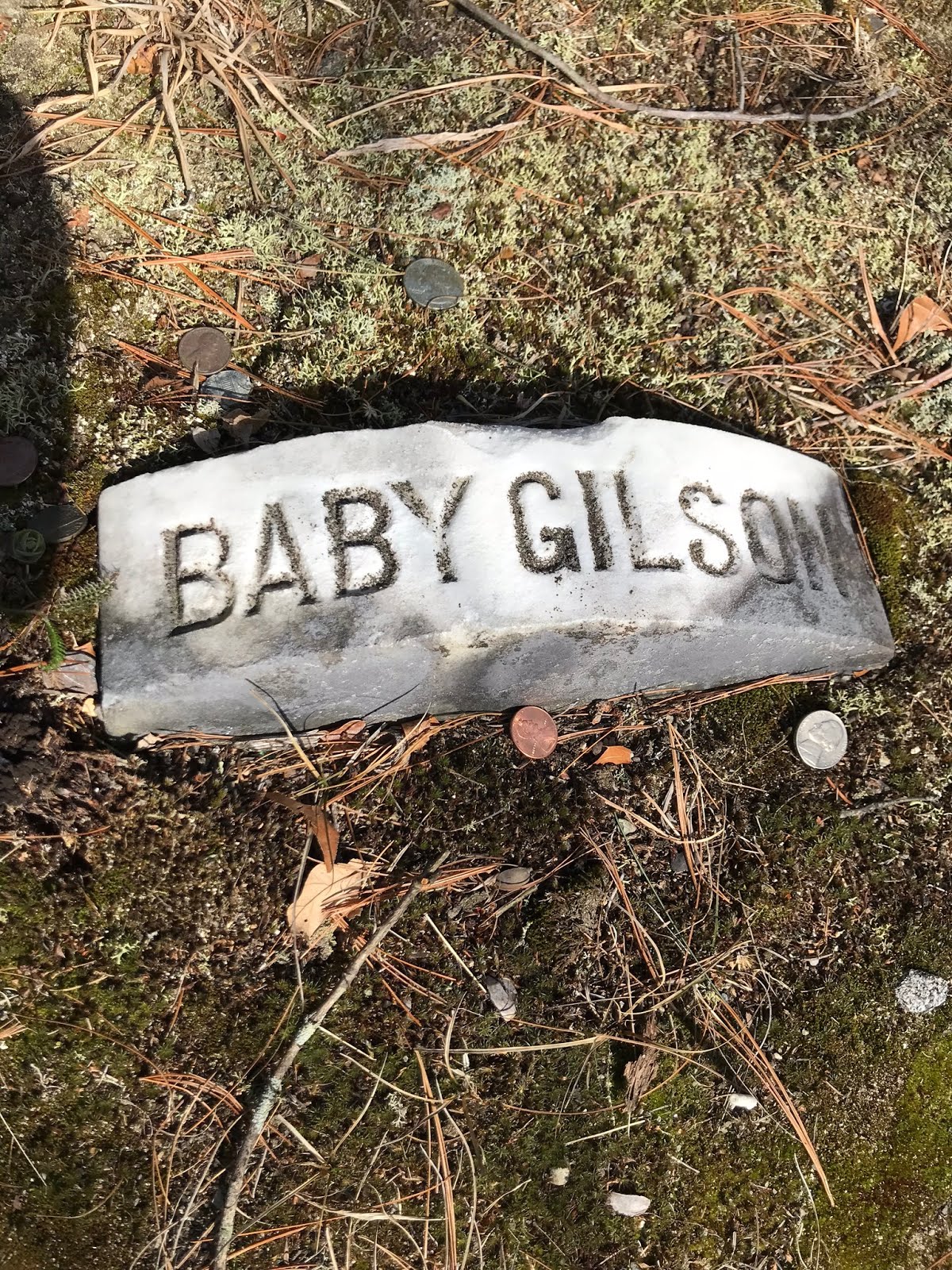
The neglect and the coins make Gilson Road Cemetery feel weird, and so do all the child graves. And there are a lot of them. For example, there are three identical tiny gravestones for unnamed babies from the Gilson family. Coins have been left on all of them. Perhaps these graves marked "Baby Gilson" have given rise to the legend about Betty Gilson and her baby?

Here is another child's grave, this time with a stuffed Big Bird left at it. All the graves are all quite old, so it's very, very unlikely Big Bird was left by someone who knew the child while he was alive.


The most memorable grave is probably that of little Walter Gilson, who died in 1811 when he was just over three years old. Walter's gravestone has a round hole drilled all the way through it. I haven't found a definitive explanation for this and have never seen another grave like it anywhere else.


People have left a lot of items at Walter's grave, including Barbie dolls, a solar powered crucifix, toy cars, and a rubber space alien. I think the stuffed Scooby Doo is particularly appropriate. A ghost-hunting dog is probably the best toy for a haunted cemetery.


Finally, adding to the weirdness, we saw this object on the ground. Was it a charm of some kind? It definitely had a Blair Witch vibe to it, but I suppose it could just have been a broken dreamcatcher. Or maybe not. We just left it right where it was. I'm not messing around with somebody else's graveyard magic, thank you very much.


There are a few theories about why the cemetery is supposed to be so haunted. According to one it was the site of a bloody battle between two local Native American tribes. Another claims the cemetery was the site of not one, but two deadly house fires. I don't think there's any evidence to back up either theory so they may just be legends. Still, true or not, they reflect the eerie atmosphere of the cemetery.

I guess you can see why I came away from Gilson Road Cemetery with a lot of questions. It's one of the more interesting graveyards I've been to recently and I recommend visiting if you get the chance. Maybe you'll find more answers than I did! My usual caveats apply: don't go at night and don't damage anything. This is someone's final resting place so be respectful. 

February 15, 2016

A Monster and A Martyr in Puritan Boston

The English writer John Josselyn visited New England for fifteen months in the 1630s. In September of 1639, while he was staying on one of the Boston harbor islands, the following occurred:

… The next day a grave and sober person described the Monster to me, that was born at Boston of one Mrs. Dyer a great Sectarie (sectarian), the nine and twentieth of June, it was (it should seem) without a head, but having horns like a Beast, and ears, scales on a rough skin like a fish called a Thornback, legs and claw like a Hawke, and in other respects as a Woman-Child (An Account of Two Voyages to New England, 1674). 

Josselyn is often called a credulous writer because his books are full of tall-tales, folklore, and monsters. But in this case, he was writing about one of the most famous monsters of 17th century New England. But was the monster real? Perhaps, although he had its birthday wrong...

The story begins with Mary Dyer, a devout Puritan who came to Boston from England with her husband William (a hat-maker) in 1635. For a while things went well for the Dyers in their new homeland, but they soon found themselves embroiled in a religious controversy.

The controversy initially focused on two groups of Boston ministers who had different theological ideas about God's relationship to men. The more conservative ministers felt that God established certain laws and would grant salvation only to people who followed those laws. This viewpoint is sometimes called the "covenant of works." The more radical ministers believed that God would save anyone who had faith in Christ, a viewpoint called the "covenant of grace." This controversy was called the Antinomian Controversy, from a Greek work meaning "opposed to laws."

Theology is kind of a dry subject, so I think it's hard for modern New Englanders to understand how divisive this controversy was to 17th century Boston. But think about it this way: Boston was a theocratic society founded by fundamentalist religious radicals who had fled England. The Antinomian Controversy pitted one group of fundamentalists against other fundamentalists who were even more radical than they were.

Ann Hutchinson's house stood at this spot on the corner of School and Washington streets in Boston.
The controversy nearly split Boston apart. Aside from the various ministers, one of the leading figures of the "covenant of grace" group was Anne Hutchinson, a wealthy and successful midwife. She was quite influential among the colony's women, and would often share her theological insights with dozens of women (and their husbands) in her large Boston house.

Mary and William Dyer were among those who attended the older, wealthier Hutchinson's talks and Mary soon became one of her most ardent supporters.

The controversy ended abruptly in 1637 when John Winthrop became the colony's new governor. The previous governor, who was more lenient, went back to England. One of the radical ministers was banished from Massachusetts, and several of his supporters lost their political positions. A new, less tolerant tone was set in Boston. Things didn't look good for Hutchinson and her friends.

It was in this political atmosphere that Mary Dyer gave birth on October 11, 1637. Anne Hutchinson and one other midwife were in attendance. Unfortunately the baby was stillborn and deformed. Unusual births among humans and animals were called "prodigies" at that time, and were seen as omens and warnings from God. Hutchinson and Dyer both understood their enemies would use the dead infant's strange appearance as a weapon against them and quickly buried it.

For several months Dyer's baby remained a secret from the authorities. In the spring of 1638 Governor Winthrop exiled Ann Hutchinson from Boston, and at the same time he learned about the Dyer's child. Along with a large group of ministers and magistrates Winthrop exhumed the infant's corpse. He described it in the following language:

...it had a face, but no head, and the ears stood upon the shoulders and were like an ape's; it had no forehead, but over the eyes four horns, hard and sharp; two of them were above one inch long, the other two shorter … all over the breast and back full of sharp pricks and scales, like a thornback … behind, between the shoulders, it had two mouths, and in each of them a piece of red flesh sticking out; it had arms and legs as other children; but, instead of toes, it had on each foot three claws, like a young fowl, with sharp talons.

Winthrop is essentially describing a demon. European manuscripts of the time were full of illustrations of demons, who were usually depicted as a hideous mix of the human and animal. Winthrop's message was clear: God punishes religious dissenters by making them give birth to monsters.

An illustration of a demon.


Before I bring this story to its unpleasant conclusion, let me just say that while I love stories about monsters and scary creatures, Mary Dyer's story isn't really about a monster. It's about politics, religion, and the role of women in society. While Dyer's baby was indeed sadly deformed, historians agree that Winthrop exaggerated the nature of those deformities to make a political point. The authorities in Boston felt threatened by the Antinomians, and they felt threatened by women like Anne Hutchinson and Mary Dyer, who believed they were as qualified to talk about theology as any man. It's disturbing to look back and see how Governor Winthrop used the Dyer's tragedy as a tool in a political struggle.

Mary and William Dyer followed Ann Hutchinson into exile and eventually helped found Newport, Rhode Island. But Mary Dyer didn't give up the fight. It seems like Winthrop's abuse of her tragedy just fueled her fervor. She became even more religiously radical, converting to Quakerism, whose tenets include the beliefs that anyone can hear God's voice and that men and women are equals in the church. Quakers were the most heretical sect in New England at the time and their presence was forbidden in Boston.

In 1657 Mary Dyer came back to Boston. The authorities imprisoned her as a Quaker and then sent her back to Rhode Island. She didn't give up. Determined that the authorities should repeal the law against Quakers she came back to Boston twice more. The second time she was sentenced to be hanged, but a last-minute reprieve was issued as she stood at the gallows. She was exiled again, with a threat that if she ever returned to Boston she would be executed.

Dyer came back to Boston again in 1660, the following year. She was quickly arrested and sentenced to hang on Boston Neck (now Washington Street in the South End*). On June 1 she was hanged. On the gallows a minister asked if she wanted the church elders to pray for her. Dyer replied "I never knew an elder here."


Dyer died as a martyr, and her death had the effect that she wanted. Many people who witnessed her execution were quite moved, and news of her death spread through the colonies. Dyer's story eventually reached the king of England, who issued an edict banning the execution of Quaker's.

Times have certainly changed. The Puritans are long gone. Massachusetts has a female senator in Washington. There's now a Quaker meeting house on Beacon Hill, and a statue of Mary Dyer sits in front of the Massachusetts State House. And no one calls stillborn babies monsters anymore.

 *A popular restaurant ironically called The Gallows is located there.

January 06, 2013

Bringing Up Baby - Magic for Your Infant

People are often critical of parents these days, saying they spend too much time and money trying to guarantee their children a good future with dance lessons, tutors, soccer practice, and forced community service. "Why oh why," these critics say, "can't we let children be children and raise them like they were in the past?"

Well, surprise surprise. Parents in past also wanted what was best for their children and did what they could to give them a good future. Sometimes they would even use a little magic. They probably wouldn't have used the word magic, but I think that's the modern category the following folk practices best fit into.

Folk painting by Sheldon Peck (1797 - 1868)
For example, to ensure that your newborn will grow up to be smart, be sure to take him/her up a flight of stairs before you ever bring him/her down a flight of stairs. Ideally you should bring your baby all the way up to the attic and bump his head (gently) against the ceiling.

This folklore is from the 19th century, when most women still give birth at home. The assumption is that if you gave birth on the ground floor you would bring your baby up to the second floor or even higher. If you gave birth on the second floor you could bring him up to the attic. The symbolism is obvious - you want your baby to rise in the world.

Of course there is the possibility that you might give birth in the attic or in a house that has only one floor. Does this mean that your baby is destined to a low-achieving dunderhead? No! Simply bring in a small stepladder and walk up it with your baby. You will have done the symbolic moving up in the world, and your baby can now be carried down a flight of stairs without concern for its future.

Conversely, within the first eleven months of your baby's life you want it to fall out of bed at least once. This is a sign that s/he is intelligent and will do well in life. I guess it is also a sign that carrying the baby up stairs to the attic really worked.

While these charms and omens seem kind of cute others are a little more serious. Infant mortality was quite high in the past and most families feared losing a child. Carrying the baby up the stepladder was supposed to ensure she lived through her first year. You should also leave at least one article of clothing unmade or unpurchased before a child is born to make sure it is healthy the first twelve months. To have a full wardrobe for an unborn child is tempting fate. You don't want to look too confident to those powers that control a baby's health.

As I mentioned in a post several years ago, you also shouldn't allow your baby to see its reflection before it is a year old. To do so indicates the child will die.

I don't want to end on a particularly dour note. After all, life is full of second chances. A mother who loses her baby should sell all the deceased child's clothing. It's said this will bring more children to her in the future.

I found this information in Fanny Bergen's Current Superstitions. Collected from the Oral Tradition of English Speaking Folk (1896).