October 15, 2023

The Devil's Washbowl: Home of the Pigman?

Tony and I recently took a weekend trip up to Vermont. Our final destination was Montpelier to see an old friend, but we made a few stops along the way. Some people visit Vermont to see fall foliage and quaint towns. We wanted to see the Pigman!

The Pigman is the resident monster of Northfield, Vermont, a cute little town best known as the home of Norwich University, the oldest private military college in the United States. But if you journey outside the charming downtown and into the dense woods, according to legend you might encounter the half-human, half-porcine horror known as the Pigman. He's said to lurk most frequently in an area known as the Devil's Washbowl, a densely wooded, rocky, and remote area. 

Way back in 1971, a Northfield farmer's twenty-year old son disappeared from home. Perhaps he had run away to the big city, the police suggested. He was never found, but shortly after his disappearance various animals went missing around town as well: mostly dogs and cats. Were these things connected? 

One night a farmer heard something rummaging through his garbage cans. Thinking it was a raccoon, the farmer flicked on his outside light. It wasn't a raccoon. It was a naked man. His body was covered in short white hair, and he had the face of a pig. The man - creature? - ran off into the darkness. 

A few weeks later, during a high-school dance, four students were smoking and drinking in a sand pit behind the school. As they talked, they saw something move towards them in the night. It was a naked man with the hideous face of a pig. Terrified, the four students ran into the school gymnasium and told their friends what they had seen. A group of students ran out to see the creature, but it had vanished, leaving behind only beaten-down undergrowth as proof it had been there. 

Jeff Hatch was one of the students that rushed out to find the Pigman, and many years later he told Vermont author Joseph Citro about the creature. Citro included the legend in his book Green Mountains, Dark Tales, and in subsequent books, like Weird New England and The Vermont Monster Guide. According to Hatch, locals at first suspected the Pigman was living at a nearby pig farm (which makes sense), but many motorists that year reported seeing a strange white creature near the Devil's Washbowl, a stony hillside depression that a stream runs through. A young couple that had parked their car near the Devil's Washbowl for a romantic interlude also claimed the Pigman had attacked them, and the young man had the claw marks on his body to prove it. 

Small piles of bones and piles of hay, which seemed to have been used as bedding, were found in caves near the Devil's Washbowl, further lending credence to the idea it was the Pigman's lair. Jeff Hatch claims the police went to investigate, but never found anything. 

Some people want to see the Eiffel Tower or the Pyramids. Ever since reading this story, I've wanted to see the Devil's Washbowl, so we made it a stop on our Vermont trip. Devil's Washbowl Road is easy to find on Google maps, but when we visited it was not marked by any street signs. (It looked like they had been stolen by vandals.) It's a dirt road that wends its way along a steep, wooded hillside. There are a few houses and farms along the road, but mostly you're in the woods. Devil's Washbowl Road is pretty, but it also reminded me of the beginning of a horror movie, particularly as we were two city boys out of our element. 


I had asked Joseph Citro how to find the Washbowl itself, and he told me I would see it when the road passed over a culvert. After mistakenly thinking a small stream was it, we came to the actual Devil's Washbowl. Many geologic features in New England bear the Devil's name, often because they are rough and vaguely inhospitable to humans. This is one of them. A stream runs down a rocky hillside, empties into a rocky basin, and then disappears into the woods. I haven't found a specific legend explaining the origin of the Washbowl's name, but it does look like someplace where the Devil would wash his hands after committing a nefarious deed. 

Would you go down there? We did not...

We pulled over and got out of the car to take some photos. Other than the sound of rushing water, it was very quiet. I debated climbing down into the Washbowl itself to find one of the caves, but I (wisely) decided not to. My main concerns: breaking a leg, getting Lyme disease, touching poison ivy, getting eaten by the Pigman. Four good reasons to stay near the car. And then Tony noticed a good reason to get back in the car: a big piece of animal scat, relatively fresh. Was it from a bear, or maybe a coyote? Or perhaps it was from a half-man, half-pig, humanoid monster? We didn't stick around to find out. 


Jeff Hatch seemed to think the Pigman was actually the farmer's son who went missing in 1971, who somehow devolved after living in the woods. That's the original theory, and there are a few other theories circulating these days about the creature's origin. One suggests that he is the unholy offspring of a lonely farmer and a much beloved swine. I won't comment on that one, other than to say I don't think that's how biology works.  

Another, more detailed story about the Pigman's origins seems to have appeared online around 2013. This story claims he was originally a teenager known as Sam Harris. On October 30, 1951, Sam went out to cause mischief in Northfield. The night before Halloween was called Picket Night in Northfield, and it was the designated night for kids to wax windows, egg cars, and throw toilet paper in trees. Sam left home that night but didn't return... until three years later. Sam appeared on his parents' front porch one night in 1954, naked, squealing and tossing bloody pig innards on the porch floor. The sight supposedly drove his mother to suicide (she threw herself into a pen full of ravenous hogs), and a teacher who tried to debunk the legend was found dead with the words "PICKET NIGHT" carved on her body. 

Still not going down there...

In 2014, another addition to the legend appeared online, this time from horror author William Dalphin, who grew up in Northfield. Dalphin claims that in the 1980s, a group of teenagers camping near the Devil's Washbowl encountered the Pigman, who clubbed one boy on the head and dragged him off into the woods. The boy was never seen again, except possibly by one local man who said he had seen the teenager rummaging through his trash, wearing just a pair of torn jeans. His body was covered with short white hair and his eyes had a hollow expression. Dalphin intended his story as fiction, but it has since been cited as part of the actual legend. 

Northfield is not the only place in the United States that is supposedly terrorized by a pigman. A bridge in Denton, Texas, is said to be the home of a pig-headed madman who menaces teenagers. He is either a local hunter transformed into a were-pig after being bitten by a feral hog, or he is the disfigured victim of gangsters who cut off his nose and sliced open his cheeks. Also haunting bridges are the the Pigman of Hawkinsville, Georgia, the Pigman of Angola, New York, and the Pigman of Shelby County, Tennessee, who is said to appear near the bridge at night if you shout, "Pigman" three times. A similar legend is told about Pig Lady Road in Hillsborough, New Jersey, where a monstrous Pig Lady appears if you say her name three times. 

I enjoyed my trip to the Devil's Washbowl, even if it was a little creepy. Perhaps next year I could road-trip across the country, visiting assorted haunted Pig People locations? I suppose I could, but maybe that would be pushing my luck. I should probably count myself lucky I didn't see the Pigman on our trip to Northfield. 

September 21, 2023

The Haunted Charlesgate: Ghosts, College Students, and Weird Engimas

Living someplace old and historic, like the Boston area, brings both perils and joys. Among its current perils is the decaying subway system, which has been well-documented elsewhere. To avoid the most hellish parts of the MBTA, lately my commute home from work has involved more walking. Which brings me to one of the joys of living in the Boston area: beautiful old architecture. 

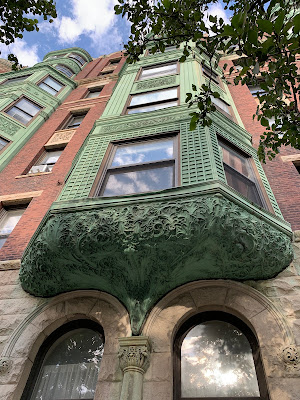
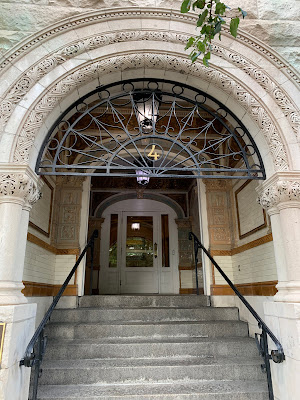
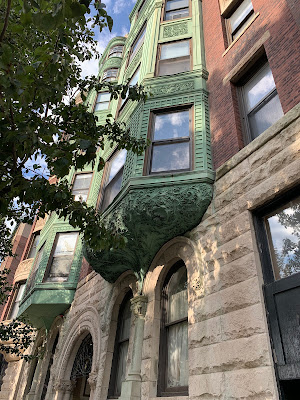
Most nights, I walk through parts of Back Bay on my way home. Among all the beautiful old brownstones and apartment buildings, one in particular stands out: the former Charlesgate Hotel, located at the corner of Beacon Street and Charlesgate East. The hotel was designed by John Pickering Putnam, a prominent local architect, and completed in the 1890s. Putnam apparently loved the building he created, and took up residence there with his own family. 

He died there on February 23, 1917 at the age of sixty. A legend claims it was suicide, but he really died of natural causes. Still, esotericists of a certain bent will notice he died on the 23rd, making his death an example of the 23 enigma, the idea that the number 23 is considered strange, somewhat sinister, and connected to unusual phenomena. So maybe Putnam's death date was a precursor of the weirdness that was to come...

The Charlesgate operated as a hotel until 1947, when it was sold to Boston University as a dorm. In 1981, it was sold to Emerson College, which also used it as a dorm until 1995. It was during those 14 years that the Charlesgate acquired its reputation as one of the most haunted buildings in Boston. Here are a few of the ghostly legends from that time..

The building was said to be haunted by the ghost of Elsa Putnam, John Pickering Putnam's daughter, who died as a little girl when she was playing with a ball on an upper floor. The ball rolled into an open elevator shaft, and Elsa ran after it and fell to her doom. This story is not true - Elsa Putnam lived until the 1970s and had several children of her own - but many Emerson students still reported seeing her ghost. 

Another legend claims that mobsters owned the building in the 1930s and murdered three people in the elevator. The ghosts of these gangland slaying victims were often seen wandering in the dormitory. Emerson students also claimed they saw the restless spirits of young women who had committed suicide in the building back when it housed female Boston University students. 

A phantom "Man in Black" was also seen lurking around the elevator. No one was quite sure who he was, but students were afraid to encounter this black-clad ghost, particularly late at night. 

Even when ghosts were not seen, Emerson students living in the Charlesgate experienced a variety of strange phenomena including unexplained cold spots, toilets flushing by themselves, and doors slamming shut. Some students also claimed the hotel had once been the headquarters for a demonic cult. According to an article in a 1990 issue of Fate magazine:

"Also at one point, a good part of Charlesgate Hall's residents allegedly belonged to a demonic cult. 

When Emerson College bought Charlesgate Hall as a dormitory in 1980, it was not completely filled by students. It was claimed that some members of the cult still lived there, and it was not unusual for students to walk by the open door of a room belonging to a cult member and find a group of them chanting."

Well, college is supposed to expose you to new experiences, isn't it? The same Fate article also claims that Emerson forbid students from using Ouija boards in the Charlesgate - and then goes on to describe a group of them using one to contact spirits in the dorm. I guess college is also about defying authority.

The Charlesgate's ghosts have been written about in many places: The Berkeley Beacon (Emerson's student paper), The Boston Phoenix, Emerson's official newsite, and various books about haunted locations in Boston. The building also appears in Scott Von Doviak's 2018 novel, Charlesgate Confidential, as do some of the ghost stories. The combination of a creepy old hotel, ghosts, and college students makes the Charlesgate an appealing subject for writers.

The Charlesgate is no longer a dormitory, but instead is filled with condos and apartments. I haven't heard of any ghosts appearing in the building since it became condos. Are any ghosts even there now? Maybe the ghosts were chased away during the renovations, or maybe they were conjured up by the Emerson students who lived there. College students tend to like ghost stories, and many local New England colleges are said to have haunted dormitories. 

I mentioned the 23 enigma at the start of this post. Although the concept first appeared in works by William S. Burroughs, it was popularized by the author Robert Anton Wilson. Wilson didn't necessarily believe the 23 enigma was real, but rather that it showed how people have the ability to find patterns in random occurrences. Some people starting seeing the number 23 in all kinds of unexpected places once they learn about the enigma. The number is only meaningful, though, because they think it is significant. They are creating a pattern out of random data.

Perhaps the ghost stories at the Charlesgate are something similar. Students heard rumors the dorm is haunted, and then noticed lights flickering, strange cold spots, and weird noises at night. These all could have perfectly rational explanations - old buildings often have bad fuses, drafty windows, and frisky rodents - but students interpreted them as ghostly phenomena because they had heard the rumors. 

This is, of course, all speculation on my part. The only way for me to know for certain would be to rent an apartment at the Charlesgate and see what happens. A one bedroom starts at $2,400/month, which is more than I have budgeted for ghost-hunting. Or then again, maybe I'm just scared that the legends are true? I don't want to encounter the Man in Black late at night, no matter what he is. 


August 20, 2023

Beyond Skinwalker Ranch: Orbs, Pukwudgies, and Sacred Chants

I don't watch a lot of paranormal TV shows, but I felt compelled to watch Beyond Skinwalker Ranch when I heard they filmed an episode here in Massachusetts. Pukwudgies, glowing orbs, and people wandering around a bleak wintry New England swamp? Count me in.

First, a little background. Skinwalker Ranch is a ranch in Utah where people have supposedly witnessed many strange phenomena over the years, like UFOs, Bigfoot, cattle mutilations, glowing orbs, and electromagnetic disturbances. The ranch is named after a type of legendary shape-shifting Navaho shaman, the skinwalker. Skinwalker Ranch has been the subject of books, movies and TV shows, including the History Channel's Secrets of Skinwalker Ranch. Beyond Skinwalker Ranch is a spin-off of that show, where paranormal investigators visit places that are not Skinwalker Ranch.

An illustration of a pukwudgie from Beyond Skinwalker Ranch

On July 18, Beyond Skinwalker Ranch aired an episode where two investigators, Andy Bustamente and Paul Beban, visit the Bridgewater Triangle in Massachusetts to find similarities between the weird phenomena there and what goes on at Skinwalker Ranch. The Bridgewater Triangle is an area in southeastern Massachusetts where a lot of strange phenomena have been reported, and was given its name by cryptozoologist Loren Coleman in the 1970s. I'm not sure when they filmed the episode, but Bustamente and Beban wear winter coats and you can see their breath, so I'm guessing sometime last winter or fall? I'm a sucker for anything filmed in the New England woods, particularly when the leaves are down, so I was hooked. 

Bustamente and Beban first visit three locations in the Triangle. The first is Skim Milk Bridge, an old Colonial-era stone bridge in West Bridgewater. The bridge was once part of a busy commercial route, but roads were rerouted and now it's part of a hiking trail in the woods. In 1916, a young woman went missing while canoeing, and her body was found under the bridge. There have been rumors since that time that the bridge may be haunted, but blogger Kristen Evans contacted me after reading this post and said the body may have actually been discovered at another bridge. 

Location number two is Anawan Rock, a large rock where Chief Anawan was captured by English colonists in 1676 during King Philip's War. Anawan was executed shortly thereafter. Much like Skim Milk Bridge, Anawan Rock is also said to be haunted. 

Finally, Bustamente and Beban wander into the Hockomock Swamp looking for pukwudgies, the small, hairy, magical humanoids that are said to lurk in the swamps and woods of New England. But before they head into the swamp, they talk with Raynham resident Bill Russo about his famous 1990 encounter with a pukwudgie. This is one of my favorite pukwudgie stories and is very creepy to hear. 

Andy Bustamente in Beyond Skinwalker Ranch

Do the Beyond Skinwalker crew actually find anything? They don't find a pukwudgie, but while walking around the swamp at night they do find an animal den which their infrared equipment shows to be very warm. They also hear something walking around and snapping branches. The investigators say this is strange, but maybe it was just a fox or a raccoon walking back to its cozy den? All of Bustamente and Beban's equipment also malfunctions at one point, leaving them with no recorded data. "No data is data," someone says at the end of the show. 

At another point, their equipment shows high levels of background radiation and their compasses all indicate that north is in different directions. I thought this was interesting, but a local resident who is with the two investigators expresses some concern about the high radiation. He raises a good point. Should people who live nearby be worried about radiation? No one answers the question, so I'm assuming they don't? 

The highlight of the episode is that they see two glowing objects in the sky. UFOs? UAPs? Call them what you will. They see the first one at Anawan Rock. Bustamente and Beban discuss playing some kind of Algonquin chant to summon the spirits haunting the rock, but since they don't have one handy they instead play a recording of a Hebrew religious chant that was used in an earlier episode. As the chant plays, a glowing object flies above them through the night sky. They insist it is not a plane, and although I suppose it could be a drone I was willing to suspend my disbelief. The weirdness of the situation was very appealing to me. Playing a Hebrew chant at a rock haunted by Algonquin ghosts to summon a UFO? It doesn't quite make any sense but seems very appropriate somehow for 21st century America. 

They see the other glowing object when they're out looking for pukwudgies. Again, it flies above them through the night sky, and this time one of the Beyond Skinwalker crew says the FAA shows no planes flying near them. This glowing object appears spontaneously without any Hebrew chanting. The crew doesn't get a pukwudgie, but does get another UFO, which is a good consolation prize. 

Overall, I enjoyed the episode. It was great to see some local people and locations on the show, and I liked seeing the UFOs, whatever they were. Did Beyond Skinwalker Ranch find any definite evidence of weird paranormal phenomena? Not really, and I doubt anyone ever will. By it's very nature, the paranormal can't be pinned down, categorized, or satisfactorily explained. That would just make it normal, not paranormal. It's the little hints at an answer, and the mystery itself, that keeps us watching these shows, and lures us into the New England swamps and woods.

August 08, 2023

A Nantucket Ghost Story: The Man with the Long Chin

Nantucket is a playground for the very wealthy these days, but that has not always been the case. In the past, the island has been home to Native Americans, Puritans, Quakers, whalers, and an assortment of artists and eccentrics. Nantucket has a very long history, and a long history usually means ghost stories. 

After the whaling industry collapsed in the mid-19th century, Nantucket became sparsely populated. There wasn't a lot of economic development on the island, which meant that very few of the old historic houses were torn down to make room for new ones. Those old houses are now mostly vacation homes for the wealthy, but there may be some unexpected guests stopping by to visit, as the following story indicates. 

The oldest house in Nantucket. 

It comes from Blue Balliett's 1984 book, The Ghosts of Nantucket: 23 True Accounts. I bought this at a used bookstore a few years ago, and really enjoy it. It's full of old-fashioned ghost stories, and also has some charming line drawings of old Nantucket houses. 

Back in July of 1981, a seven-year old girl named Jesse and her parents were invited to a dinner party at an old house on India Street in Nantucket. The adults were having a great time at the party, but Jesse was the only child there and quickly became bored. To keep her entertained, one of the hosts suggested she take a tally of interesting items in the house: candlesticks, mirrors, brass doorknobs, etc. 

The adults could hear her counting in a nearby room counting as they talked and ate dinner. But their dinner conversation was suddenly interrupted when Jesse ran into the dining room, terrified and exclaiming that she had seen a strange man in the house. Her parents and the hosts followed the frightened child into the room where she said she had seen the man, but there was no one there. 

Jesse said the man had a very large chin and was wearing a strange, dark blue suit. He had tipped his hat to her and then vanished into thin air. Although she had been scared, Jesse said he seemed friendly. She emphasized repeatedly that he had a long face and very large chin. Since Jesse was safe and unhurt, the adults at the party didn't take her story very seriously. After all, children do have active imaginations. 

Vintage photo from Ebay

A few weeks went by, and Jesse and her parents had mostly forgotten about her strange experience. One afternoon they were invited back to the old house on India Street, and the owners showed them something they had found in the attic. It was a line drawing that showed people attending a garden party at the house, probably from the 1940s or 1950s. 

When Jesse saw the drawing she said, "That's him! The man with the long chin." One of the people in the drawing was indeed a man with an unusually long chin. Some text on the back of the drawing identified everyone in it. The long-chinned man was William Hunt, a previous owner of the old house. 

After doing a little research, the current owners of the house learned that William Hunt had committed suicide in 1961, twenty years before he tipped his hat to Jesse. 

*****

This is a very satisfying ghost story to me. It has an old house, someone encountering the supernatural, and proof at the end that the encounter was real. That proof is often a major aspect of classic ghost stories. For example, think of phantom hitchhiker stories. Someone always has to independently verify and identify the hitch-hiking ghost. "That girl hitchhiking was my daughter, and she died on this night twenty years ago on the way to her prom. You saw her ghost!" Or this story, from Cape Cod: "That seaweed you found only grows on the bodies of people who drowned. You saw the sailor's ghost!" 

In these older, classic ghost stories, someone who did not witness the paranormal encounter has to confirm it was authentic, or someone finds a piece of outside evidence (a piece of seaweed, a drawing, etc.) that confirms the encounter. It's what makes these stories satisfying. If this story just ended with Jesse telling everyone she had seen a long-chinned man it wouldn't quite feel the same. 

July 09, 2023

The Glocester Ghoul: A Monster and A Pirate in Rhode Island

A while ago I was poking around on the Internet and saw articles about a monster called the Glocester Ghoul. I had never heard of this terrifying creature before, and of course wanted to find out more. This is what I learned...

The monster supposedly lurks in the woods and swamps of Glocester, Rhode Island, a small town in the northwestern part of the state. Here's a fun fact about Glocester. Its name used to be spelled "Gloucester," like the town in Massachusetts, but in 1806 its citizens decided to change the spelling to "Glocester" to avoid confusion with the Massachusetts port. The two towns are different in other ways, as well. Gloucester, MA is haunted by witches and sea-serpents. Glocester, RI, is haunted by a large scaly monster that roams through the woods: the Glocester Ghoul. 

Image from TeePublic 

One of the earliest accounts of the monster was an article that appeared in various newspapers (including The Boston Globe) in January and February of 1896. Titled "Monster, Cow, or Ghost?," the article claims a Glocester man named Neil Hopkins encountered a monster while walking home from work one night:

"It seemed to be all a-fire; it had a hot breath," Hopkins told his neighbors. "There was a metallic sound, like the clanking of steel against steel... I could hear the dead branches and twigs crackling under the heavy tramp."

Unfortunately Hopkins only caught a brief glimpse of the creature before it ran off into the woods, but he said "it was as big as an elephant, and that he is certain it had no tail." 

The article goes on to suggest the creature may have been the same one seen seen in 1839 by Albert Hicks and three other local men. They believed Captain Kidd had buried some of his treasure on a Glocester farm and were digging to find it, but their efforts were interrupted by the appearance of a monster. Hicks described the following:

"It was a large animal, with staring eyes as big as pewter bowls. The eyes looked like balls of fire. When it breathed as it went by flames came out of its mouth and nostrils... It was as big as a cow, with dark wings on each side like a bat's. It had spiral horns like a ram's, as big around as a stovepipe. Its feet were formed like a duck's... The body was covered with scales as big as clam shells, which made a rattling noise as the beast moved along..."

That's an impressive monster, even if it's only as big as a cow, and not an elephant, like Neil Hopkins said. It sounds like some kind of dragon, doesn't it? 

Beyond the scaly monster, there are a few other interesting things about this story:

1. Treasure-digging was a common activity in the 18th and 19th centuries. People thought New England was full of buried treasure, and would get together with friends to try to find it. They never seemed to succeed, though, often saying they had been on the verge of finding the gold only to be scared off by a monstrous guardian of some kind, like demonic dogs, sinister black cats, and maybe even the Devil himself. Digging for Captain Kidd's treasure and encountering a monster would have been a familiar theme to a 19th century newspaper's readers.

2. Albert Hicks, who was digging with his friends for pirate treasure, ironically later became one of the last people in the United States to be executed as a pirate. Hicks was born in 1820 in Foster, Rhode Island, and was executed in New York in 1860 after killing three men on a small boat to steal their money. He dictated a confessional biography before his execution. In it, he claimed to have killed dozens (if not hundreds) of people as a pirate and highway robber. Hicks had a reputation as a teller of tall tales, so he may have exaggerated his victim count. 

Drawing of Albert Hicks from an 1860 newspaper (via Wikipedia).

3. Despite being fond of tall tales, there's one thing not found in Hicks's biography, The Life, Trial, Confession and Execution of Albert Hicks, and that's a large scaly monster. Hicks does mention digging for treasure when he was young, but says nothing about encountering a monster. If he had encountered a monster I'm sure it would have been in there. So perhaps this story was created by someone else?

According to folklorist Stephen Olbrys Gencarella, the story was written by a reporter for a New York newspaper, The New York World, where it was published on January 12, 1896. That reporter based their story on an earlier one that had appeared in The Providence Journal on May 5, 1889, which was titled "Glocester Gold Digging." The Journal article contains various Glocester legends, including one about six men who went digging for Captain Kidd's treasure on November 13, 1833. One of the men was indeed Albert Hicks, and the six men saw a creature that looked exactly like the one in The New York World article. The big difference between the two articles are that the men also see a meteor strike the earth before they see the monster, and it is other men who describe the monster, not Albert Hicks. Hicks only played a minor role, but The New York World reporter probably played it up to capitalize on Hick's notoriety. 

One note about that meteor: the six men took the meteor as a good omen, and didn't seem to connect it with the appearance of the monster. 

The story about the Glocester monster appeared in various newspapers in 1896, but then more or less disappeared for over a century. The story reappeared on the blog Strange New England in 2019, where the monster was given the catchy name "The Glocester Ghoul." The name seems to have stuck, and I've seen the Glocester Ghoul mentioned a few places online. You can now even buy a Glocester Ghoul tee-shirt online:

From TeePublic

I feel like every state deserves a good monster, so hopefully knowledge of the Glocester Ghoul will spread. Is there really a large, scaly creature lurking in the woods and swamps of Glocester? Probably not, but I write that from the safety of my home on a sunny summer day. I might have a different opinion if I were out in the woods at night. I don't think anyone's allegedly seen the creature since the 1800s, but if you have drop a note in the comments. I'd be curious - and a little scared - to know more...

*****

I got a lot of my information from Stephen Olbrys Gencarella's article "Lovecraft and the Folklore of Glocester's Dark Swamp," which appeared in Lovecraft Annual, No. 16 (2022), pp. 90 -127.