People from Massachusetts are usually pretty reserved, but we’re oddly passionate about Dunkin’ Donuts. The company started in Quincy in 1950, and even though it’s now a global behemoth we still think of it as a local chain. It’s hard not to since there are so many stores in the state. There are approximately 1,050 Dunkin’ locations in Massachusetts – that’s roughly one store for every 6,500 residents.
I don’t know how many Bigfoots live in Massachusetts, so unfortunately I cannot calculate the ratio of Dunkin’ stores to Bigfoots in our state. But because there are so many Dunkins here, I had a hunch at least one Bigfoot encounter would involve a Dunkin’ Donuts. It just seemed inevitable. A quick search of the Bigfoot Field Researchers Organization (BFRO) website confirmed that my suspicion was correct – there was a Bigfoot sighting in Massachusetts that involved a Dunkin’.
I suspect there are more, but here are the details from the BFRO about the one confirmed case. On a hot July day in 1996, a 10-year-old boy in Rowley was feeling bored. As he tried to think of something fun to do, he remembered that a neighbor had recently told him about a path through the woods that led to a nearby Dunkin’ Donuts. He perked up at the thought, and decided to find the path. Was he planning to buy a donut, some munchkins, or a bagel with cream cheese (which had just been added to the menu that year)? Or perhaps he was going to try an “adult beverage” (i.e. an iced coffee)?
Was Bigfoot seen behind this Dunkin' Donuts in Rowley, MA? Photo by CD Rasmussen, posted on Google
Sadly, the BFRO report doesn’t specify what he wanted to buy, but it does tell us that he convinced a friend to join him on his adventure. The store was less than a mile away so the boy and his friend thought it was going to be an easy trip, but after walking for a while through the woods they got lost. They could have easily turned back, but they did not. Instead, they showed true Massachusetts grit and forged ahead through the undergrowth, determined to reach Dunkin’ Donuts.
Suddenly, they heard the sound of large animals moving nearby. Turning towards the noise, the boy and his friend were amazed see three humanoid figures running along a nearby hilltop. The creatures were not wearing any clothes and were covered in tan fur. Years later, the boy (now a man) told a BFRO investigator that the figures were around six-feet tall and had rugged but not ‘jacked’ (i.e. overly muscular) builds. He was unable to make out their faces because they were too far away.
Photo by Mike Mozart from Wikipedia.
The boy and his friend stood paralyzed with fear, but after the creatures vanished among the trees they ran back to the friend’s house and told his mother what they had seen. I assume she was surprised, but she may not have been. The BFRO investigator notes that several other people have also reported seeing Bigfoot in that same area near the Dunkin’ on the Newburyport Turnpike, so maybe she already knew about the creatures in the woods behind her house.
The report leaves one important question unanswered – where were the three hairy humanoids running to? The boy didn’t say which direction they were headed, but if they were Massachusetts Bigfoot, maybe they were also going to the Dunkin’ Donuts themselves? It’s just a suspicion on my part.
Does a tentacled, horned, snake-like monster haunt Nagog Pond in Littleton, Massachusetts? There aren't a lot of legends about lake monsters here in the Bay State, so I was excited when I first stumbled upon the possible Littleton lake monster a few years ago. It has been lurking in the back of my mind since then, and I finally decided to do a little more research.
Nagog Pond is on the border of Littleton and Acton, and was formerly called Nagog Lake. It's a kettle hole pond, meaning it was formed thousands of years ago when the glaciers melted at the end of the last ice ice. Kettle hole ponds are so-called because they hold water just like a tea kettle.
I've seen a few explanations for the name "Nagog," which is apparently derived from a word in one of the local Algonquin dialects. Some people say nagog means "corner," since the lake is in one corner of Littleton, and other say it is derived from "magog," which means water. As an FYI, Nagog is pronounced NAY-gog. Nagog Pond was used for fishing and recreational sailing in the past, and it now supplies drinking water to the nearby town of Concord.
Illustration from Uriah Jewett and the Sea Serpent of Lake Mephemgagog (1917)
To understand the monster, you first need to know a little local history. Littleton was originally established in 1645 as Nashoba Plantation, a village for local Nipmuc and Pennacook Indians who had converted to Christianity. It was one of six so-called Praying Indian Villages that were created in Massachusetts by the Puritan minister John Eliot. The term "plantation" here does not refer to a large farm based on slave labor like you would find in the old American south, but instead to a farming settlement. The Praying Indians from Nashoba and the other villages were forcibly moved to Deer Island in Boston Harbor during King Philip's war by their English neighbors who thought they would join Philip (Metacomet) in his rebellion. Many of the Indians died from starvation and exposure on Deer Island, and the rest intermarried with English settlers or gradually joined other Indian groups after the war ended. All the Praying Indian villages eventually became English towns.
The last Indian to live in Nashoba was Wunnuhhew, also known as Sarah Doublet, who returned to the village after King Phillip's War. Doublet sold the remaining 500 acres of Nashoba in 1734 to cover the cost of her care when she was elderly. She died two years later.
Sarah Doublet is one of the topics in John Hanson Mitchell's 1998 non-fiction book Trespassing: An Inquiry into the Private Ownership of Land. This is where the monster comes in. Mitchell's book is the only place I've found reference to the Nagog Pond monster. According to Mitchell, Sarah Doublet and the other Indians at Nashoba believed the pond was home to a large monster named Ap'cinic. Ap'cinic was a horned water-serpent, and also had tentacles that it used to probe the shoreline for prey. The creature seemed to have a particular appetite for human intestines.
"She knew the terror that flies by night, the fiery worm, the gnashing devils, and the legends of the tentacled, horned monster who would reach up out of the dark waters of Nagog at certain times and draw the entrails of passing villagers down into the depths." (Mitchell, Trespassing, p. 23)
Mitchell talks about Ap'cinic's tentacles a few other times. An earthquake struck the area in the 1600s, and he describes the monster reacting to it: "... the waters of Nagog churned and roiled and swelled, and the horned water beast who lived most of his time unseen beneath the surface rose up and spirited his vicious hunting tentacles through the drying air." (Mitchell, Trespassing, p. 65)
At one point in the book, Mitchell encounters some teenagers illegally swimming in Nagog Pond. He tries to warn them away by telling them about Ap'cinic:
"It had these long tentacles, they say, and a huge gnashing beak and horns on its head. At night it would reach up and feel along the shore for people, fishermen, swimmers, things like that. If it caught you, it would either drag you down into the waters, or worse, slice you open and suck out your intestines."
The teenagers were quiet for a minute.
"You mean it would like eat you alive?" Tracy asked.
"Yeah, suck out your inner body parts while you clung to a tree."
"Cool," she said. (Mitchell, Trespassing, p. 154)
The teenagers are intrigued, but not too worried. After all, is the story about Ap'cinic even true? Was there ever a monster lurking in the pond? You may wonder the same thing yourself.
To be clear, Trespassing is marketed as a non-fiction book. It is about the history of Littleton, Massachusetts, about people who actually lived, and even about the dry business of town governance. Town hearings about zoning are a key part of the book. Ap'cininc is only a very small part of Trespassing.
From Native People of Southern New England, 1500 - 1650.
Sarah Doublet (Wunnuhhew) really lived in Nashoba, but we don't know much about her life, and sadly Mitchell doesn't cite any sources for the legend of Ap'cinic. It's possible he made the story up. On the other hand, it's entirely possible that the Indians at Nashoba did believe a horned serpent lived in the pond. Horned serpents were part of the Alonquin cosmology. The anthropologist Kathleen Brandon writes:
"Among the manitou known to the Ninnimissinuok (i.e. New England Indians) was the giant horned or antlered, under (water) world serpent, a being familiar to other Algonquian-speaking people as well. Images of this fearsome underwater dweller sometimes decorated amulets, bowls, and other objects." (Kathleen Bragdon, Native People of Southern New England, 1500 - 1650, 1996, p.187)
So perhaps the Indians at Nashoba did believe a horned serpent lived in this particular pond, but John Hanson Mitchell doesn't present any concrete evidence they did. He doesn't explain where he found the name Ap'cinic, or why he thinks Ap'cinic had tentacles.
I think the word "manitou" is key to understanding what's happening with Ap'cinic. Manitou means spiritual power, or anything that has a lot of spiritual power. My hunch is that Mitchell is responding to the spiritual power he feels around Nagog Pond, and he's trying to tell the reader what it feels like for him, and what he thought it felt like for the Indians who lived there hundreds of years ago. Mitchell has written several books about the history of Littleton, and has a deep awareness of its history and geology. Ap'cinic is the sensation Mitchell feels when he is near the pond. Ap'cinic is how Mitchell experiences the spirit of the place:
"Back at the car I stood on the road for a while looking up at the hill, simply feeling the sensation. Nothing happened, nothing seized me by the throat and dragged me back into the swamps to draw me, struggling, into the murky depths. And below me at the pond, I could not see the slimy gleam of the blind, searching tentacles of the Ap'cinic, feeling along the shores for victims." (Mitchell, Trespassing, p. 109)
If you were to probe the depths of Nagog Pond with a camera, I don't think you would find any trace of a giant monster. But perhaps, if you were sitting in the woods by the lake on a still autumn night, with your phone silenced and your mind cleared from worries, you might catch a glimpse of Ap'cinic. Maybe it would look differently to you, and instead of a horned serpent you'd see a hairy humanoid wading along the shore, or a giant black bird flying overhead, or a strange glowing orb hovering above the water. Or maybe you'd just get the feeling of a sentient presence surrounding you.
The ancient Romans had a term for the spirit of a place: genius loci, or local spirit. Your belief in spirits as actual autonomous beings, or as a psychological metaphor, will depend on your intellectual temperament. But Ap'cinic may still hold a strange power, even if you think of him simply as a psychological experience:
"...a lake provides a ready-made metaphor for the Soul of the World, a symbol of the collective unconscious, an imaginative nexus where individual perception (or "misperception") and collective myth meet. Regardless of the actual characteristics of the lake, it is transformed by the Imagination into a reflection of the unconscious itself, becoming a dark, impenetrable, bottomless kingdom which does not yield up its dead. (Patrick Harpur, Daimonic Reality. A Field Guide to the Otherworld. 2003, p. 129)
That sounds intimidating, doesn't it? But perhaps less intimidating than a tentacled monster that wants to eat your intestines.
Tony and I recently took a weekend trip up to Vermont. Our final destination was Montpelier to see an old friend, but we made a few stops along the way. Some people visit Vermont to see fall foliage and quaint towns. We wanted to see the Pigman!
The Pigman is the resident monster of Northfield, Vermont, a cute little town best known as the home of Norwich University, the oldest private military college in the United States. But if you journey outside the charming downtown and into the dense woods, according to legend you might encounter the half-human, half-porcine horror known as the Pigman. He's said to lurk most frequently in an area known as the Devil's Washbowl, a densely wooded, rocky, and remote area.
Way back in 1971, a Northfield farmer's twenty-year old son disappeared from home. Perhaps he had run away to the big city, the police suggested. He was never found, but shortly after his disappearance various animals went missing around town as well: mostly dogs and cats. Were these things connected?
One night a farmer heard something rummaging through his garbage cans. Thinking it was a raccoon, the farmer flicked on his outside light. It wasn't a raccoon. It was a naked man. His body was covered in short white hair, and he had the face of a pig. The man - creature? - ran off into the darkness.
A few weeks later, during a high-school dance, four students were smoking and drinking in a sand pit behind the school. As they talked, they saw something move towards them in the night. It was a naked man with the hideous face of a pig. Terrified, the four students ran into the school gymnasium and told their friends what they had seen. A group of students ran out to see the creature, but it had vanished, leaving behind only beaten-down undergrowth as proof it had been there.
Jeff Hatch was one of the students that rushed out to find the Pigman, and many years later he told Vermont author Joseph Citro about the creature. Citro included the legend in his book Green Mountains, Dark Tales, and in subsequent books, like Weird New England and The Vermont Monster Guide. According to Hatch, locals at first suspected the Pigman was living at a nearby pig farm (which makes sense), but many motorists that year reported seeing a strange white creature near the Devil's Washbowl, a stony hillside depression that a stream runs through. A young couple that had parked their car near the Devil's Washbowl for a romantic interlude also claimed the Pigman had attacked them, and the young man had the claw marks on his body to prove it.
Small piles of bones and piles of hay, which seemed to have been used as bedding, were found in caves near the Devil's Washbowl, further lending credence to the idea it was the Pigman's lair. Jeff Hatch claims the police went to investigate, but never found anything.
Some people want to see the Eiffel Tower or the Pyramids. Ever since reading this story, I've wanted to see the Devil's Washbowl, so we made it a stop on our Vermont trip. Devil's Washbowl Road is easy to find on Google maps, but when we visited it was not marked by any street signs. (It looked like they had been stolen by vandals.) It's a dirt road that wends its way along a steep, wooded hillside. There are a few houses and farms along the road, but mostly you're in the woods. Devil's Washbowl Road is pretty, but it also reminded me of the beginning of a horror movie, particularly as we were two city boys out of our element.
I had asked Joseph Citro how to find the Washbowl itself, and he told me I would see it when the road passed over a culvert. After mistakenly thinking a small stream was it, we came to the actual Devil's Washbowl. Many geologic features in New England bear the Devil's name, often because they are rough and vaguely inhospitable to humans. This is one of them. A stream runs down a rocky hillside, empties into a rocky basin, and then disappears into the woods. I haven't found a specific legend explaining the origin of the Washbowl's name, but it does look like someplace where the Devil would wash his hands after committing a nefarious deed.
Would you go down there? We did not...
We pulled over and got out of the car to take some photos. Other than the sound of rushing water, it was very quiet. I debated climbing down into the Washbowl itself to find one of the caves, but I (wisely) decided not to. My main concerns: breaking a leg, getting Lyme disease, touching poison ivy, getting eaten by the Pigman. Four good reasons to stay near the car. And then Tony noticed a good reason to get back in the car: a big piece of animal scat, relatively fresh. Was it from a bear, or maybe a coyote? Or perhaps it was from a half-man, half-pig, humanoid monster? We didn't stick around to find out.
Jeff Hatch seemed to think the Pigman was actually the farmer's son who went missing in 1971, who somehow devolved after living in the woods. That's the original theory, and there are a few other theories circulating these days about the creature's origin. One suggests that he is the unholy offspring of a lonely farmer and a much beloved swine. I won't comment on that one, other than to say I don't think that's how biology works.
Another, more detailed story about the Pigman's origins seems to have appeared online around 2013. This story claims he was originally a teenager known as Sam Harris. On October 30, 1951, Sam went out to cause mischief in Northfield. The night before Halloween was called Picket Night in Northfield, and it was the designated night for kids to wax windows, egg cars, and throw toilet paper in trees. Sam left home that night but didn't return... until three years later. Sam appeared on his parents' front porch one night in 1954, naked, squealing and tossing bloody pig innards on the porch floor. The sight supposedly drove his mother to suicide (she threw herself into a pen full of ravenous hogs), and a teacher who tried to debunk the legend was found dead with the words "PICKET NIGHT" carved on her body.
Still not going down there...
In 2014, another addition to the legend appeared online, this time from horror author William Dalphin, who grew up in Northfield. Dalphin claims that in the 1980s, a group of teenagers camping near the Devil's Washbowl encountered the Pigman, who clubbed one boy on the head and dragged him off into the woods. The boy was never seen again, except possibly by one local man who said he had seen the teenager rummaging through his trash, wearing just a pair of torn jeans. His body was covered with short white hair and his eyes had a hollow expression. Dalphin intended his story as fiction, but it has since been cited as part of the actual legend.
Northfield is not the only place in the United States that is supposedly terrorized by a pigman. A bridge in Denton, Texas, is said to be the home of a pig-headed madman who menaces teenagers. He is either a local hunter transformed into a were-pig after being bitten by a feral hog, or he is the disfigured victim of gangsters who cut off his nose and sliced open his cheeks. Also haunting bridges are the the Pigman of Hawkinsville, Georgia, the Pigman of Angola, New York, and the Pigman of Shelby County, Tennessee, who is said to appear near the bridge at night if you shout, "Pigman" three times. A similar legend is told about Pig Lady Road in Hillsborough, New Jersey, where a monstrous Pig Lady appears if you say her name three times.
I enjoyed my trip to the Devil's Washbowl, even if it was a little creepy. Perhaps next year I could road-trip across the country, visiting assorted haunted Pig People locations? I suppose I could, but maybe that would be pushing my luck. I should probably count myself lucky I didn't see the Pigman on our trip to Northfield.
A while ago I was poking around on the Internet and saw articles about a monster called the Glocester Ghoul. I had never heard of this terrifying creature before, and of course wanted to find out more. This is what I learned...
The monster supposedly lurks in the woods and swamps of Glocester, Rhode Island, a small town in the northwestern part of the state. Here's a fun fact about Glocester. Its name used to be spelled "Gloucester," like the town in Massachusetts, but in 1806 its citizens decided to change the spelling to "Glocester" to avoid confusion with the Massachusetts port. The two towns are different in other ways, as well. Gloucester, MA is haunted by witches and sea-serpents. Glocester, RI, is haunted by a large scaly monster that roams through the woods: the Glocester Ghoul.
One of the earliest accounts of the monster was an article that appeared in various newspapers (including The Boston Globe) in January and February of 1896. Titled "Monster, Cow, or Ghost?," the article claims a Glocester man named Neil Hopkins encountered a monster while walking home from work one night:
"It seemed to be all a-fire; it had a hot breath," Hopkins told his neighbors. "There was a metallic sound, like the clanking of steel against steel... I could hear the dead branches and twigs crackling under the heavy tramp."
Unfortunately Hopkins only caught a brief glimpse of the creature before it ran off into the woods, but he said "it was as big as an elephant, and that he is certain it had no tail."
The article goes on to suggest the creature may have been the same one seen seen in 1839 by Albert Hicks and three other local men. They believed Captain Kidd had buried some of his treasure on a Glocester farm and were digging to find it, but their efforts were interrupted by the appearance of a monster. Hicks described the following:
"It was a large animal, with staring eyes as big as pewter bowls. The eyes looked like balls of fire. When it breathed as it went by flames came out of its mouth and nostrils... It was as big as a cow, with dark wings on each side like a bat's. It had spiral horns like a ram's, as big around as a stovepipe. Its feet were formed like a duck's... The body was covered with scales as big as clam shells, which made a rattling noise as the beast moved along..."
That's an impressive monster, even if it's only as big as a cow, and not an elephant, like Neil Hopkins said. It sounds like some kind of dragon, doesn't it?
Beyond the scaly monster, there are a few other interesting things about this story:
1. Treasure-digging was a common activity in the 18th and 19th centuries. People thought New England was full of buried treasure, and would get together with friends to try to find it. They never seemed to succeed, though, often saying they had been on the verge of finding the gold only to be scared off by a monstrous guardian of some kind, like demonic dogs, sinister black cats, and maybe even the Devil himself. Digging for Captain Kidd's treasure and encountering a monster would have been a familiar theme to a 19th century newspaper's readers.
2. Albert Hicks, who was digging with his friends for pirate treasure, ironically later became one of the last people in the United States to be executed as a pirate. Hicks was born in 1820 in Foster, Rhode Island, and was executed in New York in 1860 after killing three men on a small boat to steal their money. He dictated a confessional biography before his execution. In it, he claimed to have killed dozens (if not hundreds) of people as a pirate and highway robber. Hicks had a reputation as a teller of tall tales, so he may have exaggerated his victim count.
Drawing of Albert Hicks from an 1860 newspaper (via Wikipedia).
3. Despite being fond of tall tales, there's one thing not found in Hicks's biography, The Life, Trial, Confession and Execution of Albert Hicks, and that's a large scaly monster. Hicks does mention digging for treasure when he was young, but says nothing about encountering a monster. If he had encountered a monster I'm sure it would have been in there. So perhaps this story was created by someone else?
According to folklorist Stephen Olbrys Gencarella, the story was written by a reporter for a New York newspaper, The New York World, where it was published on January 12, 1896. That reporter based their story on an earlier one that had appeared in The Providence Journal on May 5, 1889, which was titled "Glocester Gold Digging." The Journal article contains various Glocester legends, including one about six men who went digging for Captain Kidd's treasure on November 13, 1833. One of the men was indeed Albert Hicks, and the six men saw a creature that looked exactly like the one in The New York World article. The big difference between the two articles are that the men also see a meteor strike the earth before they see the monster, and it is other men who describe the monster, not Albert Hicks. Hicks only played a minor role, but The New York World reporter probably played it up to capitalize on Hick's notoriety.
One note about that meteor: the six men took the meteor as a good omen, and didn't seem to connect it with the appearance of the monster.
The story about the Glocester monster appeared in various newspapers in 1896, but then more or less disappeared for over a century. The story reappeared on the blog Strange New England in 2019, where the monster was given the catchy name "The Glocester Ghoul." The name seems to have stuck, and I've seen the Glocester Ghoul mentioned a few places online. You can now even buy a Glocester Ghoul tee-shirt online:
I feel like every state deserves a good monster, so hopefully knowledge of the Glocester Ghoul will spread. Is there really a large, scaly creature lurking in the woods and swamps of Glocester? Probably not, but I write that from the safety of my home on a sunny summer day. I might have a different opinion if I were out in the woods at night. I don't think anyone's allegedly seen the creature since the 1800s, but if you have drop a note in the comments. I'd be curious - and a little scared - to know more...
*****
I got a lot of my information from Stephen Olbrys Gencarella's article "Lovecraft and the Folklore of Glocester's Dark Swamp," which appeared in Lovecraft Annual, No. 16 (2022), pp. 90 -127.
Do you read The Old Farmer's Almanac? I do, even though I'm not a farmer (but I am getting old). It's sold at supermarkets and CVS stores here in Boston, so clearly it's not just intended for farmers. It's for anyone who likes weird and possibly useful information
I like it for the astronomical information (full moons, sunrise and sunset times, etc.), and also the weird little facts the editors list for each month. For instance, the 2022 edition of the Almanac notes that J. Edgar Hoover, the FBI's notorious first director, died on May 2, and that stage and TV magician Doug Henning was born on May 3. Fun facts about the cycle of life and death.
The Almanac also notes that Bigfoot was seen in Hollis, New Hampshire on May 7, 1977. Another fun fact, this time about the weird things that happen in this part of the world.
I was excited to see this mentioned in The Old Farmer's Almanac, since it's a famous New England Bigfoot sighting. In fact, I wrote about it way back in 2015. I was planning to rewrite that post, but I like the original so much I'm posting it again. I found Bigfoot in the Almanac, but in 1977 some folks found him at the flea market...
Finding Bigfoot At the Flea Market: An Encounter from 1977
When I was a kid my parents often took my brother and me to flea markets and yard sales. It was the 1970s and I guess this was the thing to do. Quite often we didn't find anything good, but every now and then we'd get some great stuff. I still have a large teak Buddha I found, and we definitely found plenty of old paperbacks about weird occult and paranormal topics.
I never had an actual paranormal experience at a flea market, but apparently they do happen. Or at least they did, back in the 1970s.
On the evening of May 7, 1977 a Lowell, Massachusetts man named Gerald St. Louis arrived at a flea market site in Hollis, New Hampshire. St. Louis had brought his wife and two sons with him. The flea market began the next day, and the St. Louises wanted to get a good spot to set up their table early in the morning. After sunset they went to sleep in their pickup truck. Attached to the truck was a small trailer.
They were awakened that night when their truck began shaking. Standing next to their vehicle was a large humanoid. Mr. St. Louis later described the creature as being 8 or 9 feet high, brown-colored, and covered in long hair. When he turned on the headlights it became startled and ran across the parking lot, jumping easily over a four-foot high fence. Once over the fence it stood and stared at the truck.
Needless to say the St. Louis family got out of there fast. They drove to the Hollis police station and reported their sighting to Chief Paul Bosquet. The police inspected the area, but found no sign of the creature. The ground was covered in pine needles and not even any footprints could be seen. Well, at least according to the press at the time. I've seen at least one article online that says 16-inch footprints were found in the soil.
Chief Bosquet said he thought the family had seen a bear. Whatever it was, it seriously spooked them. They left Hollis quickly and didn't even take their trailer with them. I guess they got more than they bargained for at that flea market. (Get it? Bad pun.)
Was it just a bear? I have no idea, but someone else had a similar experience a few days earlier. A woman named Regina Evans was camping in Hollis on May 5, 1977 when she was awakened in the middle of the night by someone shaking her trailer. She did not see the culprit, but large footprints were found nearby.
Andre the Giant and Lee Majors in The Six Million Dollar Man.
The 1970s was a heady time for paranormal phenomena. The occult and metaphysical movements of the late 1960s had paved the way for Bigfoot, UFOs and the Bermuda Triangle to conquer America. Bigfoot was featured in movies like The Legend of Boggy Creek (1972), In Search of Bigfoot (1976), and just plain Bigfoot (1970), where a biker gang tries to save women captured by the cryptid. Bigfoot also showed up on TV. He was actually a bionic robot created by aliens on an episode of The Six Million Dollar Man, while on the kids' show Bigfoot and Wildboy he fought crime.
As a result of all this, most Americans knew what Bigfoot looked like and what he did - jump out of the woods, scare people, and then disappear. Were the experiences of the St. Louis family and Regina Evans colored by the media? It's very possible, but something really did shake their vehicles in the middle of the night, and the St. Louises seemed legitimately scared.
Perhaps it was pranksters enacting the role of Bigfoot. It's a time-honored tradition. In ancient Greece people dressed like satyrs and in the Middle Ages they dressed like leafy, hairy wildmen. Dressing in an ape costume and running through the woods might just be part of our cultural heritage. We all think there are monsters in the woods, so someone needs to play the part.
Or who knows? Maybe there really are creatures lurking in the woods, and they are the ones who change costumes over time, appearing as whatever we expect, a goat-footed daemon to the ancient Greeks and a huge hairy monster to someone who just wanted to go to a flea market.
Bigfoot was not seen again in Hollis, but happily he's still out there somewhere, lurking behind the trees and evading easy categorization.
On Monday, January 17, the Full Wolf Moon will rise at 4:13 pm and cast its lupine light across New England. Get out there and howl, folks! We're supposed to have a lot of rain here in Boston, so the moon may not be visible, but it will still be up in the sky even if you can't see it.
In honor of the Wolf Moon, here is a story about a possible werewolf I found on Phantoms and Monsters. Phantoms and Monsters is a great site if you enjoy reading about paranormal encounters - check it out if you like weird tales.
The story goes something like this. In the spring of 2006, a group of friends from Natick decided to go camping. Rather than drive up to New Hampshire or out to western Massachusetts, they decided to camp closer to home. They chose a patch of woods behind some apartment buildings near an old, abandoned factory.
Oliver Reed in The Curse of the Werewolf (1961)
My first thought on reading this was, "That's probably not an official camp site." My second thought was, "Camping near an abandoned factory sounds like it would be spooky." My second thought was definitely correct.
The person who submitted the story wrote:
Now before I go further I must say that my area has experienced very weird sounds. Although in my opinion, they are very un-wolf like. They sound like a woman screaming crossed with long dog barks. A very indescribable and terrible sound. They come from various directions, though usually from the apartment area. (Phantoms and Monsters)
Coyotes? Maybe, or maybe not. But strange sounds in the woods just add to the spooky vibe.
The friends set up their tents and settled in for the night. After everyone had fallen asleep, one of the campers left her tent to urinate. She felt like she was being watched, though, so she woke up her boyfriend and asked him to come with her. He also felt they were being watched as they stepped away from the tents.
As he stood watch, the boyfriend saw something moving through the trees away from the tents. It was tall, grey, and covered in fur:
He could see it through the brush... a large (approximately 6.5-7 foot in height) man-shaped figure, covered in grayish fur, sporting wolf-like features and a bushy tail swaying behind it. He was shocked and ran into the tent, leaving his girlfriend who came running in a moment later, after hearing the rustling of the creature.
They spent the rest of the night awake in their tent, occasionally hearing strange cries in the woods. They and the other campers quickly left the woods once the morning came.
That's the end of the story. Like most monster stories, it's pretty simple. People see monster, people freak out, monster leaves. It's as if the monster just wants to be seen and acknowledged. Maybe the monster just wants to remind us that there are still weird things lurking out there in the world, even in a patch of woods near an abandoned factory.
An abandoned factory in the woods behind some apartments sounds like a liminal space to me. A liminal space is someplace that isn't quite one thing or another, a zone between one place and another. Liminal spaces are thresholds.
It makes sense that the campers would see a werewolf in a liminal space. A werewolf is part human and part animal. It's both these things, and yet neither. The campsite was forested but formerly industrial, it was suburban and yet wild. It's the type of place where teenagers go to do forbidden things, and where campers would see uncanny creatures. It makes sense.
Did they really see a werewolf? I can hear some of you asking that question. I am a little skeptical that there are large, physical monsters roaming around our woods. (Of course, I don't go into the woods late at night!) I don't think that means the campers made this story up, though. There are lots of middle positions between hardcore skepticism and total belief. Maybe the campers inadvertently conjured up something from deep inside their psyches, or maybe they glimpsed the spirit of that land, what the ancient Romans would call a genius loci.
We had a nice storm last Friday, getting around 10 inches of snow here in the Boston area. I made sure to strap on my boots and stomped around in the snow while it was still fresh.
Forty-five years ago, in December of 1976, someone stomped through the snow near Robinson State Park in Agawam, Massachusetts. Someone who apparently did not wear shoes. Residents of the town found bare footprints, and each footprint was 27 inches long. Someone, or something, quite large had been walking in the snow.
Many people assumed the tracks were made by Bigfoot. It was 1976, after all, and Bigfoot was a popular topic in the mass media. Bigfoot tracks were being seen all across the country. A documentary about the mysterious humanoid, In Search of Bigfoot, had played in movie theaters around the US, and a bionic Bigfoot (from outer space!) had been featured on The Six Million Dollar Man, a popular TV show. So perhaps it was inevitable that Bigfoot would even appear in Massachusetts.
Ted Cassidy as Bionic Bigfoot in The Six Million Dollar Man
The Agawam police took the footprints seriously, sending out a "Bigfoot team" to investigate. Bigfoot hunters, who were less common in 1976 than they are now, also came to town. At least one of them, Lee Frank, was invited by a concerned Agawam citizen.
"The prints look good - but "Bigfoot" tracks are a dime a dozen...we really need to see him," said Lee Frank, who reportedly travels all over the United States investigating sightings of the legendary animal.
Frank and other trackers spent Wednesday night camping in zero temperatures beside the footprints in the snow, but failed to spot a 7 to 12-foot monster on the prowl by Westfield River. "Bigfoot" investigators also planned to spend Thursday camping in the woods in hopes of spotting the big fellow.
"Whatever the tracks are, they merit further investigation," Frank said, adding that it is impossible to determine at this point how the tracks were made." ("'Bigfoot' Eludes Team On Overnight Campout", Morning Union (Springfield, Massachusetts), December 31, 1976, from Bigfoot Encounters).
The Agawam police were unsure if the footprints were really made by Bigfoot, or if they were a hoax. It turns out they were a hoax. In early January, the police confiscated two large plywood feet from David Deschenes, a 16-year old Agawam resident.
"I did it as a joke for the little kids around here, but it got out of hand. The next thing I knew the police were out at two in the morning looking around, taking it seriously. I didn't feel like going out to tell them I was 'bigfoot'", Deschenes said. ("Bigfoot Sorry About Stepping On Law," Kenosha (Wisconsin) News, January 6, 1977, fromBigfoot Encounters).
I find hoaxes really interesting, because even if they are not strictly true, they illustrate what people think might be true. So while Bigfoot was not really running around Agawam, people were willing to think he was. David Deschenes was just enacting something his neighbors thought might be possible. The people in 1976 weren't that different from previous generations of New England residents, many of whom also believed large hairy humanoids were running around the region. They called them "wild men" instead of Bigfoot, although, if real, they were equally tricky and elusive as their modern counterpart.
David Deschenes may have been a hoaxer, but he was also a trend-setter. In 1977, the company K-Tel produced and marketed plastic Bigfoot snowshoes for children. Kids all across the nation were soon leaving Bigfoot tracks in the snow, just like David had. I wanted these as a kid, but never bought them! I should have followed David's lead and just made my own.
Here's an interesting and very brief story that appears in Phillip Imbrogno's 2010 book Files from the Edge: A Paranormal Investigator's Explorations into High Strangeness. Imbrogno writes:
Although most Bigfoot sightings come from credible sources, some seem really questionable. For example, in 1992 I received a call from a Connecticut woman who said that a black helicopter landed in her yard and a Bigfoot jumped out, messed up the yard, and stole her clothes hanging on the line too dry. The creature then quickly climbed back into the helicopter and took off. As strange as it sounds, I've heard even weirder reports. Such tales are not this book's focus, but they do exist!
First of all, I have to say this story is amazing. I love the idea of Bigfoot jumping out of a mysterious black helicopter just to act like a bad teenager, messing up someone's yard and stealing their laundry. Amazing! Was Bigfoot piloting the helicopter, or was someone else? Maybe there were two Bigfoots on board, one acting as pilot and one as laundry thief. I want more details.
Getty Images.
I'm not really familiar with Phillip Imbrogno, but some people in the paranormal community claim he has faked his academic credentials. You can look up the details online if you're curious. You may want to take his writings with a grain of salt, and even he says the story about Bigfoot and the helicopter is pretty questionable.
There is a certain "mix and match" aspect to some contemporary paranormal stories that make them seem even stranger than they normally would. A Bigfoot or UFO story is anomalous by its very nature, but some of these stories are strange hybrids of multiple paranormal ideas. For example, last week's story about ZoZo was "reptoid entity + Ouija board = demon," or possibly "reptoid entity + Ouija board = alien being," depending on when it was told.
This week's story is the same. Black helicopters have been a feature of UFO and paranormal accounts for decades, and they are often implied to be part of some unnamed government conspiracy. And of course, Bigfoot has been a staple of paranormal stories for decades. When they're mashed together they provide surprisingly entertaining results: "Bigfoot + black helicopter = missing laundry."
I like old folklore as well as new paranormal stories, but the older folklore was much more standardized. For example, classic witch tales from across New England were all pretty similar, reflecting the shared belief system of our cultural ancestors. Ghost stories were pretty much the same as well. People are much more creative now with their stories of strange encounters. I think there's just a wider range of beliefs these days. Some people think Bigfoot is a reclusive animal, some think he's an alien, others that he's from another dimension. Apparently someone thinks he flies around in a black helicopter pulling pranks. There's a lot of variety.
A cynic might say this is all caused by capitalism and our ever-expanding range of media outlets. Readers and viewers crave novelty, so authors and TV producers always need to find new stories to tell (and sell). People online need to post weirder and wilder stories in order to get views and likes. You saw a UFO last night or a mysterious large footprint in the snow? Old news! Tell me about black-eyed children who came out of a UFO after you bought a haunted house. Then maybe I'll read your post. Maybe.
That's the skeptical perspective. On the other hand, humans have been experiencing strange phenomena for thousands of years, and probably will for thousands more. These experiences have always been filtered through our cultural perspectives. The ancient Greeks saw nymphs and satyrs, the Puritans saw witches and ghosts, people in the late 20th century saw UFOs and Bigfoot. As we move into the 21st century American culture is comprised of more viewpoints, and more diverse viewpoints, than ever before. We just have a larger set of cultural filters than people had in the past, so let's enjoy the weirdness that results. And of course, keep an eye on your laundry.
It happened on a warm night in the summer of 2001. A young man was working late at a store in his hometown of Norton, Massachusetts. At 11:30 pm he locked up and started to walk home.
He lived just a mile away, so even though it was quite dark he took a shortcut through the woods. It was a route he had taken many times before without incident. But tonight would be different. The path through the woods was dimly lit by distant streetlights. Partway down the path the man yawned, and was terrified to hear something roaring as if in response. It sounded like a large animal. He froze. In the dim light he saw someone, or rather something, emerge from behind a tree. The creature was nearly 8 feet tall and reptilian in nature, resembling a lizard with a man's face. It was powerfully built and looked like it could "have ripped the witness limb from limb if it wanted to."
Photo from Spawn of the Slithis (1978)
This is all pretty weird, but here's where it gets weirder. As the young man stood there, terrified, he suddenly saw a flash of bright light in the sky. When he looked back at the tree the lizard creature was gone. Stranger still, the young man's watch said it was 1:45 a.m. More than an hour had passed and he didn't know what had occurred in that missing time.
*****
That's the end of the story. It appears in Albert Rosales's book Humanoid Encounters: 2000 - 2009, and Rosales found the story online on a site called "Your True Tales." There are lots of interesting things about this story.
First of all, it's about a lizard man, which is pretty amazing. Lizard men do pop up in North American folklore and cryptozoology now and then; the most famous is the Lizard Man of Bishopville, North Carolina who was seen in that town for several years beginning in 1986. There aren't many stories from New England about lizard men, though. This one's kind of an anomaly.
The Lizard Man of Bishopville appeared in swampy areas. So did this one. Norton, Massachusetts has lots of swamps within its boundaries, including parts of the infamous 16,000 acre Hockomock Swamp. The Hockomock Swamp is the center of an area called the Bridgewater Triangle, which is famous for its paranormal activity. Norton sits squarely inside that triangle, so perhaps its not totally surprising a reptilian humanoid would appear in a giant swamp also known for its ghosts, UFO sightings, and Sasquatch encounters.
So are there lizard monsters hibernating in the muddy swamps of Norton? Maybe, but maybe not. The strange flash of light and the missing time at the end of the story seem to indicate the creature is not really of this world. After all, strange lights and missing time are often associated with UFOs, not animals that live in the woods. If the Norton lizard man was just a physical creature he would have trudged off, not disappeared in a flash of light.
Personally, I'd call the police or at least Animal Control if I encountered a large lizard creature. This person didn't, which is perhaps why this story is not that well known. Also, lots of weird things are said to happen in the Bridgewater Triangle. Giant snakes, phantom panthers, strange lights, Bigfoot, pukwudgies. If it's paranormal it's probably happened there. In another place or another time a lizard man would probably stand out. In the Bridgewater Triangle he's just another guest at the party.
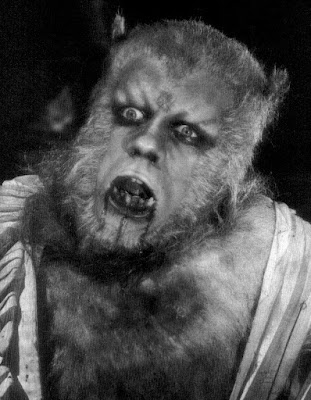
Many, many years ago when I was a small child I saw Abbot and Costello Meet Frankenstein (1948) on some local TV station. Although this movie is a very broad comedy, I was still really scared by the monsters in it, particularly by the Wolfman. I was probably five years old so maybe this is understandable, or maybe I was just a really cowardly kid. Regardless, the Wolfman was portrayed by Lon Chaney Jr., and his transformation from a mild-mannered human to a hirsute and ferocious monster terrified me.
Lon Chaney Jr. in Abbot and Costello Meet Frankenstein
He was also the most sympathetic of the movie's monsters, though, so I was also fascinated. Once I got over my fear of werewolves I learned to love stories about them. Sabine Baring Gould's The Book of Werewolves (1865) is a good source for European legends, as is Montague Summers's The Werewolf in Legend and Lore (1933). Both of those are easily available, but sadly, there isn't too much written about New England werewolves. Maybe that's because we don't have a lot of werewolves here, which could be a good thing depending on how you feel about ravening monsters.
The word werewolf comes from an Old English term, werwulf, or man-wolf, and refers to a human who can transform into a wolf. The reasons for this ability vary in old legends and include things like curses, deals with the Devil, or witchcraft. The idea that someone can become a werewolf after being bitten or scratched by one is a more recent pop culture innovation. Lycanthropy (the fancy term for werewolfism) was originally considered a moral condition, not an infectious disease.
There are lots of New England legends about people transforming into animals, but they're usually about witches, and witches don't like to change into wolves. Witches prefer to transform into more discrete animals like birds, cats, and even horses. It's easier to cause mischief that way. No one suspects an innocent-looking bird but people are pretty suspicious when a wolf shows up. Still, during the Salem witch trials Tituba confessed to seeing cats, birds and wolves in the company of witches, implying that these were either demons or witches in animal form.
That's not the only local connection between witches and wolves. There is also an obscure legend that one of Cape Ann's Dogtown witches, Daffy Archer, may have been a werewolf or had one at her command. You can read more about the Dogtown werewolf here.
Some of New England's other werewolf legends come from French-Canadian immigrants, who brought stories of the loup-garou with them from Quebec. A loup-garou is someone, usually male, who has signed a deal with the Devil and can transform into a wolf. They are scary and dangerous, but happily can be repelled by prayer and religious symbols, as this tale from Vermont shows.
Those stories are over a hundred years old, but I just read another werewolf account, and it's relatively recent. It appears in Albert Rosales book Humanoid Encounters: 2000 - 2009. According to Rosales, on December 16, 2008, four students in Pawtucket, Rhode Island decided to take a walk in the woods after finishing their exams. They followed an old waterway deeper and deeper into the woods. As they walked it became increasingly quiet.
Noticeably quiet. No birds. No squirrels. No breeze.
Scarily quiet.
The students suddenly became aware that they were not alone. Someone - or rather something - was in the woods with them. The creature was about six feet tall. It stood upright like a man, but had the head of a wolf. The students stood still in terror, petrified that the creature would approach them.
The wolf creature looked around, sensing it was not alone, but did not see the students. Finally it ran off further into the trees and was lost to sight. After waiting to make sure it was really gone the students left the woods. One of the witnesses was convinced the creature was a werewolf.
What did the others think it was if not a werewolf? Rosales's book doesn't say. It also doesn't include some details that would be useful, like how old the students were or their names. Still, I'm happy to find another local werewolf story to add to my collection. This reads like a classic paranormal encounter: the journey out of consensus reality into the woods, the eerie expectant stillness, the advent of a strange entity, and the return back to the normal world.
The moral aspects of older werewolf stories are missing here. There's no witchcraft or deal with the Devil. Instead, we just have some young folks who have an encounter with a monstrous being in the woods. The lesson is not a moral one, but rather an ontological one: there are still monsters lurking out in the trees.
Social distancing. It's the phrase on everyone's lips these days - and I hope those lips are hidden behind a mask. Maintaining a safe distance from others is one of the ways we can help end the COVID-19 pandemic.
Public health experts have been doing their best to spread the social distancing gospel, and they have an unusual ally helping them: Bigfoot. The ever-elusive cryptid has become the unofficial poster boy for social distancing.
It makes perfect sense. After all, have you ever been closer than six feet to a Sasquatch? Probably not. When someone gets too close to Bigfoot he runs away. Or maybe he throws a boulder. Either way, he doesn't want to catch COVID-19.
Shortly after the pandemic started in the U.S. I started seeing "Bigfoot: Social Distancing Champion" memes showing up in my social media. I don't know who first created it but the meme has really taken off this spring. Here are just a few samples:
You can buy "Bigfoot: Social Distancing Champion" tee-shirts online, and there is even a Bigfoot: Social Distancing Champion running challenge to benefit U.S. food banks. All participants run on their own, unlike traditional road races.
There are also quite a few videos out there. My favorite is this one from Gatorland, an alligator theme park outside of Orlando. The park's new mascot is Social Distancing Skunk Ape, which is the Florida term for Bigfoot. He's insistent you stay distant!
Bigfoot's social distancing even made news here in Massachusetts. In April, Brimfield resident Tod Disotell reported that a six-foot tall Bigfoot statue had been stolen from his front yard. Disotell, an anthropologist who has appeared on Spike TV's show 10 Million Dollar Bigfoot Bounty, had been adorning the statue with face masks and signs encouraging social distancing.
From Twitter
Disotell's statue became something of a local attraction, but was stolen the night of April 22. Security camera footage showed two hooded figures cutting a security chain before absconding with the statue. Happily, police located the statue a few days later in downtown Worcester. Bigfoot is now back in Disotell's front yard to encourage people to maintain social distancing.
People use the symbol of Bigfoot in all kinds of ways. Corporations put him in a lot of ads, but I find his non-commercial appearances more interesting. During the insanely snowy winter of 2015 (aka Snowmageddon), a Somerville, Massachusetts man in a Yeti costume became an internet sensation. In 2017, a marijuana leaf-covered Bigfoot gained brief fame as Pot Sasquatch. And last fall, a small Vermont town learned that construction on a bridge was delayed due to Bigfoot. The big monster doesn't usually say much but people find lots of ways to make this shy, quiet cryptid speak for them.
The real Bigfoot hasn't said anything about this current fame, but that's probably because he's out in the woods social distancing. He's setting a good example for all of us.
*****
Tune into Midnight Society radio this Thursday, June 18 to hear me talk with host Tim Weisberg about cryptids, witchcraft, and other weird New England themes. The show airs live from 10:00 pm - 1:00 am Eastern time. It will be a spooky good time!
I want to thank Simon Young and Chris Woodyard of the Fairy Investigation Society for telling me about the following bizarre story. Here's a trigger warning - there is sexual assault involved.
*****
Newspapers in 19th century America often printed some pretty outrageous stories. Publishers wanted to sell papers, and sometimes the stories that sold best were about weird supernatural phenomena, like this one about a family persecuted by goblins. The story, which was printed in the July 6, 1895 issue of The Cincinnati Enquirer, begins by describing an abandoned house in a village in Worcester County, Massachusetts. The house is "sadly dilapidated, with ragged roof and windows, in an inclosure, overgrown by brush and weeds, at the mercy of the elements, for nobody enters its creaking doors nor approaching it nearer than necessity demands. To old and young alike it is the abode of mystery and dread—of specters to torment and vanquish the strongest man!" Many years ago a family named Dane lived in the village. They were prominent members of the community with ancestry dating back to the Puritan era. The Danes lived a respectable and unremarkable life. One day Mrs. Dane was home alone with a servant when the crockery and dishes began to fall off the shelves. At first the two women were puzzled, but they grew scared once the dishes were thrown at them by invisible hands. Even the broken pieces on the floor flew about the room, cutting the Mrs. Dane and the servant. When the men of the family returned home that evening the poltergeist activity occurred again with greater ferocity, knocking over chairs, bureaus, and mirrors. Up until this point the story is a classic haunted house story of the kind that has been told in New England for centuries. But it gets weirder. The Danes decided to leave their house and stay with their neighbors, the Grahams. The weird phenomena follow them. The Grahams' house is filled with the sounds of wood being chopped, furniture breaking, and strange voices issuing threats. This goes on for a while, until one night during a thunderstorm all hell breaks loose.
During the storm the families' candles are mysteriously extinguished and the house is plunged into darkness. But the Grahams and Danes are suddenly not alone. Illuminated by flashes of lightning, they see that the house is filled with monstrous, foul-mouthed gnomes:
When lightning projected vivid flashes into every nook and corner of the Graham domicile it was found to be peopled with an innumerable multitude of gnome-like creatures, with large eyes and noses, perpendicular mouths, a superabundance of hair on heads and chins, and complexion of bright green. These monsters laughed grimly and made threatening gestures. As an evidence that they prided themselves upon their hideousness the most grotesquely hideous among them were the leaders of their orgies, and gave the word of command, supplemented by voluminous profanity (The Cincinnati Enquirer, July 6, 1895, p.6)
The Danes decide to leave the house, hoping that the hideous gnomes will follow them and spare the Grahams. The gnomes have other plans, though. All the members of both families find themselves unwillingly propelled into their beds where they are unable to move. Then - there's no other way to say this - the gnomes rape everyone.
Then began an orgy of grosser kind than can be risked in a description for the public eye. Truthfully might these devoted people have felt that “Hell is empty and all is devils here,” for in the bottomless pit no darker devilments are devised. The house was suddenly illuminated by phosphorescent gleams, making the green gnomes still greener, and at once their acts were of the grossest and most utterly indescribable obscenity. Those old tales of phallic orgies in Pompeii seem to have been rendered tame and semi-decent in comparison... (The Cincinnati Enquirer, July 6, 1895, p.6)
At one point the gnomes also whip their female victims with "illuminated wires" and two of the women "carried the marks of the devil’s flogging as long as they lived." Yikes!
The gnomes disappeared when the sun rose, but they returned to the house every time there was a thunderstorm to torment the Danes and Grahams. They turned bread into rats and meat into snakes. They threw a blood-like fluid onto people that caused festering sores, and threw real human blood on the walls, permanently staining them. The Danes and Grahams held a prayer meeting to exorcise the evil gnomes. The little monsters failed to appear during the next thunderstorm, but the Grahams' house was instead pelted with boulders that smashed the windows and lodged in the fireplace. During the same storm a "luminous apparition" also appeared in the sky, denouncing the Puritan witchcraft trials of the 1600s. The article ends inconclusively. The Dane house is destroyed by lightning and villagers see green gnomes dancing in the flames as it burns. The Graham house becomes abandoned and is eventually destroyed. But it's not clear what happens to the two families or the gnomes, or even which haunted house is being referenced at the start of the story.
There's a lot to think about here. It's interesting that the story appeared in an Ohio newspaper. If it had appeared in a Massachusetts paper readers would have wanted more details, like the village's name or the years when it happened. They would also have suspected it wasn't true. But perhaps to an Ohio reader Massachusetts was a distant land where people used to hang witches and weird things happened*, or at least a place where people told strange stories like this one. Parts of Ohio were settled by New Englanders, so it makes sense that a story like this appeared in The Cincinnati Enquirer. And some aspects of it do seem authentically New Englandy to me, like the poltergeist activity (which has been reported in this region for more than 300 years) and the connections to the Puritans and the witch trials which are alluded to. The weirdest part of the story obviously is those evil, hyper-sexualized green gnomes. There are plenty of local stories about fairies and other Little People, but nothing like this one. I'm going to assume they came from deep inside the author's imagination. At least I hope so. *OK, both of those are true.