Showing posts with label little people. Show all posts

June 11, 2023

Strange and Stranger: Some American Fairy Encounters

I had the day off today, and spent some time organizing my books. As I was moving my musty tomes around I picked up Fairies: Real Encounters with Little People by Janet Bord, something I haven't looked at in a few years. Published in 1997, Fairies gives a nice overview of fairy lore and encounters from around the world. 

Although much of the book deals with the Ireland and Great Britain, Bord does devote a chapter to fairies from other places. The chapter is evocatively titled "Dwarfs, mummies, and little green men: Little People around the world." Bord discusses some interesting fairy encounters from the United States in the chapter. Here are a few of my favorites, in increasing order of strangeness.  

STRANGE: In the 19th century, a young man in Snowhill, Maryland, was wooing a young woman who lived in the nearby town of Pocomoke. One night he discussed marriage with her, but they argued because she was not really keen on the idea. As he rode away from her house in his wagon, the man noticed something strange. A little man wearing a green plaid jacket and yellow necktie stood near the woods. The little man smiled but didn't speak, even when the young man tried to start a conversation. Unnerved, the young man whipped his horses and rode off. Even though the horses were galloping at a good speed, the little man in green ran after the wagon and caught up to it. He ran next to the wagon, smiling maniacally at the young man. The little man disappeared once the wagon left Pocomoke. The young man believed the strange occurrence was an omen, warning him away from the young woman. He stopped seeing her and eventually married someone else. 

STRANGER: In an undated encounter from the Morongo Valley of California, a man was driving his truck when a little green man ran into the road. He braked and came to a sudden stop. As he sat in the truck, trying to figure out what he had just seen, he heard a noise coming from underneath his truck. He got out and saw that the little green man was trying to remove a protective metal plate near the radiator. The man got back in his car, drove to a nearby friend's house, and wired the plate back in place. The next day he found the screws lying in the road where the little green man had removed them. 

STRANGEST: The weirdest story comes from Farmersville, Texas. In 1913, a boy named Silbie Latham and his two brothers were out cutting cotton when their dogs started barking wildly. The boys ran to see what was upsetting the dogs.

What they found was a little man about eighteen inches tall, and dark green in colour. He wasn't wearing any clothes, but his body looked like a rubber suit, including a hat that looked like a 'Mexican hat.' As the boys looked on, the dogs jumped on the little man and tore him to pieces. The boys saw that he had human-looking internal organs, and red blood. Afterwards, the dogs avoided the spot where the remains lay rotting in the sun, and they seemed frightened. Next day, when the boys went to the place again, there was nothing to be found, not even a bloodstain (Janet Bord, Fairies: Real Encounters with Little People (1997), p.71)

Many years later, in 1978, Silbie Latham told his story to a staff person at the Fort Worth Museum of Science and History. The staff person said that Latham clearly believed the story to be true, and rejected the staff person's suggestion that the little green man had just been a large frog. 

That's really an insane story, right? Things must be bigger and weirder down in Texas, because Bord does include a few stories from Massachusetts in the book, but they're not nearly as crazy as that one. For example, she discusses the Dover Demon, the infamous humanoid cryptid seen in Dover, Massachusetts on April 21 and April 22, 1977 by several teenagers. The first person to see the creature was Bill Baxter, age 17, who was driving down a wooded road with two friends. He saw a creature that looked like this:

That drawing is the actual one Bill made that night. He claimed he saw a creature about the size of a baby, with long spindly limbs and fingers that wrapped round the rocks. Its eyes glowed bright orange in the car headlights. His two friends did not see the creature, but three other teenagers did, including John Baxter, age 15, who was walking home from his girlfriend's house. Baxter drew the following picture:

The creature was dubbed "The Dover Demon" by cryptozoologist Loren Coleman, and the name stuck. The Dover Demon has become pretty famous, and is one of those creatures that has never really been pigeon-holed or satisfactorily categorized. Was it one of the Little People, as Janet Bord suggests? Was it an extraterrestrial creature of some kind? Or was it all just a hoax? There's no clear answer, and no one saw the Dover Demon again. 

Janet Bord includes a couple other encounters from Massachusetts, and unlike the Dover Demon they involve beings that are more obviously fairies. In the spring of 1974, teenaged Jane Woodruff was walking to high school in Lexington with a friend when they saw something - or rather someone - sitting in patch of weeds on the side of the road. It was a leprechaun.

'Did you see that?' we exclaimed in unison. Surprisingly enough, we both described the leprechaun the same way: green clothes, a long thin curved golden pipe between his lips and a flopped-over conical cap (Janet Bord, Fairies: Real Encounters with Little People (1997), p.73) 

A year later, Woodruff and a friend named Orin saw hundreds of small fairies dancing in a field of blue wildflowers in the town of Ashby. The fairies were only around 5 inches tall. Although the thought of encountering hundreds of fairies is a little unnerving - what if they swarm you? - Woodruff's stories are very gentle compared to the others.

In Fairies, Bord evaluates the many possible theories about what fairies might be. For example, some people think they are really extraterrestrials, some think they are the remnants of an earlier and smaller human race, and others theorize they could perhaps be the spirits of the dead. Bord reviews all the different theories, and concludes that there's really no strong evidence for any of them. And yet people still continue to encounter them, in stranger and stranger ways. 

September 29, 2021

Book Review: Mythical Creatures of Maine

If you ever find yourself in the lonely woods of far northern Maine, be careful going out at night. According to legends, headless giants are sometimes seen wandering the roads in the darkness. Are they dangerous? Probably, but no one has ever gotten close enough to one to find out. No one has been that brave - or that stupid. 

I hadn't heard about the headless giants of Maine until I read Christopher Packard's Mythical Creatures of Maine, which was recently published by Down East Books. Mythical Creatures is a handsome little hardcover book, with full-color illustrations, that describes dozens of strange and wonderful creatures from Maine folklore. The publisher sent me a copy to review, but it was too late - I had already bought a copy for myself. 


Some of the creatures described in this book will definitely be familiar to you, like mermaids (seen in Casco Bay in 1639) and Bigfoot (seen since at least the 1950s, and probably much earlier). Others might be moderately familiar, like the loup-garou, the French-Canadian werewolf, or the Turner Beast, aka the Maine mutant, a strange dog-like animal that was hit by a car in 2006. And some will be downright obscure, like the dungavenhooter, a mouthless crocodile that appeared in tall tales told by lumberjacks. Or those headless giants that roam around at night. 

Packard includes quite a few creatures from the tall tales of lumberjacks and other woodsmen. These are creatures like the aforementioned dungavenhooter or the wamfahoofus, a one-armed monster that lurks in muddy puddles and likes to eat boots. I don't know if anyone really ever believed in these "fearsome critters of the lumber woods," and they may just have been jokey explanations for things like losing your boot in a big mud puddle. Still, they're interesting to read about.

Packard's book is arranged like an encyclopedia or dictionary, with entries for the different creatures listed in alphabetical order, and it's fun to browse through descriptions of creature like the Ice Hornet or Will-O-The-Wisp. But Mythical Creatures also explains which cultures these creatures originated from, like the indigenous Wabanaki tribes, the French, and the English. (Note: legends about the headless giants come from the Maliseet, a Native American tribe found in Maine and New Brunswick). 

An appendix at the end of the book gives a brief but helpful overview of Wabanaki languages and culture, topics probably new to some readers, and Packard describes many creatures and beings from Wabanaki mythology in the book, including Pamola, the guardian spirit of Mt. Katahdin, various little people like the river-dwelling manogmasak and the forest-dwelling mikumwesuk, and the fearsome man-eating giants known variously as the wendigo, chenoo, or kiwakw
Much like the headless giants, you don't want to meet a wendigo.

I would recommend this book for anyone who likes folklore, New England history, or even just stories about monsters. So really, probably most people who read this blog!

*****

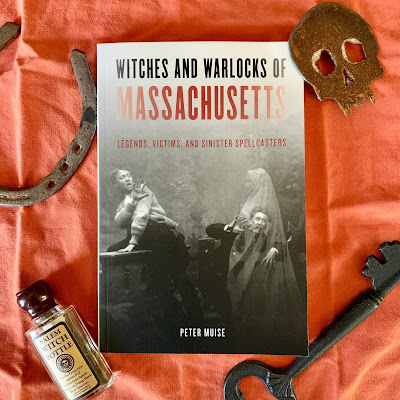
Speaking of books, I will give a shameless promotion for my own new book, Witches and Warlocks of Massachusetts. I've been appearing on a lot of podcasts recently; I was recently on the Weird Tales radio show, which was a lot of fun. 

Witches and Warlocks of Massachusetts is available wherever you buy books online!


May 18, 2020

Orgiastic Gnomes Terrorized a Massachusetts Family in 1895

I want to thank Simon Young and Chris Woodyard of the Fairy Investigation Society for telling me about the following bizarre story. 

Here's a trigger warning - there is sexual assault involved. 


*****

Newspapers in 19th century America often printed some pretty outrageous stories. Publishers wanted to sell papers, and sometimes the stories that sold best were about weird supernatural phenomena, like this one about a family persecuted by goblins. 

The story, which was printed in the July 6, 1895 issue of The Cincinnati Enquirer, begins by describing an abandoned house in a village in Worcester County, Massachusetts. The house is "sadly dilapidated, with ragged roof and windows, in an inclosure, overgrown by brush and weeds, at the mercy of the elements, for nobody enters its creaking doors nor approaching it nearer than necessity demands. To old and young alike it is the abode of mystery and dread—of specters to torment and vanquish the strongest man!"

Many years ago a family named Dane lived in the village. They were prominent members of the community with ancestry dating back to the Puritan era. The Danes lived a respectable and unremarkable life. One day Mrs. Dane was home alone with a servant when the crockery and dishes began to fall off the shelves. At first the two women were puzzled, but they grew scared once the dishes were thrown at them by invisible hands. Even the broken pieces on the floor flew about the room, cutting the Mrs. Dane and the servant. When the men of the family returned home that evening the poltergeist activity occurred again with greater ferocity, knocking over chairs, bureaus, and mirrors. 

Up until this point the story is a classic haunted house story of the kind that has been told in New England for centuries. But it gets weirder. 

The Danes decided to leave their house and stay with their neighbors, the Grahams. The weird phenomena follow them. The Grahams' house is filled with the sounds of wood being chopped, furniture breaking, and strange voices issuing threats. This goes on for a while, until one night during a thunderstorm all hell breaks loose. 


During the storm the families' candles are mysteriously extinguished and the house is plunged into darkness. But the Grahams and Danes are suddenly not alone. Illuminated by flashes of lightning, they see that the house is filled with monstrous, foul-mouthed gnomes: 


When lightning projected vivid flashes into every nook and corner of the Graham domicile it was found to be peopled with an innumerable multitude of gnome-like creatures, with large eyes and noses, perpendicular mouths, a superabundance of hair on heads and chins, and complexion of bright green. These monsters laughed grimly and made threatening gestures. As an evidence that they prided themselves upon their hideousness the most grotesquely hideous among them were the leaders of their orgies, and gave the word of command, supplemented by voluminous profanity (The Cincinnati Enquirer, July 6, 1895, p.6)

The Danes decide to leave the house, hoping that the hideous gnomes will follow them and spare the Grahams. The gnomes have other plans, though. All the members of both families find themselves unwillingly propelled into their beds where they are unable to move. Then - there's no other way to say this - the gnomes rape everyone. 


Then began an orgy of grosser kind than can be risked in a description for the public eye. Truthfully might these devoted people have felt that “Hell is empty and all is devils here,” for in the bottomless pit no darker devilments are devised. The house was suddenly illuminated by phosphorescent gleams, making the green gnomes still greener, and at once their acts were of the grossest and most utterly indescribable obscenity. Those old tales of phallic orgies in Pompeii seem to have been rendered tame and semi-decent in comparison... (The Cincinnati Enquirer, July 6, 1895, p.6)

At one point the gnomes also whip their female victims with "illuminated wires" and two of the women "carried the marks of the devil’s flogging as long as they lived." Yikes!


The gnomes disappeared when the sun rose, but they returned to the house every time there was a thunderstorm to torment the Danes and Grahams. They turned bread into rats and meat into snakes. They threw a blood-like fluid onto people that caused festering sores, and threw real human blood on the walls, permanently staining them. 

The Danes and Grahams held a prayer meeting to exorcise the evil gnomes. The little monsters failed to appear during the next thunderstorm, but the Grahams' house was instead pelted with boulders that smashed the windows and lodged in the fireplace. During the same storm a "luminous apparition" also appeared in the sky, denouncing the Puritan witchcraft trials of the 1600s. 

The article ends inconclusively. The Dane house is destroyed by lightning and villagers see green gnomes dancing in the flames as it burns. The Graham house becomes abandoned and is eventually destroyed. But it's not clear what happens to the two families or the gnomes, or even which haunted house is being referenced at the start of the story. 


There's a lot to think about here. It's interesting that the story appeared in an Ohio newspaper. If it had appeared in a Massachusetts paper readers would have wanted more details, like the village's name or the years when it happened. They would also have suspected it wasn't true. But perhaps to an Ohio reader Massachusetts was a distant land where people used to hang witches and weird things happened*, or at least a place where people told strange stories like this one. 

Parts of Ohio were settled by New Englanders, so it makes sense that a story like this appeared in The Cincinnati Enquirer. And some aspects of it do seem authentically New Englandy to me, like the poltergeist activity (which has been reported in this region for more than 300 years) and the connections to the Puritans and the witch trials which are alluded to. 

The weirdest part of the story obviously is those evil, hyper-sexualized green gnomes. There are plenty of local stories about fairies and other Little People, but nothing like this one. I'm going to assume they came from deep inside the author's imagination. At least I hope so. 

*OK, both of those are true. 

January 21, 2019

Two Encounters with Pukwudgies in Lawrence, Massachusetts

One of the nice things about writing this blog is that sometimes people share strange stories with me. Last week someone I'll call Miss S. wrote and told me about some unusual things that happened to her family thirty years ago. She said I could share them so here they are.

The first incident happened to Miss S.'s brother Bob. He was just a child at the time (maybe seven or eight years old) and was watching TV with some cousins at his grandparent's house in Lawrence, Massachusetts. They were sitting on the couch, which faced the TV but had its back towards a doorway into another room.

As they sat there watching TV Bob felt someone pull on the back of his hair. He thought it was his cousin Sandra and he told her to stop. Sandra denied pulling his hair. A few seconds later he felt it again. Again he yelled at his cousin, who still said she didn't do it. A few more seconds passed and Bob once again felt someone tug on his air.

He turned around angrily, expecting to see one his cousins hiding behind the couch. But his anger turned to surprise when he saw who was there. Instead of a cousin, he saw a little old lady with long white hair. And when I write little, I mean quite small - she was only two or three feet tall. When she saw Bob looking at her she quickly started to run towards the front door of the house. She disappeared into thin air before she reached it.

Bob was understandably surprised by this, but when he blurted out what he had seen his grandmother told him not to worry about it. "Don't worry," she said. "They're friendly.'

The second incident occurred one day when Bob's mother took him and his cousins, including Sandra, out to the movies. After the movie was over they returned to their grandparents' house. The door was locked. No one was supposed to be home so they were surprised to see through the window that a lamp was on in the living room. Sandra peered through the window to see if she could see her grandparents. She jumped back from the window and screamed "I am getting the f***k out of here!"

Bob's mother stepped up to the window and looked inside. She saw a very short old man with long white hair run out of the living room. She gathered the kids together and they quickly left.


Miss S. says that her brother and mother still talk about these two incidents. They say that in retrospect they should have known something odd was happening in the grandparents' home. They would sometimes find the tin of coffee opened and spilled onto the floor, and bottles of Coke stored in the attic opened and half drunk. When asked about these things the grandparents would just shrug and say they had rats, but can rats take the metal caps off glass bottles?

In her email Miss S. wrote that she thought these were encounters with pukwudgies, the magical little people from local Native American lore. The beings her family members saw were short, fast and had very long hair, which certainly matches some of the descriptions from local Algonquin lore. That lore also describes them as being mischievous but shy, which matches these two encounters.

It's important to note that historically Native American lore from New England includes a wide variety of little people known by many names. It was only in the late 20th and early 21st century that pukwudgie, a word of Ojibwa origin, has become widely used to describe them. I use it because it is a convenient term that people are familiar with.

I think it's also important to point out that Miss S.'s grandparents, mother, and brother are of Mi'kmaq heritage. The Mi'kmaq are a Native American group originally from Canada's Maritime provinces and parts of Maine. Mi'kmaq legends tell of small beings called the wiklatmuj or pukulatmuj. They enjoy playing tricks, including tying knots in people's hair. Was this what the old woman was trying to do to  Bob? 

It seems possible that since the grandparents were Mi'kmaq they weren't worried about having the little people in their house. They understood that they were just part of life. A family of European descent unfamiliar with these beings would probably have called an exorcist!

Most local Native American groups tried to foster good relationships with the pukwudgies. Like any neighbor, they could be malicious when treated poorly and helpful when treated right. Miss S. says she has never seen the little people herself, but when she moves to a new house she always does something her mother taught her. She leaves a small spice cake on the back steps the first night she moves in. She says her house is peaceful and her garden very productive.

It may seem strange that pukwudgies would appear in someone's house since they are usually associated with woods and forests. The grandparents' house was in an urban part of Lawrence, so it was definitely not a rural environment. However, I have found at least two other cases where a small, fairy-type being has appeared in someone's home. In one case, a house in Somerville was allegedly haunted by a troll. I've also read about a house in Weymouth that might have been inhabited by a mischievous pukwudgie. Are some accounts of haunted houses actually caused by pukwudgies instead of ghosts? That's probably an unanswerable question.

June 27, 2016

Little people and swamp spirits in Vermont

So we had beautiful summer weather this past weekend. The sun was shining, the birds were singing, and there wasn't a cloud in the sky.

I suppose I should have gone out roaming through the woods looking for monsters or exploring historic old cemeteries (or maybe just going to the beach), but instead I decided to update the blog. Hopefully those of you out roaming through New England will find this week's information helpful, particularly if you are in Vermont.

Over the last year or so I've been researching the various fairies that make their homes in New Enlgand, and I realized I didn't have much information about Vermont. With it's rounded Green Mountains and dense woods I knew there had to be some fairies living up there!

There is a little bit of information floating around on the web, but I found a decent written source in William Haviland and Marjory Power's The Original Vermonters (1981), a book which summarizes anthropological and historical information about the Abenaki. The Abenaki were the Indian groups who lived in Vermont before the Europeans came, and who still live there today.

Haviland and Power describe quite a few mythical beings, but two of them seem particularly fairy-like. One of them is called simply "the swamp spirit" or "swamp creature." The swamp spirit was seldom seen, but could often be heard crying from the swampy areas where it lived. Lone travelers were the most likely to hear the creature's cries.

The authors claim this being was "more mischievous than malevolent," but then go on to say it liked to lure children into swamps where it either kept them forever or just outright killed them. This sounds malevolent to me, and it did to Abenaki parents as well, who warned their children to stay away from swamps. I've tried to avoid swamps most of my life - too many mosquitoes - and now I have one more good reason!

Me looking at a swamp. Stay away!


The other fairy-like creature Haviland and Power discuss are the Manogemassak, a name which they translate simply as "Little People." Happily these beings are much less malevolent than the swamp spirit.

The Manogemassak live in rivers and tend to avoid humans as much as possible. This is easy for them to do because of their unique anatomy. The Manogemassak are incredibly narrow, and their faces are described as being as thin as an axe blade. They are so thin that they can only be viewed in profile, not when faced head on. This makes it quite hard for humans to see them.

The Manogemassak also travel in stone canoes, and when humans approach they will submerge under water like a submarine. Stone canoes don't sound practical, but they work just fine if you are a magical being, and they feature in several American Indian myths from New England. For example, the gigantic culture-hero Glooskap was said to travel by stone canoe.

Although the Manogemassak are quite hard to see their handiwork is easy to find, particularly near Button Bay on Lake Champlain. The shores of Button Bay are littered with small round stones which the Manogemassak allegedly make (and which give the bay its name).

The website Native Languages includes a little more information about the Manogemassak. For example, it notes that they sometimes make small clay sculptures that look like animals or people. Finding one of these is considered lucky. The site also claims that geometric markings on rocks indicate a dwelling of the Little People, and that curious humans should stay away.

So, in summary, stay away from swamps and away from rocks with odd markings. Helpful advice for safely enjoying summer outings in the New England woods!

January 10, 2016

The Little People with the Deadly Stare

This post is probably better suited for Lent, but I thought I would share it now because it is also a little bit spooky, and seems appropriate for a rainy gloomy Sunday like today. So here goes!

*****

The Passamaquoddy Indians live in northern Maine on the Canadian border. They dwell primarily in two areas, Indian Township in Princeton and Pleasant Point Reservation in Perry. Many Passamaquoddy also dwell in Canada across the border, which was drawn through their ancestral lands centuries ago.

Most Native American folklore from New England is full of interesting supernatural beings, and Passamaquoddy lore is no different. Their stories tell of demi-gods, thunderbirds, and talking animals. They also tell of magical little people.

The Passamaquoddy claim there are two types of little people associated with their tribe. The first are the Nagumwasuck, who live alongside the Passmaquoddy on their reservation and have a society that parallels the human one. When a human dies the Nagumwasuck mourn. When a human baby is born the Nagumwasuck celebrate. When a church was built on one of the reservations the Nagumwasuck made a tiny version of their own.

Although they are hideously ugly and don't like to be seen, the Nagumwasuck overall are benevolent. Not so their cousins the Mekumwasuck. The Meckumwasuck are quite short (about three feet tall) and have extremely hairy faces. They live in the woods outside human society and dress in outlandish clothing. Overall this doesn't sound so bad, but here's the kicker: anyone the Mekumwasuck looks directly at will sicken and die.

Yikes.

The Passamaquoddy converted to Catholicism centuries ago, and apparently the Mekumwasuck converted along with them. These dangerous creatures now watch over the church, and will punish anyone who tries to violate the Catholic Church's rules.

For example, back in 1970 several men broke into a Passamaquoddy church to steal the sacramental wine. This was a bad idea. The Mekumwasuck appeared and chased off the men, who were terrified. One of the would-be-thieves tried to escape through a window but got stuck. The little people beat him until he broke through the window and ran off into the night.

Even minor infractions can draw the attention of the Mekumwasuck. In 1971 the local priest gave the community permission to hold a dance in the church - even though it was Lent. (If this were a horror film the ominous music would play.) People were uneasy because dancing during Lent didn't sound quite orthodox, but about seventy-five people still came out for it.

Shortly after the dance started a teenage boy nervously said the thought he had seen a Mekumwasuck lurking nearby. He asked his cousin if he could see it. At first the cousin refused to look, fearing the entity's deadly stare, but finally worked up his courage and looked. He too saw the Mekumwasuck.

Clearly this was a bad omen. Within minutes everyone fled the dance. Happily no one died that night, but if they had not heeded the Mekumwasuck's warning who knows what might have happened? It was the last time anyone tried to hold a dance during Lent.

*****

I first read about the Mekumwasuck in Joseph Citro's book Passing Strange (1996), but it seems like the story originally appears in Katharine Briggs's A Dictionary of Fairies (1976). The Passamaquoddy information is one the few New World sections in Briggs's book, which covers mostly European fairy lore.

Interestingly, Briggs claims she was given the information by Susan Stevens, an anthropologist who married into the Passamaquoddy. Stevens was actually serving as a chaperone at the Lenten dance that ended so abruptly. That means that story actually happened and is not just a traditional tale handed down over time.

Briggs suggests that the Mekumwasuck are basically European gargoyles adopted into a Native American culture, but I think she has it backwards. Native Americans in New England already had traditions about magical little people well before the Europeans arrived, and these traditions changed based on the situations the different tribes found themselves in.

For example, while the Mekuwasuck kill anyone who desecrates the Catholic Church, the similarly-named Makiwasug of Mohegan folklore are less malevolent and less focused on Christianity. While the Makiawasug also do not like being looked at they will not kill anyone who sees them, but instead will simply steal their belongings. Sometime in the past the Passamaquoddy and the Mohegan probably shared similar beliefs about the little people, but those beliefs have diverged over time based on their subsequent histories.

June 29, 2014

The Little People Who Live Under the Hill

In September of 2012, a developer trying to build housing in Montville, Connecticut received some surprising news during a town hearing. They would need to alter their project because it threatened small stone structures that had been made by magical, dwarf-like creatures that lived underground.

Readers may be familiar with situations like this from Iceland, where construction projects are not allowed to harm the dwelling places of elves. But they are rare here in New England, where most people don't believe in fairies, elves, and dwarves. (Bigfoot, ghosts, and UFOs are another story...)

However, magical little people are an ancient tradition among the Algonquian tribes that are native to this area, and the developer was planning to build 120 units of housing on Mohegan Hill, which is the historic and spiritual home of the sovereign Mohegan Tribe. Although the hill is not technically within the boundaries of the tribe's reservation, it is still very important to them. A letter from the tribe's historic preservation officer explained the significance of the stone structures:

-->
The sacred stone piles on Mohegan Hill are a critical feature of the traditional landscape of Mohegan Hill; they were created by the “Little People” who live deep within the ground of Mohegan Hill. These “Little People” or Makiawisug are the ancient culture heroes of this region. These stone piles also possess powers that protect the Mohegan people from outsiders. Not only do the “Little People” still live within the ground on the Hill and continue to guard the stones, these stone piles are perceived as being made of the bones of Mother Earth and they contain messages that guide generation after generation of Mohegan People. Contemporary Mohegan tribal members make offerings to the “Little People” in hopes that they will continue to protect our Tribe.

The Makiawisug are similar in some ways to the fairies or dwarves that are familiar to people from European folklore. According the Mohegan medicine woman Gladys Tantaquidgeon (b. 1899, d. 2005), the Makiawisug are ancient beings who have lived under Mohegan Hill since before the Mohegans arrived. They are dense, bulky and born from the stones of the earth. But they are also delicate, wearing lady slipper flowers as moccasins. The Makiawisug are often mistaken for small children on the rare occasions they are seen by humans, but are quite wise. Many medicine people among the Mohegan learned their skills from the Makiawisug.

Photo of Gladys Tantaquidgeon from Wikipedia.
Tantaquidgeon learned four important tips about the Makiawisug from her elders:

1. If you come upon one of the Makiawisug, do not look directly at him. If you look directly at the Little People they will point their finger at you, which allows them to become invisible. Once invisible they will secretly enter your home and steal your possessions. 

2. To get help from the Makiawisug, leave them offerings. They prefer baskets of cornbread and berries, but sometimes they will also accept meat.

3. Never speak about the Makiawisug during the summer. This is the season when they are most active and wandering through the woods. They will be offended by overhearing your comments and you don't want to offend them. (See #1 above.) I realize I am publishing this post in the summer and it may incite discussion. Maybe you can think of it instead as a warning to avoid discussing the Little People, particularly if you are out in the woods. 

4. The Makiawisug are led by Granny Squannit, a very powerful and ancient being. Stay on her good side! Granny Squannit is most likely the modern name for Squauanit, a goddess who was one of the thirty-seven deities revered across southern New England by the Algonquians. 

These four rules come from the book Medicine Trail: the Life and Lessons of Gladys Tantaquidgeon by Melissa Jayne Fawcett. I think it's quite interesting that some of them are similar to rules about interacting with fairies from Europe. For example, in Europe fairies are said to be most active around the summer solstice, and Europeans who believe in fairies often don't speak directly about them for fear of offending them. In many parts of Europe it was also traditional to leave out offerings for the fairy folk, who often were said to live inside certain hills with their queen.

I suppose if you are historically minded you might say the Mohegan picked up some European traditions from English settlers and added them to their original Makiawisug beliefs. If you're feeling a little more metaphysical, perhaps you'd say that although European fairies and Mohegan Makiawisug are different beings, magical beings across the world still share a lot of similar traits.

But whatever you say about the Makiawisug, try not to say it during the summer, and certainly not if you're walking through the woods!

PS - The information about the housing developer and the stone structures is online here.