Showing posts with label Horace Beck. Show all posts

April 18, 2021

Rats, Cats, and Death: Horror on Haskell Island

Haskell Island is located off the coast of Harpswell, Maine. It's a small island, and apparently has no full time residents these days, just vacation homes. It looks quite idyllic, but like many quaint New England locales Haskell Island has a strange past. 

According to legend, the island was first colonized by the two Haskell brothers, way back in the 1600s. The Hakells were very industrious and transformed the island into an agricultural paradise. They planted an orchard, plowed the land into fertile fields, and fished in Casco Bay. The brothers prospered in their little Eden. 

Unfortunately, one day they accidentally brought some rats to the island in their boat while transporting supplies. Haskell Island had everything the rats could want: food, water, places to nest, and no predators. The rats multiplied rapidly and soon threatened the brothers' livelihood.
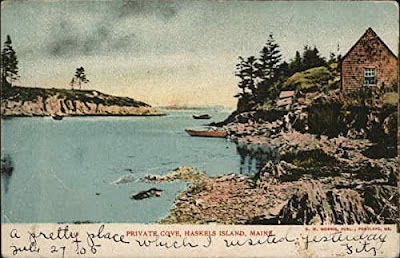
Antique Haskell Island postcard from Amazon. "A pretty place which I visited yesterday..."

To stop the rats, the Haskell brothers brought a couple of cats to their island. The brothers didn't provide any food for the cats and expected them to survive by killing rats. The cats met their expectations. They ate rats, and there were so many rats that the cats thrived and multiplied. Soon there were more cats than rats, and eventually there were no rats left at all, just an island full of hungry cats. 

The cats roved the island, howling with hunger. They climbed the apple trees, roamed the fields, and paced the shore, looking for something to kill and eat. 

The Haskell brothers had to do something about the ravenous felines, but something happened before they could devise a plan: one of them became sick. He fell seriously ill, so his brother took the boat and went to the mainland to get a physician. "Hurry back," the sick brother said weakly as he lay in bed. 

Can you see where this is going? An island full of hungry cats, an incapacitated man lying weak and helpless in bed? When the healthy brother returned to the island, he and the physician were horrified by what they found inside the Haskells' house. The sick brother had been ripped to shreds, and the cats were tearing the last morsels of flesh from his body. At last their hunger was sated. 

*****

It's a simple little story, but really resonates with me. It appears in Horace Beck's 1957 book The Folklore of Maine. The Maine Encyclopedia says Haskell Island was named for a Captain Haskell who purchased, but never lived on, the island, so I don't think the man-eating cat story is true. Still, it has the power of a good horror movie, and reads like an environmentalist fable. The brothers try to master the island, but end up doomed by their own actions and the invasive species they brought to the island. 

It reminds me of "Bart the Mother," a 1998 episode of The Simpsons where Springfield is overrun by ravenous lizards. At first people are happy because the lizards eat all the pigeons, but then realize they'll need to import snakes to eat the lizards, and then gorillas to eat the snakes...


Horace Beck notes that there is a coda to the story. According to some people, the sick brother was not killed by cats, but by pirates. He had seen the pirates burying their treasure on Haskell Island, and they killed him to keep their secret safe. Then they made it look like the cats had done it to deflect attention. I don't find that explanation quite as compelling, though. The story is structured like a version of "I Know an Old Lady Who Swallowed A Spider," and randomly introducing pirates just doesn't make sense. 

February 20, 2015

Matinicus Rock Light: A Ghost Behind Closed Doors

I'll be busy this weekend so I'm publishing my blog post a little early. Enjoy!

*****

Here's a nice little ghost story from Horace Beck's 1957 book The Folklore of Maine. While researching the book Beck visited various locales around Maine, including the lighthouse on Matinicus Rock, which is located about five miles from Matinicus Island in Penobscot Bay.

Matinicus Rock isn't very big (only about 30 acres), but there has been a lighthouse on it since 1827. For many years there were two towers with lights, one each on the north and south ends of the building. When Beck visited only the south light was in use. The north tower had been decommissioned and the door was locked tight.


Beck asked the Coast Guard crew who manned the lighthouse why the north tower was locked. Their answer: to keep the ghost inside.

They told Beck that many years ago a lighthouse keeper had hanged himself in that tower, and since that time his spirit could be heard roaming through the tower on dark, windy nights. The ghost also broke dishes, slammed doors, and made equipment malfunction. The crew on the island learned the only way to control the ghost was to keep the north tower door locked. For some reason, the ghost wouldn't pass through the locked door.

A few years prior to Beck's visit a Coast Guard officer had come to Matinicus Rock for an inspection. When he heard the ghost story he demanded that the crew abandon their superstitious nonsense and unlock the door. They did as they were ordered, and that night all the lights on the island failed. The crew once again locked the door to the north tower and the lighthouse hadn't seen any trouble since.


Beck couldn't find any record of a suicide at that lighthouse, but the Coast Guard crew was quite adamant about there being a ghost. The ghost story continued until at least the 1970s, when men stationed on the island claimed a strange light could be seen coming from the abandoned north tower on dark nights. They believed the light was the ghost of a lighthouse keeper who had killed himself. The crew nicknamed the ghost Moe.


Matinicus Rock light was automated in 1983 and has been unmanned since then, at least by the living. I suppose the ghost is still out there.

*****

I like the idea that you can contain a ghost by locking the door. It seems appropriately symbolic, and reminds me of those Japanese horror films like The Grudge where ghosts were sealed behind doors with masking tape. But was (is?) Moe even really a ghost? There is no record of any suicides on the island so maybe the ghost is really some other spirit that likes lonely lighthouses. Skeptics might say the Coast Guard crew just made the story up, but personally I will withhold judgement until I spend a dark night alone out on Matinicus Rock.

I found the two lighthouse images on this great sight devoted to New England lighthouses. Good stuff!

December 30, 2014

Weeping Turtles and Flying Souls: John Josselyn's World of Wonders

Sometimes when I read some weird old text or strange witchcraft narrative, I think, "Did the world operate by different rules in the past? This doesn't sound like the one I live in."

I first read about the concept of the past having different rules in John Crowley's book The Solitudes, the first in his fantasy fiction quartet Aegypt. The Solitudes tells how an unemployed historian named Pierce Moffet becomes stranded the small town of Blackbury Jambs. Moffet is hired by a wealthy resident to write a biography of a local writer of historical fiction. But as Pierce researches the writer's life, he begins to question whether the laws of physics and reality have been stable across time. Perhaps, he thinks, there was a time when magic really did work and the world was stranger than it is now.

The book that most recently brought this idea to my mind is non-fiction: John Josselyn's An Account of Two Voyages to New England (1674). Not much is known about Josselyn, an Englishman who traveled to New England in 1638 and 1663. His life story is unknown, but in addition to An Account, he also wrote New-England's Rarities Discovered (1672). Both books contain extensive lists of New England flora and fauna, and historians speculate that Josselyn may have been trained as a surgeon. But although he was interested in science, sometimes the New England he describes just doesn't sound like the one we live in.

For example, he describes a deer-like animal called a maccarib, which has two horns "growing backwards along their backs to their rumps" with "another horn in the middle of their forehead, about half a yard long, very straight but wreathed like a unicorn's horn..." I don't think there are any three-horned deer in North America, or ever were. He also tells how the local Indians would pick up a live rattlesnake with one hand, strip off the flesh with their teeth, and eat the snake whole. It sounds unbelievable, but then again he also claims the Indians spoke in rhymed verse and that his English neighbors in Maine encountered angry mermen, ghosts, and a ship crewed by female witches.


Josselyn makes our region sound like Narnia or Wonderland, and the ocean was just as strange as the land. Here's something Josselyn experienced on his trip across the Atlantic from England:

July the Sixth: Calm now for two or three days, our men went out to swim, some hoisted the shallop (a small boat) out and took diverse Turtles, there being an infinite number of them all over the Sea as far as we could ken, and a man may ken at sea in a clear air 20 miles. They floated upon the top of the water being asleep, and driving gently upon them with the Shallop, of a sudden they took hold of their hinder legs and lifted them into the boat... When they were brought aboard they sobbed and wept exceedingly, continuing to do so till the next day that we killed them, by chopping off their heads.

I do believe that animals feel emotions and fear, but I don't think that turtles can shed tears and sob. Maybe sometimes their eyes might get runny, but that's not what Josselyn is describing. He's describing a boat full of sad turtles crying because they know their going to be eaten. I'm reminded of the talking animals that fill fairy tales and children's books.

I don't find myself believing all Josselyn's tales, but they are still compelling. Did the world really operate by different rules in the 1600s? Maybe, but maybe he's just describing how the world should be, or how the world feels. After all, I'm sure turtles don't want to be eaten, and would probably cry if they could. I doubt there were any maccaribs wandering around, but it probably felt like there could be to an Englishman standing on the coast of a vast new continent.

Other stories are expressions of ancient metaphysical theories about the human soul, like the following:
Near upon twenty years since there lived an old planter at Black-point (now Scarborough, Maine), who on a sunshine day about one of the clock lying upon a green bank not far from his house, charged his son, a lad of 12 years of age, to awaken him when he had slept two hours. The old man falls asleep and lying upon his back gaped with his mouth wide enough for a hawk to shit into it. After a little while the lad sitting by spied a humble-bee (i.e. bumblebee) creeping out of his father's mouth, which taking wing flew quite out of sight. The hour as the lad guessed being come to awaken his father, he jogg'd him and called aloud "Father, Father, it is two o'clock!" but all would not rouse him. At last he sees the humble-bee returning, who lighted upon the sleeper's lip and walked down, as the lad conceived into his belly, and presently he awaked. 

After describing this Josselyn goes on to talk about how bad the mosquitoes are in Maine, as if the bee story were just an everyday occurrence like mosquitoes. But the bee story is really interesting, and not just because the sleeping farmer's mouth is open wide enough for a "hawk to shit into it."

As  Horace Beck points out in his book The Folklore of Maine (1957), the bee story is actually quite old and was well known in the Middle Ages. It was believed that the human soul could leave the body while a person was asleep, usually in the shape of an animal. In most stories mice or snakes emerge from the sleeper's mouth, but a German story tells how a bee flew from a king's mouth while he was asleep. The king's guard followed the bee as it flew to the king's secret treasure trove. The guard killed the bee, the king died, and the guard became a rich man. Happily, nothing so dramatic happened to the Maine farmer.

Beck claims this tale had disappeared from Europe by the seventeenth century, so it's interesting it shows up in Josselyn's book. Old beliefs about the human soul are behind a lot of New England witchcraft stories, and the bee soul appears again in a story from the late 1800s about a Cape Cod witch. For John Josselyn, New England was a land of wonders where an old farmer's soul could fly free during a sunny afternoon's nap. For the Puritans and their descendants, these wonders were exiled to the dark realm of witchcraft. The rules that ruled their world were different.

We still live in a world dominated by a Puritan worldview about the supernatural, not John Josselyn's. Our supernatural world is dark, not sunny. New England is ghost-haunted, witch-haunted, Devil-haunted, monster-haunted, etc. Name something spooky and we have it! We can't change history, and our region's eerie history is part of its charm. Most people, myself included, have affection for New England's residents of the dark.

But wouldn't it be nice to bring some of those spirits out into the sun now and then? Wouldn't it be nice to lie out in a sunny field and let your soul buzz around like a bee? Maybe just briefly the world could be a place of wonders instead of terrors.

And on that note: Happy New Year! Here's hoping 2015 is full of wonders for you, and only as much spookiness as you want. And if you do fall asleep in a field, don't open your mouth too wide.

July 24, 2011

Omens from Maine


License plates from Maine call the state Vacationland or the Pine Tree State. It sounds so innocent and idyllic!

Anyone who has read a Stephen King novel knows there's a dark side to Maine, however. That dark side has probably been there since the area was first settled.

Horace Beck's book The Foklore of Maine lists some signs Mainers use to foretell death. Here are a few of them:

A beetle clicking on the hearth is a sign someone will die.

A howling dog? A sure sign of death.

If you see tallow building up around your candle, be leery because it's an omen of doom.

If a corpse is limp, it means another person will die soon.

A white horse at a funeral means another death is coming. (If you're at a funeral with a limp corpse and a white horse I guess you're really in big trouble!)

Don't let a partridge in your house because it is an omen of death. Was this ever a common situation, or is just it a local variation on the common belief that a bird in the house means someone will die? Although not mentioned by Beck, the gorbey and the whippoorwill are two other New England birds associated with mortality and the soul.

The belief about birds apparently even affected how the Mainers decorated their houses. According to Beck's book, wallpaper with birds on it brings bad luck. Just play it safe and use paint, I say!

July 16, 2011

The Horned Boy of Bangor


After last week's post about Pamola I got a hankering for more Maine folklore. Here's a great story from Horace Beck's 1957 book The Folklore of Maine.

Many years ago near Bangor a family had two sons. The older boy was always mischievous and getting into trouble. He was so poorly behaved that his neighbors said he had the Devil in him. The younger boy, however, was quiet and well-behaved.

One day the older boy found out his younger brother would be walking home after dark. "Aha!" he thought. "The perfect occasion for a prank."

He covered his body with a cow skin, put a cow skull on his head, and hid in the bushes near the road. When his little brother walked by, he jumped from his hiding place, howling and waving his arms. He expected his brother to run all the way home!

The surprise was on him. His younger brother picked up a large branch and hit the horned monster soundly on the head. Then he ran home.

When he told his parents what happened they ran down the road. Their worst fears were confirmed - their oldest son was dead, killed with a single blow.

His parents pulled off the cow skin, but no matter how hard they tried they were unable to remove the horns from his head. They asked neigbhors and friends to help, but to no avail. The horns wouldn't budge. It was if they were fused to his head.

A few days later the boy was buried with the horns still attached. At the funeral all the neighbors whispered, "We always knew he had the Devil in him."