June 26, 2022

Don't Mess with Thankful Buck: Witchcraft, Black Cats, and A Punished Husband

In my last post, I wrote about Nathan Selee, an alleged wizard who lived in Easton, Massachusetts in the 18th century. People in New England believed that witchcraft ran in families, so it's not surprising one of his sisters was also considered a witch. Her name was Thankful Selee Buck.

Once again, I get my information about the Selee family from William L. Chaffin’s History of the Town of Easton (1886). The stories about Thankful are not as outrageous as those told about her brother. There are no demonic imps running sawmills, or mysterious strangers presenting books of evil magic. Instead, we mostly have classic New England tales of witchcraft.

For example, Chaffin writes that "Loads of hay were sometimes stopped in front of her house, and could not move until she gave the signal, when a black cat was seen to come out from under the hay and glide away." This type of legend is associated with many other witches across New England, although not always with a black cat involved. And just what (or who?) was that mysterious feline? 

A neighbor was said to have caught a black cat doing some mischief, and to have given her a severe beating on the head; the next day it was observed that Thankful Buck had lost an eye. (Chaffin, History of Easton)

Stories about mysterious animals and injured witches have been told in New England for hundreds of years, starting with the Puritans. It was widely believed that witches could project their souls out of their bodies in the shape of animals. These animals were still subject to physical harm, though, so if someone hurt the animal the injury would appear on the witch's human body. Ouch! In some stories, the animals are even killed, which causes the witch to die.

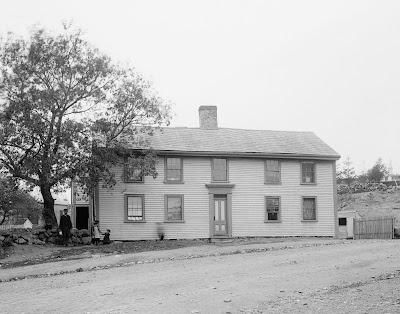
Photo courtesy Library of Congress

Chaffin does tell two stories about Thankful Buck that are more unusual. They both relate to her family. First, he writes that she was "said to have performed her incantations at midnight with her daughters, one of whom inherited her name and reputation, by pouring water from one pan into another." As I mentioned, New Englanders believed witchcraft ran in families, so it makes sense people in Easton thought at least one of Thankful's daughters was a witch. The detail about using two pans of water is an interesting one, and I don't think I've seen that one before. If anyone tries this at midnight, let me know the result!

Finally, Chaffin writes that Thankful once sent her husband to buy her a particular type of wool fabric. He returned home empty-handed, and was unable to enter the house due to an angry Thankful's magic. Only when he came home with the fabric was he able to get into the house. This story makes me laugh - do not make a witch angry! - but it also points out how often these stories about the fear of powerful women. Clearly, she was the one in charge of the Buck household. 

William Chaffin claims that even when he was writing in 1886, some of his Easton neighbors still believed these stories were true. Chaffin is skeptical; he wonders, for example, why Thankful Buck didn't use her magic to save her eye, or if perhaps Thankful and her brother Nathan deliberately cultivated reputations as witches to instill fear in their neighbors. 

I suppose that's possible - see for example the Dogtown witches - but I think it's more likely the Selees and Bucks were just unpopular with their neighbors. Perhaps they were demanding, or maybe they were rude and ill-mannered. It didn't take much to get accused of witchcraft in these small New England town. Happily, they lived after the witchcraft trials ended, so they were not brought to court or executed. I appreciate these old witchcraft legends, but I always try to remember they were about real people, not magical witches. 

June 12, 2022

Satanic Imps, A Wizard and Grim Predictions in Easton, Massaschusetts

A while ago my friend Sam Baltrusis asked me if I knew anything about a haunted mill pond in Easton, Massachusetts. I did not – this legend was new to me. I am always excited to learn about a new local legend, so thank you Sam for pointing me towards this one. 

I did some research and found some interesting stories about the pond and the alleged wizard who used to live nearby. If you visit Mill Pond in Easton today, you will find the following sign:

 “Site of the the sawmill built by John Selee in the 18th century and continued by his son, Nathan, a wizard who purportedly used satanic imps to run the mill at night.”

William Seltzer Rice, "Mill on the Stanislaus," 1940

The sign was put up in 1999, and I appreciate that Easton’s Conservation Commission included the legend of Nathan Selee on it. Legends like this one are an interesting and important part of our local history and heritage. And who doesn't love a story about Satanic imps?

Nathan Selee was born in 1733, served as a private in the American Revolution, and died in 1815 at age 82. That’s what Vol. 103 of the Daughters of the American Revolution Lineage Book (1928) tells us. The Lineage Book doesn’t say anything about Selee’s alleged supernatural antics, though. For that, I turned to to William L. Chaffin’s History of the Town of Easton (1886), which says the following about the Selee sawmill:

Nathan Selee sawed lumber there late in the century; and strange stories were told, and even believed by superstitious people, about the Devil or his imps running the mill at night, Nathan Selee being reported as knowing too much about magic arts, and being on too good terms for awhile with their author. But sawing logs by water- power on cold nights seems rather uncongenial work for his Satanic Majesty; it would be more easy to credit his running a steam saw-mill, with a blazing furnace. It is wiser to acquit Mr. Selee of any such questionable partnership, and to think that the rolling and buzzing of wheel and saw, which the belated passers-by supposed they heard, were all in their own brains, and might easily be accounted for by the strength and quantity of hard cider or New England rum they had taken.

According to legend, witches were often given small demons (called familiars or imps) to help them with their work by the Devil, and male witches were often credited with being unnaturally industrious by their superstitious neighbors. These are of course only legends, and Chaffin is basically saying Nathan Selee's neighbors were just drunkards who mistook the routine sounds of the mill for something supernatural. 

This might be true, but it seems Nathan Selee definitely had a sorcerous reputation around Easton, because Chaffin includes another legend about him in his History:

Mr. Selee was a clairvoyant, and many stories are current of what he saw and foretold. He was in Stimson Williams's house on one occasion, and knowing his gifts in that direction, one of Mr. Williams's daughters asked him to tell her fortune, but he declined; and after leaving the house, he said to a man who came out with him that if she could see what the next week would bring her, she would not have asked to have her fortune told. She died the next week.

Spooky! That sounds like a classic legend to me. Despite supposedly having accurate psychic powers, though, Nathan Selee ultimately gave up on the magical arts. He didn't want to deal with the Devil. Again, from Chaffin’s History of the Town of Easton: 

The story is still believed also, that, having sought long for a certain book on magic which he thought would perfect him in the art, the door of his shop opened one day and a stranger handed him the book and vanished. Directly upon the departure of this strange visitant a wild storm began to rage; the winds howled, the lightnings flashed, the thunders roared, and destruction seemed to impend. Mr. Selee took the book and all other books of the kind that he possessed, and threw them into the fire; and then going to the door and looking out he saw the sun shining, and everything beautiful and peaceful. This determined him to have no more to do with the dangerous subject.

I'm not sure why folks in Easton thought Selee was a wizard. In the 1600s, people who were demanding and cantankerous were the ones often accused of witchcraft by their neighbors. I haven't found anything that indicates Selee was either of those things, but that may have still been the case. 

Happily, Nathan Selee was born after the witchcraft trials ended, because otherwise his sorcerous reputation could have led to his execution by hanging. Rather than a tragic tale, he's left a legacy of interesting legends and a nice sign alongside a peaceful pond. 

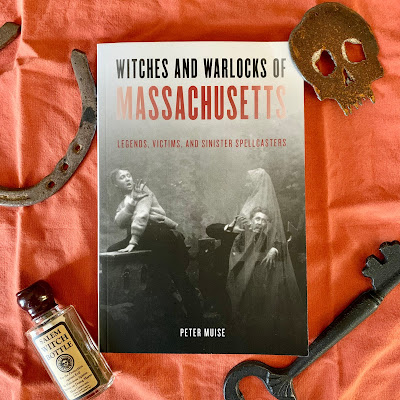
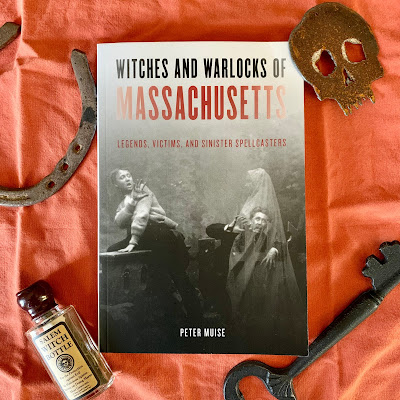
I wish I had learned about this story while I was writing my book Witches and Warlocks of Massachusetts, but maybe I can include it in a second edition? If you want to read lots of other stories about witches in the Bay State, you can find my book wherever you buy books online. 


May 15, 2022

Finding Bigfoot in The Old Farmer's Almanac (and the Flea Market)

Do you read The Old Farmer's Almanac? I do, even though I'm not a farmer (but I am getting old). It's sold at supermarkets and CVS stores here in Boston, so clearly it's not just intended for farmers. It's for anyone who likes weird and possibly useful information

I like it for the astronomical information (full moons, sunrise and sunset times, etc.), and also the weird little facts the editors list for each month. For instance, the 2022 edition of the Almanac notes that J. Edgar Hoover, the FBI's notorious first director, died on May 2,  and that stage and TV magician Doug Henning was born on May 3. Fun facts about the cycle of life and death. 

The Almanac also notes that Bigfoot was seen in Hollis, New Hampshire on May 7, 1977. Another fun fact, this time about the weird things that happen in this part of the world. 

I was excited to see this mentioned in The Old Farmer's Almanac, since it's a famous New England Bigfoot sighting. In fact, I wrote about it way back in 2015. I was planning to rewrite that post, but I like the original so much I'm posting it again. I found Bigfoot in the Almanac, but in 1977 some folks found him at the flea market...


Finding Bigfoot At the Flea Market: An Encounter from 1977

When I was a kid my parents often took my brother and me to flea markets and yard sales. It was the 1970s and I guess this was the thing to do. Quite often we didn't find anything good, but every now and then we'd get some great stuff. I still have a large teak Buddha I found, and we definitely found plenty of old paperbacks about weird occult and paranormal topics.

I never had an actual paranormal experience at a flea market, but apparently they do happen. Or at least they did, back in the 1970s.

On the evening of May 7, 1977 a Lowell, Massachusetts man named Gerald St. Louis arrived at a flea market site in Hollis, New Hampshire. St. Louis had brought his wife and two sons with him. The flea market began the next day, and the St. Louises wanted to get a good spot to set up their table early in the morning. After sunset they went to sleep in their pickup truck. Attached to the truck was a small trailer. 

They were awakened that night when their truck began shaking. Standing next to their vehicle was a large humanoid. Mr. St. Louis later described the creature as being 8 or 9 feet high, brown-colored, and covered in long hair. When he turned on the headlights it became startled and ran across the parking lot, jumping easily over a four-foot high fence. Once over the fence it stood and stared at the truck. 

Needless to say the St. Louis family got out of there fast. They drove to the Hollis police station and reported their sighting to Chief Paul Bosquet. The police inspected the area, but found no sign of the creature. The ground was covered in pine needles and not even any footprints could be seen. Well, at least according to the press at the time. I've seen at least one article online that says 16-inch footprints were found in the soil.

Chief Bosquet said he thought the family had seen a bear. Whatever it was, it seriously spooked them. They left Hollis quickly and didn't even take their trailer with them. I guess they got more than they bargained for at that flea market. (Get it? Bad pun.)

Was it just a bear? I have no idea, but someone else had a similar experience a few days earlier. A woman named Regina Evans was camping in Hollis on May 5, 1977 when she was awakened in the middle of the night by someone shaking her trailer. She did not see the culprit, but large footprints were found nearby.

Andre the Giant and Lee Majors in The Six Million Dollar Man.

The 1970s was a heady time for paranormal phenomena. The occult and metaphysical movements of the late 1960s had paved the way for Bigfoot, UFOs and the Bermuda Triangle to conquer America. Bigfoot was featured in movies like The Legend of Boggy Creek (1972),  In Search of Bigfoot (1976), and just plain Bigfoot (1970), where a biker gang tries to save women captured by the cryptid. Bigfoot also showed up on TV. He was actually a bionic robot created by aliens on an episode of The Six Million Dollar Man, while on the kids' show Bigfoot and Wildboy he fought crime.

As a result of all this, most Americans knew what Bigfoot looked like and what he did - jump out of the woods, scare people, and then disappear. Were the experiences of the St. Louis family and Regina Evans colored by the media? It's very possible, but something really did shake their vehicles in the middle of the night, and the St. Louises seemed legitimately scared.

Perhaps it was pranksters enacting the role of Bigfoot. It's a time-honored tradition. In ancient Greece people dressed like satyrs and in the Middle Ages they dressed like leafy, hairy wildmen. Dressing in an ape costume and running through the woods might just be part of our cultural heritage. We all think there are monsters in the woods, so someone needs to play the part. 

Or who knows? Maybe there really are creatures lurking in the woods, and they are the ones who change costumes over time, appearing as whatever we expect, a goat-footed daemon to the ancient Greeks and a huge hairy monster to someone who just wanted to go to a flea market.

Bigfoot was not seen again in Hollis, but happily he's still out there somewhere, lurking behind the trees and evading easy categorization.

April 24, 2022

Edward Dimond, the Wizard of Marblehead

This is my final Marblehead post, at least for now. It's a fascinating town and I hope to write more about it in the future. But today I just want to talk about Edward Dimond, the wizard of Marblehead. 

Witches and magicians of all types were generally viewed with suspicion in early New England. People definitely consulted fortune tellers and herbal healers in times of need (despite their Puritan ministers telling them not to), but those fortune tellers and healers often became scapegoats when things went wrong. Openly practicing magic was a risky business, and you might find yourself hanging by your neck from a tree. 

Edward Dimond of Marblehead seems to be an exception to this rule. He had a reputation in town as a powerful magician, and was known as Wizard Dimond. But unlike many others who practiced magic, he was a well-respected member of the community. 

The Old Brig, Edward Dimond's house. Photo from the Phillips
Library at the Peabody Essex Museum.

Born in 1641, Dimond claimed he came from a long line of famous astrologers and necromancers. Records indicate Wizard Dimond’s profession was “shoreman” and tradition says he was a retired sea captain. Like most Marblehead residents he had a strong connection to the ocean and his house, called the Old Brig, was supposedly constructed from the planks of a ship. It still stands today on Orne Street. 

Unlike most towns in Massachusetts, Marblehead wasn’t founded by Puritans looking to practice their religion but instead by fisherman and sailors who just wanted to earn a living. They were more tolerant of magic and fortune-telling than their Puritan neighbors, particularly if it helped them in their daily lives. In other towns Wizard Dimond would have been accused of witchcraft. In Marblehead, he was a valued member of the community.  

According to legends, Dimond used his magic to help ships off the coast of Marblehead when they encountered trouble. On stormy nights, Wizard Dimond positioned himself in the graveyard on Burial Hill, roaming around the tombstones and shouting orders to ships miles away. The sailors on those ships should have been too far away to hear his voice, but amazingly they did, and they also knew to follow his commands if they wanted to safely reach the harbor. The hungry waves claimed those who didn’t heed the wizard of Marblehead.

Old Burial Hill, Marblehead.

People also came to Wizard Dimond to learn the future, but one of his specialties was finding lost or stolen objects. He once helped an elderly couple locate their stolen money and also identified the man who stole it. 

Another well-known Marblehead legend tells how he helped an elderly widow. The widow, who was quite poor, came to Dimond’s house on a cold winter night. All her firewood had been stolen, she said, and she would freeze to death unless he found the thief. Using his magical abilities, Wizard Dimond first learned the thief’s name. Going further, he then cast a spell on him, cursing him to walk up and down the Marblehead streets until sunrise with a huge, heavy log tied to his back. In the morning the thief, cold and exhausted, confessed to the widow and returned her firewood. He learned his lesson and never stole again. 

Dimond claimed that magical powers ran in his family. His granddaughter was Moll Pitcher, the famous fortune-teller of Lynn, so maybe there is some truth to that claim. 

Edward Dimond died in 1732 at the venerable age of 91. His grave site has been long forgotten, but perhaps his spirit is still roving around Burial Hill on stormy nights, giving orders to ships at sea.

*****

If you like reading about Massachusetts's magical past, you may enjoy my book Witches and Warlocks of Massachusetts, which was published last October. It's available wherever you buy books online


April 09, 2022

Wilmot Redd, the Witch of Marblehead

This is my second post about Marblehead. As I mentioned in my last one, Marblehead is incredibly charming and beautiful. It's the archetypal old New England seaside town. And as we all know, old New England towns often have some weird legends attached to them...

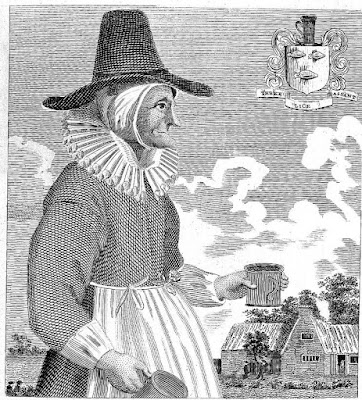
Engraving of a witch by James Caulfield, courtesy the Wellcome Collection

In Marblehead, that weird legend is about Mammy Redd, a fearsome witch who lived in the 17th century. According to various 19th century sources, Mammy Redd was a hideous old woman who terrorized the people of Marblehead. In New England Legends and Folklore (1883), Samuel Adams Drake wrote the following about her:

This woman was believed to possess the power of malignant touch and sight, and she was able, so it was whispered, to cast a spell over those whom she might in her malevolence wish to injure. To some she sent sickness and death, by merely wishing that a 'bloody cleaver' might be found in the cradle of their infant children.

A popular rhyme about Mammy Redd from the 19th century described another of her evil powers:

Old Mammy Redd

Of Marblehead

Sweet milk could turn

To mould in churn

Other versions of the rhyme specify that the mold looked like "blue wool," which sounds pretty gross. Ruining dairy products (milk, cream, or butter) is a classic New England witch's hex. 

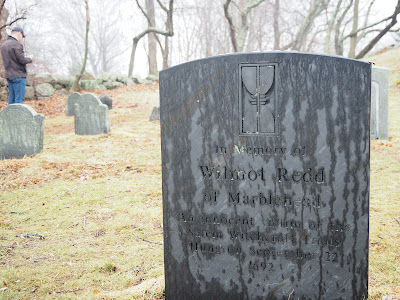
Photo by my friend Onix Marrero

The legend of Mammy Redd is based, quite loosely, on Wilmot Redd (or Read, depending on the source), a Marblehead woman who was executed during the Salem witch trials. She was the wife of a fisherman and, like many of the woman accused of witchcraft by the Puritans, was older and cantankerous. Some sources describe her as "grouty," which means rude or ill-tempered. She was not a witch, but was simply unpopular. 

Most records from her trial are lost, but those that remain describe an argument Redd had with a neighbor, Mrs. Syms. Syms believed Redd's maid had stolen some bed linens, and  exchanged harsh words with Redd. At the end of the argument, Redd supposedly cursed Syms, telling her she would never defecate or urinate again. Soon after, Syms began to suffer from constipation and had difficulty urinating. These problems only ended once she moved away from Marblehead. 

This is an absurd thing to be executed for, but the Salem judges accepted even the most ridiculous accusations at face value. During her questioning, the afflicted Salem girls (the driving force behind the witch hunt) claimed they saw Wilmot Redd's spirit offering them the Devil's black book to sign. This alleged vision sent the girls into convulsions. While most people in the courtroom took them seriously, Wilmot Redd did not. When a judge asked her opinion of the girls' convulsions, she said "My opinion is they are in a sad condition." Grouty to the end, Wilmot Redd was hanged on September 22, 1692 at Gallows Hill in Salem. 

Photo by Onix Marrero

Like everyone executed for witchcraft in Salem, Redd's body was discarded in an unmarked grave somewhere near Gallow's Hill. Perhaps her family retrieved it and secretly reburied her, perhaps not. Many years later, the town of Marblehead erected a monument to her in Old Burial Hill graveyard. As you can see from the photo, people leave coins at her grave to honor her memory. 

The town also named this small behind pond behind Old Burial Hill Redd's Pond in her honor. She and her husband lived next to the pond in the 17th century, and although her house is long gone her memory and legend still survives to this day. 

Photo of Redd's Pond by Onix Marrero

*****

If you like witch legends and the history behind them, you might like my newest book, Witches and Warlocks of Massachusetts, which is available wherever you buy books online.