December 17, 2022

Christmas Chaos: Puritans, Saturnalia, and Lords of Misrule

On December 25, 1621, some young men in Plymouth, Massachusetts wanted to celebrate Christmas. Their celebration sounds pretty meager by modern standards – just playing a few ball games in the street. However, when William Bradford, Plymouth’s governor, saw what was happening he shut their little party down. He told them they shouldn't be celebrating Christmas, but he was willing to let them observe the day by praying piously indoors. They could not have any fun, however, particularly not in public.
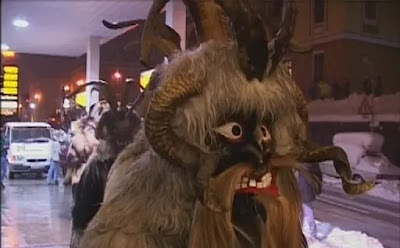
A still from Kranky Klaus (2003), a film by Cameron Jamie.

This sounds like a Grinchy move, and it was. Unlike Governor Bradford and many other Plymouth colonists, the game-players weren’t Puritans. They hadn’t realized how strongly the Puritans hated and feared Christmas. In 1659, the Massachusetts legislature even passed a bill banning Christmas - that's how much they hated the holiday. The bill was repealed in 1681 by Sir Edmund Andros, a much-despised governor appointed by the English king, but Christmas was still not widely celebrated in Massachusetts, or New England in general, until the mid-19th century. Schools and business remained open, and churches did not hold religious services on Christmas. A few  people on the margins of New England society celebrated Christmas, but most didn't.

Puritans hated Christmas for two reasons. First, they thought it was just a pagan holiday that had become thinly Christianized. There’s probably some truth in that. The Bible does not indicate the date of Christ’s birth, so the early Church fathers decided it should be celebrated on December 25, a time when people across the Roman Empire were already celebrating various winter holidays like the Saturnalia and the birthday of Sol Invictus, the sun god. It made good political sense for the new religion to piggyback on already popular holidays.
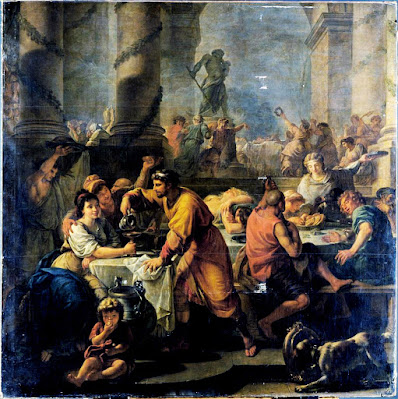
Saturnalia by Antoine Callet

Puritans also hated Christmas because it was celebrated very differently in the 17th century than it is now. Christmas was a raucous and chaotic holiday that featured lots of drunken public revelry and social disorder. There is still some heavy drinking at Christmas these days, but in the 17th century Christmas was associated with large, drunken, disorderly mobs roaming through the streets and countryside. This can be traced back to the Roman Saturnalia, which celebrated the god Saturn, who had supposedly ruled over Earth’s Golden Age. During Saturn’s reign, everyone had been equal. There were no slaves and no masters, no kings and no subjects, no bosses and no employees. It was blissful and idyllic anarchy, with the Earth providing bountiful food so no one needed to work. These beliefs about the Golden Age were reflected in the Saturnalian celebrations holiday, with masters waiting on their slaves, men dressing as women, and much public drinking and ribaldry. All boundaries were dissolved. 

Saturnalia was a season of misrule, a time when society’s rules were temporarily inverted or suspended. It was a release valve, a way for the lower classes to temporarily let off some steam and a way for the upper classes to buy some good will. After the Roman Empire collapsed, this pattern continued in Europe through the Middle Ages and into the Renaissance, but Christmas became the holiday of misrule, not Saturnalia. In many European towns and cities, prominent lower class men were appointed the Lord of Misrule by their fellows to preside over the holiday debauchery, leading crowds that mocked priests, noblemen, and the wealthy with impudence. Carolers, often drunk and in costume, demanded food and drink at wealthy homes. Once the celebrations ended, the Lord of Misrule stepped down and the old hierarchical relationships reasserted themselves until Christmas came around again. 
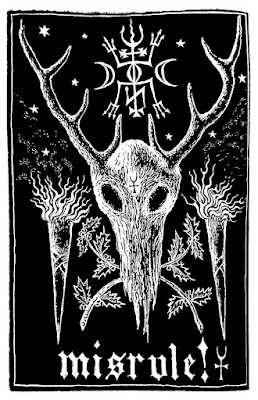
Illustration from Masks of Misrule (1996) by Nigel Aldcroft Jackson

The misrule of Christmas was antithetical to the Puritan values of hard-work, moderation, and self-control, but some modern Americans have recently have shown interest in bringing back a little of the old Christmas chaos. Some contemporary witches and occultists acknowledge a Lord of Misrule in their winter solstice rituals, and the Krampus, a monstrous Yule creature associated with misrule from northern Europe, has become increasingly popular, appearing on t-shirts, tree ornaments, and in movies. Krampus celebrations are a long-standing tradition in Germany and Austria, and some Americans are trying to bring it here.

Idyllic holiday anarchy sounds like fun, but there was definitely a dark side to Christmas misrule. The threat of violence lurked beneath the surface, and vandalism sometimes occurred, even in Puritan New England. For example, a group of young men in Salem, Massachusetts harassed 72-year-old John Rowden on Christmas night in 1679. The men forcibly entered Rowden's home, caroled, and then demanded wine as payment for their performance. Rowden refused, and in retaliation the young men pelted his house with stones and branches for 90 minutes, knocked down a stone wall, and stole six pecks of apple from his cellar. Something similar happened in Deerfield, Massachusetts in 1794, when shopkeeper John Birge was awoken at 2:00 am on December 22 by a group of drunken men demanding entrance to his home. He refused, and the men broke his windows.

Perhaps if Rowden and Birge had played along, their property wouldn't have been damaged. Much like Halloween's trick-or-treat, if you gave out food, liquor or money at Christmas you and your home would escape unharmed. The threat of violent retaliation was an integral part of the holiday.
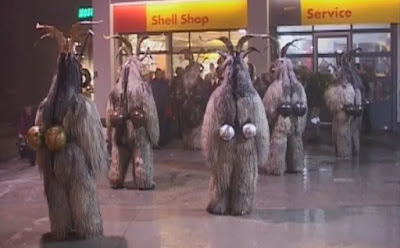
A still from Kranky Klaus (2003), a film by Cameron Jamie.

Back in 2007, I saw a short documentary by Cameron Jamie called Kranky Klaus, which follows a group of Krampuses as they roam around an Austrian town in a pre-Christmas celebration. The movie is unsettling. The Krampuses are aggressive and violent. They try to break into a pizza shop, and when a female employee stops them they push her into a snow bank. They enter a nightclub, where they knock over tables, wrestle patrons to the floor, and whip people. The Krampuses terrify a group of children, and then shove snow into pedestrians' faces in the street. No one stops them because it's a holiday tradition, but a lot of folks seem unhappy and terrified. You can watch Kranky Klaus on YouTube for yourself. What are your thoughts? Misrule and Christmas chaos sound like fun on paper, but the reality looks pretty scary.

I love weird old traditions, but I'm happy with the tamer, milder Christmas we now celebrate. The Puritan's anti-Christmas attitude wasn't defeated by misrule, but by 19th-century capitalism and a kinder, gentle approach to raising children. The prospect of happy children opening presents under a tree won out over the Puritan's "bah humbug" attitude, and over Christmas misrule as well. Feel free to celebrate Christmas (or not) as you see fit, but I'll be sitting by the tree, drinking eggnog, and listening to Mariah Carey, trying to find that happy medium between grumpy Puritan and kranky Krampus. 

*****

My favorite book about the history of Christmas is Stephen Nissenbaum's The Battle for Christmas: A Cultural History of America's Most Cherished Holiday. I got much of this post's information from it. 

December 05, 2022

Bewitched in the Woods: Old Rif and the Rabbit

A few weeks ago I went to the Boston Athenaeum and found lots of old witch stories in various in old New Hampshire history books. A few weeks ago I wrote about Mother Carr from Weare, New Hampshire. Here's another witch story I found, this time from the town of Windham. As the days grow shorter I find myself drawn more and more to these stories!

Many years ago, an enslaved Black man named Old Rif and a man named George Simpson were out hunting in the woods near Windham. After hunting for a while they became lost.

The sun was sinking behind the western hills, and they came to a halt. At that moment they saw a rabbit standing upon its hind legs, looking at them; they tried to frighten it away, but it would not away at their bidding. Old Rif knew that the rabbit was bewitched, and he had heard that to shoot silver sleeve-buttons at a rabbit would destroy the witch. So he loaded his gun, putting in his silver sleeve-buttons, and shot the rabbit. The witch was instantly killed, their minds immediately became clear, the ground at once became familiar, the pathway was plain before them, and they readily and quickly found their way home. He (Old Rif) was said to be the last slave in New Hampshire, and died not far from 1842 (L.A. Morrison, History of Windham in New Hampshire, 1719 - 1883 (1883))

There are lots of interesting things about this story. First of all, there's Old Rif. He's a reminder that there was slavery in New England. I am not an expert on the history of New England slavery, but it seems that although the New Hampshire legislature banned slavery in 1789, it was not completely abolished until the 1850s. Was Old Rif really the last slave in New Hampshire? I will leave that to a better historian than me to determine. Regardless, Old Rif is clearly the hero of this story. He knows that he and George Simpson are bewitched, and he knows how to end it.

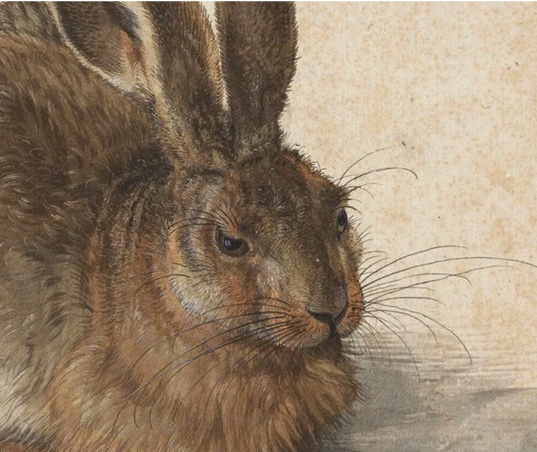
Young Hare, by Albrecht Durer

He ends the witch's spell in a traditional way - by shooting a silver button at an animal that is actually a witch in bestial form. Silver bullets are familiar to modern readers from Hollywood werewolf movies, but any silver object would do the trick. If you don't have a bullet, use a button. 

Maybe the most famous story of a witch being shot with a silver button is the one about Peg Wesson from Gloucester, Massachusetts, who had taken the form of a crow to harass a group of soldiers. It's unclear in either story if the witch is possessing an actual animal, or if the witch has merely sent out their soul in the shape of an animal. Either way, the result of the silver button/bullet is the same - the animal is injured or killed, as is the witch. 

In the Peg Wesson story, Peg is only injured after a soldier shoots the crow with a silver button. But in this story about Old Rif, the witch dies as soon as the rabbit is shot. I wish there was more information about the witch in this story. Who were they? Did they just keel right over in their house? Did anyone find a silver button embedded in their corpse? I suppose we'll never know.

It's a little strange that the witch is never identified in Old Rif's story, but the witch is almost never the main character in these stories. These stories are instructional tales, intended to tell the listener or reader how to fight witchcraft. The witch's identity didn't really matter to the person in Windham who first told this story. What did matter was instructing people how to stop a witch.

I will end with a couple disclaimers. One, your neighbors are not evil witches hexing you. Two, please don't go around shooting random animals if you get lost in the woods. That little bunny just wants to eat some grass in peace. 

November 22, 2022

The Tough Pie Crusts of Old New England

My family always eats the same meal every Thanksgiving, consisting of turkey, squash, potatoes, turnip, stuffing and cranberry sauce. Appetizers might vary, and Tony and I eat tofurkey, but the outline of the main meal remains the same. It's basically it's a lot of autumn vegetables boiled up and mashed. Delicious!

Thanksgiving has its roots in the old New England Puritan feast days, and it's surprising how closely my family's menu matches what people would have eaten three hundred years ago. I'm descended from relatively recent immigrants (I'm only second generation American on my father's side), but somehow this was the menu that my Quebecois grandmother learned to cook. 

Dessert traditionally consists of the same three pies: squash, mincemeat, and apple. Again, these are the pies that my grandmother always made. Why squash instead of pumpkin? I have no idea. Thank God that the One Pie company still makes canned squash. When they stop we might need to abandon the squash pie for pumpkin.

This year I'll be helping out by baking the squash and mincemeat pie. My mother always makes her pie crust with flour, oil and water. It makes a very delicate crust, but is hard to roll out. I make my crust with shortening, flour, and butter. It is not quite so flakey and delicate, but it is easier for me to handle. Now, do you want to hear about a really tough pie crust?

  
I can hear you asking, "What does all this have to do with New England folklore?"

Pie is very, very old form of food. There are recipes for pie-like dishes from ancient Rome and Egypt. In Medieval England, pies usually contained a mix of sweet and savory ingredients. Mix together some fish, some fowl, some game, some vegetables and some fruit and voila! A pie. Although the ingredients have changed over time, the basic concept has remained the same: food baked inside a pastry crust. 

The pie crusts of old were generally not the tender, flaky delights that we experience today. Whether it's butter, oil or shortening, fat is inexpensive to buy these days. In the past that was not the case, and many people made their pie crusts just from flour and water with no fat added. Fat adds tenderness to the pastry, so these fat-free crusts were quite tough.

You may think I exaggerate the toughness, but it was noted by several authors. In the 1500s this type of dough was called "strong dough." The English cookbook author Hannah Glasse included the following instructions in 1747's The Art of Cookery: "First make a good standing crust, let the Wall and Bottom be very thick..." If I'm not misinterpreting her, it sounds like the crust can stand up on it's own like Play-Doh. Yikes! 

The Swedish minister Israel Acrelius lived in Delaware during the middle of the 18th century, and experienced some tough pie crusts firsthand. He wrote in 1759 that the crust "of a house pie, in country places ... is not broken even if a wagon wheel goes over it." Acrelius was probably exaggerating a little, but you get the picture.

The pie crusts in Colonial New England were as tough as those in Delaware, if not tougher. Rye grows better in our climate than wheat, so rye flour was the most commonly used flour here. Have you ever baked with rye flour? It is much, much harder than wheat flour, so imagine making a fat-free rye flour pie crust. It was probably like edible ceramic.

A sturdy rye pie crust appears in Harriet Beecher Stowe's novel Oldtown Folks (1869), which is set in late 1700s Massachusetts. Two abandoned children find shelter for the night at the home of a friendly farmer. In the morning he sends them on their way with kindly words, and a pie:
Sol added to these words a minced pie, with a rye crust of peculiarly solid texture, adapted to resist any of the incidents of time and travel, which had been set out as part of his last night's supper. 
The crust was so hard that it could be carried without a pan. Now that's a strong crust.

The hard crust does explain one thing that has always puzzled me. Housewives in pre-Industrial New England made dozens and dozens of pies in the weeks leading up Thanksgiving, and a cook prided herself on the number and variety of pies she could produce. Although some of these pies were eaten at Thanksgiving, the majority were stored in the root cellar for the winter. I always wondered if people had dozens and dozens of pie pans in their houses, but apparently they didn't. They probably just turned the pie out of its baking pan and stuck it on the shelf. The crust was so hard it would hold its shape for months. I wonder how the flavor held up?

In his 1877 book Being A Boy, Massachusetts-born writer Charles Dudley Warner talks about how a boy could steal pie from the root cellar by hiding it under his coat: 
And yet this boy would have buttoned under his jacket an entire round pumpkin-pie. And the pie was so well made and so dry that it was not injured in the least, and it never hurt the boy's clothes a bit more than if it had been inside of him instead of outside; and this boy would retire to a secluded place and eat it with another boy, being never suspected because he was not in the cellar long enough to eat a pie, and he never appeared to have one about him.
So Warner is writing about a pie so solid and so dry that someone could stuff it in their shirt without it leaking. Wow! 

Traditional New England menus are great, but let's praise innovation where we can. I don't think anyone wants to go back to eating rock solid pie crust, no matter how portable it is.

*****

If you want to learn more about traditional New England pies, I recommend James Baker's Thanksgiving: The Biography of An American Holiday and Keith Stavely and Kathleen Fitzgerald's America's Founding Food: The Story of New England Cooking. I got most of my information from those two books, which are great! This post is an updated version of one I wrote on this topic way back in 2015. 

November 12, 2022

Mother Carr, the Witch of Weare: Turn Your Clothes Inside Out

A few weekends ago I went to the library and randomly looked through the histories of some New Hampshire towns, hoping to find interesting stories about witchcraft and ghosts. Many 19th century town histories include those local legends, and I was happy to find several stories I had not read before. 

Some of those stories were about Mother Carr. She lived in Weare, New Hampshire in the early 1800s, and many people suspected her of being a witch. There are several accounts of her allegedly bewitching her neighbors, including this one.

Antique postcard of Weare, NH from Wikipedia

One summer day some of Mother Carr's neighbors went berry-picking in the woods. It was a very successful trip. They returned carrying buckets that overflowed with ripe juicy berries. When Mother Carr saw all the delicious berries she asked if she could have some, but her neighbors refused. She stomped off angrily, telling them they would regret their stinginess. (Cue the ominous music...)

A few weeks later, the same group of neighbors went into the woods to pick berries again. And once again, they filled their buckets with plump, juicy berries. But as they began to make their way back to Weare they became lost. They wandered around for hours, unable to find the path that led home. No matter how hard they tried they couldn't find their way out of the woods, even though they had been there many times before. 

Suddenly, one of the berry-pickers remembered Mother Carr's angry words, and realized she had cursed them. They would never find their way home as long as they were under her spell! Someone suggested that if they turned their clothes inside out the spell would be broken. It sounded foolish, but everyone was afraid of being stuck in the woods overnight, so they turned their coats, shirts, pants and skirts inside out. To their amazement, it worked. Although they were tired and bedraggled, they were able to find their way out of the woods.

Antique postcard of Weare, NH from Wikipedia

That is the end of the story. It might sound alien to a modern reader, but turning your clothes inside out is a very old form of folk magic. However, it was most often used to prevent fairies from leading you astray, not witches. As the 17th century English poet Richard Corbet wrote in his poem "Iter Boreale":

As in a conjurers circle, William found

A menes for our deliverance: Turne your cloakes,

Quoth hee, for Puck is busy in these oakes:

If ever yee at Bosworth will be found,

Then turne your cloakes, for this is Fayry-ground.

Special thanks to Beachcombing's Bizarre History Blog for posting this piece of poetry! I am not 100% sure of the metaphysics behind this folklore, but I think turning your clothes inside out is supposed to confuse the fairies, which makes them stop hexing you. 

But why would people in New Hampshire do this when they were lost in the woods? When the English Puritans came to New England they didn't bring much fairy folklore with them, but they did bring a lot of witch lore. Instead of blaming misfortunes on fairies they blamed them on unpopular neighbors (like Mother Carr) they thought were witches. Practices that were once used to protect against fairies were used to protect against witchcraft. 

I found this story in William Little's 1888 book The History of Weare, New Hampshire, 1735 - 1888. These old history books are amazing. You never know what you'll find!

October 23, 2022

The Spookiest States: Vermont and Maine Lead the Pack

People often ask me if New England is weirder or scarier than other parts of the country. I’ve been asked this by podcasters, other writers, and even personal friends. It would be easy for me to respond with a joke about scary Massachusetts drivers, our weird infatuation with Dunkin Donuts, or the frightening price of housing. But I generally avoid going for the easy laugh and try to answer the question sincerely.

Certainly, it seems that New England has a reputation in popular culture as a strange place. I usually mention that the world’s three most famous horror writers all came from New England. Edgar Allen Poe (1809 – 1849) was born in Boston, and although he left as a child he returned when he was 16 to work and enlisted in the army. He didn’t remain in Boston long, and although he thought the Bostonian literary establishment was uptight he still published his first book with the byline “a Bostonian.” 

The second writer is H.P. Lovecraft (1890 – 1937), who was born in Providence and spent most of his life there. Lovecraft incorporated lots of New England history and legends into his fiction. He definitely understood the weird appeal of the region’s moldering Puritan cemeteries, old coastal towns, and dark woods. Lastly, there is the legendary Stephen King (b. 1947), who was born in Maine and still lives there. Many of his novels, including classics like Salem’s Lot and Pet Sematary, are set in Maine.

I like to think there's something unique about New England which inspired these three influential writers. Certainly, New England has some strange history due to the Puritan colonists who came in the 1600s. They brought over their beliefs in witches, ghosts and the Devil, but not the more charming folklore like fairies. That definitely shaped our region's culture. And like most of the United States, our region has its history of violence, racism and genocide. Perhaps all these things, combined with a sometimes strange and dramatic landscape and our long dark winters, helped inspire Poe, Lovecraft, and King. (The author Faye Ringel explores these themes in her book 1995 book New England’s Gothic Literature.)

But does this really mean New England is weirder or scarier than other parts of the country? And how would you even go about measuring these things regionally? I wouldn't know how to even start, but someone has tried. Cycling Frog, a THC and CBD company in Seattle, compiled a ranked list of the scariest states in the country. Vermont ranked number one, Maine came in second, and Connecticut placed fifth. Not too bad for such a small part of the United States!

The other New England states are apparently not as spooky. New Hampshire was 14, Rhode Island 19, and Massachusetts was way down the list at 35. I feel ashamed as a Massachusetts native that we ranked so low. Massholes, we need to try harder to be spooky.

Upon reading this list two questions came to my mind. How did they rank the states, and why did a CBD/THC company do this? Sadly, I can only answer the first one. Cycling Frog looked at how many of the following each state had:

1. Serial killers (from murderpedia.org)

2. Haunted locations (from frightfind.com)

3. UFO sightings (from National UFO Reporting Center)

4. Ghosts (from ghostsofamerica.com)

5. Top 100 horror films set there (from IMDb.com)

To measure equitably across states, they wanted to show how many of each phenomena the states have per 100,000 people. For example, Texas had the most number of serial killers with 890 (!), but it has a very large population. This means that Delaware, which has a much smaller population, actually has the highest number of serial killers per person, with 41 serial killers per 100,000 inhabitants. According to Cycling Frog, this makes Delaware the most murderous state. (Note: Massholes, we do NOT need to try harder at being serial killers.)

Vermont was ranked the scariest because it had the highest number of UFO sightings and haunted places per person, and also had a high number of ghost sightings as well. That's pretty impressive, which is why they think Vermont is the scariest state. But is it? When I think of Vermont, I tend to think of Ben and Jerry's Ice Cream, rolling green hills, and peaceful hippies. Maybe all that peace and love is just a cover for the true horrors of Vermont. 

Let's face it, I don't think this survey is statistically valid, but it is fun to think about as we approach Halloween. Apparently if you live in Vermont, Maine or Connecticut you're ensured a spooky Halloween. The rest of us may just have to console ourselves by eating extra candy corn and Twix.