Showing posts with label Indian pudding. Show all posts

January 19, 2015

The Proof Is In The Pudding - Proof of Satan!

Small things go wrong in my life all the time. My computer at work does something weird, the Facebook app on my phone stops working, my waffles come out burned, or I miss the bus. I just take these things for granted and don't usually read anything into them.

If I lived a couple centuries ago I wouldn't be so sanguine in the face of these minor misfortunes. Thing often went wrong for our New England ancestors. Butter wouldn't churn, cattle got sick, the loom malfunctioned while weaving, a blight killed the corn. Some people would just take these things for granted, but others would find a supernatural cause. Maybe it was God, but maybe it was Satan and his followers...

John Brown of Lynn, Massachusetts was one of those people. In the late summer of 1692 John got a hankering for Indian pudding.

He desired an Indian puding to be made, which was done, and the flour and suet were white and good when put into the pot, but when (it ) came out (it) was red like a blood pudding...

That's right! His Indian pudding, instead of coming out golden brown, came out blood red. John Brown almost immediately knew who was at fault. It was Sarah Cole, a woman he had argued with over religion (she said all church-goers were devils) and also over some hogs. He had gotten ill after their spat about church-goers, and after they argued about hogs his Indian pudding turned blood red. John was fed up, and accused Sarah of witchcraft. He even testified in front of the magistrates at Salem about the Indian pudding.

Some things we might consider minor inconveniences were actually a big deal for the early settlers. If butter didn't churn, you had no way to preserve your milk. If your cow got sick, you probably wouldn't even have milk. If the loom broke you might have to go naked, and if a blight killed your corn your family could starve. These were were major problems. I can understand how someone might have blamed a witch for these things, even if I disagree with their logic.

But a discolored Indian pudding doesn't seem that important to me, and I really love Indian pudding. Was it really worth blaming Satan and his minions?

Apparently in New England it was. Here is something from a 1722 edition of the New-England Courant:

We are at present amus'd with a very odd Story from Martha's Vineyard, which however is affirm'd for a Truth by some Persons lately come from thence, viz. That at a certain House in Edgar Town, a Plain Indian Pudding, being put into the Pot and boil'd the usual Time, it came out of a Blood-red Colour, to the great Surprise of the whole Family. The Cause of this great Alteration in the Pudding is not yet known, tho' it has been Matter of great Speculation in the Neighborhood.
And here is another story, from the May 25, 1767 issue of the Boston Evening-Post, provides a possible and specifically Satanic explanation for unusual puddings.
They write from Plymouth, that an extraordinary Event has lately happen'd in the Neighborhood, in which, some say, the Devil and the Man of the House are very much to blame. The Man, it seems would now and then in a Frolick call upon the Devil to come down the Chimney; and some little Time after the last Invitation, the good Wife's Pudding turn'd black in the boiling, which she attributed to the Devil's descending the Chimney, and getting into the Pot, upon her Husband's repeated Wishes for him. Great Numbers of Peoples have been to view the Pudding, and to enquire into the Circumstances; and most of them agree, that the sudden Change must be produc'd by a Preternatural Power. But some good Housewives of a Chymical Turn assign a Natural Cause for it...
Three years ago I actually wrote briefly about those two newspaper articles, but I thought the topic was worth revisiting after I found the story about John Brown.

I think these stories are entertaining and illuminating examples of how people try to make sense of the world, particularly misfortune. Why do bad things happen to good people - or good puddings? When is it acceptable to invoke a supernatural cause, like God, Satan, black magic, or Mercury retrograde? When is the cause considered natural?

I don't think most contemporary New Englanders would blame the Devil or a witch if their pudding came out an odd color. Like the "good Housewives of a Chymical Turn" we would find a natural cause. And as the two newspapers indicate, even in the 1700s people were divided over the line dividing the natural and the supernatural. Maybe most early New Englanders only blamed the supernatural for really bad things, like mysterious deaths or unexpected calamities such as famines or epidemics. Many modern people don't invoke supernatural causes at all, blaming bad things on a random mechanistic universe.

Happily for Sarah Cole, it seems like the magistrates in Salem didn't share John Brown's concerns over the Indian pudding. On February 1, 1693 she was found not guilty of witchcraft and set free.

January 01, 2013

Bar Harbor Indian Pudding

As long-time readers of this blog may know, I am a huge Indian pudding fan. I've written about it several times in the past and will definitely write about it again in the future. I've even written about Indian pudding possessed by Satan. It's an endlessly fertile topic.

I don't think I'm the only person fascinated by this sweet (but slightly salty) cornmeal mush. You can still find it on the menu at Boston's Durgin Park restaurant, and a recent article on Saveur mentioned some chefs outside New England who have added it to their restaurant menus. Maybe if I am lucky Indian pudding will become the new hipster fad and I'll be able to find it at lots of trendy local restaurants.

Until that happy day comes I'll have to either make my own or buy it canned. When I was a kid (many years ago now) I seem to remember having canned Indian pudding made by the One Pie company in Maine, but now it seems One Pie focuses mostly on canned pumpkin and canned squash.


However, you can still buy canned Indian pudding from Bar Harbor Foods. I've seen it at Whole Foods, and the Stop and Shop in my neighborhood sold it this year starting around Thanksgiving. After Christmas it went on sale which gave me a perfect excuse to try it.


This is what I saw when I opened the can. Bar Harbor's recipe doesn't include any eggs, which is fine by me but might explain why it looked so dense when I opened the can. It was really solid.

The label said "Good hot or cold!" so I decided to try some right out of the can. It wasn't bad (there's no such thing as bad Indian pudding) but it was pretty dense. I put some in the microwave for about a minute and then tasted it again.


It was great! Heating it up really help blend the flavors, while the texture became much softer and more pudding-like. I didn't have any whipped cream or ice cream, but if I had it would have been a perfect Indian pudding experience. If you want some New England flavor at your meal but are rushed for time I think the Bar Harbor Indian pudding will do the trick.

Happy New Year!

March 13, 2012

Brown Bread, or Rye and Indian

I love the taste combination of cornmeal and molasses. I can't get enough of it, which is why I love Indian pudding and Anadama bread. It's also why I love Boston brown bread.

Some people leave off the "Boston" and just call it brown bread, but no matter what you call it this loaf is quintessentially New England. These days it's usually served with baked beans or during clambakes, but for centuries it was a common everyday bread.

Brown bread has an interesting history. When the Puritans first settled in this area their preferred grain for baking was wheat, but they soon learned that corn (maize) grew much better in the New England soil. According to historians, the average farm produced 100 bushels of corn to 18 bushels of wheat. This ratio only got worse after a wheat fungus evocatively called "the blast" arrived. Ultimately, New Englanders needed to import wheat from other parts of the country, which made it quite expensive.

My brown bread is indeed very brown!


Although wheat didn't grow well here, a less popular European grain did - rye. Along with cornmeal, rye flour became the main ingredient for the bread baked by common people, and also gave it it's name, Rye and Indian. This name later became condensed to one word, Ryaninjun. The term Indian here refers to Indian corn, or maize.

The Puritans made Ryaninjun by mixing the two flours with some leavening and liquid, and forming them into dome shaped loaves (similar to modern soda bread). Ryaninjun loaves were baked on oak leaves or cabbage leaves, which imparted an interesting flavor. In the autumn small children were sent out to gather oak leaves specifically for baking bread.

In the 1820s, Ryaninjun also began to be called brown bread, and the two terms became interchangeable. At this time recipes began to include molasses, and called for steaming the bread in cylindrical molds rather than baking.

In the earliest twenty-first century the name Ryaninjun has disappeared, but many recipes still call for steaming the bread, often in coffee cans. I baked mine in a loaf pan, using a recipe I found in a Mark Bittman cookbook. The recipe didn't call for lining the pan with oak leaves, but I think I'll try that in the fall!

I got this information from Keith Stavely and Kathleen Fitzgerald's wonderful book America's Founding Food: The Story of New England Cooking.


February 19, 2012

The Devil Is In My Pudding!


I apologize for another post about Indian pudding, but I have realized that I was lucky last week - the Devil didn't interfere with my pudding! This apparently was a problem our New England ancestors had to deal with.

For example, here is an article from the March 19, 1722 issue of the the New-England Courant.

We are at present amus'd with a very odd Story from Martha's Vineyard, which however is affirm'd for a Truth by some Persons lately come from thence, viz. That at a certain House in Edgar Town, a Plain Indian Pudding, being put into the Pot and boil'd the usual Time, it came out of a Blood-red Colour, to the great Surprise of the whole Family. The Cause of this great Alteration in the Pudding is not yet known, tho' it has been Matter of great Speculation in the Neighborhood.
Things must have been pretty quiet in Edgartown if a red Indian pudding was considered newsworthy. But why did the pudding turn red? This next story, from the May 25, 1767 issue of the Boston Evening-Post, provides a possible (and Satanic) explanation for unusual puddings.

They write from Plymouth, that an extraordinary Event has lately happen'd in the Neighborhood, in which, some say, the Devil and the Man of the House are very much to blame. The Man, it seems would now and then in a Frolick call upon the Devil to come down the Chimney; and some little Time after the last Invitation, the good Wife's Pudding turn'd black in the boiling, which she attributed to the Devil's descending the Chimney, and getting into the Pot, upon her Husband's repeated Wishes for him. Great Numbers of Peoples have been to view the Pudding, and to enquire into the Circumstances; and most of them agree, that the sudden Change must be produc'd by a Preternatural Power. But some good Housewives of a Chymical Turn assign a Natural Cause for it. However, 'tis thought, it will have this good Effect upon the Man, that he will no more be so free with the Devil in his Cups, lest his Satanick Majesty should again unluckily tumble in the Pot.

These news articles provide three insights into pre-industrial New England life:

1. People lived in a world where supernatural entities played a very active role.

2. No one had TV or the Internet, so strange baking mishaps provided a lot of entertainment.

3. Indian pudding was newsworthy. 

Next week, I'll write about something other than Indian pudding. I promise!

Note: I found these newspaper quotes in Richard Dorson's Jonathan Draws the Long Bow (1946).

February 12, 2012

Indian Pudding: The World's Oldest Recipes


It was kind of cold here yesterday, and we actually had a few snowflakes. Most of this winter has been freakishly mild, but yesterday it finally felt like the temperature matched the season. To celebrate I decided to make Indian pudding.

As a lot of people know, and I've written here before, New England Indian pudding doesn't have anything to do with the flavorful and spicy cuisine of South Asian. Despite its name it's really an old Puritan dish that has been made in this area for hundreds of years.

Stirring together cornmeal and milk.
 When the Puritans came to North America they brought their love of puddings with them. Wheat flour is one of the key ingredients of English style puddings, but unfortunately wheat didn't grow well in New England. Not wishing to be deprived of pudding the Puritans adapted their recipes to incorporate Indian corn (maize) and voila! Indian pudding was born.

The first cookbook in America, Amelia Simmons' 1796 American Cookery, contains three recipes for Indian pudding.

No. 1. 3 pints scalded milk, 7 spoons fine Indian meal, stir well
together while hot, let stand till cooled; add 7 eggs, half pound
raisins, 4 ounces butter, spice and sugar, bake one and half hour.

No. 2. 3 pints scalded milk to one pint meal salted; cool, add 2 eggs,
4 ounces butter, sugar or molasses and spice q. f. it will require two
and half hours baking.

No. 3. Salt a pint meal, wet with one quart milk, sweeten and put into
a strong cloth, brass or bell metal vessel, stone or earthern pot,
secure from wet and boil 12 hours.

I'm amazed to see that number three takes twelve hours to cook! Wow! These are the oldest Indian pudding recipes on record, and obviously come from an era when cooking was much more difficult.

Most modern recipes for Indian pudding have four key ingredients: cornmeal, molasses, milk, and spices. I used this recipe from New York Times writer Mark Bittman. It didn't take 12 hours, but it did take about two and half.

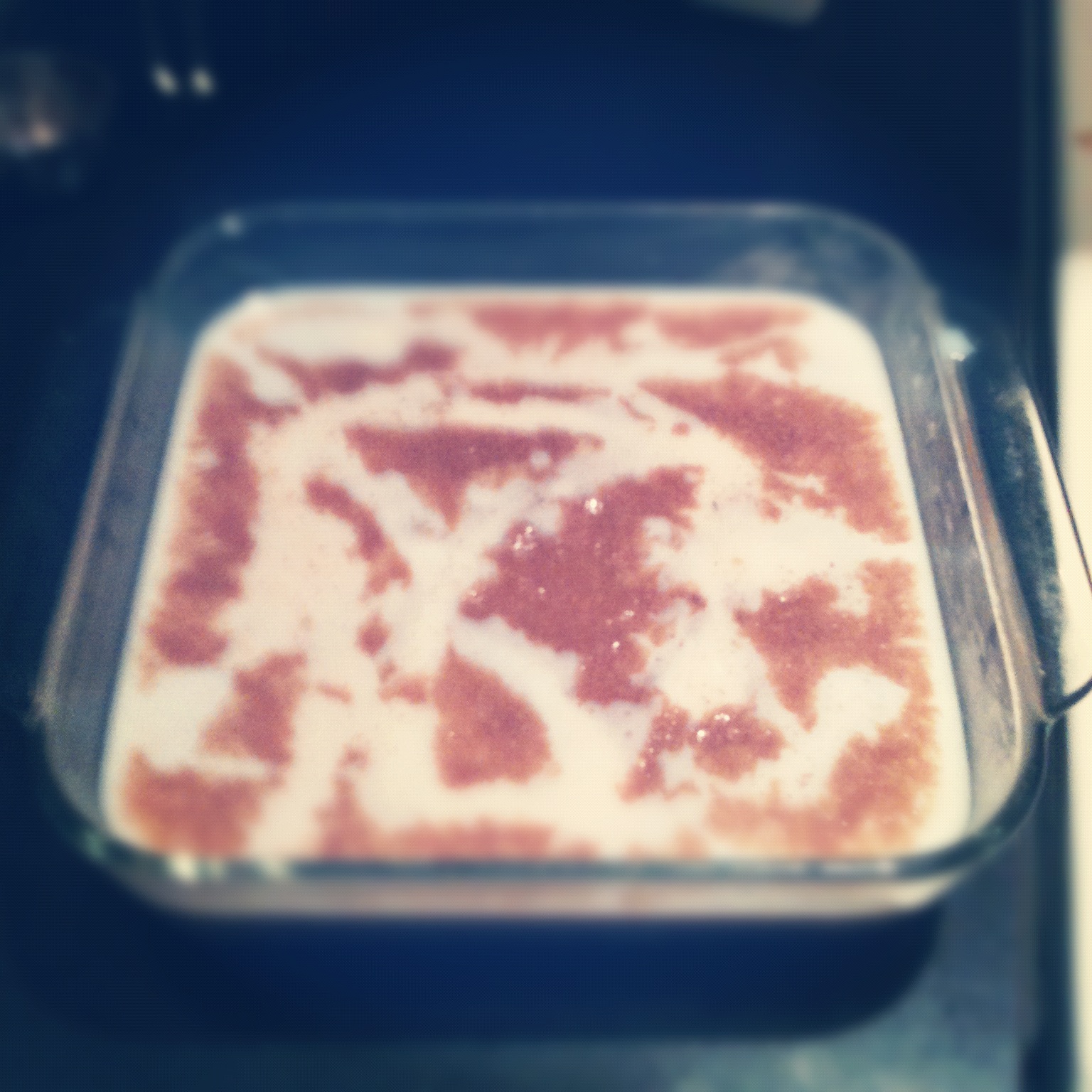
Like a lot of other recipes I have seen, one key step is to pour some milk directly on top of the pudding and then put it in the oven without stirring.

Pour the pudding into a greased pan...


... and then pour milk right on top!


Somehow it all magically works and it gives the pudding a nice texture. Do any foodies out there know why this is?


Two hours later, a humble looking but heavenly dessert!


Indian pudding is not what you would call a glamorous dish. When it comes out of the oven it's brown and kind of goopy looking. It was really delicious though!

March 09, 2011

How Tough Is Your Indian Pudding?


As some of you might know, I’m a big fan of Indian pudding. I can’t get enough of that spicy/sweet/mealy dessert!

If you don’t know what Indian pudding is and are embarrassed to ask, it’s a Colonial-era pudding made from corn meal, molasses, spices, salt, milk and usually eggs. It's named Indian pudding because the Puritans called corn meal “Indian meal.”

A post I wrote two years ago still gets lots of hits, so clearly there are other fans of Indian pudding out there. Rejoice, Indian pudding fans. Today’s post is for you!

Harriet Beecher Stowe is best known as an abolitionist and the author of Uncle Tom’s Cabin, but this Connecticut native wrote several other novels. Some of them contain interesting pieces of New England folklore. For example, her 1859 novel The Minister’s Wooing is set in Newport, Rhode Island and contains this cryptic piece of dialogue. It’s uttered by a young woman discussing her skills as a potential wife:

“I’ve been practicing on my pudding now these six years, and I shouldn’t be afraid to throw one up chimney with any girl.”

I like how she says “up chimney”, rather than “up the chimney.” It reminds me of when I was a kid and I’d ask my mother where Dad was. Ninety percent of the time her answer was “Down cellar!”, which is a New England way of saying down in the basement.

Watch out for the pudding! Photo from a site about the history of chimneys.

However, I wasn’t alive in 1859 so I don’t understand why girls would be throwing puddings up the chimney. Well, according to Mrs. Stowe there was a tradition that “no young lady was fit to be married till she could construct a boiled Indian-pudding of such consistency that it could be thrown up chimney and come down on the ground, outside, without breaking.” The Minister’s Wooing is actually set in the 1790s, so Stowe is describing something that was probably told to her by her parents or grandparents.

Was this an actual tradition, or did someone pull a fast one on Harriet? I might say she’s the one pulling a hoax on her readers, but that seems unlikely because she seems very sincere in her devotion to Indian pudding. At one point in the novel she rhapsodizes about its “gelatinous softness, matured by long and patient brooding in the motherly old oven.” I don’t think someone who wrote that would knowingly lie to us!

On the other hand, that same softness she raves about would seem to preclude throwing it up and out a chimney. Wouldn’t it need to be really bouncy and tough to survive that? To settle this question, I’d ask my readers with fireplaces to give this a try. To make things easier, boil your pudding in a bag or maybe cheesecloth, like the characters in The Minister’s Wooing do. They don’t bake it in a dish. Perhaps that’s the secret to a bouncy pudding?

I wish I could say I unearthed this crazy factoid myself, but I actually read it in America’s Founding Food: the Story of New England Cooking by Keith Stavely and Kathleen Fitzgerald. It’s a great book!


December 27, 2010

Top Ten New England Folkore Stories of 2010


There are a lot of top ten lists out this week. The top ten movies, the top ten fashion faux pas, the top ten books, etc.

Here's the only list worth reading - the top ten New England folkore stories of 2010, based on the number of hits they received on this blog. Enjoy, and thanks for reading in 2010!

1. Nathaniel Hawthorne Sees A Ghost
A famous author goes to the library and encounters the ghost of someone he never spoke to. Soul searching ensues! This post is so popular it makes me wonder if local schools assign Hawthorne's story for English class and kids are searching the Web rather than reading the assignment.

2. Dungeon Rock: Pirates, Treasure and Spirits
Pirates? Yes. Buried treasure? Yes. A cave and spirits? Yes. Convenient location in Lynn, Massachusetts? Yes. A photo of me looking insane? Yes. Even though I posted this way back in 2008, clearly Dungeon Rock still has everything people want to read about.

3. Cannibal Giants of the Snowy Northern Forest
This one is another oldie (from 2009), but we all like reading about monsters, particularly when they could be lurking in your own backyard. Great reading for a blizzardy day like today. Make sure you stock up on supplies first...

4. The Dogtown Werewolf
Another monster, another popular post. Does a werewolf really haunt Dogtown Common on Cape Anne? I can't decide, but the evidence and coincidences are definitely creepy.

5. Why Babies Shouldn't See Mirrors and Vampires Have No Reflection
Readers are either interested in supernatural advice for new mothers or the vampire craze has spilled over to this blog. Either way, folklore about reflections and the soul is interesting stuff.

6. Full Buck Moon
A good post for hunters, Native Americans, Wiccans and animal lovers. I think I covered a lot of diverse constituencies with one post!

7. Negro Election Day
Election Day used to be THE holiday in New England, but African Americans weren't allowed to vote so they were missing all the fun. It was a conundrum, but human ingenuity and the need for a party triumphed!

8. Thomas Morton and the Maypole of Merrymount
Very, very briefly a multi-cultural, tolerant, fun-loving utopian outpost flourished in Quincy, Massachusetts. Maybe someday it will return! This was also another post with a Nathaniel Hawthorne connection.

9. Grandmother Woodchuck
We all need a wise, grandmother to look after us. The Algonquian hero Glookskap's grandmother just happened to be a magical woodchuck. Anyone have a problem with that?

10. Indian Pudding
It's sweet, it's salty, it's spicy and it's made with cornmeal. Could Indian pudding be the perfect food? The thousands who have read this post clearly think so.

January 03, 2010

Anadama Bread


It's been snowing for 36 hours non-stop. The weather forecast says it might stop by midnight, but right now it's snowing harder than ever!

On a snowy day I like to make bread, and today's loaf of choice is Anadama bread. It's very New England!

Some quick facts:

  • Anadama bread supposedly got its name when a Yankee farmer came home from a hard day in the fields to find his wife Anna had once again prepared nothing but boiled cornmeal mush for dinner. "Anna, damn her!" he shouted, and mixed the flavorless mush with molasses, flour, yeast and salt. The result? A delicious bread.
  • Another variation on this legend claims that Anna was actually very good at baking. When she died her husband missed her bread so much he wrote this on her tombstone: "Anna was a lovely bride, but Anna damn her up and died!"
  • Anadama is basically a sandwich style bread, but with cornmeal and molasses. Imagine Indian pudding in a loaf. Yum
  • I'm using a recipe from Baking Illustrated by America's Test Kitchen, but there are plenty of recipes on the Web, like this one. The Old Farmer's Almanac has a slight variation that involves boiled molasses and a story about a fisherman instead of a farmer.
  • The true origins of this bread are murky. For instance, Wikipedia and this site owned by the Smith family of Rockport claim the bread's origins can only be traced back to the 1940s. However, the Food Timeline notes that the U.S. Patent office has a patent from 1850 for Anadama bread, so it was probably being baked since the mid-19th century.


August 30, 2009

Full Corn Moon - with Music


Next week's full moon is the Full Corn Moon, according to the Old Farmer's Almanac. I tend to think of fresh local corn as a summer thing, but the corn season is at it's height now. Some years if we're lucky we can buy local corn until Halloween.

Corn, or maize, is of course native to the Americas, and was probably first grown in New England around 1,000 A.D. It became more integral to the Algonquian's diet in the following centuries, particularly in southern New England where the weather was milder. (This info is from Kathleen Bragdon's Native People of Southern New England 1500-1650). Maize was believed to have been a gift from the gods.

I have a neighbor who is American Indian, and one summer she was growing corn with red, black and yellow kernels in the neighborhood garden. This is often called Indian corn and is used for wreaths and centerpieces in the fall, but as she pointed out "All corn is Indian corn. The correct term is decorative corn." Point taken!

The English settlers coined the term Indian corn. In Britain, the word "corn" refers to any grain. Wheat, oats, barley, whatever - it's all corn to the British. When they arrived in the New World they called maize Indian corn to differentiate it from all the other things they called corn. Gradually the term for maize just became corn, with Americans calling wheat, barley, oats, etc. grain or cereal.

The Algonquians in New England had some interesting recipes for corn. In addition to roasting, boiling and mashing it, they would:

  • According to Roger Williams, "bake bread of Indian corn which they call pagataw; with this and austres (oysters) a kind of snail, they make a dish which is widely used."

  • According to Timothy Alden, "pound mature corn fine, sift it, make it into a dough with water or bear oil, cover the dough with leaves or pat it into little inch-thick cakes, and bake it in the ashes."

Bear oil is hard to find these days at the supermarket, but you can still find oysters. The favorite corn dish for the English was Indian pudding, which I discussed earlier this year. (Recipes are from Indian New England Before the Mayflower by Howard Russell.)

Finally, in an effort to take advantage of the Web's multi-media capacities, here is a link to Vanessa Williams singing "Colors of the Wind" from Pocahontas, Disney's animated take on colonialism and cultural conflict. It has the lyric: "Have you ever heard the wolf cry to the blue corn moon?" The movie may be a little hokey, but at least they didn't tack on a happy ending, and the song is good.

March 16, 2009

Indian Pudding!

It's been a while since I've posted anything. I could tell you it's because work has been so busy, but there's another reason - it's because I've been busy making Indian pudding!

A quick FAQ about Indian pudding:

- It's not from India. That delicious pudding you get in Indian restaurants is called kheer.

- American Indians didn't create it, either. But, since it is made with cornmeal, the Puritans called it Indian pudding. (What modern Americans call corn, a.k.a maize, was originally called Indian corn, to differentiate it from what the English called corn, which was really any grain. Hopefully, that's not too confusing!)

- Indian pudding is a dessert that has been made in New England for hundreds of years. The basic recipe involves cornmeal, milk, molasses, and some spices. There are lots of recipes floating on the Web: traditional, microwave, and even vegan.

- I think it's one of those dishes, like baked beans, that a Puritan housewife could just throw in the stove while she went to church for a long, long time. Then, when church was over, she could come home and make herself feel better after all the damnation talk by eating slow-baked cornmeal sweetened with molasses.

- When I was in middle school, it was sometimes served for dessert as part of the hot lunch program. I don't remember any school lunch desserts except this one, and that's because it's so darn delicious.

- When I was a kid, you could also buy it canned in any supermarket. Now, the only place I've seen it is Whole Foods, where you can buy Bar Harbor brand Indian pudding. I've never tried it, but there's no such thing as bad Indian pudding.

- Although, these taste testers at the Onion really don't like it. I can tell they're not from New England, though, because they had never even heard of Indian pudding. I don't think you should trust their opinion.

- Indian pudding is sometimes called hasty pudding, which is also a venerable Harvard theatrical troupe known for its comedic drag productions. They serve Indian pudding at all their banquets.