On the twenty-fifth of December it was, that Mercy said, They (the invisible witches) were going to have a Dance; and immediately those that were attending her, most plainly Heard and Felt a Dance, as of Barefooted People, upon the Floor; whereof they are willing to make oath before any Lawful Authority.If I should now venture to suppose, That the Witches do sometimes come in person to do their Mischiefs, and yet have the horrible skill of clothing themselves with Invisbilities, it would seem Romantic. And yet I am inclinable to think it...
December 22, 2021
In 1692, Invisible Witches Danced in Boston on Christmas Day
December 13, 2021
Folklore Books (and Weird Fiction) for Christmas
Drinking eggnog. Wrapping gifts. Hallmark Christmas movies. These are all perfectly fine ways to get in the holiday mood, but sometimes I find myself wanting something different. Maybe something that will connect me to New England's historic roots, or evokes the increasing December darkness. Or maybe a folktale about murderous Christmas elves, or a tale about a snowy Massachusetts seaport with unholy secrets...
I've published this list before, but here it is again: those books that really put me in the Yuletide mood. I reread some of these every year. What are your favorite holiday folklore books or strange Christmas tales?
Ever wonder why Americans celebrate Christmas the way we do? Nissenbaum’s book traces the development of our modern child-focused and gift-focused holiday from the raucous holidays of the past. Several chapters in The Battle for Christmas focus specifically on early New England, looking at why the Puritans hated Christmas, which people celebrated Christmas despite it being banned, and how capitalism shaped the holiday. Christmas used to be a multi-week drunken orgy when the lower classes extorted food and liquor from the wealthy. Nissenbaum explains how it became a holiday where we sit peacefully around Christmas trees and exchange presents.
Do you exchange presents at Christmas time? Do you incorporate Santa Claus into you celebrations? Do you spend the holiday with your family? If you answered yes to any of these questions, you can thank Clement Clarke Moore. Moore was a prominent New York City clergyman who was annoyed at the drunken Christmas celebrations that kept disrupting his family’s peaceful home. Moore wrote “A Visit from St. Nicholas’ in 1823 to encourage a gentler, sober and more familial holiday. And it worked! Moore’s poem permanently shaped the way Americans and much of the world celebrate Christmas.
Again, no connection to New England, but lots of dark folk stories from Iceland. Many of them are set at Christmas time. The elves in these tales are not cute and whimsical, but instead are strange, dangerous, and often murderous. As are the trolls, witches, and lustful ghosts with shattered skulls who appear. Merry Christmas? This book is holiday reading for those of you who wish every holiday was like Halloween.
December 05, 2021
Meeting the Devil on Christmas Day
Ho ho ho! It's December, and Christmas madness is once again upon us. We just decorated our tree, I've had my first glass of eggnog, and I made fruitcake yesterday. Bring on the holidays.
Christmas is so widely celebrated in modern New England that you might not believe it was once viewed as a dangerous and possibly even Satanic holiday. But it's true! The following post (which I first published in 2017) explains more...
*****
In 1662, Rebecca Greensmith of Hartford, Connecticut was arrested and charged with witchcraft. She confessed to meeting the Devil, but she denied having signed a contract with him. Well, at least she hadn't signed one at the time of her arrest. Rebecca and the Devil were waiting for a special day to sign it: Christmas.
The Reverend John Whiting of Hartford wrote the following in a letter:But that the devil told her, that at Christmas they would have a merry meeting, and then the covenant should be drawn and subscribed. ... Mr. Stone (being then in court) with much weight and earnestness laid forth the exceeding heinousness and hazard of that dreadful sin, and therewith solemnly took notice (upon the occasion given) of the devil's loving Christmas. (quoted in David Hall's Witch-Hunting in Seventeenth-Century New England.)That sounds a little strange to modern readers. Why would the Devil love Christmas? Isn't it a holiday about hope, love and charity?
![]() |
| Merry Christmas? |
Four-hundred years ago, Christmas was a very different holiday than it is today. It wasn't focused on family, gift-giving, and children. Instead, it was characterized by heavy drinking and public rituals that inverted the social order. Europe and its colonies were agricultural societies then, and food and alcohol were most plentiful during the late autumn and early winter. Crops had been harvested, herd animals slaughtered, and beer brewed. There was no more farm-work to be done.
In short, it was a great time to have a huge party. Wealthy people would feast themselves and their friends at home. People from the lower social classes, usually groups of young men, roamed around at night in disguise. The young men (called mummers) would usually target the homes of the wealthy, where they would perform a skit or song in return for food or beer. This is the origin of the wandering Christmas carolers so often portrayed in Christmas stories or movies. If they were denied entry or not given gifts for their performance, the mummers would retaliate with violence or by vandalizing property.
Some hints of this older-style Christmas can still be heard in the lyrics of Christmas carols. For example, "The Gloucestershire Wassail" describes men threatening a butler to give them good strong beer and demanding entry to a wealthy person's home:
Come butler, come fill us a bowl of the best
Then we hope that your soul in heaven may rest
But if you do draw us a bowl of the small
Then down shall go butler, bowl and all.
Be here any maids? I suppose here be some;The lyrics of "We Wish You A Merry Christmas" describe something similar:
Sure they will not let young men stand on the cold stone!
Sing hey O, maids! come trole back the pin,
And the fairest maid in the house let us all in.
Oh, bring us a figgy pudding;Christmas was raucous, drunken, socially disruptive, and occasionally violent. The Puritans valued order, sobriety, and hard work. They didn't want anything to do with Christmas.
Oh, bring us a figgy pudding;
Oh, bring us a figgy pudding and a cup of good cheer
We won't go until we get some;
We won't go until we get some, so bring some out here
During their brief tenure ruling old England the Puritans tried to suppress Christmas celebrations. The Puritans who colonized New England did the same. It was even illegal to celebrate Christmas in Massachusetts between 1659 and 1681. Anyone found doing so could be fined five shillings.
Puritan ministers in New England wrote sermons against Christmas. The Reverend Increase Mather wrote the following, equating Christmas with pagan deities and Satan:
The Feast of Christ's nativity is attended with such profaneness, as that it deserve the name of Saturn's Mass, or of Bacchus his Mass, or if you will, the Devil's Mass, rather than have the holy name of Christ put upon it. (A Testimony Against Several Prophane and Superstitious Customs, Now Practiced by Some in New-England, 1687).Mather mentions Saturn for a very specific reason. The Bible doesn't provide a date for Christ's birth, and the early Christian church fathers decided to place it on December 25 to coincide with pagan Roman winter holidays like Saturnalia, which venerated the harvest god Saturn. This compromise between Christianity and paganism was another argument the Puritans used for hating Christmas.
So there you have it. That's why the Puritans thought the Devil loved Christmas. Their efforts to suppress Christmas were modestly successful. Christmas wasn't widely celebrated in New England until the mid-nineteenth century. Christmas is now the biggest holiday in the United States. The Puritans would have blamed Satan, but I think it's just because people like to have fun.
November 29, 2021
The Ghost of Catherine's Hill: You Better Give Her A Ride
There's a lonely stretch of Route 182 in Maine. It's known as Black's Woods Road, and runs between Franklin and Cherryfield. This part of the state is quite rural, and the trees press heavily in on the road, particularly on a dark, moonless night.
The road climbs a small mountain known as Catherine's Hill, and if you're unlucky you might see Catherine herself one night while driving along Route 182. Catherine is a ghost, and appears as a forlorn young woman wandering the side of the road in an evening gown, either pale blue or white in color.
If you see Catherine, you should stop and offer her a ride. She'll tell you she's going go to Bangor. You should let her in even though it's a long drive and you might not be going that way. Otherwise, bad luck will come to you.
![]() |
| Photo from Pinterest |
Here's an example. One night a salesman was driving along Route 182 when he saw Catherine walking by the side of the road. He was in a hurry and was also unnerved by the sight of a young woman in a formal gown alone in the woods. He instinctively knew something was uncanny about her, so he sped past without stopping. It was a fatal mistake. As he glanced in the rear view mirror, he saw Catherine suddenly sitting in the back seat of his car - without her head. Her bloody-necked corpse filled him with terror (of course!) and he lost control of the car. He died instantly when it hit a tree.
Some legends say Catherine was driving to her prom with her boyfriend when they got in an accident and both died. She was decapitated, and now walks along Route 182 trying to find her boyfriend. Sometimes Catherine is even seen wandering headless along the side of the road. You should still stop and offer her a ride if you see her in this condition, unless you want something bad to happen to you. The bad luck isn't always immediate. Sometimes it takes a few days, but it always comes. Better to just offer her headless corpse a ride.
There are a few variations of the legend. Maybe she died on the way to her wedding, and maybe she died in the 1800s in a carriage accident. Despite the minor fluctuating details, the core of the story remains the same: offer Catherine a ride or face the consequences.
To me, the legend feels like a variant of the classic ghostly hitchhiker story. In that story, which is told all across the country, a driver picks up a young woman who is hitchhiking. The driver agrees to take her to her destination. Upon reaching the destination, the young woman vanishes. The driver asks somebody at the destination if they can explain what happened, and is told, "Why, that young woman was my daughter/sister/grandmother/etc. and she died in an accident this very night many years ago!" The Catherine's Hill legend includes some of these elements (the young woman who died, someone giving her a ride) but omits the revelation at the end. Instead, it substitutes a curse - anyone who doesn't offer Catherine a ride suffers a horrible fate. It's a nice twist on a classic story.
This story has apparently been told for many years, but I just learned about it recently when someone who heard me on a radio show emailed me about it. Thank you Larry! It is a great story! If anyone is interested in learning more, this article from the Bangor Daily News is quite good. You can also check out Marcus Librizzi's book Dark Woods, Chill Waters: Ghost Stories from Down East Maine (2007).
Speaking of books, they make good holiday gifts. My new book, Witches and Warlocks of Massachusetts, is now available wherever books are sold online. It's the perfect gift for almost anyone!
November 21, 2021
Plymouth, 1734: A Haunted Mansion and A Court Case
It's Thanksgiving week, so here's a spooky story about a haunted mansion from Plymouth, Massachusetts. It's spooky if you believe in ghosts, but it's even spookier if you've ever been a landlord. Read on...
In 1725, a wealthy sea captain named Thompson Phillips married Hannah Cotton, the daughter of Reverend Josiah Cotton of Plymouth. Shortly after their marriage, Phillips built a large mansion in Plymouth for him and his new wife to live in. It was one of the finest homes in town.
Sadly, Thompson Phillips drowned in a storm while sailing to Jamaica. Shortly after remarrying, his widow also died, from smallpox. Ownership of the mansion passed to Reverend Cotton.
Reverend Cotton lived on a prosperous farm just outside of town and did not really want to own a large empty mansion. He tried to sell the house, but the local economy was in a slump and he could not find a buyer. He decided to rent it out and soon found some tenants.
Foremost among them was John Clarke. Clarke worked as a joiner, a type of skilled woodworker. He renovated several rooms into workshops, and lived in the mansion with his family and some apprentices. His colleagues Thomas Savery and Samuel Holmes and their families also moved into the mansion, as did a spinster named Ann Palmer. For a while all was good. The tenants lived and worked in the deceased sea captain's mansion, and Reverent Cotton collected rent from them.

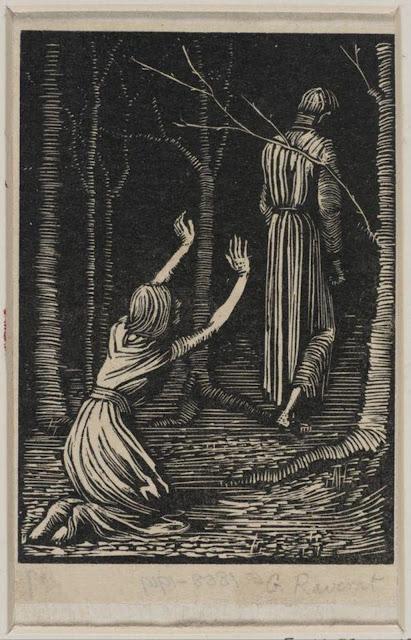
Gwendolen Raverat, Clerk Saunders' Ghost, 1918 woodcut.
The good times didn't last. In January 1733, the tenants began to hear strange noises. Sometimes they sounded like the death moans of a dying person, and at other times like a cane being struck against the walls. The tenants couldn't discern where the noises were coming from. Adding to the weirdness, doors and cabinet drawers would open on their own accord.
Various people, both inside and outside the house, also reported strange lights. For example, one night Mary Little, who lived near the mansion, saw a strange blue light ("a pale blewish light") in one of the upstairs windows. She watched the light for nearly 30 minutes before it disappeared. The next morning she asked John Clarke's wife if the apprentices had been up in the attic late at night with a candle. Mrs. Clarke looked surprised. No one had been upstairs at all!
News of the strange phenomena began to spread through Plymouth, and soon nearly everyone in town believed the mansion was haunted. Large crowds gathered outside the house at night trying to see the weird blue lights or hear the mysterious groans.
Reverend Cotton was unhappy about the rumors and believed they were false. Several weeks before the alleged hauntings became public, he had argued with John Clarke. Cotton wanted to move one of his son-in-laws into the mansion and wanted John Savery, Clarke's colleague, to move out. Clarke was infuriated. He shouted that the house was haunted and that he, and all the tenants, would move out. Cotton didn't believe the house was haunted and thought the rumors about ghosts were just a way to get back at him.
By October of 1733, all the tenants had vacated the mansion, claiming they were unable to live with the supernatural phenomena. Reverend Cotton attempted to find new ones, but no one was willing to move in. Many people believed the house was haunted, and those who were skeptical didn't want to deal with the large crowds of gawkers who gathered outside almost nightly.
Cotton finally took his former tenants to court. They owed him unpaid rent and had broken their lease, but he thought it unlikely he'd be able to get recompense for that in court. Instead, he sued them for slander. The case was heard on March 5, 1734 in the Plymouth County Inferior Court of Common Pleas. Reverend Cotton was ill and could not attend the trial, but his lawyer, John Cushing Jr., grilled the defendants. He argued they had lied about the hauntings to break the lease and prevent Cotton from renting to future tenants. After all, Cushing said, it was the 18th century. How could anyone still believe in ghosts, witches, and demons?
Cushing (and Cotton, who had helped develop their legal strategy), underestimated the jury's belief in the supernatural. The jury believed the house was indeed haunted and also believed Cotton's former tenants were telling the truth. They found them innocent of slander. Cotton appealed the case and brought it to Plymouth Superior Court a month later. Once again a jury found the defendants innocent, and this time also required Cotton to pay their court costs. Clearly, people in Plymouth believed in ghosts.
Reverend Cotton gave up trying to sue the tenants, and eventually he moved into the allegedly haunted mansion with his own family. They lived there for more than five years, and never experienced any strange phenomena. Cotton also wrote an essay decrying superstitious beliefs, but sadly never published it. The building was eventually sold, and still stands on King Street in Plymouth today. As far as I know, no one has reported any ghosts since.
My source for today's post was Douglas Winiarski's article "'Pale Blewish Lights and A Dead Man's Groan: Tales of the Supernatural from Eighteenth-Century Plymouth,"which appeared in The William and Mary Quarterly, Oct. 1998, Vol. 55, No. 4, p. 497 - 530.
If you want to read more supernatural tales from the Bay State, I recommend my new book Witches and Warlocks of Massachusetts, which is available wherever books are sold online. It's a perfect Christmas gift too!